The Marc Lou body ad space auction may be the most audacious founder-led marketing experiment of 2026. On September 8, the Bali-based French solopreneur — best known for a portfolio of micro-SaaS products generating roughly $80,000–$100,000 per month — launched a website with a characteristically provocative name: I Sell My Body, hosted at hyrox.marclou.com. The premise was simple, absurd, and strategically calculated. Marc Louvion offered 15 designated spots across his muscles as literal advertising inventory for startup logos, to be applied as temporary tattoos during his participation in the HYROX İzmir fitness race on September 19, 2026.
The 48-hour auction closed on September 10. The final tally: $112,062 in total bids. AI video startup Higgsfield AI alone committed between $68,000 and $80,000 for 10 of the 15 available spots. Stanley — the drinkware and lifestyle brand — secured the glutes for $20,000. The left chest slot commanded $16,000. Within 72 hours of launch, the campaign landing page had attracted 60,207 unique visitors from 184 countries.
On September 11, Lou posted to X (formerly Twitter) what would become the campaign’s defining statement:
“$112,000. That’s how much I’m getting paid to race at HYROX in İzmir, Turkey, on September 19th. That’s 3x what the 2026 world champion made.”
The stunt was not an accident. It was a precisely engineered exercise in what marketing strategists now call attention arbitrage: exploiting the gap between the low cost of an unconventional media format and its disproportionately high viral reach.
Executive Briefing
- The Campaign: Marc Lou auctioned 15 body spots as temporary tattoo ad inventory for a HYROX fitness race in İzmir, Turkey (September 19, 2026), starting at $1,000 per slot with a price-doubling mechanic.
- Total Revenue: $112,062 generated in approximately 48 hours, with virtually zero cost of goods sold.
- Traffic: 60,207 unique visitors from 184 countries on the campaign landing page within 72 hours.
- Top Buyers: Higgsfield AI ($68,000–$80,000 for 10 spots), Stanley ($20,000 for the glutes), Peptide Confidential ($8,000), OrcaRouter ($4,000), Sam’s List ($4,000).
- Competitive Response: Rival company Revid.ai launched a parasitic counter-campaign offering $68,000 in service credits, matching Higgsfield’s ad spend as its own promotional ammunition.
- Copycat Ecosystem: Within days, an indie developer launched
stickonme.com, productizing the exact body-ad auction model as a self-service marketplace for any athlete.
From 30 Failures to a Six-Figure SaaS Portfolio
Understanding why this stunt resonated requires understanding the man behind it. Marc Louvion — known universally as Marc Lou — graduated with a Computer Science degree in France in 2016 and spent the next five years cycling through startup failures. His early ventures included a “Tinder for sports lovers” application and an AI startup that never achieved product-market fit. By his own count, he accumulated roughly 30 failed projects before achieving any meaningful traction.
The turning point arrived in November 2021 when he was fired from a position at Tai Lopez’s company. Instead of re-entering the traditional employment market, Louvion relocated to Bali with his wife and adopted a radically different approach: building micro-SaaS products at extreme velocity, documenting every step publicly on X, and treating each new product as a low-cost lottery ticket rather than a decade-long commitment.
The ShipFast Breakthrough and Portfolio Evolution
His breakout product was ShipFast (shipfa.st), a Next.js boilerplate that packages authentication, Stripe payment processing, email integration, and database setup into a pre-configured starter kit. The pitch was compelling and specific: launch a SaaS product in days, not months. ShipFast generated $64,500 in its first month and $250,000 within five months, establishing Louvion as a legitimate authority in the rapid-deployment software ecosystem.
By mid-2026, the landscape had shifted. AI coding tools had eroded the demand for boilerplate kits, and ShipFast’s monthly revenue had declined to approximately $2,000–$3,000. Louvion, however, had already diversified. His current portfolio spans multiple products, each targeting a specific pain point in the solopreneur ecosystem:
- TrustMRR (
trustmrr.com): A startup acquisition marketplace with verified Stripe revenue data — approximately $40,000–$44,000/month. - DataFast (
datafa.st): A revenue-first web analytics platform — approximately $26,000–$29,000/month. - Ship or Die: A community and resource hub — approximately $7,000/month.
- CodeFast (
codefa.st): Developer courses — approximately $5,000/month. - Other tools: ByeDispute (Stripe chargeback defense), ZenVoice (invoice generation).
With approximately 200,000 followers on X and 152,000 YouTube subscribers, Louvion commands one of the largest personal distribution channels in the indie hacker ecosystem. This portfolio-level resilience and audience scale is precisely what makes the body-ad stunt commercially viable. When a founder is already generating near-six-figure monthly revenue from software, selling temporary tattoo space on muscle groups is not desperation — it is performance marketing theater with essentially zero risk.
The Technical Architecture: 3D Photogrammetry Meets Auction Theory
The campaign’s landing page was itself a technical showcase — consistent with Louvion’s philosophy of launching MVPs within 24 hours that still demonstrate genuine engineering craft.
Building the Interactive 3D Body Model
Louvion’s wife captured approximately 300 high-resolution photographs of his body using the Polycam 3D capture app. The resulting photogrammetric mesh was imported into Blender for clean-up, UV mapping, and texture optimization. The finalized 3D model was then rendered on a Next.js landing page using Three.js, integrated via Codex and Anthropic Model Context Protocol (MCP) workflows.
The result was a fully interactive experience: potential sponsors could rotate Lou’s 3D avatar 360 degrees and click directly on individual muscle zones to view the current price, the highest bidder, and place an instant bid — all connected to live Stripe payment processing.
The Doubling-Bid Auction Mechanics
The pricing mechanism drew directly from auction theory and scarcity economics. The structural rules were deliberately designed to create compounding urgency:
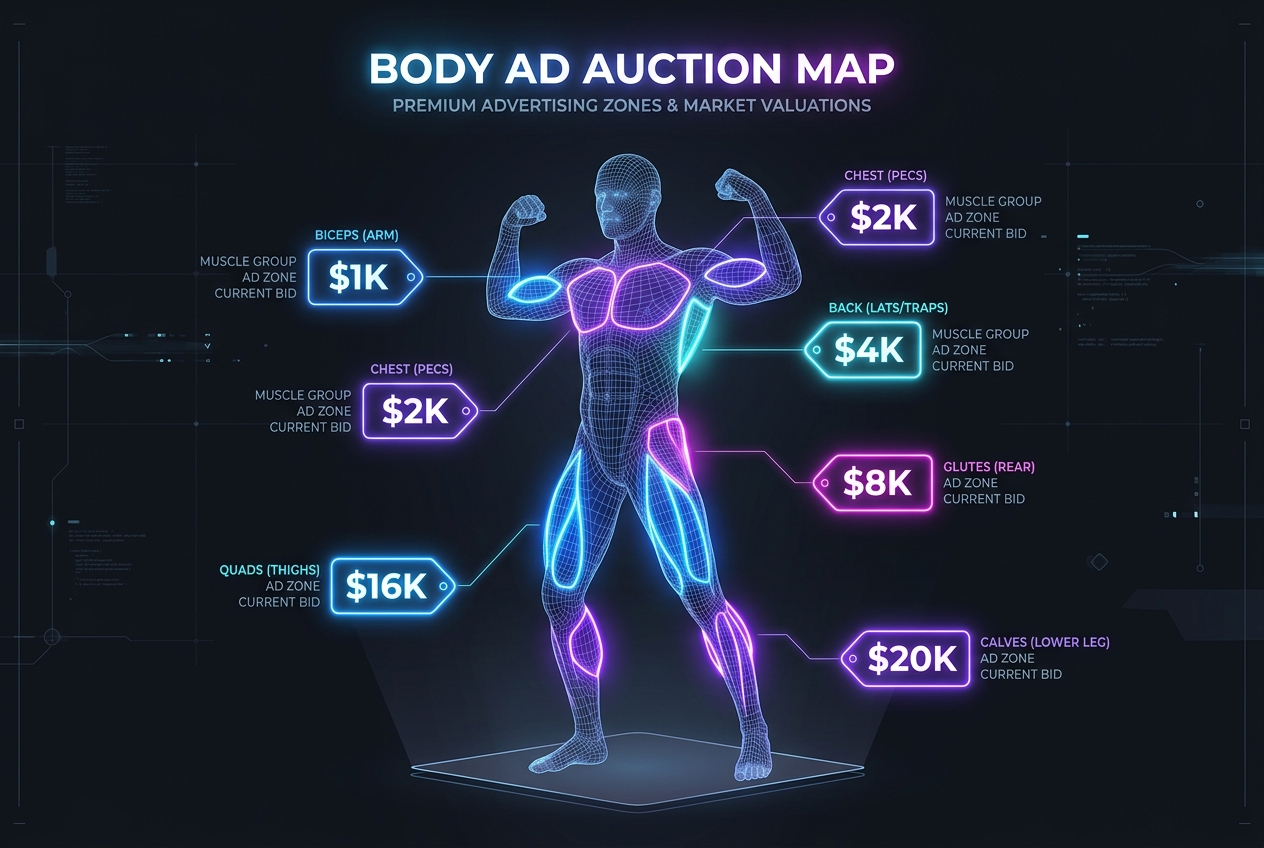
- Starting price: $1,000 per slot across 15 designated anatomical zones (chest, shoulders, biceps, forearms, upper back, lower back, quadriceps, calves, glutes/shorts).
- The doubling rule: Any takeover bid had to strictly double the standing price ($1,000 → $2,000 → $4,000 → $8,000 → $16,000 → $20,000+).
- Automated refunds: When an advertiser was outbid, their payment was automatically refunded via the Stripe API — minus non-refundable Stripe credit card processing fees (~2.9% + 30¢).
- Deliverables per winning bid: (1) A branded temporary tattoo on the designated muscle for race day, (2) logo and clickable backlink on the campaign page, (3) featured sponsor mentions across Lou’s YouTube videos and X threads.
This doubling function created an exponential pricing cliff. A spot that started at $1,000 quickly escalated through four or five bidding rounds to $16,000 or $20,000, locking out casual bidders and forcing deep-pocketed, VC-backed AI startups to bid aggressively to defend their placements.
The Full Sponsor Roster: Who Bought Skin
The auction attracted a revealing cross-section of B2B AI tools, consumer brands, and indie hacker products — all seeking mindshare with Louvion’s tech-heavy audience:
| Sponsor | Placement | Winning Bid |
|---|---|---|
| Stanley | Glutes / Buttocks | $20,000 |
| Higgsfield AI | 10 spots (torso, arms, back) | $68,000–$80,000 total |
| Peptide Confidential | Left Quadricep | $8,000 |
| OrcaRouter (Continuum AI) | Left Calf | $4,000 |
| Sam’s List | Right Calf | $4,000 |
| ZeroRank | Upper body | Undisclosed |
| AudioPen | Upper back | Undisclosed |
Stanley’s placement on the glutes was the most discussed sponsorship of the campaign — the deliberate comedic juxtaposition of a mainstream lifestyle brand on an athlete’s buttocks generated its own secondary wave of social media content. OrcaRouter’s parent company, Continuum AI, went so far as to issue an official Japanese PR Times press release announcing its sponsorship, with the custom race-day slogan: “STOP PICKING MODELS. START ROUTING THEM.”
The Higgsfield Gambit and Revid’s Counter-Strike
The dominant buyer in the auction was Higgsfield AI, an AI-powered video generation startup. The company aggressively secured 10 of the 15 available spots for a reported $68,000–$80,000 in total.
The B2B Acquisition Math
On the surface, this appears extravagant. But the calculus becomes significantly more favorable when measured against traditional B2B SaaS customer acquisition costs. A single enterprise demo lead in the AI tooling space routinely costs $200–$500 through conventional paid channels (Google Ads, LinkedIn Sponsored Content, conference sponsorships). If the viral wave generates 200–300 qualified leads for Higgsfield, the effective CPL drops to $226–$340 — competitive with standard digital acquisition and carrying vastly superior brand memorability.
Higgsfield further amplified its return by launching a follow-up marketing campaign directly referencing its participation. The meta-marketing layer — a company marketing its own marketing spend — created a secondary wave of attention that extended the lifecycle of the original stunt well beyond race day.
Revid’s Parasitic Counter-Campaign
Competitor Revid.ai — a direct rival to Higgsfield in the AI video generation space — responded with a sharp counter-offensive. The company publicly offered $68,000 in service credits to prospective customers, explicitly framing the offer as “what Higgsfield spent on tattoos.” This parasitic marketing maneuver — using a rival’s expenditure as the hook for its own promotion — demonstrated how a single founder’s body-ad experiment could cascade into a multi-company marketing event, with each participant extracting incremental attention from the same viral nucleus.
The Historical Lineage: From Pixel Grids to Human Billboards
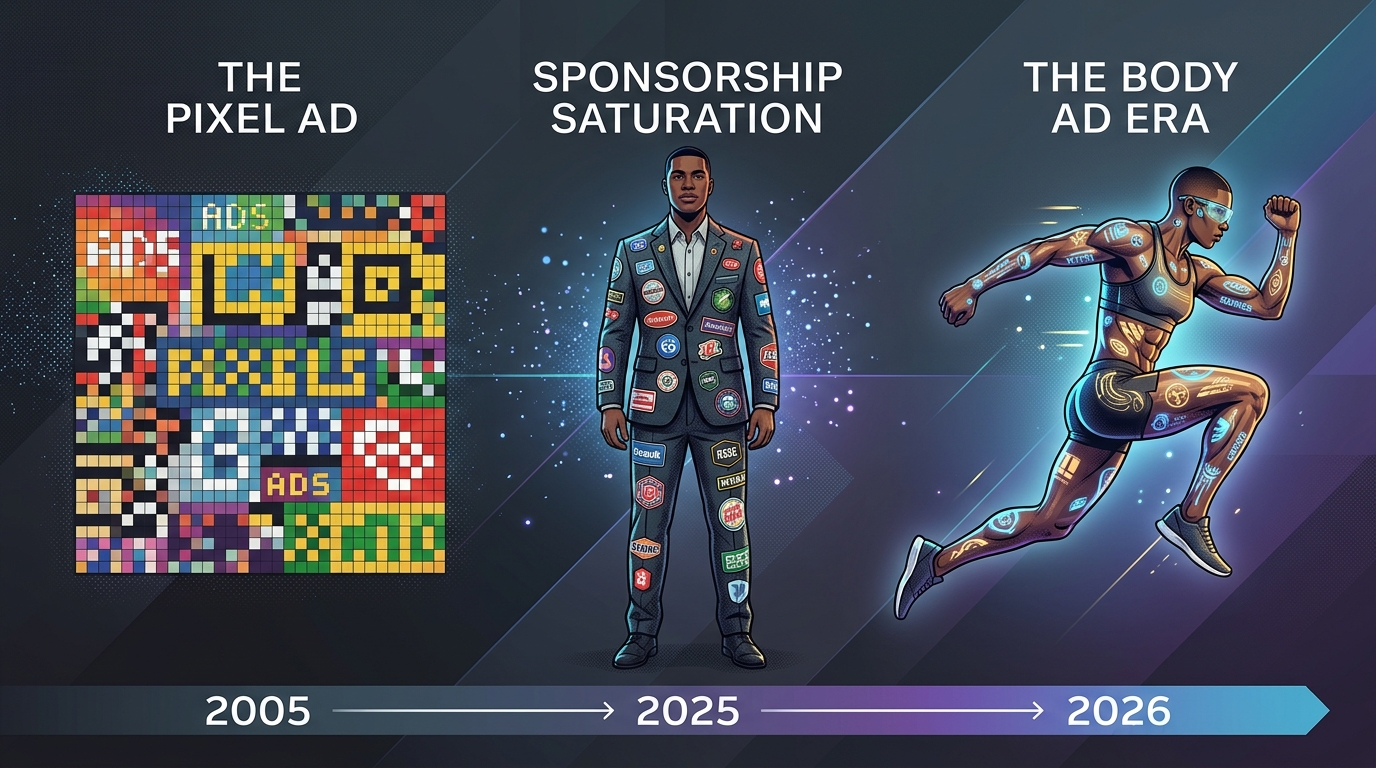
Louvion’s stunt did not emerge from a vacuum. It sits at the end of a two-decade lineage of escalating guerrilla advertising experiments that have progressively blurred the boundary between human identity and commercial surface area.
The Precedents
- 2005 — The Million Dollar Homepage: 21-year-old British student Alex Tew sold 1 million pixels on a single webpage for $1 each, inventing the viral pixel grid and proving that artificial scarcity on a digital surface could generate real revenue.
- Early 2000s — Casino Skin Tattoos: Online gambling platform GoldenPalace.com paid individuals — including professional boxers like Bernard Hopkins — to permanently or temporarily tattoo its URL on their bodies during televised events.
- Late 2025 — Dagobert Renouf’s Wedding Tuxedo: French startup founder Dagobert Renouf sold 26 ad spots on his wedding tuxedo to tech sponsors to fund his wedding, generating significant attention within the French and European indie hacker communities.
- September 2026 — Marc Lou’s 3D Body Auction: Lou modernized the entire lineage by combining high-end 3D WebGL photogrammetry, game-theoretic doubling-bid auction mechanics, automated Stripe payment infrastructure, and athletic endurance spectacle.
The structural evolution is clear: from static digital surfaces (pixels) → fabric (tuxedos) → human skin at athletic events, each iteration increases the intimacy of the ad placement and the virality of the spectacle.
Critical Controversies, Risks and Counter-Perspectives
The stunt’s success in generating attention was undeniable. But several structural risks and debates deserve rigorous scrutiny.
The Commodification Debate
Commentators and ethicists raised pointed questions about the “literal human billboard” dimension. While temporary tattoos are hardly permanent body modification, the deliberate framing — “I Sell My Body” — invites scrutiny about where the line sits between creative marketing and the commodification of physical personhood. Critics drew parallels to dystopian scenarios where individuals monetize their skin as advertising inventory, a concept that feels considerably less fictional when it generates $112,000 in 48 hours.
The Measurability Problem
Unlike digital ad campaigns with granular attribution — click tracking, conversion pixels, UTM parameters — a temporary tattoo on a man’s glutes during a fitness race offers no native measurement infrastructure. How does Higgsfield AI quantify whether its $68,000–$80,000 investment generated meaningful pipeline velocity? The honest answer is that the ROI case rests almost entirely on social media impressions, PR pickup, and brand recall — metrics that are notoriously difficult to tie directly to revenue.
The Stripe Fee Friction
A design flaw in the auction mechanics drew criticism. Bidders who were outbid at high price points ($8,000 or $16,000) received full refunds of the bid amount — minus Stripe’s non-refundable processing fees of approximately 2.9% + 30¢ per transaction. At a $16,000 bid, this amounted to approximately $464 lost without winning the ad spot. For companies participating in aggressive bidding wars across multiple slots, these cumulative fee losses became a non-trivial cost of participation.
The Scalability Ceiling
This campaign works precisely because it is Marc Lou executing it. The economic value of the body-ad inventory is inseparable from his personal audience of 200,000+ X followers, his reputation within the indie hacker community, and his demonstrated ability to convert attention into viral social media content. A founder with 500 followers attempting the same experiment would generate approximately zero bids. The tactic is fundamentally non-transferable to founders who have not already invested years in building a personal media moat.
The Athletic Regulation Question
Observers also questioned whether HYROX’s official rules would permit commercial logos on athlete skin during sanctioned competition, or whether race organizers might restrict non-official sponsors. This regulatory uncertainty remained unresolved as of the auction close date.
The Copycat Economy: From Stunt to Platform
The speed of productization was remarkable. Within days of Lou’s auction close, an indie developer launched Stick On Me (stickonme.com) on Reddit’s r/SideProject. The platform operationalized Marc Lou’s exact model as a self-service marketplace:
- Any marathon runner, cyclist, bodybuilder, or HYROX racer uploads three photos.
- The site generates a 3D avatar with designated ad slots.
- Brands bid using the same doubling-auction mechanic.
- The platform prints and delivers temporary tattoos to the athlete before race day.
This reflexive platformization is characteristic of the 2026 indie hacker ecosystem. Every viral stunt is dissected, cloned, and repackaged into a micro-SaaS within 168 hours. The relevant question is not whether copycats will emerge — they already have — but whether the format can sustain commercial viability when the audience is fragmented across thousands of amateur athletes rather than concentrated in a single high-profile founder.
Strategic Outlook: Key Catalysts to Watch
The HYROX İzmir race on September 19 will produce the actual visual content — the photographs and video clips of a founder covered in startup logos pushing sleds, completing burpee broad jumps, and grinding through sandbag lunges. The performance of that content across X, YouTube, and Instagram will determine whether this was a one-time novelty or the prototype of a repeatable marketing format.
Several indicators will signal whether the body-ad model has structural legs:
- Higgsfield AI’s post-race attribution data: If the company publicly reports lead generation or signup metrics tied to the campaign, it validates the ROI case and encourages imitators.
- Stick On Me traction: Whether the copycat marketplace achieves meaningful adoption will reveal if the format works when detached from a celebrity founder’s personal brand.
- Louvion’s follow-up: Whether he runs a second body-ad campaign — perhaps at a larger HYROX event or a different sporting context — will reveal whether he views this as a sustainable channel or a one-time attention spike.
- Platform algorithm response: X’s content ranking algorithm heavily influences the reach of personality-driven stunts. Any changes that penalize promotional spectacle could limit the format’s future effectiveness.
- HYROX’s institutional response: Whether the race organization embraces, ignores, or restricts non-official body sponsorships at future events will shape the regulatory environment.
The broader trajectory, however, is clear. In a marketing landscape increasingly dominated by AI-generated noise, the founders who can command genuine human attention — through personality, physical presence, and the willingness to make themselves the spectacle — hold a structural advantage that no ad budget can replicate.
Strategic Inquiries & Analysis
How much did Marc Lou actually earn from the body-ad auction?
The auction closed at $112,062 in total bids across 15 available body spots. Individual slot prices ranged from $1,000 (the opening bid floor) to $20,000 (the glutes, won by Stanley). Higgsfield AI was the dominant buyer at $68,000–$80,000 across 10 spots. The campaign attracted 60,207 unique visitors from 184 countries. The cost of goods sold was effectively zero — temporary tattoos cost pennies to print, the 3D model was built in under a day using Polycam and Blender, and hosting costs were negligible. This places the campaign’s profit margin above 99%.
Why did Higgsfield AI spend $68,000+ on temporary tattoos?
Higgsfield AI competes in the crowded AI video generation market. Traditional B2B customer acquisition in this space costs $200–$500 per qualified lead through Google Ads and LinkedIn. If the body-ad campaign generates 200–300 qualified leads through viral social exposure, the effective cost per lead is competitive with standard digital channels. Higgsfield also launched a secondary marketing campaign referencing its sponsorship, extracting additional reach from the initial investment. Competitor Revid.ai’s counter-campaign — offering $68,000 in credits to Higgsfield customers — provided further proof that the investment had achieved its primary goal: forcing competitors to react.
Can other founders replicate this strategy?
Not easily, and the emergence of stickonme.com will test this thesis directly. The economic value of body-ad inventory is directly proportional to the founder’s existing audience size and engagement quality. Marc Lou commands approximately 200,000 followers on X, 152,000 YouTube subscribers, and a deep reputation within the indie hacker community. A founder without an equivalent personal distribution channel would likely generate negligible interest. The tactic is best understood as an audience monetization play — the body is merely the novelty wrapper around pre-existing media value.
Does this signal a broader shift in startup marketing?
The campaign crystallizes three converging trends of 2026: the declining effectiveness of traditional digital advertising due to AI content saturation, the rising premium on founder-led personal media as a trust-building mechanism, and the growing interest in physical-world “attention arbitrage” that breaks through digital noise. The historical lineage — from Alex Tew’s Million Dollar Homepage (2005) to GoldenPalace.com’s skin tattoos to Dagobert Renouf’s wedding tuxedo (2025) — shows a consistent pattern: the most effective guerrilla marketing stunts combine artificial scarcity, physical spectacle, and built-in social media shareability. Marc Lou’s 3D auction simply modernized this playbook with WebGL, game theory, and Stripe automation.
The Founder as the Final Ad Format
Marc Lou’s body-ad experiment distills a fundamental truth about the 2026 marketing landscape into its most visceral form. When AI can generate infinite content, when ad-blockers filter corporate messaging, and when platform algorithms reward personality over brand accounts, the founder’s own physical presence becomes the last advertising surface that audiences genuinely pay attention to.
The unit economics tell the story with uncomfortable clarity. An amateur HYROX competitor earned $112,062 in 48 hours by selling temporary tattoo space — roughly three times what the actual 2026 HYROX World Champion earned in official prize money. This is not a commentary on athletic achievement. It is a statement about the 2026 attention economy: distribution and personal brand now surpass pure performance in monetary value, whether the arena is software, sports, or the skin on a founder’s back.
Whether this specific format endures beyond a single race in İzmir is secondary to the structural insight it reveals. In an attention economy approaching saturation, the scarcest commodity is not content, not reach, and not impressions. It is the willingness of a real human to stake their personal credibility — and their actual body — on the proposition that a brand deserves your attention.
The race is on September 19. The tattoos are printed. The real question is not whether they will wash off. It is whether the playbook they represent will stick.