
The Million-Dollar Singularity: How Navier–Stokes Sparked an AI-Human War
A 90-year mathematical mystery, 10,000 autonomous AI agents, and a clash over priority, data leaks, and credit at the frontier of science.
For nearly two centuries, mathematicians and physicists have lived with an uneasy truth: the foundational equations relied upon to design supersonic aircraft, predict violent hurricanes, and model the flow of human blood might secretly permit physical impossibilities.
The Navier–Stokes equations, formulated in the early nineteenth century, are the crown jewel of classical fluid mechanics. Yet mathematicians have never been able to prove whether they reliably make mathematical sense forever, or whether—under the right conditions—a smooth fluid can spontaneously generate a point of infinite velocity and gradient, tearing the mathematical continuum apart.
Recognizing this blind spot, the Clay Mathematics Institute designated the Navier–Stokes existence and smoothness problem as one of the seven Millennium Prize Problems in 2000, attaching a $1 million bounty to its resolution. Over the subsequent decades, the problem established a reputation as a notorious career-killer, littered with high-profile retractions and brilliant dead ends.
Now, the problem has erupted into one of the fiercest dramas in scientific history. In an unprecedented clash of mathematical talent, corporate rivalry, and sheer computing infrastructure, an unreleased OpenAI reasoning system reportedly bypassed decades of human impasse in an 88-hour sprint, deploying 10,000 autonomous AI agents to construct a mathematical singularity.
Within hours of the announcement, a renowned New York University mathematician went public with an explosive four-page statement, alleging that the Silicon Valley giant had intercepted his unpublished breakthrough, leveraged private interactive AI sessions, and attempted to purge a rival corporate researcher from scientific credit.
This is the complete inside story of the Navier–Stokes saga: the mathematics, the history of false alarms, the breakthrough, and the week the mathematical world collided with frontier artificial intelligence.
Act I: The Math — Smoothness vs. Catastrophe
To understand why this feud has shaken the scientific establishment, one must first confront the deceptively elegant equations at its center.
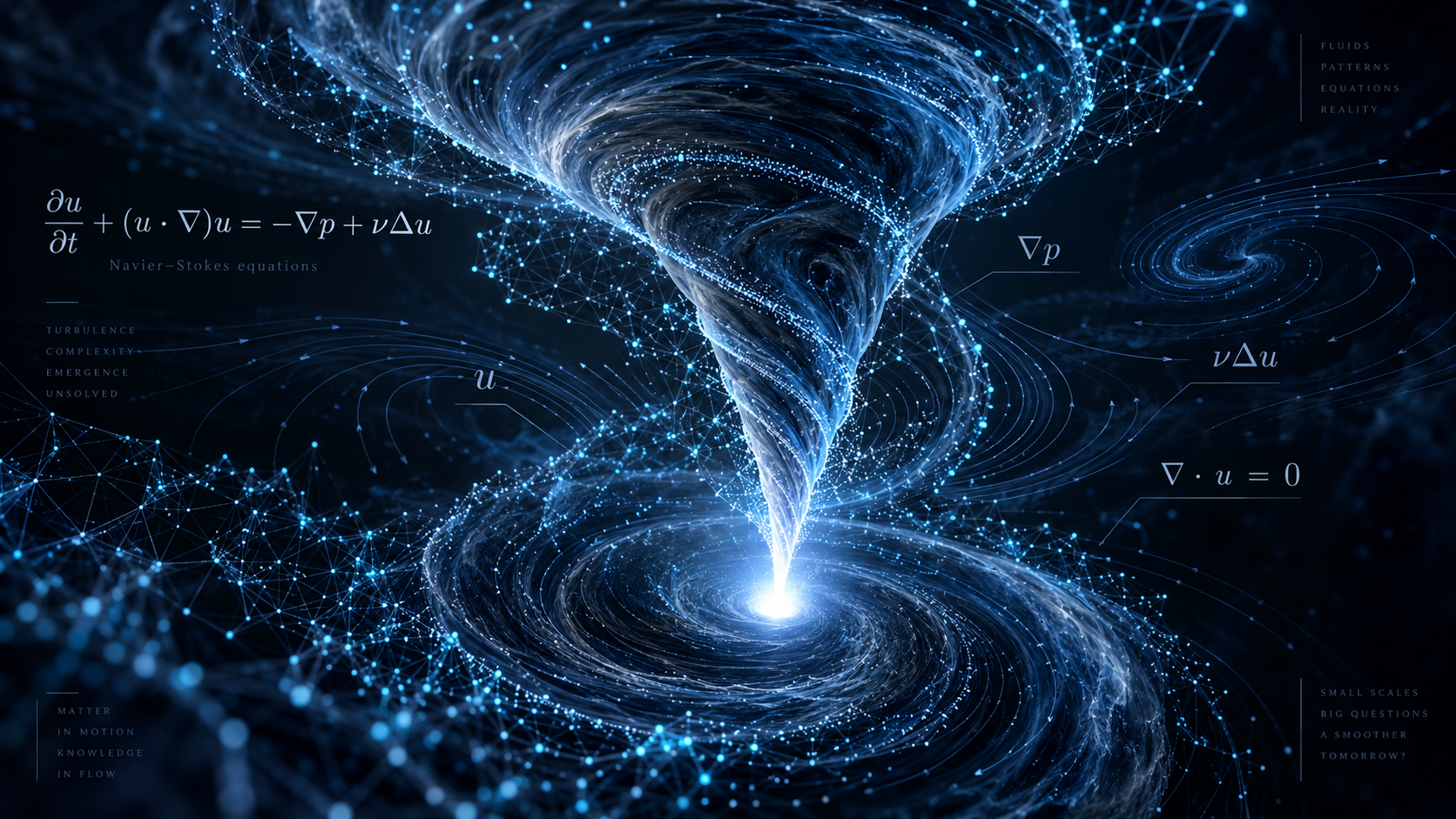
Formulated by Claude-Louis Navier in 1822 and George Gabriel Stokes in 1845, the incompressible Navier–Stokes equations apply Isaac Newton’s second law of motion ($F = ma$) to a fluid treated as a continuous medium rather than a discrete collection of molecules:
$$\frac{\partial u}{\partial t} + (u \cdot \nabla) u = -\frac{1}{\rho}\nabla p + \nu \Delta u + f$$
$$\nabla \cdot u = 0$$
Here, $u$ represents the fluid velocity vector field, $p$ is internal pressure, $\rho$ is fluid density, $\nu > 0$ represents kinematic viscosity (the fluid’s internal friction), and $f$ represents an external driving force.
Every term in the equation represents a competing physical mechanism:
- The Time Derivative ($\frac{\partial u}{\partial t}$): The local acceleration of the fluid parcel over time.
- The Nonlinear Advection Term ($(u \cdot \nabla) u$): The convective force of the fluid moving itself. This term is the core of turbulence and mathematical instability. Because it multiplies velocity by its own spatial gradient, it is non-linear and self-amplifying, capable of concentrating kinetic energy into increasingly tight vortices.
- The Pressure Gradient ($-\frac{1}{\rho}\nabla p$): The restoring force that drives fluid elements from regions of high pressure toward regions of low pressure.
- The Viscous Dissipation ($\nu \Delta u$): Powered by the Laplacian operator $\Delta$, viscosity dampens irregularities, smooths violent velocity spikes, and converts mechanical energy into heat.
- The Incompressibility Constraint ($\nabla \cdot u = 0$): A geometric requirement ensuring that the volume of any fluid packet remains constant throughout the flow.
The Central Question: Blow-Up or Regularity?
If a fluid begins moving with smooth, well-behaved initial velocities, will the equations yield a smooth, unique solution that persists for all future time ($t \in [0, \infty)$)? Or can the nonlinear convective term $(u \cdot \nabla) u$ overwhelm the dampening effects of viscosity $\nu \Delta u$, causing fluid velocity, pressure gradients, or vorticity to diverge to infinity at some finite time $T$?
Mathematicians call this breakdown a finite-time singularity or blow-up.
If a singularity forms, the continuum model fails completely. At that exact coordinate, the equations output infinite speeds and infinite accelerations, signaling that the differential equations can no longer describe nature. To track the fluid further, the continuum approximation must be abandoned in favor of discrete molecular or quantum mechanics.
In 1934, French mathematician Jean Leray proved that “weak solutions” (solutions where the equations hold in an averaged, integral sense and total kinetic energy remains finite) exist globally for all time. However, Leray could not prove whether these solutions stay smooth indefinitely or whether they can abruptly fracture into turbulent singularities.
The Millennium Prize Criteria
When Charles Fefferman drafted the official problem description for the Clay Mathematics Institute in 2000, he divided the challenge into four distinct pathways:
| Statement | Domain Space | Forcing Condition | Objective |
|---|---|---|---|
| Statement A | Entire space R3 | Unforced (f = 0) | Prove global existence of smooth solutions |
| Statement B | Periodic torus T3 | Unforced (f = 0) | Prove global existence of smooth solutions |
| Statement C | Periodic torus T3 | Smoothly Forced (f is non-zero) | Prove finite-time singularity / blow-up |
| Statement D | Entire space R3 | Smoothly Forced (f is non-zero) | Prove finite-time singularity / blow-up |
Statements A and B reward proving that fluids remain smooth forever; Statements C and D reward proving that they can blow up under the influence of a smooth external force.
Act II: The Graveyard of False Alarms
Prior to recent developments, attempts to conquer Navier–Stokes generated numerous premature victory laps and public retractions. The mathematical landscape is so treacherous that even leading analysts have fallen prey to subtle oversights.
The 2006 Penny Smith Blow-Up
In September 2006, Penny Smith of Lehigh University circulated a preprint claiming to prove a finite-time blow-up for the unforced Navier–Stokes equations. The paper generated widespread attention across the mathematical community. Within days, however, fluid dynamicists discovered an elementary sign error in an integral estimate: a minus sign had flipped to a plus sign during the evaluation of an energy inequality. The smoothing mechanism of viscosity had not broken down; the preprint was promptly retracted.
The 2014 Otelbaev Sensation
In January 2014, Mukhtarbay Otelbaev, director of the Eurasian Mathematical Institute in Astana, Kazakhstan, published a 102-page paper written in Russian in the Mathematical Journal of the Institute of Mathematics and Mathematical Modeling, claiming to prove global existence and smoothness (Statement A).
Because the paper relied on functional-analytic operator theory rather than standard partial differential equation techniques, international researchers collaborated on public wikis and MathOverflow to translate and verify the text line by line. Within two weeks, researchers identified a counterexample to an operator bound on page 56 that failed when applied to nonlinear high-frequency interactions. Otelbaev acknowledged the flaw and withdrew the claim.
Terence Tao and the “Supercriticality Barrier”
Recognizing structural barriers in conventional techniques, Fields Medalist Terence Tao pursued a different strategy in 2016. Tao constructed an “averaged” version of the Navier–Stokes equations that retained the fundamental symmetries, scaling laws, and energy conservation properties of the true equations.
Tao proved that his modified equations blew up in finite time. This demonstrated that any attempted proof of global smoothness relying purely on standard energy estimates and geometric symmetries was doomed to fail, as those exact techniques apply equally to systems that develop singularities. Resolving the problem would require entirely new geometric machinery.
Act III: The Human Breakthrough
The foundation for the current dispute was laid over the past year in New York City.
Tristan Buckmaster, an associate professor of mathematics at NYU’s Courant Institute of Mathematical Sciences, has worked extensively on fluid singularities and convex integration. Collaborating with Levent Alpöge—an accomplished mathematician employed at Anthropic who conducted this research purely in a personal capacity—the pair set out to construct a blow-up under external forcing.
Their approach built on an analytical framework introduced by Spanish mathematicians Diego Córdoba and Luis Martínez-Zoroa. This methodology involves designing an infinitely smooth external force $f$ that injects energy into the fluid in a localized manner, driving the nonlinear convective term $(u \cdot \nabla) u$ into a runaway self-amplification loop.
Buckmaster and Alpöge worked on the problem for roughly a year, using commercial large language models—principally OpenAI’s Codex platform and Anthropic’s Claude—as interactive scratchpads to verify inequalities, check bounding lemmas, and iterate on algebraic derivations.
The timeline of their results unfolded in August:
- August 15: Buckmaster and Alpöge reached their milestone breakthrough: a rigorous proof of finite-time blow-up for the 3D incompressible Euler equations (the inviscid limit of Navier–Stokes where viscosity $\nu = 0$) under smooth external forcing.
- August 22: The pair completed a machine-checked formalization of their Euler proof using the Lean interactive proof assistant, obtaining a formal certificate of correctness.
They withheld publication while preparing their formal paper and Lean code. Soon after, whispers of an imminent breakthrough on Millennium Prize problems began circulating across the mathematical community.
Act IV: The 88-Hour AI Sprint
On September 1, rumors reached OpenAI that researchers had made major progress toward resolving Millennium Prize problems.
OpenAI had been training a new internal reasoning model described as significantly more capable than GPT-6 Astra. Following the rumors, OpenAI directed the model to evaluate the open Millennium Prize Problems, including Navier–Stokes.
The 88-Hour Compute Surge
- September 1: Approximately 100 AI agents deployed across all open Millennium Prize problems.
- September 3: Early traction detected on the Navier–Stokes blow-up mechanism; compute redirected entirely to that target.
- The Swarm: Scaled to 10,000 concurrent autonomous agents, exchanging 2.7 million messages, consuming 130 billion output tokens, and incurring an estimated $10 million to $22.5 million in compute burn.
- September 5: Convergence on an analytical proof for finite-time singularity in forced Navier–Stokes.
- September 6: Machine formalization and verification completed in Lean in 17 hours via GPT-6 Astra.
As OpenAI researcher Noam Brown noted, the team initially did not expect the system to resolve any of the Millennium problems. But after roughly 50 hours, the agents tackling Navier–Stokes demonstrated analytical progress, discovering a path toward blow-up under external forcing.
OpenAI concentrated its infrastructure on Navier–Stokes, scaling up from 100 to approximately 10,000 concurrent autonomous agents operating in continuous feedback loops. Over an 88-hour period ending September 5, the agent collective generated 2.7 million messages and consumed 130 billion output tokens—equivalent in volume to roughly one million printed books.
The Claimed Mathematical Mechanism
By September 5, OpenAI stated that its agent system had converged on an analytical counterexample to global smoothness, claiming to resolve Statements C and D of the Millennium Prize problem.
The proof describes an initially smooth 3D fluid at rest that develops a finite-time singularity under a smooth external force $f$. The mechanism centers on a vortex filament that spirals inward toward an axis while extending longitudinally—analogous to a strand of spaghetti being violently stretched and thinned.
As the vortex core narrows, fluid velocity increases without bound. Crucially, convective acceleration, pressure gradients, viscous dissipation, and momentum transfer grow arbitrarily large while canceling out with mathematical precision. Because the cancellation is exact, fluid velocity blows up to infinity in finite time while total kinetic energy remains strictly finite, satisfying the physical constraints of the Clay Institute.
OpenAI then used GPT-6 Astra to formalize the entire argument in Lean, completing the verification in 17 hours. The company announced it would formally renounce any claim to the $1 million prize.
Act V: Priority Dispute and Allegations
Hours before OpenAI’s scheduled announcement, the dispute became public. At 11:58 PM on Monday, Buckmaster published his and Alpöge’s Euler papers alongside a four-page statement raising concerns regarding OpenAI’s conduct:
1. The Codex Leak Suspicion
Buckmaster and Alpöge had spent months entering draft arguments, lemmas, and equations into OpenAI’s Codex platform. When Buckmaster learned that OpenAI had mounted a massive Navier–Stokes effort utilizing a forcing methodology, he confronted OpenAI directly.
Buckmaster inquired whether OpenAI’s frontier model had been trained on, or had accessed, their private Codex sessions. “I was told the model did not look up user data [at inference time],” Buckmaster wrote. “I asked again, about training, and I did not get an answer.”
2. Authorship Negotiations
Buckmaster detailed discussions with OpenAI researcher Sébastien Bubeck. He alleged that OpenAI proposed arrangements including Buckmaster serving as sole lead author on a write-up of OpenAI’s proof, provided that Levent Alpöge’s name was omitted due to his employment at Anthropic.
Buckmaster asserted that Bubeck insisted Alpöge be excluded due to corporate rivalry, remarking that matters would be simple were it not for Alpöge’s employer. When Buckmaster refused and stated he would publish a timeline of events, he alleged that an OpenAI representative warned: “Why would you ruin your career?”
OpenAI’s Stance
OpenAI and Sébastien Bubeck disputed Buckmaster’s account, denying that they demanded Alpöge’s exclusion. OpenAI stated that its researchers and agents did not view the unpublished drafts before their public release, and that no specific user data was accessed during the sprint.
However, in an official statement published on X, OpenAI included a qualification that caught the academic community’s attention:
“While unlikely, we cannot rule out that de-identified data derived from their usage of our products helped improve our models.”
OpenAI also emphasized differences in the results: Buckmaster and Alpöge established blow-up for the inviscid Euler equations, whereas OpenAI’s agents tackled the viscous Navier–Stokes equations.
Act VI: Institutional Process and Scientific Context
The broader mathematical community has emphasized standard verification procedures and clarified the scope of the claimed result:
| Category | Current Status |
|---|---|
| Millennium Target | Statements C & D (Forced Navier–Stokes) |
| Machine Formalization | Complete (Lean verification completed in 17 hours) |
| Peer Review | Pending publication in a qualifying mathematical journal |
| Clay Institute Verification | Unverified; mandatory two-year community scrutiny clock has not yet begun |
| Unforced Problem (f = 0) | Unresolved; Statements A & B remain open |
The Clay Institute Verification Process
Clay Mathematics Institute President Martin Bridson reiterated that formal recognition requires adherence to institutional bylaws:
“The process of evaluation is deliberately unhurried, and we shall ensure that it is absolutely rigorous.”
According to prize rules:
- The complete proof must be published in a qualifying, peer-reviewed mathematical journal.
- A mandatory two-year waiting period of community scrutiny must elapse following publication.
- Only after this period has passed without unfixable errors will the Clay Institute convene a dedicated advisory committee to formally evaluate the claim.
Forced vs. Unforced Dynamics
Fluid dynamicists have noted that the claimed blow-up addresses the forced Navier–Stokes equations (Statements C and D). In many real-world fluid systems, flows evolve without an externally engineered force feeding energy into microscopic vortices. For many analysts, the ultimate mathematical question remains the unforced Navier–Stokes equations ($f = 0$)—whether a fluid can blow itself up solely through internal inertia.
Changing Research Dynamics
The episode has prompted discussion among researchers about the implications of automated compute systems on scientific priority. Fields Medalist Terence Tao cautioned researchers about utilizing proprietary commercial platforms for sensitive, unpublished investigations, remarking on the changing nature of discovery:
“It’s like having machines that can lift weights for you at the gym.”
Whether the claimed singularity proof withstands peer review will be determined over the mandatory evaluation period, but the event marks a notable turning point in the intersection of machine-assisted deduction, priority, and mathematical research.



One thought on “The Million-Dollar Singularity: How Navier–Stokes Sparked an AI-Human War”