A critical mission to save NASA’s Neil Gehrels Swift Observatory, a valuable half-billion-dollar space telescope, has achieved a major pre-launch testing milestone. This daring venture aims to prevent Swift from plummeting back to Earth and burning up in the atmosphere. The success of the “Link” robotic servicing spacecraft’s environmental tests brings us closer to an unprecedented orbital rescue. This ambitious project not only secures Swift’s future but also pioneers a new era of responsive satellite servicing, blending commercial innovation with high-stakes space exploration.
The Race Against Time for NASA’s Swift Observatory
Launched in 2004, the Neil Gehrels Swift Observatory quickly became indispensable for cosmic discovery. Valued at approximately $500 million, this sophisticated space telescope excels at detecting gamma-ray bursts. These are the most powerful explosions in the universe, providing vital insights into dying massive stars, merging neutron stars, and the formation of new black holes. Its unique ability to rapidly pivot and observe these fleeting events makes it irreplaceable, with no other U.S. satellite fully replicating its multi-wavelength capabilities.
A Vanishing Orbit: Why Swift Needs a Boost
For two decades, Swift orbited Earth, performing groundbreaking science. Initially positioned at about 600 kilometers, its altitude has significantly degraded. The observatory now hovers at around 400 kilometers. This alarming descent is due to atmospheric drag, a natural force that constantly pulls satellites closer to Earth. Compounding the problem, Swift lacks its own onboard propulsion system to counteract this decay. Recent years have seen increased solar activity, which expands Earth’s atmosphere, further accelerating Swift’s orbital drop. Without intervention, experts anticipate Swift’s fiery re-entry into the atmosphere later this year, likely by late 2026. This imminent threat triggered NASA’s urgent call for a solution.
Katalyst Space Technologies Steps Up
In September 2025, NASA awarded a $30 million contract to Katalyst Space Technologies, an Arizona-based firm, to undertake this challenging rescue. Katalyst’s mission: design, build, and launch a robotic servicing spacecraft named “Link.” Link’s primary goal is to rendezvous with Swift, dock securely, and then utilize its own thrusters to boost the observatory back to a stable 600-kilometer orbit. This maneuver is projected to extend Swift’s operational life by another decade or more, demonstrating an incredibly cost-effective approach to preserving a valuable asset rather than building a replacement.
Link’s Crucial Pre-Launch Milestones Achieved
The development of the Link spacecraft has been remarkably fast-paced. Katalyst brought Link to this advanced stage in just eight months. This rapid progress culminated in a critical series of pre-launch tests at NASA’s Goddard Space Flight Center in Greenbelt, Maryland. These evaluations ensure Link can withstand the extreme rigors of launch and the harsh vacuum of space.
Environmental Gauntlet at NASA Goddard
On May 8, 2026, NASA confirmed Link’s successful completion of its comprehensive environmental testing suite. This included a demanding stint in a vibration chamber, meticulously simulating the intense shaking and g-forces Link will endure during launch. The spacecraft then moved into the Space Environment Simulator (SES). Inside the SES, Link faced the vacuum of space, experiencing extreme hot and cold temperatures. During these crucial tests, the 4.9-foot-tall, 770-pound spacecraft demonstrated key functionalities. It successfully fired its three ion thrusters and deployed one of its three robotic arms. These evaluations, which concluded on May 4, confirm Link’s readiness for the upcoming mission. Following the tests, Link returned to Katalyst’s facilities in Broomfield, Colorado, for final pre-launch preparations.
Expertise and Partnership in Action
This mission epitomizes a collaborative, yet risk-tolerant, approach. John Van Eepoel, Swift’s mission director at NASA Goddard, described it as a “fast, high-risk, high-reward mission.” He highlighted NASA’s support, stating, “we’re glad they were able to use NASA’s facilities to test Link and draw on our expertise to help tackle questions that popped up along the way.” Shawn Domagal-Goldman, acting director of NASA Headquarters’ Astrophysics Division, emphasized the forward-thinking nature. He noted that leveraging commercial technologies already under development makes this approach both more affordable than replacing Swift and beneficial to the nation, expanding satellite servicing to a broader class of spacecraft. Kieran Wilson, Link’s principal investigator at Katalyst, acknowledged the intense pressure. “We’re in a race against the clock,” Wilson stated, underscoring the need to balance thorough testing with rapid problem-solving to maximize success.
A Unique Launch for a Unique Mission: The Pegasus XL
Selecting the right launch vehicle for the Swift rescue mission was paramount, given the observatory’s specific orbital parameters and the tight schedule. Katalyst, in November 2025, opted for Northrop Grumman’s Pegasus XL air-launched rocket. This choice highlights a strategic alignment of cost-effectiveness, responsiveness, and unique capabilities.
Air-Launched Advantage: Meeting Strict Demands
The Pegasus XL, known for its versatility, is deployed from Northrop Grumman’s L-1011 Stargazer aircraft at an altitude of approximately 39,000 feet. This air-launch capability allows the rocket to precisely target Swift’s unique low-inclination orbit, which swings only 20.6 degrees north and south of the equator. Such a dedicated launch on a larger rocket, like a Falcon 9, could have cost $65-70 million, far exceeding the project’s $30 million budget. Kurt Eberly, Director of Space Launch for Northrop Grumman, affirmed Pegasus’s suitability, noting its ability to be “rapidly deployed anywhere on Earth to reach any orbit.” The mission is scheduled for June 2026. Link will first integrate with the Pegasus rocket at NASA’s Wallops Flight Facility in Virginia. Later that month, the L-1011 aircraft will deploy the spacecraft from the Marshall Islands, delivering Link to its rendezvous point with Swift. This mission is expected to be the final flight for the venerable Pegasus program.
The “How”: Link’s Orbital Mechanics and Capture Strategy
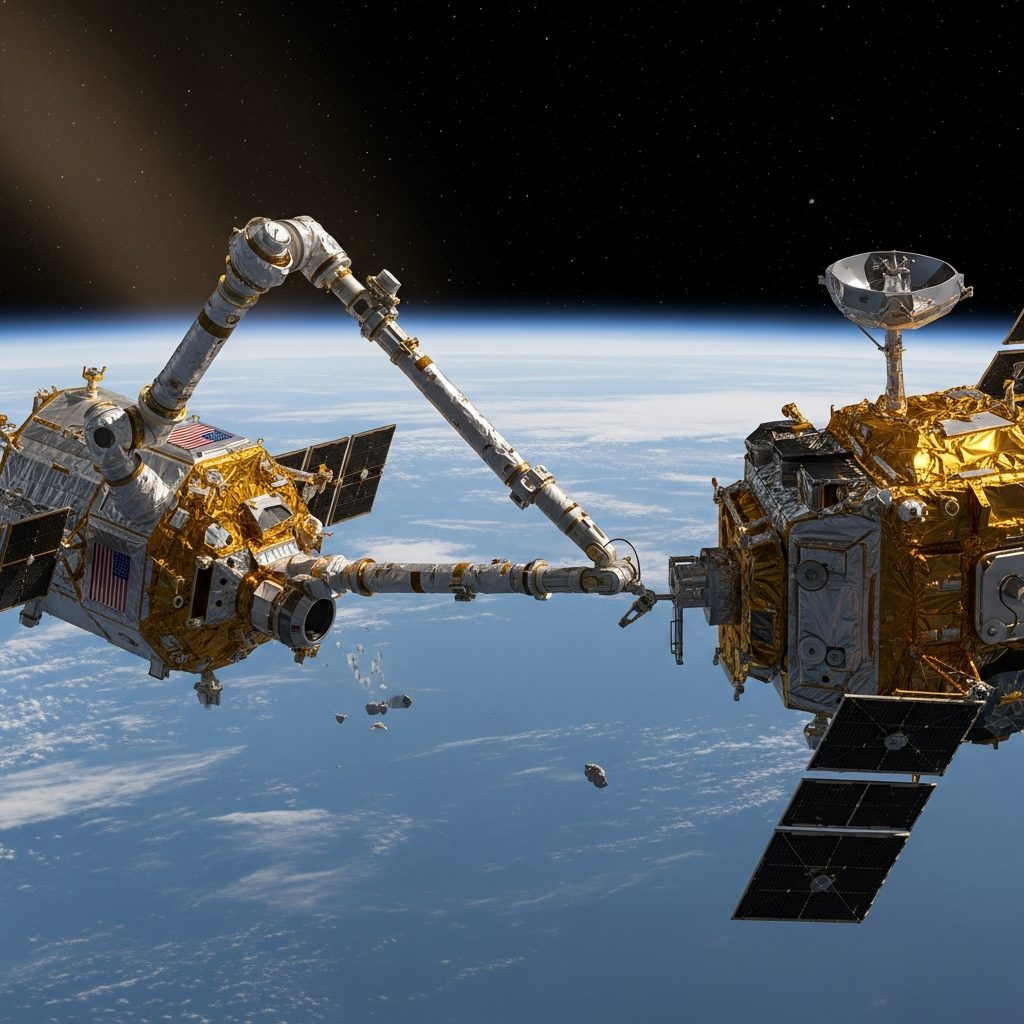
Once in proximity to Swift, the Link spacecraft will begin a meticulous two-to-three-week inspection phase. During this period, Link will capture high-resolution imagery from a safe distance, thoroughly assessing Swift’s current state. The most challenging aspect will be the delicate capture itself. Swift was never designed for in-orbit servicing, presenting significant technical hurdles. Engineers face challenges like the lack of detailed pre-launch images of Swift’s underside and concerns about the degradation of its exterior materials, such as paint and insulation, after 22 years in space. These materials could be brittle or unreliable for grabbing. Link’s three versatile robotic arms are designed to adapt to various possibilities, and engineers anticipate gaining crucial insights during the slow approach and inspection. NASA and Northrop Grumman have collaborated with Katalyst, using old pre-launch photographs to identify the safest capture points, developing both primary and backup strategies.
Beyond Swift: The Future of Satellite Servicing
The Swift rescue mission represents more than just saving a single telescope; it signifies a pivotal moment for the future of space operations. It’s a testament to NASA’s evolving strategy, embracing commercial sector agility and innovative solutions.
A Blueprint for Responsive Space Missions
NASA’s “forward-leaning, risk-tolerant approach” to the Swift mission signals a shift from traditional, lengthy development cycles. This mission leverages existing commercial technologies rather than inventing new ones, enabling rapid assembly and launch within an aggressive nine-month timeline. Katalyst’s CEO, Ghonhee Lee, emphasized this approach, stating they prioritized speed to meet the deadline. This model contrasts with past projects that suffered from scope creep and delays. Kieran Wilson, Katalyst’s vice president of technology, believes that successfully executing this mission in such a short timeframe could serve as a blueprint for future “responsive missions” — allowing for quicker, more adaptable responses to critical situations in space. This initiative also expands the use of satellite servicing, proving it can be a viable, affordable solution for a broader range of spacecraft, not just those specifically designed for it. Katalyst itself plans to expand its operations, aiming to launch its larger Nexus spacecraft for diverse servicing in geostationary orbit by 2027.
Preserving Vital Scientific Assets
Ultimately, the Swift rescue mission underscores the profound value of preserving existing scientific assets. Swift’s continued operation provides invaluable data on the universe’s most extreme phenomena, contributing to our understanding of black holes, neutron stars, and cosmic evolution. This mission not only extends Swift’s operational life but also demonstrates a crucial capability for future space exploration. It will mark the first time a private spacecraft has captured and boosted an uncrewed U.S. government satellite. If successful, this venture will pave the way for more agile, cost-effective methods to maintain, upgrade, and even relocate spacecraft, ensuring humanity continues to unlock the universe’s secrets for decades to come.
Frequently Asked Questions
Why is NASA’s Swift Observatory in danger, and what makes it so valuable?
NASA’s Neil Gehrels Swift Observatory, a $500 million space telescope launched in 2004, is critically endangered due to orbital decay. Its altitude has dropped from 600 km to approximately 400 km because of atmospheric drag and accelerated by increased solar activity. Swift lacks onboard propulsion to correct this. It is invaluable for studying gamma-ray bursts, the most powerful cosmic explosions, offering unique, multi-wavelength observations crucial for understanding black holes and neutron stars. Losing Swift would mean losing an irreplaceable scientific asset without a planned replacement.
Which company and rocket are key to the Swift rescue mission, and how will they operate?
Katalyst Space Technologies is the private company leading the rescue, developing the “Link” robotic servicing spacecraft. The mission will launch aboard Northrop Grumman’s Pegasus XL air-launched rocket. The Pegasus XL will be deployed from an L-1011 Stargazer aircraft at 39,000 feet, allowing for precise orbital insertion tailored to Swift’s unique low-inclination orbit. Once near Swift, Link will conduct a detailed inspection for weeks, then use its three robotic arms to capture the observatory and boost it to a higher, stable orbit.
What are the broader implications of the Swift rescue for future space missions and satellite servicing?
The Swift rescue mission, a “fast, high-risk, high-reward” endeavor, represents a significant shift in NASA’s approach. It champions a “risk-tolerant” and “forward-leaning” model, leveraging commercial technologies for rapid and cost-effective solutions. Successfully saving Swift demonstrates a crucial capability for extending the life of existing spacecraft, avoiding the much higher cost of replacement. This mission sets a precedent for future responsive satellite servicing, potentially enabling more agile maintenance, upgrades, and even repositioning of satellites, benefiting both government and commercial space operations.