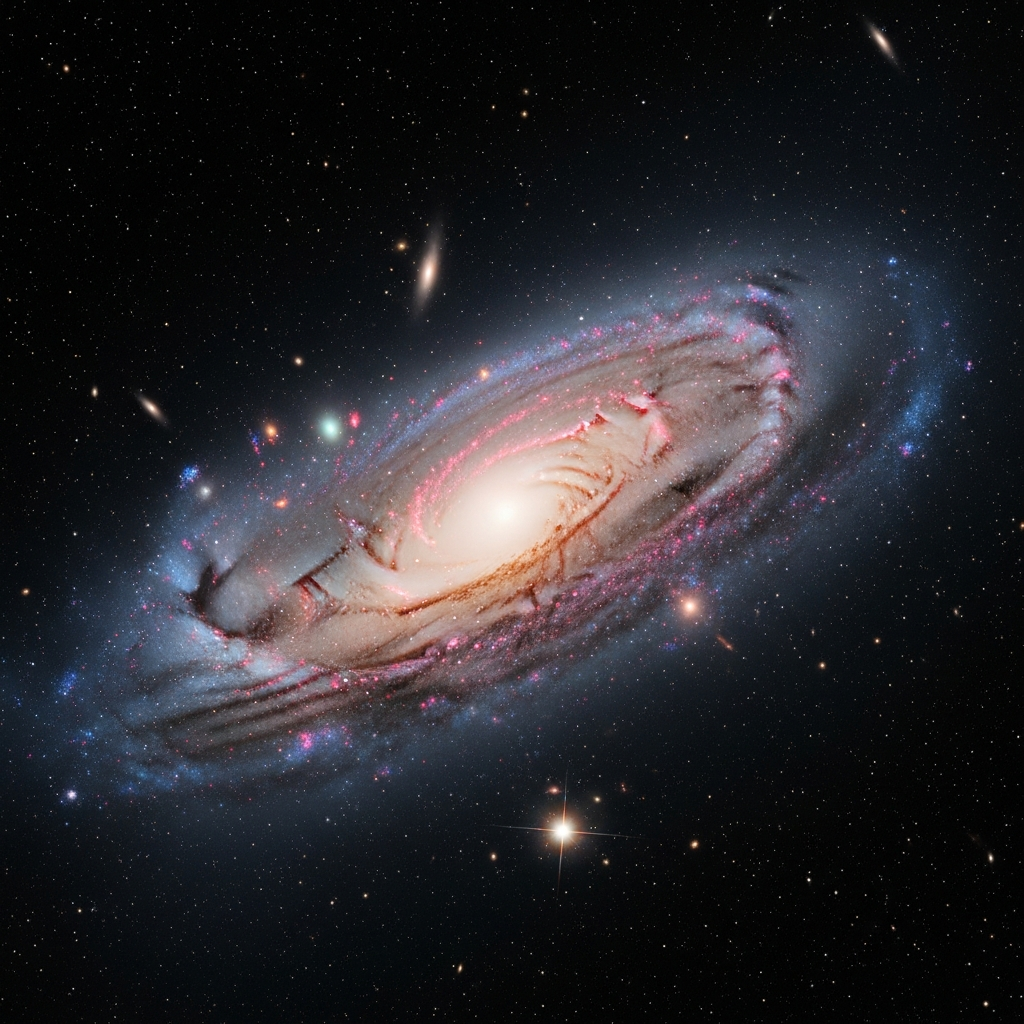
A groundbreaking new image from NASA’s James Webb Space Telescope has dramatically illuminated the vibrant heart of Messier 77, a stunning barred spiral galaxy located 45 million light-years away. This cosmic portrait reveals an exceptionally brilliant core, outshining all other elements within its view. At the heart of this galactic spectacle lies a supermassive black hole, an astounding 8 million times the sun’s mass, actively devouring surrounding gas and generating an intense, radiant glow. This incredible observation, captured by Webb’s cutting-edge mid-infrared instrument, offers astronomers unparalleled insights into active galactic nuclei and the dynamic evolution of galaxies across the universe.
Unveiling the Cosmic Jewel: Messier 77
Messier 77, often known as M77 or NGC 1068, stands out as a remarkable barred spiral galaxy. It resides a considerable distance from Earth, approximately 45 million light-years away. For context, a single light-year stretches about 6 trillion miles. This celestial marvel is nestled within the constellation Cetus, commonly referred to as the “whale” constellation. M77 holds particular significance for astronomers due to its dual attributes: its relative proximity to us and its spectacular, active features. This combination makes it an ideal candidate for detailed scientific examination, serving as a cosmic laboratory for understanding profound galactic processes.
The galaxy’s structure, a “barred spiral,” means it features a central bar-shaped structure composed of stars. From this bar, the spiral arms extend outwards. However, the new image from the Webb Space Telescope focuses intently on its luminous core. This central region is far more brilliant than anything else visible within the galaxy, a testament to the powerful processes occurring within.
What Makes Messier 77 So Special?
Astronomers have long been fascinated by Messier 77. Its status as a Seyfert galaxy is key to its appeal. Seyfert galaxies are a type of active galaxy, meaning their nuclei are highly luminous and emit strong radiation across the electromagnetic spectrum. This intense emission stems from material accreting onto a central supermassive black hole. Studying M77 allows scientists to observe these active galactic nuclei (AGNs) in detail, providing clues about galaxy evolution. Its relative closeness also offers an advantage, enabling more precise observations compared to more distant, fainter objects.
At the Core: A Supermassive Black Hole’s Powerhouse
The extraordinary brilliance emanating from Messier 77’s heart is not just starlight. Instead, it is powered by an active nucleus, specifically a supermassive black hole. This colossal entity boasts a mass 8 million times greater than our sun. Such a powerful gravitational force draws in vast amounts of surrounding gas and dust. As this material spirals inward towards the black hole, it forms an accretion disk.
Within this disk, the gas particles experience immense friction and compression. This process heats the gas to extreme temperatures. When matter reaches these incredible temperatures, it radiates intensely across various wavelengths, including mid-infrared light. The Webb Telescope’s specialized mid-infrared instrument (MIRI) was perfectly suited to capture these stunning, intricate details. It pierced through obscuring dust, allowing scientists to witness the glowing heart of this distant galaxy.
The Role of Webb’s Mid-Infrared Instrument
The James Webb Space Telescope is equipped with state-of-the-art instruments designed for infrared astronomy. Its Mid-Infrared Instrument (MIRI) is crucial for observing objects like Messier 77’s core. Unlike optical telescopes, MIRI can detect the longer wavelengths of infrared light. This capability is vital for several reasons:
Seeing Through Dust: Interstellar dust often obscures visible light from galactic centers. Infrared light, however, can penetrate this dust, revealing hidden structures and processes.
Detecting Cooler Objects: MIRI can also detect cooler objects that don’t emit much visible light, such as nascent stars and forming planets.
- Observing Redshifted Light: For extremely distant objects, the light is stretched into infrared wavelengths by the expansion of the universe. Webb’s infrared vision allows us to see these ancient, distant phenomena.
- abcnews.com
- kdhnews.com
- www.thestar.com
MIRI’s sensitivity allowed Webb to capture the precise thermal radiation from the superheated gas around Messier 77’s black hole. This provides invaluable data for understanding how black holes influence their host galaxies.
The James Webb Space Telescope: A New Era of Discovery
Launched in 2021, the James Webb Space Telescope stands as the world’s largest and most powerful space observatory. Its deployment marked a significant leap in our ability to peer into the cosmos. Webb’s primary mission involves studying every phase in the history of our universe. This ranges from the first luminous glows after the Big Bang to the formation of galaxies, stars, and planetary systems.
Beyond its groundbreaking image of Messier 77, Webb has already delivered a continuous stream of unprecedented discoveries. It has provided the deepest and sharpest infrared images of the distant universe to date. Scientists have used Webb to analyze the atmospheres of exoplanets, observe the birth of stars in stellar nurseries, and explore the very first galaxies that formed billions of years ago. Each new image and data set from Webb pushes the boundaries of our cosmic understanding.
Other Transformative Discoveries by Webb
Webb’s unparalleled infrared capabilities allow it to detect faint signals from the early universe. Its observations are helping refine our models of galaxy formation and evolution. For instance, Webb has revealed surprisingly mature galaxies existing much earlier than theories predicted. This challenges existing cosmological models. Furthermore, its detailed spectroscopy of exoplanet atmospheres offers tantalizing clues about the potential for life beyond Earth. Webb is truly reshaping our perception of the universe.
Why Messier 77 Matters to Science
The study of Messier 77 is critical for advancing our knowledge in several areas of astrophysics. Its active galactic nucleus provides a direct laboratory for examining how supermassive black holes operate. Scientists can study how these behemoths interact with and influence the gas, dust, and stars in their host galaxies. These interactions play a crucial role in regulating star formation and shaping the overall evolution of galaxies.
By observing M77, researchers gain insight into the “feedback loop” between black holes and their surroundings. This loop can either trigger new star formation or, conversely, expel gas and shut down star-forming activity. Understanding these dynamics is essential for building comprehensive models of how galaxies, including our own Milky Way, have evolved over cosmic time. M77 serves as a benchmark for comparative studies with other active galaxies.
Unlocking Galactic Evolution Secrets
The intense radiation from Messier 77’s black hole also affects the interstellar medium, the material between stars. This energy can heat the gas, ionize it, and even drive powerful outflows. Such outflows can sweep gas out of the galaxy, potentially starving it of material for future star formation. This process is a key element in understanding how galaxies stop forming stars and transition into different types. Webb’s data from M77 will provide crucial observational evidence to support or refute theoretical models of this phenomenon.
Frequently Asked Questions
What makes Messier 77’s core so bright in the Webb Telescope image?
The extraordinary brightness of Messier 77’s core, as captured by the Webb Space Telescope, is due to the presence of an active galactic nucleus (AGN) powered by a supermassive black hole. This black hole, estimated to be 8 million times the mass of our sun, actively pulls in surrounding gas. As the gas spirals into a tight orbit, it becomes incredibly hot due to friction and compression, causing it to radiate intensely across the electromagnetic spectrum, particularly in the mid-infrared range that Webb’s instruments observe. This powerful emission outshines other galactic components.
How does the James Webb Space Telescope capture such detailed images of distant galaxies?
The James Webb Space Telescope captures detailed images of distant galaxies like Messier 77 primarily through its advanced infrared instruments, such as the Mid-Infrared Instrument (MIRI). Unlike optical telescopes, Webb’s infrared vision allows it to see through vast clouds of cosmic dust that would otherwise obscure visible light. This capability reveals structures and processes hidden from other telescopes. Additionally, Webb’s large mirror and position in space, far from Earth’s atmospheric interference, enable it to collect faint light from distant objects with unprecedented clarity and sensitivity, providing stunning, high-resolution views of the cosmos.
Why is Messier 77 considered a significant object for astronomers to study?
Messier 77 is highly significant to astronomers for several key reasons. Firstly, it is a relatively nearby barred spiral galaxy with a highly active galactic nucleus, making it an accessible and ideal target for detailed observation of supermassive black holes in action. Secondly, its status as a Seyfert galaxy allows scientists to study the intricate interplay between a central black hole and its host galaxy, providing crucial insights into galaxy evolution, star formation regulation, and the “feedback loop” that shapes cosmic structures. Its proximity offers unparalleled opportunities for high-resolution studies that are difficult for more distant active galaxies.
Conclusion
The latest image from the James Webb Space Telescope offers a truly spectacular view into the brilliant heart of Messier 77. This powerful observation not only showcases the incredible capabilities of Webb’s mid-infrared instrument but also provides invaluable data for understanding some of the most energetic phenomena in the universe. The blazing core, driven by an immense supermassive black hole, serves as a natural laboratory for astrophysicists to unravel the mysteries of active galactic nuclei and the profound ways they influence the evolution of galaxies. As Webb continues its mission, we can anticipate a wealth of further discoveries, continually deepening our appreciation for the dynamic and awe-inspiring cosmos. Stay tuned for more groundbreaking insights from humanity’s most powerful eye on the universe.