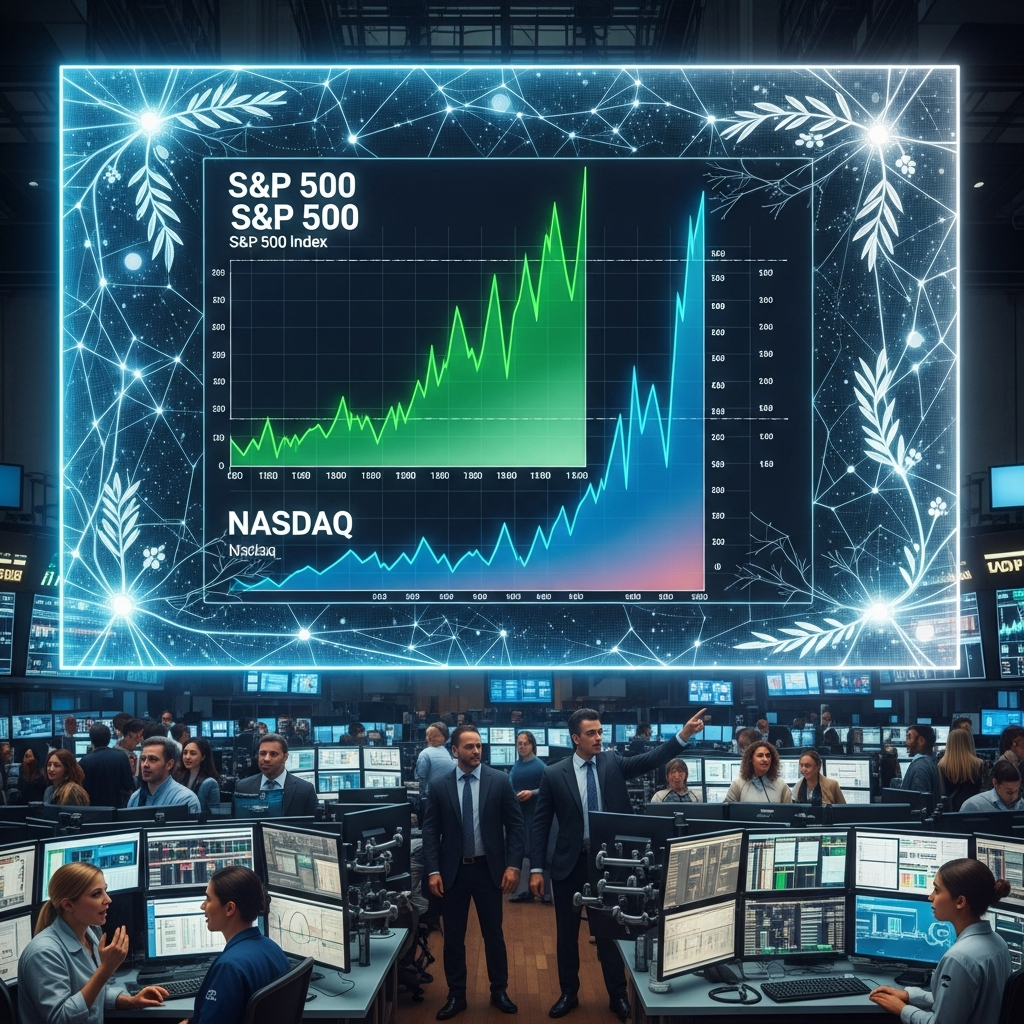
Wall Street recently witnessed a historic stock market rally, propelling the S&P 500 and Nasdaq Composite to unprecedented record highs. This remarkable surge was primarily fueled by a powerful combination of groundbreaking advancements in artificial intelligence (AI) and a significant de-escalation of geopolitical tensions stemming from US-Iran diplomacy. Investors celebrated robust corporate earnings and the prospect of stability, driving broad market optimism and reshaping investment landscapes across various sectors. This analysis delves into the critical factors behind the recent market exuberance, offering insights into the forces that shaped this period of exceptional growth.
Geopolitical Relief: Iran Diplomacy Calms Markets
A major catalyst for the positive market sentiment was the dramatic improvement in US-Iran relations. Reports of a potential peace deal and subsequent ceasefire announcements, particularly concerning the crucial Strait of Hormuz, ignited a “relief rally” across global financial markets. The prospect of the strait, a vital global energy chokepoint, reopening for commercial traffic sent shockwaves through the energy sector.
Brent crude futures plummeted below $100 per barrel, and US benchmark WTI crude saw significant drops, sometimes falling by over 10%. This sharp decline in oil prices alleviated concerns about sticky inflation, sparking speculation that the Federal Reserve might reconsider its interest rate policies. While initial optimism was high, some reports of ceasefire violations and persistent disagreements tempered gains. However, the overarching theme was a reduction in the “fear trade,” allowing investors to focus on growth opportunities rather than geopolitical risk. The swift market recovery following initial conflict-induced losses demonstrated a remarkable resilience and willingness to embrace positive diplomatic signals.
The Strait of Hormuz: A Global Economic Barometer
The Strait of Hormuz’s status proved to be a critical barometer for market sentiment. Its potential reopening, even with caveats, dramatically impacted energy futures and indirectly boosted other sectors by reducing input costs. Experts noted, however, that while oil prices fell, they often remained above “fair value,” indicating lingering market skepticism about the ceasefire’s long-term durability. Points of contention, such as Iran’s nuclear program and the terms of transit through the Strait, continued to be key negotiation hurdles. The dynamic interplay between diplomatic progress and market reaction underscored the profound influence of geopolitical stability on global economic forecasts.
AI Revolution: Tech Stocks Lead the Charge to New Highs
The enduring power of the artificial intelligence (AI) trade remained a primary engine of the stock market rally. The tech-heavy Nasdaq Composite, in particular, rode this wave, with the semiconductor sector experiencing an unparalleled surge. Companies like Nvidia (NVDA) hit new highs, reflecting insatiable demand for their specialized chips integral to AI development.
Advanced Micro Devices (AMD) saw its stock surge by as much as 19% after reporting stronger-than-anticipated quarterly guidance, specifically highlighting server CPU demand for AI workloads. This signaled an emerging “CPU comeback” story, as sophisticated AI agents increasingly require a broader array of processing power beyond just GPUs. Supermicro (SMCI) likewise rallied significantly on robust AI server demand. The global impact was evident as Samsung Electronics (005930.KS) achieved a $1 trillion market valuation, driven by a nearly 400% year-over-year stock surge, largely due to high-bandwidth memory orders for AI. Even “picks and shovels” aspects of AI infrastructure saw gains, with Corning (GLW) benefiting from a long-term partnership with Nvidia to expand US optical connectivity for AI data centers. Tech and semiconductor ETFs consistently reached new records, solidifying AI’s role as a transformative economic force.
Broader Tech Gains and Ecosystem Impact
The AI-driven tech surge extended beyond semiconductors, impacting cloud computing, software, and even infrastructure components. Companies like Oracle (ORCL) saw significant gains, partly due to strategic partnerships to power AI data centers. Tesla (TSLA) demonstrated strong retail investor inflows, suggesting continued conviction in the EV maker despite market fluctuations. The sheer scale of AI development also led to discussions around regulation, with the White House considering executive orders for vetting new frontier AI models for safety, mirroring agreements with leading AI firms to ensure security.
Strong Earnings Season Provides Fundamental Support
Beneath the excitement of AI and geopolitics, a remarkably strong earnings season provided a solid fundamental underpinning for the market’s ascent. The US stock market experienced one of its best earnings seasons in two decades, with approximately 85% of reporting S&P 500 companies surpassing profit expectations. Furthermore, about 77% delivered upside revenue surprises.
On a blended basis, over 80% of companies exceeded estimates, a testament to corporate resilience and efficiency. Deutsche Bank highlighted that, for the first time in four years, all 11 top-level sectors were projected to show year-on-year earnings growth. This broad-based strength underscored a healthy corporate environment, with notable companies like Disney (DIS), CVS (CVS), Uber (UBER), and Novo Nordisk (NVO) reporting robust results. This consistent performance reinforced investor confidence and justified elevated valuations for many stocks, contributing significantly to the sustained upward trajectory of the Nasdaq S&P 500 and Dow.
Economic Data and Sectoral Nuances
Economic indicators offered a mixed but generally stable picture. The US added 109,000 private-sector jobs in April, according to ADP, marking the largest monthly gain since January 2025 and suggesting labor market stability. However, the surge in gasoline prices during the Iran conflict highlighted a “K-shaped economy” dynamic. Economists observed that lower-income households significantly cut gasoline consumption, leading to smaller nominal spending increases, while high-income households experienced larger spending jumps due to minimal consumption reductions.
Sectorally, while tech and industrials flourished, other areas faced specific challenges. Airline stocks, for instance, were impacted by rising jet fuel costs and weather disruptions. Energy stocks, after an initial surge during conflict escalation, retreated sharply as oil prices fell. This divergence underscored the complex interplay of global events, corporate performance, and consumer behavior shaping the broader economic landscape.
Global Reach and Analyst Perspectives
The market rally was not confined to the US. World stocks, as measured by MSCI’s world share index, held near record highs, indicating a broader global recovery. The decline in the US Dollar Index, driven by reduced “risk-off” sentiment, bolstered international returns and saw several country-specific ETFs, including those from Korea, Taiwan, Greece, and Poland, outperform the S&P 500.
UBS strategists provided valuable insights for investors navigating all-time high markets. They asserted that rising earnings expectations and supportive policy are more critical than the record levels themselves. Historical data from 1960 shows that hitting a record high has not typically led to weaker forward returns for the S&P 500, with average returns comparable to periods below records. This perspective offered reassurance to investors concerned about buying at peak valuations, emphasizing the importance of underlying fundamentals and future growth prospects.
Frequently Asked Questions
What were the primary drivers behind the recent historic stock market records?
The recent historic stock market records for indices like the S&P 500 and Nasdaq Composite were predominantly driven by two powerful forces. First, robust optimism surrounded US-Iran diplomatic efforts, leading to hopes of peace and the reopening of the Strait of Hormuz, which significantly lowered oil prices and reduced geopolitical risk. Second, an accelerating artificial intelligence (AI) boom fueled unprecedented demand for tech and AI stocks, particularly in the semiconductor sector with companies like Nvidia, AMD, and Supermicro seeing massive gains. This was further supported by a strong corporate earnings season, with over 80% of S&P 500 companies beating profit expectations.
How did the US-Iran diplomacy specifically impact energy markets and global trade?
The US-Iran diplomatic progress, including announcements of ceasefires and potential peace deals, directly impacted energy markets by causing a sharp plunge in oil prices. Brent crude and WTI crude futures fell significantly as the prospect of the Strait of Hormuz, a critical global shipping lane, reopening for commercial traffic emerged. This eased concerns about supply disruptions and lowered inflation expectations. While this provided a “relief rally” for broader markets, the actual movement through the Strait of Hormuz saw only limited, gradual improvement, and lingering disagreements between the nations kept some market participants cautious about the long-term stability of the ceasefire and its full impact on global trade.
Should investors be concerned about market highs, or are they sustainable given current trends?
While investing in all-time high markets can naturally raise concerns, analysts suggest focusing on underlying fundamentals rather than just headline figures. UBS strategists indicate that rising earnings expectations and supportive economic policies are more crucial indicators than the record levels themselves. Historical data shows that reaching a record high has not typically led to weaker future returns for the S&P 500. Given the strong Q1 earnings season, the transformative impact of the AI stocks boom, and the potential for continued geopolitical stability, the sustainability largely depends on these factors. Investors should remain vigilant about economic data and potential policy shifts, but current trends indicate significant fundamental support.
Navigating a Dynamic Market Landscape
The recent surge in US stock markets underscores a period defined by both technological innovation and delicate geopolitical maneuvering. The powerful dual catalysts of an expanding AI revolution and crucial diplomatic progress regarding Iran created an environment where record closes became increasingly common. While the stock market rally presented significant opportunities, it also highlighted the interconnectedness of global events and their immediate impact on financial asset classes. For investors, understanding these drivers, coupled with a focus on strong corporate fundamentals and evolving economic landscapes, remains paramount in navigating what promises to be a continuously dynamic market.