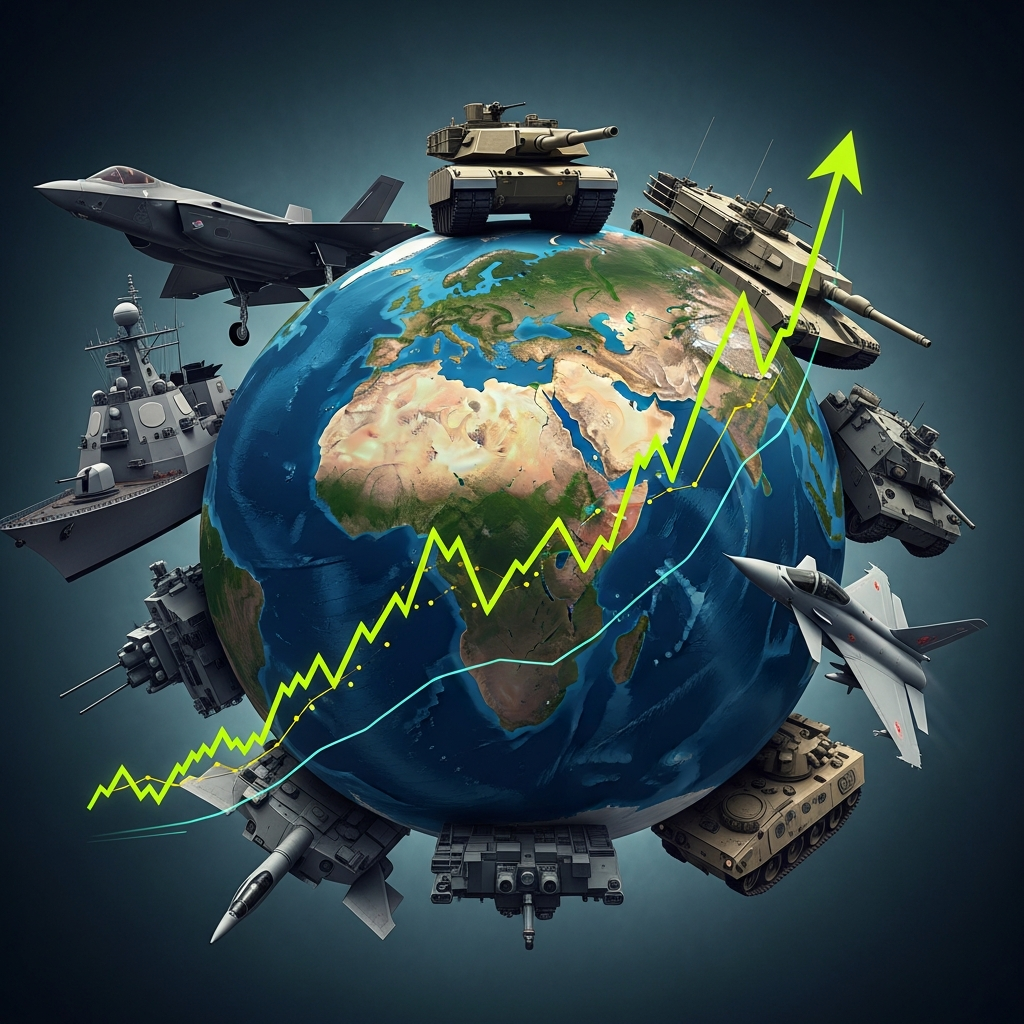
Global military expenditure reached an unprecedented $2.887 trillion in 2025, marking the eleventh consecutive year of increase. This significant surge, revealed by new data from the Stockholm International Peace Research Institute (SIPRI), pushed the global military burden—spending as a share of gross domestic product (GDP)—to 2.5 percent, its highest level since 2009. The ongoing wars in Ukraine, Gaza, and Sudan, coupled with escalating geopolitical tensions and widespread uncertainty, fueled this rearmament drive across the globe, with Europe and Asia leading the charge in expenditure growth.
While the overall annual increase of 2.9 percent in real terms was slightly slower than the previous year, this moderation was primarily due to a temporary dip in United States military spending. Excluding the USA, global defense budgets actually climbed by a more substantial 9.2 percent in 2025. Experts predict this upward trend in military outlays is likely to continue into 2026 and beyond, driven by enduring crises and long-term strategic objectives set by various nations.
The Global Picture: Record Spending and Shifting Dynamics
The world’s top three military spenders—the USA, China, and Russia—collectively accounted for a staggering $1.480 trillion, or 51 percent of the total global expenditure. Despite a 7.5 percent reduction in US military spending in 2025, primarily due to a lack of new financial aid approvals for Ukraine, the country remained the largest defense budget holder. This temporary dip contrasts sharply with the broader trend of rising military investment seen across continents.
Xiao Liang, a researcher with SIPRI’s Military Expenditure and Arms Production Programme, emphasized that states are responding to a year marked by intense conflicts and global instability. The scale of armament drives suggests a deepening commitment to military strength. This shift could lead to profound consequences for global stability and resource allocation, potentially impacting social services or development aid as more economic output is directed towards defense.
Europe’s Resurgence: Responding to Insecurity
Europe emerged as a primary driver of the global spending increase, with its military expenditure soaring by 14 percent to $864 billion. This marked the sharpest annual growth in Central and Western Europe since the end of the Cold War. Russia’s full-scale invasion of Ukraine fundamentally reshaped the continent’s security landscape, prompting many nations, especially NATO members, to ramp up their defense budgets significantly.
Spending by both Russia and Ukraine continued their ascent for the fourth year of their ongoing conflict. Russia’s military outlays grew by 5.9 percent to $190 billion, imposing a substantial military burden of 7.5 percent of its GDP. Ukraine, ranking as the world’s seventh-largest spender in 2025, saw an extraordinary 20 percent increase to $84.1 billion, representing an immense 40 percent of its GDP. Lorenzo Scarazzato, a SIPRI researcher, highlighted the unsustainable nature of such proportions, noting that military spending as a share of government expenditure reached its highest recorded level for both nations. Continued growth is anticipated if the war persists, supported by Russia’s oil revenues and Ukraine’s expected European Union loan.
NATO Allies Reinforce Defenses
The 29 European NATO members collectively spent $559 billion in 2025, with 22 of them meeting or exceeding the alliance’s 2.0 percent of GDP military spending target. Germany, for instance, became Europe’s largest military spender, with its budget increasing by 24 percent year-on-year to $114 billion. For the first time since 1990, Germany surpassed the 2.0 percent threshold, reaching 2.3 percent of GDP. This was facilitated by amending its fiscal rules to exempt military spending above 1 percent of GDP from its strict debt brake. Spain also saw a significant 50 percent jump, reaching $40.2 billion and exceeding 2.0 percent of GDP for the first time since 1994. Other notable increases included Poland (23%) and Italy (20%).
Jade Guiberteau Ricard, another SIPRI researcher, noted that this accelerated growth reflects Europe’s pursuit of greater self-reliance and increased pressure from the United States for enhanced burden-sharing within NATO. However, Ricard cautioned about the risk of blurring lines between traditional military spending and other “defense- and security-related” expenditures as states strive to meet new targets, which could reduce transparency and complicate accurate assessments of military capabilities. The International Institute for Strategic Studies (IISS) also reported a 12.6% rise in European defense spending, far outpacing the global average.
Asia’s Ascent: Modernization and Regional Tensions
Military expenditure in Asia and Oceania reached $681 billion in 2025, an 8.1 percent increase over 2024. This marked the largest annual rise in the region since 2009. China, the world’s second-largest military spender, continued its relentless modernization drive, increasing its military budget by 7.4 percent to $336 billion. This represents China’s 31st consecutive year of increased spending, marked by advances in stealth bombers and sixth-generation fighter jet prototypes.
This military buildup by China has significant regional implications, influencing higher spending among its neighbors. Japan’s military expenditure rose by 9.7 percent to $62.2 billion, reaching 1.4 percent of GDP – its highest share since 1958. Taiwan’s spending surged by 14 percent to $18.2 billion (2.1 percent of GDP), the largest annual increase since at least 1988, against a backdrop of intensifying military exercises by the People’s Liberation Army around the island.
Diego Lopes da Silva, a Senior Researcher with SIPRI, explained that US allies in the region, such as Australia, Japan, and the Philippines, are increasing their military outlays not only due to long-standing regional tensions but also growing uncertainty over US support. Like Europe, these nations face pressure from the US administration to bolster their defense budgets and enhance self-reliance. India, the world’s fifth-largest military spender, increased its budget by 8.9 percent to $92.1 billion, partly driven by tensions with China and a conflict with Pakistan in 2025, leading to substantial investments in aerospace and drones. Pakistan’s spending also increased by 11% to $11.9 billion.
Middle East and Other Regions: Varied Dynamics
Military expenditure in the Middle East remained relatively stable in 2025, reaching an estimated $218 billion, a marginal 0.1 percent higher than in 2024. This stability masks varied national trends. Israel’s military spending decreased by 4.9 percent to $48.3 billion, reflecting a reduction in the intensity of the war in Gaza after a ceasefire agreement with Hamas in January 2025. However, Israel’s spending remained 97 percent higher than in 2022. Türkiye’s military budget grew by 7.2 percent to $30.0 billion, partly driven by ongoing military operations.
Iran’s spending nominally increased but declined by 5.6 percent in real terms due to high inflation. Zubaida Karim, a SIPRI researcher, noted that official figures likely understate Iran’s true military spending, as the nation uses off-budget oil revenues to finance its military, including missile and drone production. Saudi Arabia, the eighth-biggest military spender, increased its outlays by 1.4 percent to $83.2 billion.
In Africa, total military spending rose by 8.5 percent to $58.2 billion, with Nigeria’s expenditure growing by 55 percent to $2.1 billion amidst insurgencies and extremist violence. Guyana saw a 16 percent increase to $248 million, fueled by escalating tensions with Venezuela over the Essequibo region. Venezuela’s military spending, however, remains largely unknown due to a lack of public data.
The Broader Implications and Future Outlook
The sustained rise in global military spending has significant long-term implications. The “military burden” — the share of national economies dedicated to defense — has not been this high in over a decade. SIPRI expert Diego Lopes da Silva challenged the notion that a more evenly distributed military balance automatically makes the world safer, arguing instead that it signifies “more arms and more weapons,” accelerating a dangerous new arms race, eroding trust, and increasing the risk of miscalculation. Pope Leo XIV, through an appeal from the Vatican, warned against large-scale investment in armed conflicts, advocating for these resources to be used to strengthen health systems and protect life.
The consensus among experts is that this upward trend is unlikely to reverse course soon. Given the multitude of current global crises and long-term military spending targets set by states, military outlays are projected to continue growing through 2026 and beyond. This trajectory highlights a world in a “crisis mode,” prioritizing security and defense in response to an increasingly unstable geopolitical environment.
Frequently Asked Questions
What were the key drivers behind the record surge in global military spending in 2025?
The record surge in global military spending, reaching $2.887 trillion in 2025, was primarily driven by ongoing wars and conflicts in regions like Ukraine and Gaza, coupled with heightened geopolitical tensions and widespread global uncertainty. Many nations, especially European NATO members, significantly increased their defense budgets to deter potential aggression and pursue greater self-reliance. Furthermore, a long-term military modernization push by powers like China and renewed security concerns in Asia also fueled the rise, with states responding to what they perceive as an increasingly unstable world order.
Which regions and countries saw the most significant changes in defense budgets in 2025?
Europe experienced the most significant regional surge, with military spending rising by 14%, largely due to rearmament efforts by NATO members like Germany (up 24% to $114 billion) and Spain (up 50% to $40.2 billion), as well as continued high spending by Russia and Ukraine due to the ongoing war. Asia and Oceania also saw a substantial 8.1% increase, driven by China’s consistent military modernization and increased spending by US allies like Japan and Taiwan amidst regional tensions. In contrast, the United States saw a 7.5% decrease, primarily due to a halt in new military aid for Ukraine, though this dip is expected to be short-lived.
What are the long-term implications of sustained global military spending increases?
The sustained increase in global military spending carries several critical long-term implications. It raises the “military burden” on global GDP to its highest level since 2009, potentially diverting resources from vital social services, development aid, and climate initiatives. Experts warn that this proliferation of arms and weapons could accelerate a dangerous new arms race, erode international trust, and heighten the risk of miscalculation, making the world more perilous. Moreover, it signifies a prolonged period of geopolitical instability and a global prioritization of hard security measures over cooperative peace-building efforts, with calls from figures like Pope Leo XIV to redirect these vast resources towards strengthening health systems.