
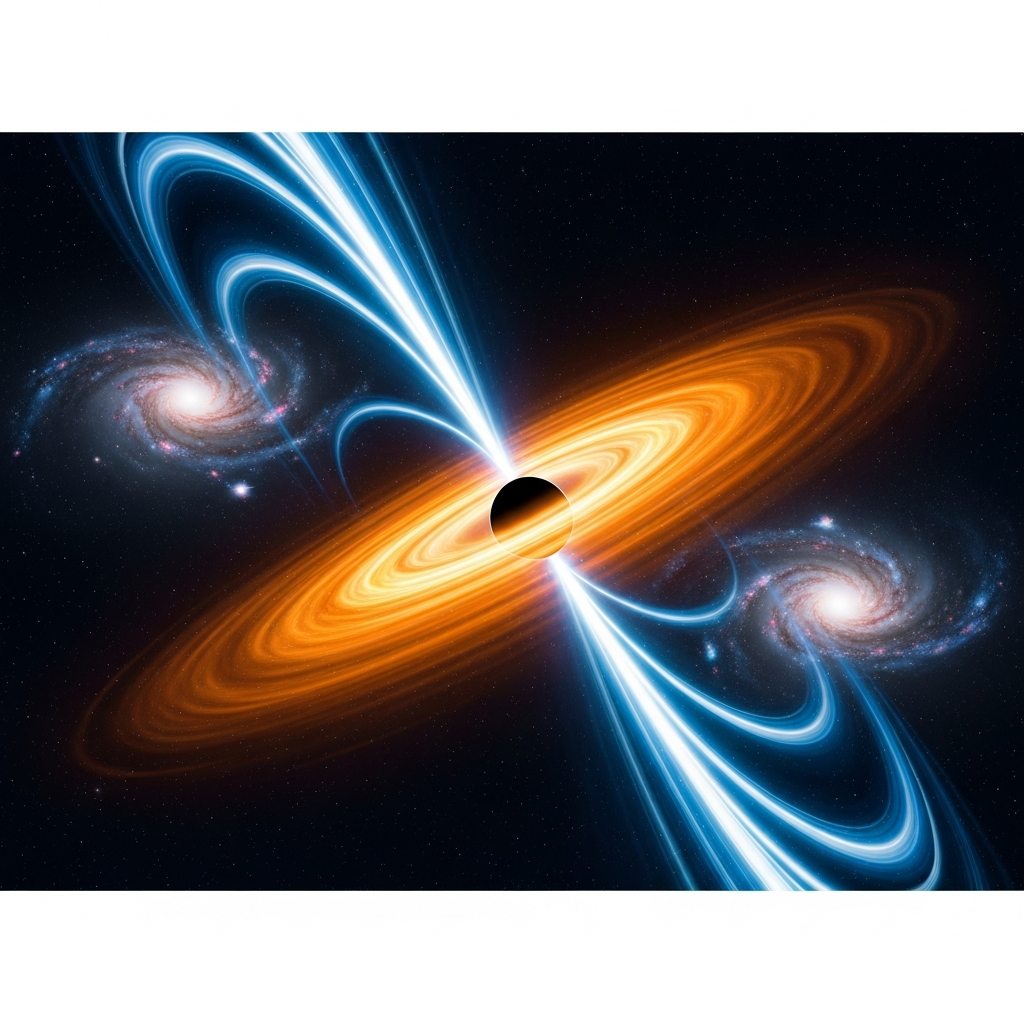
The universe constantly unveils its awe-inspiring wonders, and none are more mysterious than black holes. For over six decades, astronomers have meticulously studied Cygnus X-1, the very first black hole ever confirmed. Now, groundbreaking research has finally measured the incredible energy and speed of its unique “dancing jets,” providing unprecedented insights into these cosmic behemoths. This pivotal discovery offers an anchor for understanding black holes across the cosmos, from stellar giants to supermassive entities, and their profound impact on galaxy evolution.
Cygnus X-1: A Cosmic Icon Unveiled
Cygnus X-1 holds a special place in astronomical history. First spotted in 1964 and officially confirmed in 1971, it became the undisputed evidence that black holes truly exist. This remarkable object is a stellar-mass black hole, an impressive 21 times more massive than our Sun. It resides approximately 7,000 light-years away within the familiar constellation Cygnus.
Cygnus X-1 doesn’t exist in isolation. It’s locked in a tight binary system with a blue supergiant star named HDE 226868, a companion nearly twice its size. The black hole mercilessly strips away the outer layers of its partner, creating a superhot, swirling ring of matter known as an accretion disk. This disk shines intensely in X-ray light, making Cygnus X-1 one of the brightest X-ray sources in our galaxy. While the black hole itself emits no visible light, its brilliant companion star is observable with a decent telescope, offering a rare opportunity to witness a black hole system firsthand.
The Enigma of Black Hole Jets
Like many active black holes, Cygnus X-1 expels two colossal beams of energy, extending outward from its poles. These jets are composed of superheated plasma, violently ejected by the black hole’s immensely powerful and rapidly spinning magnetic field. Such jets are among the most energetic phenomena in the cosmos, propelling matter at near-light speeds.
Despite their power and prevalence, these energetic outflows have historically posed a significant challenge for astronomers. Capturing detailed images of them is one thing; accurately measuring their precise energy output and velocity is another entirely. Their constant, erratic movement made obtaining reliable data exceptionally difficult, leaving a critical gap in our understanding of black hole dynamics.
Decoding the “Dancing Jets” Phenomenon
The recent study, published in Nature Astronomy, finally cracked the code to measuring Cygnus X-1’s elusive jets. Researchers achieved this by observing a peculiar behavior: the jets “wobble” or “dance” as they blast through space. This fascinating phenomenon is caused by the blue supergiant companion, HDE 226868.
Active stars, including HDE 226868, generate strong stellar winds—streams of charged particles accelerated by their own magnetic fields. As Cygnus X-1 and its companion star orbit their shared center of mass every 5.6 days (at a mere 0.2 astronomical units apart), these powerful stellar winds constantly buffet the black hole’s plasma jets. This relentless pushing causes the jets to bend away from the supergiant star. From our vantage point on Earth, this bending and the orbital motion create the appearance of the jets swaying back and forth. Radio astronomer Steve Prabu from the University of Oxford, the study’s lead author, aptly coined this mesmerizing motion “dancing jets.”
To overcome the historical difficulty of tracking these constantly moving targets, the research team employed a clever strategy. They combined images captured by radio telescopes positioned across the globe, synthesizing the data to build an exceptionally accurate, three-dimensional picture of the jets’ shape and movement. This ingenious method allowed them to achieve what was once considered impossible.
Unprecedented Measurements: Half the Speed of Light
The results of this meticulous research are nothing short of astonishing. The measurements revealed that Cygnus X-1’s jets shine with an equivalent energy output of approximately 10,000 Suns. Even more impressively, these jets are rocketing outward at an incredible speed of 335 million mph (540 million km/h)—which is roughly half the speed of light. This makes them one of the most powerful and fastest outflows observed in the universe.
This quantification of the jets’ energy and speed is a monumental leap forward. Previously, scientists could only infer a black hole’s feeding rate by observing the X-rays from its accretion disk. Now, by measuring the energy expelled by the jets, researchers can determine a black hole’s complete “energy budget.” As study co-author James Miller-Jones, a black hole accretion expert at Curtin University, colorfully put it, this process is akin to “counting calories, only for a black hole.”
Broadening Our Cosmic Understanding
The implications of these findings extend far beyond Cygnus X-1. A key revelation from the study is that approximately 10% of the total energy released as matter spirals into the black hole is carried away by these powerful jets. This observation provides direct, observational confirmation for a fundamental assumption used in large-scale simulated models of the universe – an assumption that was previously challenging to verify.
According to Miller-Jones, the fundamental physics governing black hole behavior is believed to be similar across different scales. This means the precise measurements obtained from Cygnus X-1 can serve as a vital “anchor” for understanding the jets emanating from other black holes, whether they are stellar-mass objects like Cygnus X-1 or the monstrous supermassive black holes found at the centers of galaxies.
Improved comprehension of these powerful black hole jets is crucial for deciphering how galaxies, including our own Milky Way, have evolved over cosmic time. These immense outflows act as a significant “feedback” mechanism, injecting vast amounts of energy into their surrounding environments. This energy can influence star formation, heat interstellar gas, and ultimately sculpt the structure and growth of entire galaxies.
Beyond Cygnus X-1: More Black Hole Surprises
The universe continues to surprise us with the dynamic behavior of black holes. While Cygnus X-1’s jets offer a glimpse into steady energy expulsion, other observations reveal even more unpredictable phenomena. For instance, the James Webb Space Telescope recently provided unprecedented detail of the renowned black hole M87, not only imaging its famous forward jet but also revealing a massive “counter-jet” blasting in the opposite direction. Such remarkably clear images help astrophysicists study these near-light-speed ejections and understand their influence on galactic structures.
Even more astounding, astronomers have recently observed a supermassive black hole “vomiting” stellar material three years after it consumed a star. This delayed ejection, described as the black hole “burping out bits of its meal,” marks the first time such a significant time lag has been witnessed between a star’s consumption and the subsequent outflow of material. This discovery suggests that delayed outflows from black holes might be more common than previously thought, adding another layer of complexity to their already mysterious feeding mechanisms. These ongoing discoveries emphasize that our journey to understand black holes is far from over.
Frequently Asked Questions
How do “dancing jets” help astronomers understand black holes?
The observation of “dancing jets” from Cygnus X-1 allowed astronomers to accurately measure the energy output and speed of these powerful plasma beams for the first time. The “dancing” motion, caused by stellar winds from a companion star, provided a unique signature that could be tracked using global radio telescopes. This breakthrough confirms a key assumption in cosmic models: about 10% of the energy from matter falling into a black hole is ejected through these jets. This crucial measurement acts as an “anchor,” helping scientists understand the behavior and “energy budget” of all types of black holes, from small stellar ones to giant supermassive ones.
Can you see Cygnus X-1 or its jets from Earth?
While Cygnus X-1 itself, as a black hole, does not emit visible light and its plasma jets are primarily observed in radio waves, its companion star, HDE 226868, is* visible with a decent telescope. This makes Cygnus X-1 one of the rare black hole systems where one can actually observe its stellar partner. The “dancing jets” themselves were detected and measured using a network of advanced radio telescopes worldwide, which can capture the emissions from the high-energy plasma. So, while you won’t see the jets directly with your eyes, specialized instruments allow astronomers to “see” and study their incredible activity.
What’s the significance of Cygnus X-1’s jet energy for wider cosmic models?
The precise measurement that Cygnus X-1’s jets radiate with the energy of 10,000 Suns and carry away about 10% of the infalling matter’s energy is profoundly significant for wider cosmic models. This finding provides direct observational validation for assumptions used in large-scale simulations of the universe, improving their accuracy. Since the physics around black holes is thought to be largely universal, this data from Cygnus X-1 serves as a fundamental benchmark. It helps scientists calibrate models for how black hole jets impact their surroundings, influencing critical processes like galaxy formation, the distribution of gas, and the overall evolution of galactic structures across billions of light-years.
Continued Exploration of Cosmic Powerhouses
The measurement of Cygnus X-1’s “dancing jets” represents a monumental achievement in astronomy. It not only provides a deeper understanding of this iconic black hole but also furnishes a vital tool for unraveling the mysteries of black holes across the entire universe. As technology advances and researchers continue to probe the cosmos, each new discovery about these enigmatic powerhouses brings us closer to comprehending the fundamental forces that shape galaxies and drive the evolution of the universe itself. The dance of Cygnus X-1’s jets is a vivid reminder of the universe’s dynamic and endlessly surprising nature.


One thought on “Breaking: Cygnus X-1’s ‘Dancing Jets’ Unveil Black Hole Power”