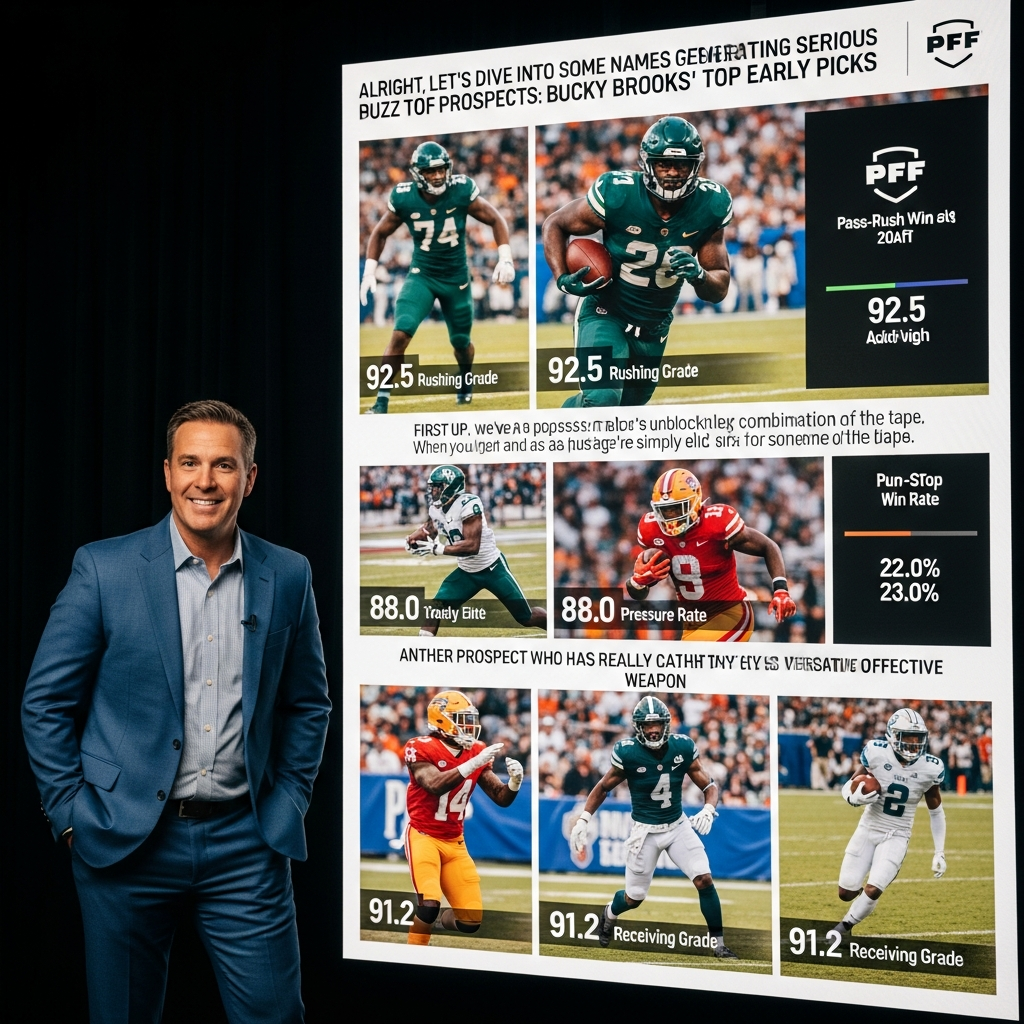
As the 2026 NFL Draft approaches in Pittsburgh, analysts are buzzing about a “rock-solid collection” of future talent poised to impact professional rosters. While traditional marquee positions like quarterback and running back may lack some of the typical “sizzle,” the overall class offers immense depth and playmaking ability across the board. This in-depth scouting report, drawing insights from NFL.com Analyst Bucky Brooks and PFF’s comprehensive big board, identifies the top 26 genuine difference-makers alongside five crucial “Red Star” sleepers destined to outperform their draft stock. Get ready to discover the prospects who could redefine NFL franchises for years to come.
Scouting the Elite: The 2026 NFL Draft’s Premier Talent
The 2026 NFL Draft class, as thoroughly scouted by experts like Bucky Brooks, is shaping up to be a treasure trove of talent. Though some top positions might not have the flash of previous years, evaluators are finding an abundance of players with high ceilings. These are the athletes capable of stepping into the league and immediately shifting the competitive landscape for their new teams. From dynamic running backs to cerebral safeties, the pathway to sustained NFL success runs through this incoming class.
Quarterback Class: Precision Over “Superpowers”
Headlining the 2026 quarterback class is Indiana’s Fernando Mendoza. The reigning Heisman Trophy winner is widely projected as the No. 1 overall pick, with PFF even linking him to the Las Vegas Raiders. Mendoza shines as a clutch competitor, known for his pinpoint accuracy in critical moments. While he might not possess the extraordinary physical gifts often associated with a top signal-caller, his exceptional football IQ, strong character, and consistent winning habits are traits that translate directly to professional success. He offers an early-impact projection as a potential franchise cornerstone.
Alabama’s Ty Simpson presents a more complex evaluation. He boasts impeccable footwork and mechanics, showcasing high-level throws and a knack for attacking the middle of the field. However, his limited college experience (just 15 starts) combined with his 6-foot-1, 211-pound frame makes him an interesting outlier. PFF highlights his intriguing NFL traits but notes inconsistent timing and ball placement due to a smaller sample size, suggesting he’ll need development time. LSU’s Garrett Nussmeier, with his NFL bloodlines and confident vertical passing, and Miami’s Carson Beck are also names to watch as developmental prospects with starting upside. Penn State’s Drew Allar possesses elite arm talent but needs to refine his accuracy and decision-making, per PFF.
Dynamic Ball-Carriers: Running Backs with Gold-Jacket Potential
The 2026 running back class features a truly exceptional talent in Notre Dame’s Jeremiyah Love. Ranked as the No. 1 player on Brooks’ draft board and identified as a potential “gold-jacket candidate,” Love is an electric playmaker. PFF describes him as the “ideal first-round running back,” citing his frame, athleticism, coordination, and playmaker mentality. He’s expected to make an impact in both the running and passing game.
Love is joined by his college teammate, Jadarian Price, and Nebraska’s Emmett Johnson as potential feature backs. Arkansas’ Mike Washington and Washington’s Jonah Coleman are slated for key roles as rotational runners. Given the depth, teams could uncover significant hidden gems among these ball-carriers on Day 2 or 3 of the draft.
Wide Receivers and Tight Ends: Polished Pass-Catchers and Flex Weapons
The wide receiver class is stacked with polished route-runners and shifty slot options. Ohio State’s Carnell Tate, Arizona State’s Jordyn Tyson, and USC’s Makai Lemon are projected as immediate impact players. PFF points to Tate’s high floor due to his strong hands, reliable blocking, and NFL-caliber route running. These three are joined by Indiana’s Omar Cooper, Texas A&M’s KC Concepcion, and Washington’s Denzel Boston. These role players could evolve into difference-makers within schemes that maximize their unique skill sets.
Teams seeking versatile tight ends will find plenty of choices. This group emphasizes “flex” tight ends capable of exploiting mismatches. Oregon’s Kenyon Sadiq, Ohio State’s Max Klare, Cincinnati’s Joe Royer, and Vanderbilt’s Eli Stowers are notable for their ability to contribute in various offensive alignments. Sadiq, in particular, is an “ideal modern tight end” with athleticism and versatility, a strong first-round projection despite limited college production, according to PFF. Utah’s Dallen Bentley offers intriguing potential as a traditional “Y” tight end, thanks to his impressive size (6-4, 253 pounds), length, and blocking prowess.
Fortifying the Trenches: Offensive Line Strength and Depth
The offensive tackle class boasts both talent and depth, potentially leading to a flurry of picks late in Round 1. Miami’s Francis Mauigoa stands out as a “well-built, well-rounded tackle prospect” with a high floor, offering power in the run game and quick feet in pass protection, per PFF. Utah products Spencer Fano and Caleb Lomu, Georgia’s Monroe Freeling, and Alabama’s Kadyn Proctor are considered likely first-round locks. Clemson’s Blake Miller and Arizona State’s Max Iheanachor also offer long-term starting potential.
On the interior offensive line, Penn State’s Vega Ioane (Olaivavega Ioane) is a special player, worthy of top-10 consideration for his dominance at the line of scrimmage. PFF noted his breakout 2025 season, earning an 80.0 overall grade, and excelling in pass protection. Texas A&M’s Chase Bisontis, Oregon’s Emmanuel Pregnon, and Georgia Tech’s Keylan Rutledge are deemed “plug-and-play” starters. Pregnon made a major leap in 2025, earning an 86.7 PFF grade and showcasing elite production in zone schemes. Any of these could sneak into the Day 1 conversation.
Defensive Standouts: Playmakers at Every Level
The defensive side of the ball also brings significant talent to the 2026 NFL Draft. From explosive edge rushers to versatile secondary stars, teams looking to bolster their defense will find impactful options. This class emphasizes players who can create disruption and elevate their unit’s performance.
Edge Rushers and Defensive Tackles: Disruptors and Run-Stoppers
The 2026 class features a collection of pass rushers and edge defenders best suited for complementary roles. Ohio State’s Arvell Reese and Texas Tech’s David Bailey are explosive defenders. PFF identifies Reese as an “elite athlete with exceptional strength,” while Bailey compensates for a lack of ideal size with “elite explosiveness and twitch.” Both possess “superpowers” that could make them perennial Pro Bowlers, but they need to round out their games. Miami’s Rueben Bain and Akheem Mesidor are relentless competitors. Bain, despite length concerns, consistently wins with power and intelligence as both a run defender and pass rusher, per PFF. These players are ideal complements to an existing dominant defender. Others piquing scouts’ interest include Auburn’s Keldric Faulk, Missouri’s Zion Young, Clemson’s T.J. Parker, and Illinois’ Gabe Jacas.
The defensive tackle class, while lacking depth among interior pass rushers, offers run-stopping “diamonds in the rough” for Day 2. Florida’s Caleb Banks, Ohio State’s Kayden McDonald, and Texas Tech’s Lee Hunter are fringe first-rounders. McDonald, in particular, achieved a career-best 86.0 PFF grade in 2025, driven by elite run defense. Keep an eye on Clemson’s Peter Woods as a surprise Day 1 pick due to his talent and traits as an inside pass rusher.
Linebackers and Secondary: Versatility and Ball-Hawking Instincts
The 2026 linebacker class is loaded with “downhill head-bangers” and “hit, run and chase” defenders. These players excel at producing splash plays against both the run and pass. Ohio State’s Sonny Styles and Arvell Reese, Georgia’s CJ Allen, and Texas’ Anthony Hill have surged to the top as difference-makers. PFF describes Styles as an “attacking linebacker with excellent anticipation” who thrives playing downhill. Texas Tech’s Jacob Rodriguez is also gaining buzz, with big-play production that includes 13 forced fumbles, 25.5 tackles for loss, and six interceptions.
The cornerbacks are highly regarded for their versatility and polish. While no single “can’t-miss” prospect stands out, LSU’s Mansoor Delane and Tennessee’s Jermod McCoy are seen as rock-solid CB1s. PFF highlights Delane as a “long, quick outside corner with excellent instincts and ball skills.” South Carolina’s Brandon Cisse and San Diego State’s Chris Johnson are Day 1 outside cornerback possibilities. Clemson’s Avieon Terrell, Miami’s Keionte Scott, and Indiana’s D’Angelo Ponds are generating significant interest as slot defenders.
The safety class features several ballhawks with versatile skills, capable of playing deep or near the box. Ohio State’s Caleb Downs flashes star potential as a high-IQ defender with game-changing skills. PFF notes his exceptional football IQ, which compensates for a lack of elite size or athleticism, giving him All-Pro potential. Downs could be joined by Oregon’s Dillon Thieneman and Toledo’s Emmanuel McNeill-Warren as Round 1 selections.
Unearthing Future Stars: All-Pro and Pro Bowl Projections
Expert analysis has identified a select group of players with the potential to reach the pinnacle of NFL success. These are the prospects who not only make immediate contributions but are expected to dominate their positions for years to come.
Projected All-Pros (Top 5 at their position in 2-3 years):
Jeremiyah Love, RB, Notre Dame
Caleb Downs, S, Ohio State
Arvell Reese, OLB/Edge, Ohio State
Jordyn Tyson, WR, Arizona State
Carnell Tate, WR, Ohio State
Olaivavega Ioane, OG, Penn State
Spencer Fano, OT, Utah
Projected Pro Bowlers (Immediate contributors, top 10 at their position in 2-3 years):
Fernando Mendoza, QB, Indiana
David Bailey, Edge, Texas Tech
Sonny Styles, LB, Ohio State
Rueben Bain Jr., Edge, Miami
Francis Mauigoa, OT, Miami
Makai Lemon, WR, USC
Mansoor Delane, CB, LSU
Jermod McCoy, CB, Tennessee
Cashius Howell, Edge, Texas A&M
Peter Woods, DT, Clemson
Kenyon Sadiq, TE, Oregon
Kadyn Proctor, OT, Alabama
Akheem Mesidor, Edge, Miami
Dillon Thieneman, S, Oregon
Caleb Lomu, OT, Utah
Caleb Banks, DT, Florida
Chase Bisontis, OG, Texas A&M
Lee Hunter, DT, Texas Tech
Colton Hood, CB, Tennessee
“Red Star” Prospects: The Must-Pick Sleepers of the 2026 NFL Draft
Beyond the highly-touted difference-makers, every draft class holds “Red Star” prospects. These are players whose skills and intangibles suggest they will significantly outperform their draft status. Scouts often “stand on the table” for these individuals, believing they possess the innate drive and talent to excel regardless of their circumstances. Identifying these hidden gems can be a game-changer for NFL franchises.
Here are five “Red Star” prospects poised to make a significant mark in the NFL:
- Kyle Louis, S, Pittsburgh (Junior RS): Often listed as a linebacker, Louis’s undersized frame and impressive “hit, run and cover” traits make him a dynamic “Big Nickel” safety. This box-area bandit excels at creating disruption through sacks, tackles for loss, and interceptions. As the hybrid linebacker-safety role grows in value, Louis’s versatility could make him an early NFL buzz generator.
- Emmett Johnson, RB, Nebraska (Junior RS): This electric 5-foot-10, 202-pound runner showcases exceptional balance, body control, and burst. Johnson possesses big-play potential, weaving through traffic with stop-start quickness and cut-back ability. His impressive pass-catching skills also make him a multi-faceted, three-down back, highly appealing to teams seeking offensive versatility.
- Malachi Fields, WR, Notre Dame (Senior): Despite a disappointing 4.61-second 40-yard dash at the Combine, astute evaluators shouldn’t overlook Fields. After a strong collegiate career, his highlight reel is packed with acrobatic catches and timely toe-taps. His consistent production over three seasons and “X” receiver traits suggest he will carve out a productive role as a WR2 in the pros, proving that game speed often outweighs combine numbers.
- Gabe Jacas, Edge, Illinois (Senior): The Big Ten sack leader is a heavy-handed, relentless pass rusher. Jacas plays with unmatched effort, energy, and expertise, allowing him to develop a diverse set of signature moves. While his game might lack “pizzazz,” his persistent threat and natural instincts are precisely what defensive coordinators covet to complement a dominant defensive line. He’s a strong bet for double-digit sacks.
- Blake Miller, OT, Clemson (Senior): With 54 career starts and over 3,700 offensive snaps, Miller enters the league as a seasoned technician. His polished footwork, nearly flawless fundamentals, and captain-level maturity make him an ideal plug-and-play Day 1 starter. Miller’s scheme-friendly game fits both zone and gap systems, giving him a strong chance for a decade-long career as a reliable edge blocker.
These “Red Star” players exemplify the genuine value found throughout the 2026 NFL Draft. Their blend of skills, intangibles, and on-field production positions them to exceed expectations and become foundational pieces for their future teams. The strategic selection of such prospects can transform a roster, highlighting the importance of deep scouting beyond just the top-tier names.
Frequently Asked Questions
What defines a “difference-maker” in the 2026 NFL Draft class?
A “difference-maker” in the 2026 NFL Draft is a prospect with the talent and potential to significantly impact an NFL team’s performance, often within their first two to three seasons. According to Bucky Brooks’ analysis, these players are expected to become immediate contributors and rank among the top 5-10 at their respective positions. For example, Indiana QB Fernando Mendoza and Notre Dame RB Jeremiyah Love are highlighted for their high football IQ, clutch performance, or explosive playmaking, setting them apart as individuals who can elevate a team’s win potential directly.
Which positions are particularly strong or weak in the 2026 NFL Draft, and who are the standout players?
The 2026 NFL Draft showcases significant depth in offensive tackle, wide receiver, and linebacker classes. Offensive tackle features Miami’s Francis Mauigoa and Utah’s Spencer Fano as potential first-round locks. The wide receiver group includes immediate impact players like Ohio State’s Carnell Tate and Arizona State’s Jordyn Tyson. Linebackers like Ohio State’s Sonny Styles and Georgia’s CJ Allen lead a “loaded” class. Conversely, the class reportedly lacks “sizzle” at quarterback and running back at the very top, beyond a few exceptional talents, and the defensive tackle class lacks depth, particularly among interior pass rushers, though run-stopping gems can be found.
How can NFL teams identify “Red Star” sleepers like Kyle Louis or Emmett Johnson to maximize draft value?
NFL teams can identify “Red Star” sleepers by focusing on players with exceptional skills and intangibles that suggest they will outperform their draft status, regardless of their measurable attributes or initial draft projections. For example, Kyle Louis’s versatility as a hybrid linebacker-safety and Emmett Johnson’s electric running style and three-down potential highlight traits that translate effectively to the NFL even if they don’t have top-tier draft capital. Astute evaluators prioritize consistent on-field production, football IQ, character, and scheme versatility over singular combine metrics, as seen with Malachi Fields’ impressive collegiate performance despite a slower 40-yard dash.
Conclusion: A Class Poised for Impact
The 2026 NFL Draft presents a fascinating blend of elite talent, positional depth, and exciting sleeper prospects. While the narrative around “sizzle” at certain positions might fluctuate, the overall class is robust, filled with players who possess the potential to be long-term starters and game-changers. From the cerebral leadership of Fernando Mendoza to the explosive playmaking of Jeremiyah Love, and the overlooked potential of “Red Star” individuals like Kyle Louis and Blake Miller, NFL teams will have ample opportunity to shape their futures.
As teams prepare for Pittsburgh, the insights from top analysts underscore a draft rich in players capable of immediate contributions and sustained success. The meticulous evaluation of both high-profile “difference-makers” and undervalued “sleepers” will be crucial for franchises looking to build competitive rosters and secure their next generation of stars. This 2026 class promises to deliver plenty of NFL impact.