A profound transformation is sweeping through software engineering, reshaping how we build, manage, and even conceptualize code. At its forefront is Andrej Karpathy, a visionary in AI from Tesla and OpenAI. His recent observations signal a massive “phase shift” in developer workflows. This shift centers on advanced AI agents like Anthropic’s Claude Code and innovative knowledge management techniques using Obsidian. Prepare to explore a world where AI doesn’t just assist but leads, dramatically altering what it means to be a programmer and a knowledge worker.
The Dawn of Agentic Coding: Karpathy’s “Phase Shift”
Andrej Karpathy, a prominent figure in artificial intelligence, has witnessed a fundamental change in software development. He detailed this shift in his “random notes from Claude Coding,” shared on X. Karpathy describes a personal coding workflow that flipped almost overnight. In November 2025, he coded 80% manually, with 20% AI assistance. By December, this ratio reversed: 80% of his code came from AI agents, requiring only 20% manual edits. He now largely “programs in English,” dictating requirements to large language models (LLMs).
This rapid evolution began when AI coding agents “crossed some kind of threshold of coherence around December 2025.” Karpathy specifically credits Anthropic’s Claude Code (Opus 4.5) and OpenAI’s Codex. This marks a leap into what some call “Software 3.0” or “Agentic Coding.” Here, humans provide only “intent,” while AI handles all implementation details. The programming style moves from “imperative” (step-by-step instructions) to “declarative” (defining success criteria). Claude Opus 4.5, for instance, demonstrates strong long-range reasoning. It understands project architecture via memory files like CLAUDE.md. This allows AI to act as a full “engineer” – reasoning, self-correcting, managing dependencies, refactoring, and writing test cases.
Beyond Code Generation: Claude as a Generalist AI Agent
Claude Code, powered by Opus 4.5, extends far beyond simple code generation. It functions as a powerful general-purpose AI agent. Its true strength lies in using code to autonomously accomplish diverse tasks across a computer. Experts like Karpathy have called it a “powerful alien tool.” Google engineer Jaana Dogan noted its ability to reproduce complex work quickly.
This capability signifies the tangible arrival of the “agentic” era. An AI that codes can perform nearly any digital task. Think beyond programming: drafting tax filings from bank statements, booking theater tickets, automating team workflows, planning vacations, reformatting spreadsheets, or even writing articles. When combined with browser control extensions, Claude Code acts as an indefatigable knowledge worker. Boris Cherny, Claude Code’s lead developer, confirmed that his team, mostly “10x generalists,” uses Claude Code for almost 100% of their development. He himself hasn’t written a line of code by hand for months.
A crucial insight is Claude Code’s capacity for self-improvement. Cherny reported that 100% of his contributions to the system (40,000 lines of new code) were AI-generated. This suggests an impending, rapid acceleration in AI capabilities, driven by autonomous development. While transformative, a current hurdle is accessibility. Users often need familiarity with terminals and basic commands. This technical barrier creates a “two-tier economy.” However, this is a solvable user experience challenge, with tools like “Claude for Excel” already in development.
The Double-Edged Sword: Productivity Gains vs. Skill Atrophy
This new paradigm offers immense productivity gains. Engineers like Ethan He (xAI) suggest a “10x engineer [can] be a one-man army.” Founders can effectively “divide themselves” by leveraging these agents. The “10x engineer” is now redefined: AI renders memorized APIs and language tricks obsolete. Future top engineers will be generalists with macroscopic vision. They will excel in product, design, business, and architecture. Their role shifts to defining requirements, designing systems, and detecting AI logic flaws. Karpathy suggests generalists will “completely crush specialists.” Humans focus on macro-strategies, while AI handles micro-details. Junior programmers, who merely translate requirements into code, face the most significant challenge.
However, this revolution casts shadows. Karpathy expresses deep concern about “disuse atrophy.” He notes his own manual coding ability is degenerating. He believes human “generation” skills (writing code from scratch) and “muscle memory” are fading. This is akin to losing mental arithmetic skills due to calculators. An even greater threat is the “Slopacolypse” predicted for 2026. This refers to an internet and code repositories overwhelmed with low-quality, AI-generated “garbage.” This code might seem correct but contains hidden dangers and is unmaintainable. Karpathy warns that current AI makes subtle conceptual errors, increasing software engineering entropy.
Boris Cherny, however, offers “technological optimism.” He believes “AI reviews AI” will avert the Slopacolypse. Anthropic already uses Claude to review code written by Claude for pull requests. This “bootstrapping” mechanism, powered by improving models like Opus 4.5, could enable AI to clean up garbage code faster than it creates it. Future IDEs might become “fully automatic garbage recycling stations.”
Mastering Knowledge: Karpathy’s Obsidian & LLM Wiki
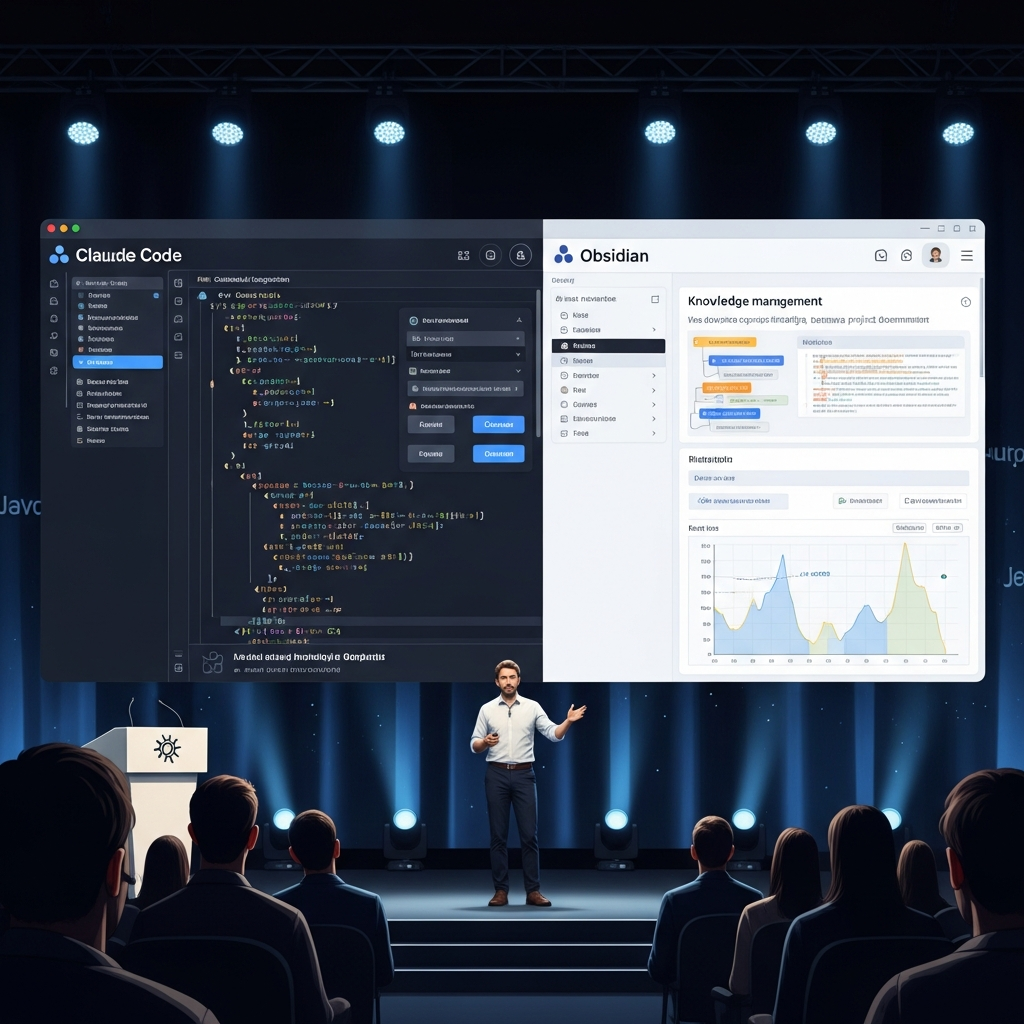
Andrej Karpathy has also introduced an innovative and cost-effective personal knowledge management system. This method leverages LLMs with markdown-based tools like Obsidian and Claude Code. Its goal is to transform unstructured data into structured, searchable wikis. This helps users map concept relationships and retrieve information efficiently. This system focuses on simplicity and persistence. It offers a viable alternative to complex traditional semantic search infrastructures. This is particularly true for small to medium-scale projects.
The core mechanism involves using LLMs to convert raw, unstructured data. This includes meeting notes, text files, or transcripts. The output is structured markdown files, creating a persistent, searchable repository. Key features include interconnected “indexes and links.” These map relationships between data points, facilitating seamless retrieval and analysis. Crucially, it offers “persistent knowledge” storage. The system retains and builds upon stored information, increasing its value over time. This differs from ephemeral AI chat interactions.
Setting up this LLM-powered wiki is straightforward. Users select Obsidian for visualizing markdown files and Claude Code for data processing. A central “vault” in Obsidian houses the data. Raw information is inputted. An LLM then processes this data into an organized wiki. This includes indexes, logs, and mapped conceptual relationships. The result is an easily searchable knowledge base that evolves with user needs, all without extensive technical infrastructure.
This approach offers several advantages. It is cost-effective, avoiding expensive embedding models or vector databases. Costs are mainly limited to LLM token usage. Its simplicity relies on markdown files and readily available tools. This ensures easy setup and maintenance. It offers adequate scalability for small to medium datasets, managing hundreds of pages. The “persistent knowledge” continuously compounds its utility.
However, limitations exist. It is not designed for massive datasets with millions of documents. It requires manual input and clear context during setup for optimal organization. Compared to traditional semantic search, it uses indexes and links to map deeper relationships. This makes it ideal for smaller-scale projects prioritizing simplicity and customization. Semantic search remains more scalable for very large datasets.
The Karpathy Loop: Automating Experimentation
Andrej Karpathy’s “AutoResearch” project demonstrates another powerful application of autonomous agents. A 630-line Python script showcased an agent’s ability to run 50 (or typically 80-100 overnight) machine learning experiments on a single GPU. It operated without human intervention, discovered a better learning rate, and committed its findings to Git. This highlights a generalizable design pattern: the “Karpathy Loop.” This loop mirrors traditional scientific experimental methodology.
The Karpathy Loop is built on three fundamental primitives:
- Editable Asset: A single, designated file (e.g.,
train.py) the agent can modify. This constraint keeps the search space interpretable. Every hypothesis can be reviewed as a clear Git diff. - Scalar Metric: A singular, objective numerical value. This unambiguously determines if a change is an improvement. It must be computable without human judgment. This prevents the agent from exploiting proxy metrics. For LLM pretraining, Karpathy chose
val_bpb(validation bits per byte). - Time-boxed Cycle: A fixed duration for each experiment. This ensures all runs are comparable in terms of compute cost and evaluation.
These three primitives, not the agent itself, make the loop broadly applicable. The fixed time budget allows fair comparison. The single editable file maintains a legible experiment journal via Git. The scalar metric removes ambiguity from optimization goals. A unique insight is the critical role of the program.md Markdown file. This document serves as the human-agent interface. It conveys instructions, constraints, and stopping criteria. Markdown blends human editability and narrative capability with sufficient structure for agents to parse human intent reliably.
Writing a precise, flexible program.md becomes a high-leverage skill. It’s akin to engineering work that produces prose. This document, effectively an inverted lab notebook, defines what should be done and why. It requires careful version control to avoid producing optimized noise. The Karpathy Loop is generalizable beyond ML. Examples include database query optimization, customer support ticket routing, agent optimization, and RAG pipeline tuning. The human role shifts from repetitive execution to high-level experimental design. Researchers define what is fixed, what varies, and what constitutes improvement, leveraging their domain knowledge.
Navigating the Future: Implications for Developers & Beyond
Andrej Karpathy’s insights paint a clear picture of a software engineering landscape undergoing a profound “phase shift.” The era of “vibe coding” is rapidly evolving into one where AI takes the primary coding role. This fundamentally alters developer workflows, skill requirements, and the very nature of software creation. Programming is transforming from grammar and algorithms to imagination and logic. The human role shifts from “construction workers” to “architects,” from “typists” to “creators.”
This transformation demands adaptation. Developers must embrace agentic tools and cultivate new skills. Strategic thinking, prompt engineering, and the ability to design high-level systems for AI to implement will be paramount. Focusing on a macroscopic vision, understanding product, design, and business context will define the successful engineers of tomorrow. While concerns about skill atrophy and low-quality AI output are valid, innovative solutions like “AI reviews AI” offer optimistic pathways forward. The methods Karpathy champions, from AI-driven coding to LLM-powered knowledge management and autonomous experimentation, provide tangible blueprints for navigating this evolving digital frontier.
Frequently Asked Questions
What is Andrej Karpathy’s “phase shift” in coding, and how does Claude Code enable it?
Andrej Karpathy’s “phase shift” describes a radical change in his personal coding workflow, transitioning from 80% manual coding to 80% AI-generated code within a single month (late 2025). This shift, which he calls “programming in English,” is primarily enabled by advanced AI coding agents like Anthropic’s Claude Code (specifically Opus 4.5). These models crossed a “threshold of coherence,” allowing them to understand human “intent” and autonomously implement complex code, functioning as full “engineers” rather than just code completion tools.
How can individuals or small teams implement a Karpathy-style knowledge management system using Obsidian and LLMs?
Implementing Karpathy’s knowledge management system involves combining large language models (LLMs) like Claude Code with markdown-based tools such as Obsidian. Users create a central “vault” in Obsidian to store raw, unstructured information. An LLM then processes this data, transforming it into structured markdown files complete with interconnected indexes and links. This creates a persistent, searchable wiki that maps conceptual relationships. The system is cost-effective, using LLM token usage as the primary cost, and provides a simple yet scalable solution for personal or small team knowledge organization.
What are the main benefits and challenges for software engineers embracing “Agentic Coding” with tools like Claude Code?
Embracing “Agentic Coding” with tools like Claude Code offers significant benefits, transforming engineers into “one-man armies” and redefining the “10x engineer” as a strategic generalist focused on high-level design. This leads to immense productivity gains by automating implementation details. However, it presents considerable challenges. Karpathy highlights “disuse atrophy,” where manual coding skills diminish from lack of practice. There’s also the risk of a “Slopacolypse,” an internet flooded with low-quality, AI-generated code. Addressing these requires new skills in prompt engineering, strategic oversight, and leveraging AI to review other AI-generated code for quality control.
Conclusion
The insights from Andrej Karpathy and his peers mark 2026 as a pivotal year for the software industry. We are witnessing an “evolution of the species” – from coding “handicraftsmen” to architects of intelligent systems. The integration of advanced AI like Claude Code into core development workflows, coupled with innovative knowledge management and autonomous experimentation methods, is not just an efficiency gain; it’s a fundamental redefinition of human-computer interaction. As AI takes on more complex tasks, our role shifts to higher-order creativity, strategic thinking, and system design. The future of software engineering is here, and it’s intelligent, agentic, and profoundly transformative.