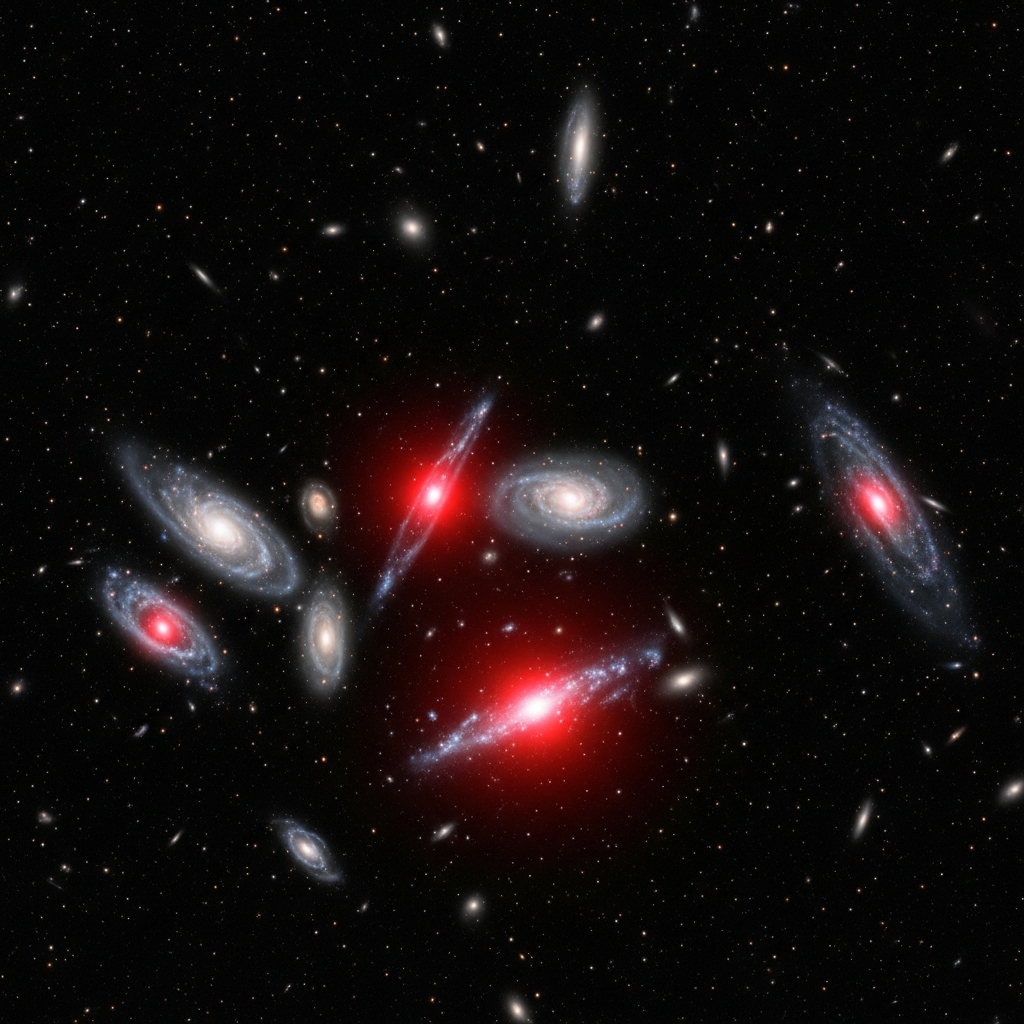
The cosmos is a tapestry of mysteries, and few recent discoveries have intrigued astronomers more than the enigmatic “little red dots” (LRDs) spotted by the James Webb Space Telescope (JWST). These distant, compact objects, first observed in 2022, seemed to permeate the early universe, defying easy explanation. Initially, scientists debated if they were active galactic nuclei (AGNs), ancient supermassive stars, or exotic black hole stars. Now, groundbreaking research suggests a compelling new answer: these little red dots might be a temporary, high-energy phase in the life cycle of growing black holes, driven by turbulent galactic interactions.
Unraveling the Cosmic Enigma of “Little Red Dots”
When the James Webb Space Telescope began delivering its unprecedented views of the early universe, the appearance of numerous “little red dots” sparked intense scientific debate. These objects appeared incredibly bright for their age and distance. Their redness comes from light stretched into the red spectrum by billions of years of cosmic expansion. Early theories struggled to fit these observations into existing models of galaxy formation and black hole growth.
Some astrophysicists, like Dr. Kirsten Banks, even suggested these were a “new class of galaxies that shouldn’t exist.” They appeared “too bright, too massive, too common” for the early universe, potentially harboring supermassive black holes growing at ridiculous speeds. Yet, a paradox remained: these seemingly powerful black holes weren’t emitting the expected X-rays, deepening the mystery. This suggested a fundamental misunderstanding of their nature.
The Stingray System: A Crucial Clue from the Early Universe
A recent study, published in Astronomy & Astrophysics, has offered a pivotal insight into these perplexing LRDs. Astronomers focused on a fascinating triple-galaxy system, affectionately nicknamed “The Stingray.” Dating back to when the universe was only about 1.1 billion years old, The Stingray provides a unique window into these formative cosmic processes. While its nickname came from its initial appearance, later analysis refined the view, revealing a complex interaction between three distinct galaxies.
The Stingray system comprises a massive, steadily evolving Balmer break galaxy, a smaller, less massive satellite star-forming galaxy, and a third object now identified as a “transitional little red dot” (tLRD). Studying this system allowed researchers to reconstruct the galaxies’ star formation histories. This helped them infer past interactions that could explain the unusual behavior of the tLRD. The powerful James Webb Space Telescope, with its deep survey capabilities, was essential for gathering this crucial data.
Decoding the “Transitional Little Red Dot” (tLRD)
Lead study author Rosa María Mérida, an astrophysicist at Saint Mary’s University, describes the tLRD as a galaxy caught in a unique cosmic phase. It possesses “all the necessary ingredients” to bridge the gap between typical active galactic nuclei and the mysterious little red dots. This includes active starbursts, a central AGN, and spectral features that closely match those observed in other LRDs.
The research suggests a specific sequence of events for the tLRD. About 100 million years before the observed epoch, the tLRD likely experienced a burst of star formation. This was probably triggered by a close encounter with the more massive Balmer break galaxy. Later, around 10 million years prior, the smaller satellite galaxy entered the system, further stirring the cosmic pot. While the larger Balmer break galaxy remained largely unaffected, the tLRD experienced significant activity. This indicated that simple gravitational interactions alone couldn’t explain its behavior.
Black Hole Behavior: The Heart of the Mystery
The key to understanding the tLRD, and perhaps all little red dots, lies in the behavior of its central black hole. Galaxy interactions often trigger bursts of star formation first. However, the activation of the central black hole, leading to an active galactic nucleus, can occur with a delay. This delayed fueling of the tLRD’s black hole, following earlier galactic encounters, might have pushed it into its peculiar, in-between state.
The tLRD exhibits spectral features characteristic of a Type I AGN, known for its bright, unobscured core. It is also compact and bright in ultraviolet light, partially resembling an LRD. However, it critically lacks a specific V-shaped spectral signature found in almost all other observed little red dots. This places the tLRD squarely “in between the little red dot population and compact Type I AGN,” as Mérida explained. It’s an object that is part AGN, part LRD, leaving astronomers to ponder if it’s evolving into or out of the LRD phase.
Shifting Theories: From Cosmic Monsters to “Baby Black Holes”
The understanding of these little red dots continues to evolve rapidly. Initial thoughts of them hosting impossibly massive black holes are being refined. Recent research, including findings highlighted by the University of Copenhagen, suggests that many “strange red dots” are actually young, rapidly growing black holes. These are surprisingly “a hundred times less massive than previously believed.” They are enshrouded in dense cocoons of gas, which they consume at incredible rates. The intense heat generated during this “messy eating” process gives them their distinctive red glow.
Further insights from Jenny Greene’s team at Princeton University revealed a critical detail: a distinct lack of evidence for dust emission in LRDs. This contradicted prior assumptions that dust caused their redness. By directly measuring a wide range of light frequencies, including X-rays and infrared, her team found LRDs were at least ten times dimmer than initially estimated. This revision suggests that the black holes within them are “much more modest,” leading some, like Rohan Naidu of MIT, to describe them as “baby black holes” or “black hole stars.” These “puffed-up black hole stars” emit most of their energy at visible wavelengths, rather than hiding it across other spectrums.
While these findings significantly alter our perception, Roberto Maiolino from the University of Cambridge cautions that light emissions primarily indicate a black hole’s growth rate rather than its total mass. This ongoing scientific discourse highlights the dynamic nature of astrophysical discovery.
The Larger Cosmic Context and Future Prospects
These discoveries by the James Webb Space Telescope are rewriting our understanding of the early universe. They offer crucial insights into how supermassive black holes, like the one at the center of our Milky Way, could have formed so rapidly after the Big Bang. The idea that little red dots represent a temporary, environment-controlled phase of black hole evolution rather than a distinct class of objects is gaining strong traction. [Explore more about black hole formation in the early universe.]
The duration of this transitional phase is critical. If it’s very short—less than about 5 million years—spotting such an object would be rare. However, if it lasts longer, astronomers anticipate finding many more “in-between” objects in current galaxy surveys. Future research will involve meticulously searching existing data for more candidates and improving theoretical models. These models need to predict how often these transitions occur and how to clearly identify them. A larger sample size and a better understanding of black hole active and quiet phases are essential for robust conclusions.
Frequently Asked Questions
What are James Webb’s “little red dots” and why are they mysterious?
The “little red dots” (LRDs) are compact, exceptionally bright objects observed by the James Webb Space Telescope in the early universe, about 1.1 billion years after the Big Bang. They are mysterious because their luminosity and prevalence challenged existing cosmological models, which couldn’t explain such massive or numerous structures so early in cosmic history. Initial theories ranged from active galactic nuclei (AGNs) and ancient supermassive stars to exotic black hole stars, but none fully fit all observations, particularly the unexpected lack of X-ray emissions from their powerful black holes.
How does the “Stingray” galaxy system help explain “little red dots”?
The “Stingray” is a triple-galaxy system observed by JWST that contains a “transitional little red dot” (tLRD). By studying its star formation history and galactic interactions, astronomers found evidence that gravitational encounters between galaxies could trigger starbursts and subsequently fuel the central black hole in the tLRD. This suggests that little red dots might not be a distinct class of objects, but rather a temporary, high-energy evolutionary phase in the life of a galaxy’s black hole, profoundly influenced by its immediate galactic environment.
How do astronomers differentiate between a “little red dot” and a typical active galactic nucleus?
Astronomers differentiate through specific spectral features and light emissions. A typical active galactic nucleus (AGN) might show a clear “V-shaped” spectral signature in its light spectrum. The tLRD in The Stingray system, while exhibiting Type I AGN characteristics (bright, unobscured core) and being compact and bright in ultraviolet light, notably lacks this key V-shaped spectral signature. Furthermore, new research suggests many LRDs are significantly dimmer than previously thought and show a lack of dust emission, emitting most of their energy at visible wavelengths, unlike many AGNs where visible light is only a fraction of their total energy output.
Conclusion
The James Webb Space Telescope continues to push the boundaries of our cosmic understanding. The journey to decipher the “little red dots” is a prime example of scientific discovery in action. What began as an unexplained anomaly in the distant universe is now increasingly understood as a dynamic, temporary phase in the dramatic evolution of galaxies and their central black holes. As astronomers continue to explore these transitional objects, we move closer to completing the epic story of how the universe’s earliest structures formed and grew, revealing a cosmos far more violent and dynamic than previously imagined.