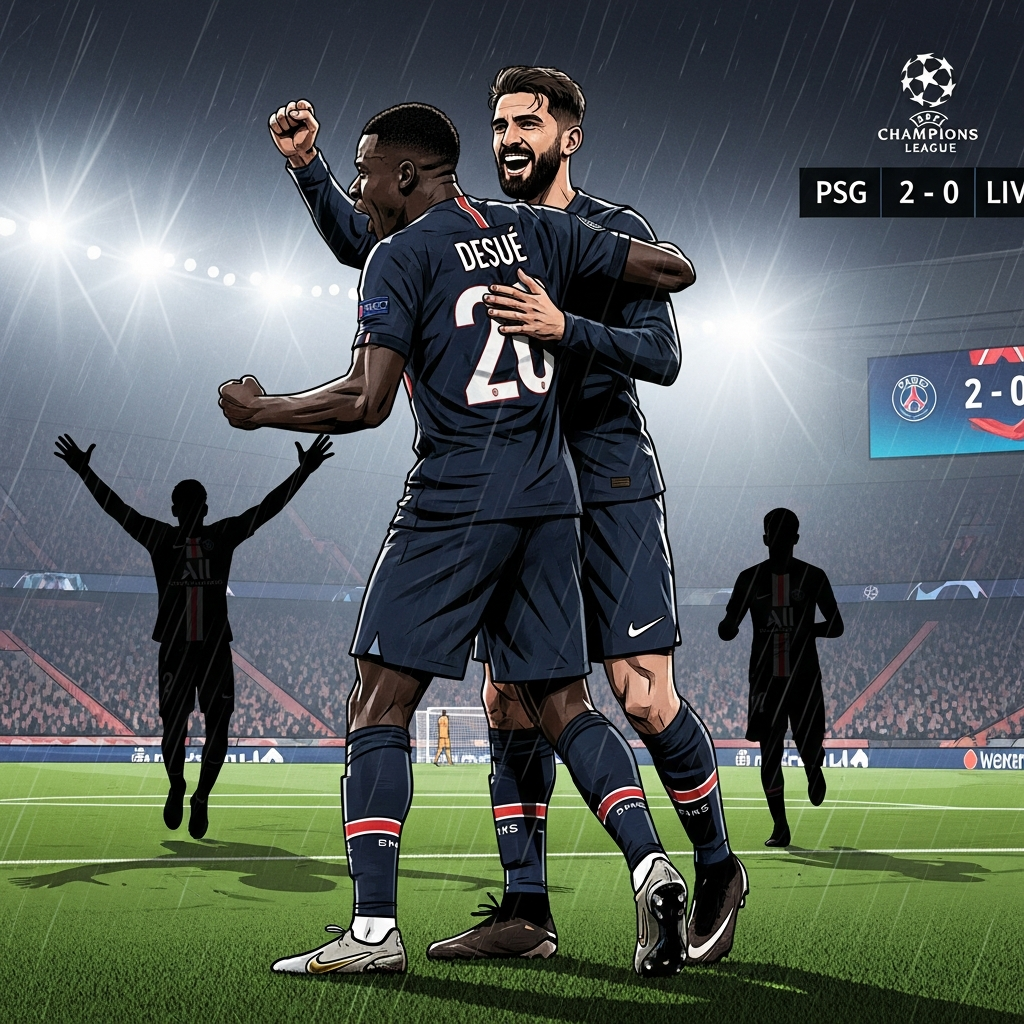
Paris Saint-Germain delivered a commanding performance at the Parc des Princes, securing a decisive 2-0 first-leg advantage over Liverpool in their UEFA Champions League quarter-final clash. Goals from the electrifying Désiré Doué and the prolific Khvicha Kvaratskhelia established a significant lead for the European champions. This outcome leaves Liverpool facing an immense challenge, as they look to overturn the deficit in the crucial second leg at Anfield.
The match served as a stark demonstration of PSG’s fluid, attacking prowess, contrasted by a Liverpool side that struggled to establish any meaningful rhythm. While the scoreline reflects a tough night for the Reds, manager Arne Slot will find limited solace knowing it could have been worse, thanks to some wayward finishing from the hosts and several crucial saves by Liverpool goalkeeper Giorgi Mamardashvili.
Early Dominance: PSG’s Attacking Masterclass
From the opening whistle, Paris Saint-Germain asserted their dominance, quickly dictating the tempo and controlling possession. Their “on-pitch football purist” approach effectively dismantled Liverpool’s “Premier League pragmatism,” as described by analysts. The statistics paint a clear picture of PSG’s superiority: an Expected Goals (xG) tally of 2.35 compared to Liverpool’s meager 0.17. PSG maintained a staggering 74% possession, unleashed 18 shots to Liverpool’s 3, and registered 6 shots on target while the Reds failed to hit the target even once.
PSG wasted no time in capitalizing on their early pressure. Just 11 minutes into the game, Ousmane Dembélé, whose creativity generated five chances throughout the match, initiated the move. He drove through the heart of Liverpool’s defense, flicking the ball to Désiré Doué. The 20-year-old winger, showcasing his blistering form, feinted left before checking back onto his right. His shot deflected off Ryan Gravenberch, looping over Mamardashvili and into the net. Doué’s goal, while fortunate in its deflection, underscored PSG’s relentless attacking intent.
Liverpool, lining up with an unfamiliar three-at-the-back formation, appeared unable to cope with PSG’s rotations and relentless movement. This tactical switch notably saw Mohamed Salah relegated to the substitutes’ bench for the entire game, a decision that raised eyebrows given Liverpool’s need for attacking impetus.
Kvaratskhelia’s Brilliance Seals the Deal
Despite some improvements from Liverpool as the first half progressed, PSG continued to pose a significant threat. Mamardashvili was called into action multiple times, making saves from both Doué and Dembélé after intricate build-up play. The pattern of PSG dominance resumed after the break. Liverpool’s players worked tirelessly to chase down a frequently mesmerizing PSG side, often being pulled out of position by their intricate passing and fluid rotations.
Dembele squandered another excellent opportunity, firing over the bar. However, just when it seemed PSG might regret their missed chances, they doubled their lead in the 65th minute. João Neves, a key orchestrator in midfield, delivered a sharp pass into the path of Khvicha Kvaratskhelia. The Georgian winger, who had an xG of 1.18 and took seven shots, displayed incredible composure. He stayed on his feet despite a challenge from Gravenberch, then scuttled past Mamardashvili before calmly slotting the ball into the net. Kvaratskhelia’s goal was a masterclass in dribbling and clinical finishing, a “slalom run” that highlighted his exceptional talent.
PSG’s control could have translated into an even wider margin. A penalty awarded to the hosts for a foul on Warren Zaire-Emery by Ibrahima Konaté was overturned after a VAR review. Later, Dembélé smashed a shot against the post following a rapid counter-attack, underscoring Liverpool’s precarious position throughout the match.
Slot’s Tactical Conundrum and Liverpool’s Struggles
Manager Arne Slot’s decision to deploy a three-at-the-back formation was a significant talking point. This novel approach for Slot’s tenure was reportedly aimed at shoring up a “leaky defence” against the “free-scoring” European champions, also influenced by injuries and Salah’s inconsistent form. While Liverpool showed moments of promise, particularly in the first half where they pressed well and stifled PSG’s deep build-up, they ultimately succumbed to the pressure.
The individual brilliance of PSG’s wide players proved to be Liverpool’s undoing. Doué and Kvaratskhelia, supported by overlapping full-backs Achraf Hakimi and Nuno Mendes, were superb. Both wingers are lauded as “dribblers and entertainers” possessing a “killer instinct,” consistently creating havoc for Liverpool’s defense. Vitinha, the PSG midfielder, was a passing maestro, completing 133 out of 139 passes (95.68% accuracy) and dictating the tempo with 147 touches.
Liverpool’s attacking output was alarmingly low. They failed to register a single shot on target throughout the entire match, a statistic that underscores their struggles. Striker Hugo Ekitike, returning to Paris, had a particularly anonymous outing, with an xG of only 0.02, just one shot, and a single touch in the penalty area, coupled with a high turnover rate. Key midfielders like Dominik Szoboszlai also struggled with turnovers, and Alexis Mac Allister, despite making six tackles, couldn’t stem the flow of PSG’s attacks.
Manager’s Perspective and Second Leg Outlook
Arne Slot candidly admitted that Liverpool was in “survival mode” for significant periods of the game, suggesting this might even reflect their season thus far. He defended his tactical choices, arguing that few teams manage to contain PSG at home. “Have you ever seen a team play tactics over here that didn’t allow PSG to have chance after chance after chance?” Slot questioned. He also explained his decision not to introduce Mohamed Salah, stating it was “more about surviving than thinking we could score” in the latter stages, opting to conserve Salah’s energy.
Looking ahead, Slot hinted at a completely different strategy for the return leg. “It’s clear and obvious we won’t play the same tactics as tonight,” he confirmed. Liverpool now faces an “almighty challenge” at Anfield on April 14, but a comeback is still within reach, albeit requiring a “superhuman effort.”
Anfield Challenge: The Path to a Champions League Comeback
Liverpool’s storied history of famous European comebacks means this tie is far from over. However, reversing a 2-0 deficit against a team of PSG’s caliber demands a monumental effort and a significant shift in performance.
For Liverpool to have any chance of progressing in the Champions League, several critical adjustments are required:
Raise Intensity from the Start: The Reds must press PSG high from the first whistle, leveraging the vociferous Anfield crowd to create an intimidating atmosphere.
Quicker Transitions and Aggressive Counter-Pressing: Disrupting PSG’s rhythm and limiting their time on the ball will be crucial. This involves winning possession back quickly and launching incisive counter-attacks.
Adventurous Full-Back Play: If a similar system is deployed, full-backs like Jeremie Frimpong and Milos Kerkez must push forward, stretching the pitch and providing attacking width that was largely absent in Paris. The shackles must come off on home soil.
Create and Convert Chances: Incredibly, Liverpool failed to register a single shot on target in the first half of the first leg, and barely improved after the break. This must change drastically. The reintroduction of Mohamed Salah is expected to be vital in this regard, offering the clinical edge and creative spark Liverpool desperately needs.
Despite being outpassed and outplayed for long stretches at the Parc des Princes, Liverpool demonstrated glimpses of being compact and well-organized. Yet, as has often been the case this season, costly lapses in concentration proved decisive. Mamardashvili’s three brilliant saves highlight his importance, and he will undoubtedly be needed again. With discipline, unwavering belief, and relentless pressure, Liverpool has a fighting chance to turn this tie around. It promises to be a captivating encounter as Liverpool’s Champions League hopes hang in the balance.
Frequently Asked Questions
What were the key tactical decisions in PSG’s 2-0 victory over Liverpool?
Liverpool manager Arne Slot opted for an unusual three-at-the-back formation, reportedly to add defensive protection against PSG’s formidable attack. This tactical switch notably led to Mohamed Salah being benched for the entire match. However, PSG’s fluid attacking system, particularly the brilliance of wide players Désiré Doué and Khvicha Kvaratskhelia, effectively exploited Liverpool’s defense, resulting in a dominant performance characterized by high possession and numerous scoring opportunities.
Where does Liverpool’s manager Arne Slot believe the team stands after the first leg?
Arne Slot admitted Liverpool was in “survival mode” for significant periods of the game, acknowledging the difficulty of containing PSG at the Parc des Princes. He defended his tactical choices by arguing that most teams struggle to prevent PSG from creating chances at home. Slot also indicated that Liverpool “won’t play the same tactics” in the second leg at Anfield, suggesting a more aggressive approach is planned for the crucial return fixture.
What must Liverpool do to achieve a Champions League comeback at Anfield?
To overcome the 2-0 deficit, Liverpool needs a “superhuman effort” at Anfield. This involves significantly raising their intensity from the first minute, pressing PSG high, and leveraging the home crowd’s energy. Crucially, they must prioritize quicker transitions, aggressive counter-pressing to disrupt PSG’s rhythm, and ensure their full-backs push forward to stretch the pitch. Most importantly, Liverpool must create and convert chances, an area where they notably struggled in the first leg, failing to register a single shot on target in the first half. The anticipated return of Mohamed Salah will be vital for providing attacking impetus.