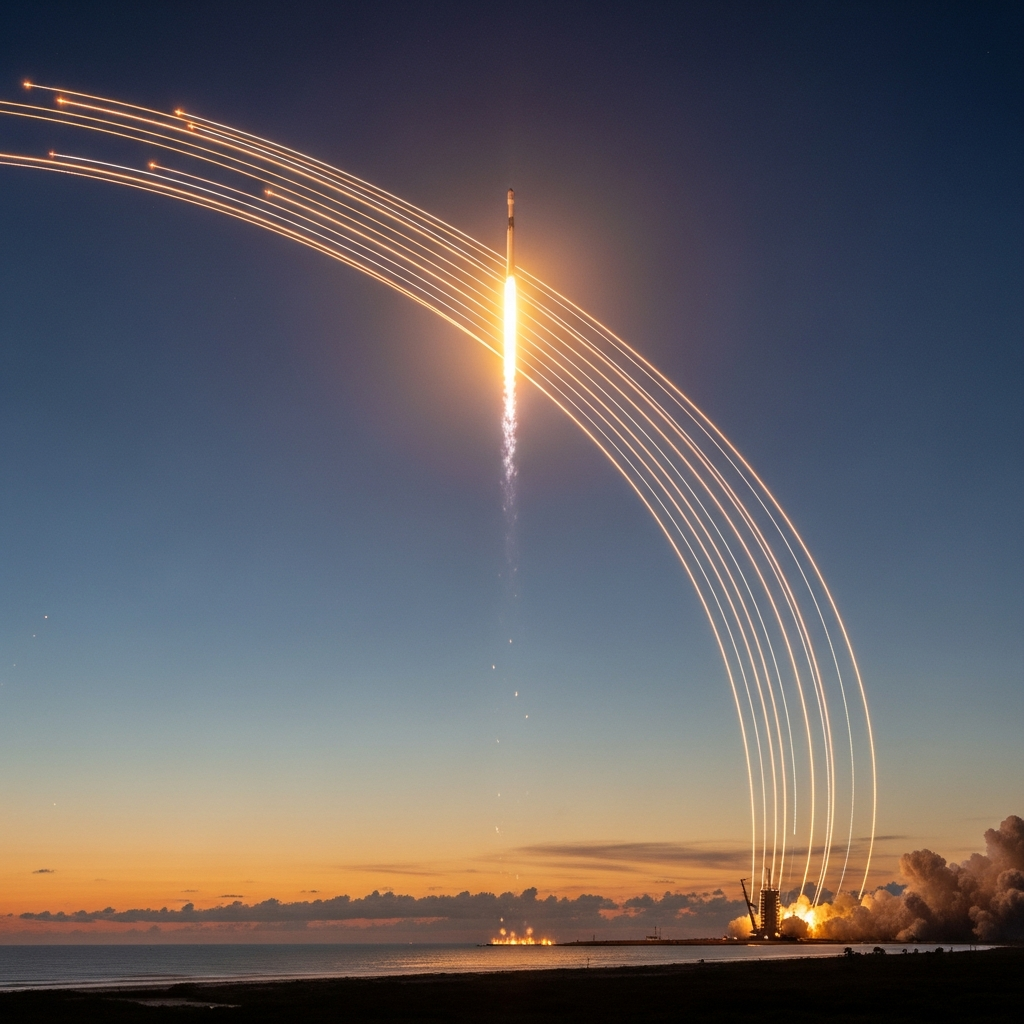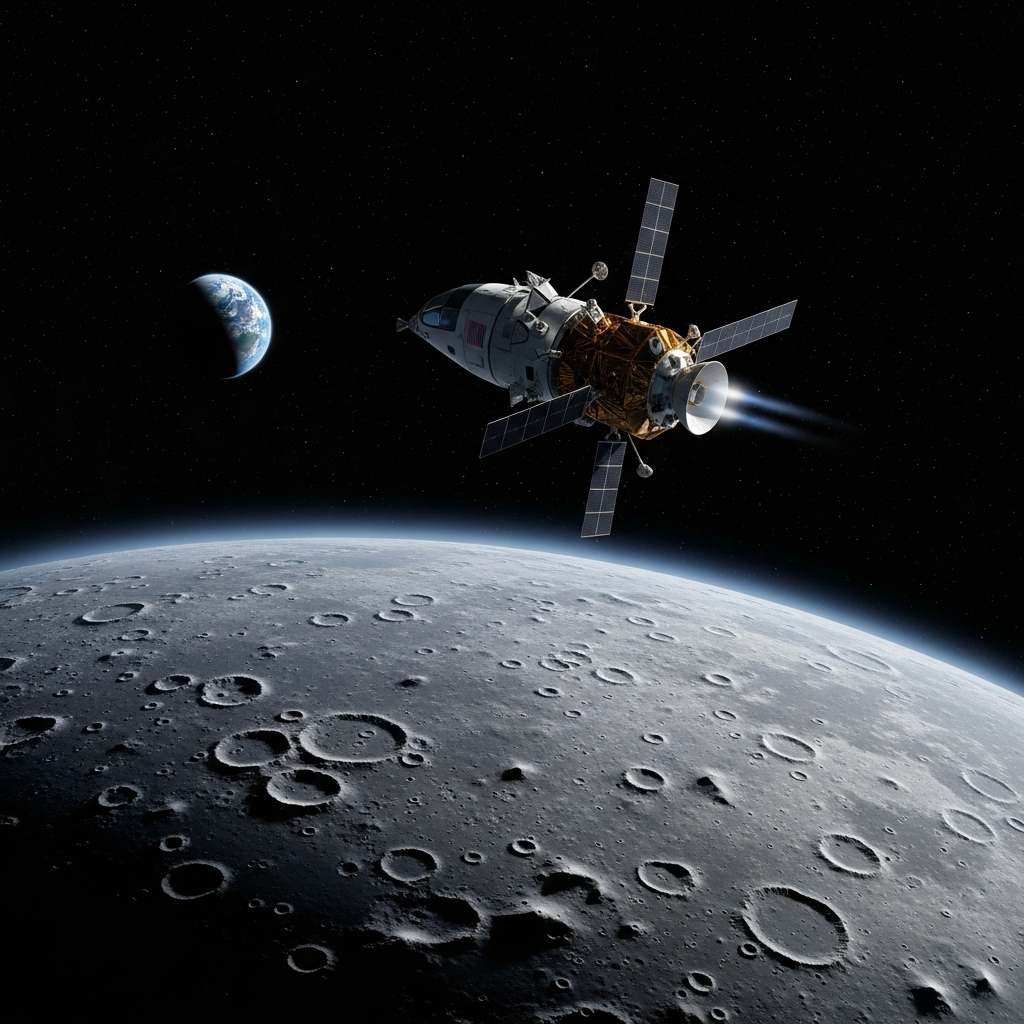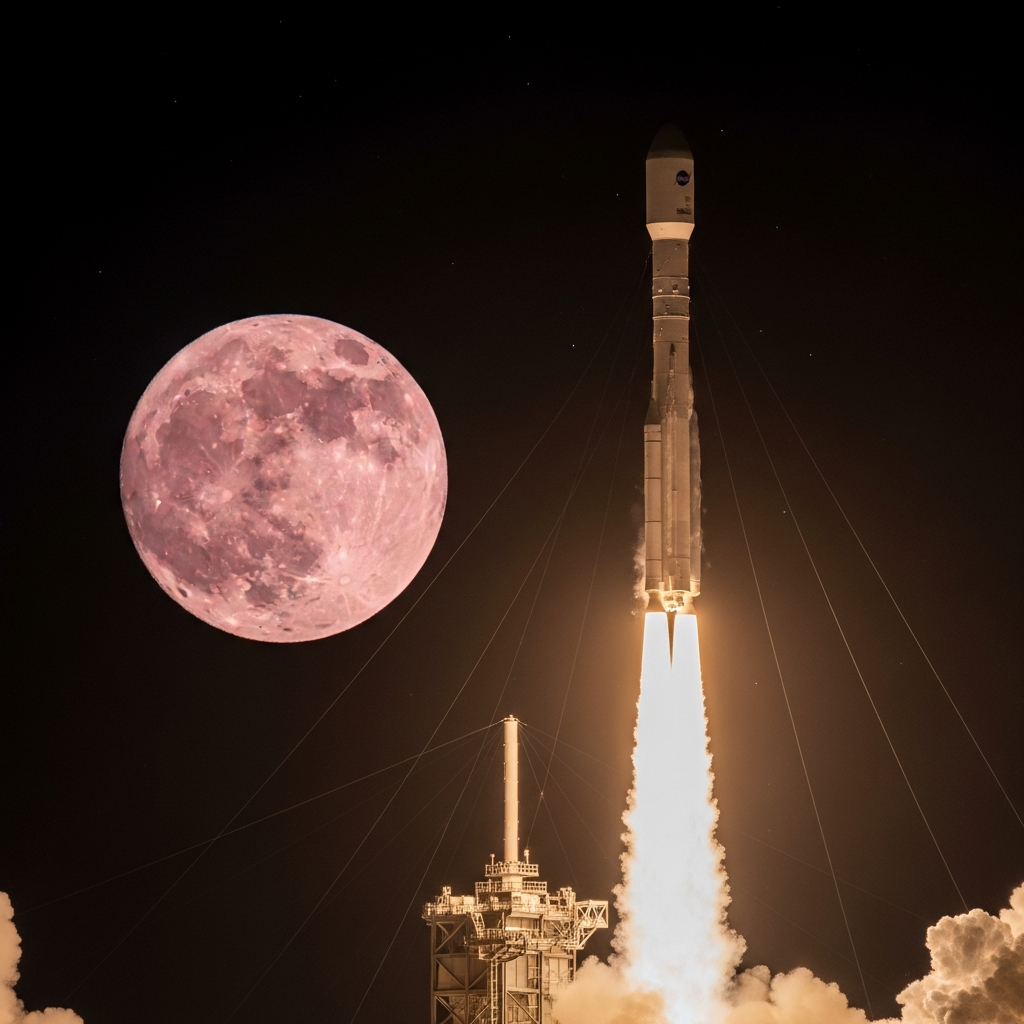
Get ready for an extraordinary week in space and sky as NASA’s highly anticipated Artemis II mission prepares for its historic journey to the Moon, coinciding with the celestial spectacle of April’s “Pink Moon.” This confluence of human ambition and natural beauty marks a pivotal moment for space exploration and astronomy enthusiasts alike. Slated for launch on Wednesday, April 1, 2026, the Artemis II mission represents humanity’s first crewed voyage to the lunar vicinity in over five decades. Simultaneously, the Pink Moon graces our night sky, offering a stunning visual treat and holding deep cultural significance.
This guide will provide a comprehensive look at both events, offering insights into the mission’s ambitious goals, the dedicated crew, and practical tips for observing the full moon. Prepare to dive into the details of a truly historic period, where the future of space exploration meets ancient lunar traditions.
Artemis II: Humanity’s Return to the Moon
The countdown has officially begun for NASA’s Artemis II test flight, a critical step towards establishing a sustainable human presence on the Moon and eventually sending astronauts to Mars. This monumental mission is the inaugural crewed launch of NASA’s powerful Space Launch System (SLS) rocket and the advanced Orion spacecraft. The launch team gathered at the Rocco Petrone Launch Control Center at NASA’s Kennedy Space Center in Florida, initiating the 49-hour, 40-minute countdown at 4:44 p.m. ET.
The targeted liftoff for Artemis II is set for Wednesday, April 1, at 6:24 p.m. ET. This 10-day journey is designed to push the boundaries of the Orion spacecraft’s life-support systems and validate essential technologies for future deep space endeavors. NASA officials express “complete confidence” in the dedicated team, the immense rocket, and the Orion spacecraft, aptly named Integrity, which has received final clearance from the Mission Management Team.
The Historic Crew and Mission Phases
A diverse and historic four-person crew will embark on this landmark Artemis II mission. Leading the charge is Commander Reid Wiseman, alongside Pilot Victor Glover, and Mission Specialist Christina Hammock Koch. They are joined by Mission Specialist Jeremy Hansen from the Canadian Space Agency (CSA). This crew makes history, including the first woman, the first person of color, and the first Canadian to venture on a lunar mission. Prior to launch, they have undergone final health checks, maintained a controlled sleep and nutrition plan, and spent time with family before entering final pre-launch quarantine at Kennedy Space Center.
The mission profile for Artemis II is divided into four distinct and critical phases:
- High Earth Orbit Check-out: The first 24 hours will be spent in high Earth orbit. Here, the crew will rigorously ensure Orion’s life-support systems, including potable water and carbon dioxide scrubbing, function flawlessly. Pilot Victor Glover will also conduct a crucial Proximity Operations demonstration, manually flying Orion near the spent upper stage. This practice is vital for future docking maneuvers with the Gateway space station or SpaceX Starship.
- Trans-Lunar Injection (TLI): After thorough systems verification, the crew will fire the engine one final time. This powerful burn will break Orion free of Earth’s gravity, setting it on a free-return trajectory around the Moon. This clever orbital mechanic ensures that even if engine failures occur after this burn, the Moon’s gravity will naturally guide the capsule back toward Earth for a safe splashdown.
- Farthest Human Travel in History: On Flight Day 6, the crew will reach the Moon, performing a high-altitude flyby approximately 4,600 miles beyond the lunar far side. This remarkable feat will likely break the record for the farthest humans have ever traveled from Earth, surpassing the Apollo 13 crew’s record from 1970. From this incredible vantage point, they will observe the entire lunar disk and Earthrise, collecting invaluable data on deep-space radiation.
- High-Speed Homecoming: Orion will then spend about four days accelerating back to Earth, reaching speeds of up to 25,000 mph. The mission concludes with a sophisticated “skip reentry,” where the capsule bounces off the atmosphere to dissipate heat. This is followed by the precise deployment of 11 parachutes for a targeted splashdown in the Pacific Ocean. The mission will only be declared a success after the U.S. Navy recovers the crew.
Pre-Launch Preparations and Weather Outlook
On the ground, engineers and launch teams are engaged in round-the-clock pre-launch activities. These include powering up flight hardware, meticulously checking all communication links, and preparing the rocket’s cryogenic systems. This preparation is crucial for the precise fueling sequence, which involves loading hundreds of thousands of gallons of super-cooled liquid hydrogen and liquid oxygen into the SLS rocket. Concurrently, at Launch Pad 39B, teams are filling the sound suppression system’s massive tank with water. This system is designed to unleash a protective deluge at liftoff, shielding the vehicle from the immense sound and vibrations generated by its engines.
Weather conditions are a primary concern, though the latest forecast from the U.S. Space Force’s 45th Weather Squadron shows an encouraging 80% chance of favorable weather for liftoff. The main risks remain the Cumulus Cloud Rule and gusty ground winds, posing a 20% chance of a scrub. Forecasters are closely monitoring a stalled front, onshore flow, and sea breezes that could trigger intermittent showers. Expected launch window conditions include a high of 75 degrees Fahrenheit, 75% humidity, and east-southeast winds of 15-20 knots. NASA adheres to strict “Go/No-Go” weather rules for crew safety and hardware integrity, covering conditions like lightning, temperature, thick clouds, and wind shear. Space weather is also under scrutiny, though a recent solar flare did not affect critical ground systems.
The Florida Space Coast Renaissance
The Artemis program has ignited an unprecedented “renaissance” along Florida’s Space Coast. This region, encompassing cities like Cape Canaveral and Titusville, is buzzing with an excitement reminiscent of the Apollo era. The revitalization marks a dramatic turnaround for an area that faced severe economic decline after the Space Shuttle program concluded in 2011.
The economic impact is substantial. Space Florida, a state-private aerospace partnership, reported a staggering $6 billion boost to the economy last year, with other estimates pointing to 13,000 new jobs and an additional $3 billion in annual spending attributable to Artemis. Private space partners like Elon Musk’s SpaceX and Jeff Bezos’s Blue Origin have established or are constructing extensive facilities, employing thousands. Retired NASA astronaut Don Thomas describes the once “no man’s land” Beachline Expressway as now “filled with heavy traffic.” New apartments, schools, and shopping centers are being built across Titusville, Melbourne, and Viera. The renewed pride is palpable; hotel marquees proclaim “Go Artemis II astronauts!”, NASA logo T-shirts are ubiquitous, and local businesses are thriving. Officials anticipate hundreds of thousands of spectators will pack local beaches and causeways on launch day, eager to witness this historic event.
The Pink Moon: April’s Celestial Spectacle
While humanity reaches for the stars, our nearest celestial neighbor offers its own display: the April 2026 “Pink Moon.” This full moon officially reaches its full phase on Wednesday, April 1, 2026, at 10:13 p.m. EDT (7:13 p.m. PDT). Despite its enchanting name, the moon is unlikely to appear pink. Its nomenclature, like many traditional full moon names, comes from the pink phlox wildflowers that bloom extensively in North America around this time of year.
When observed low on the horizon during dusk, particularly the “blue hour,” the moon is more likely to appear orange or reddish. This is because sunlight reflected by the moon travels through a denser part of Earth’s atmosphere. The atmospheric density scatters blue and violet light, allowing only the redder hues to reach our eyes.
Optimal Viewing and Cultural Significance
For optimal viewing of the Pink Moon, observers are advised to seek an elevated location, an open field, or an east-facing coastline offering an unobstructed view of the eastern horizon. For example, in New York, moonrise is expected around 7:15 p.m. EDT, while in Los Angeles, the precise moment of full moon (7:13 p.m. PDT) will coincide exactly with both sunset and moonrise on April 1. In the UK, peak visibility is at 03:12 BST on Thursday, April 2nd, with best chances for clear skies in Scotland and Northern Ireland due to a cold front moving south.
Beyond its visual appeal, the April full moon holds significant cultural importance. It is known as the Paschal Moon in Western Christian tradition. Easter Sunday is always observed on the Sunday following the first full moon after the spring equinox. With the spring equinox on March 20th (fixed as March 21st by the church), and the Pink Moon on April 2nd being the first full moon after this date, Easter Sunday in 2026 will fall on April 5th. For the Jewish calendar, Passover commences halfway through Nisan, the first month, coinciding with this April full moon. Other traditional names reflect the arrival of spring, such as the “Sprouting Grass Moon,” “Egg Moon,” and “Full Fish Moon.”
Beyond the Pink Moon: Other Lunar Events in 2026
The year 2026 is unique for lunar observers, featuring 13 full moons – a phenomenon occurring because a solar year is slightly longer than a lunar year. The Pink Moon is the fourth of these. On April 2nd, the day after the full moon, the moon will appear less than two degrees from Spica, the 16th brightest star in the night sky. To find Spica, locate the Big Dipper in the northeast, trace its handle to “Arc to Arcturus,” and then “speed on to Spica,” which will appear just below the moon.
Other significant lunar events in 2026 include a “blood moon” total lunar eclipse in March, a “blue moon” (a second full moon in a single calendar month) in May, and “supermoons” in November and December, with the latter occurring on Christmas Eve. May 2026 will specifically see the “Flower Moon” on May 1, followed by a “Blue Moon” on May 31. This truly makes 2026 a stellar year for moon gazers.
Frequently Asked Questions
What is the Artemis II mission and when is it launching?
The Artemis II mission is NASA’s first crewed test flight to the vicinity of the Moon in over 50 years, marking a crucial step towards future lunar and Mars exploration. It will test the Space Launch System (SLS) rocket and Orion spacecraft with a four-person crew. The mission is targeting a launch on Wednesday, April 1, 2026, at 6:24 p.m. ET from Kennedy Space Center in Florida, with the countdown having already commenced.
How can I best view the April “Pink Moon” in 2026?
The April 2026 “Pink Moon” officially reaches its full phase on Wednesday, April 1, at 10:13 p.m. EDT (7:13 p.m. PDT). For optimal viewing, find an elevated location or an unobstructed east-facing horizon shortly after sunset. While it’s named the “Pink Moon,” it will likely appear orange or reddish when low in the sky due to atmospheric scattering. Check local moonrise times for your specific area to catch it rising during the “blue hour.”
What is the economic impact of the Artemis program on the Florida Space Coast?
The Artemis program has sparked an economic “renaissance” on Florida’s Space Coast. Following a significant downturn after the Space Shuttle program’s end in 2011, Artemis has revitalized the region. It has contributed an estimated $6 billion boost to the economy, created approximately 13,000 new jobs, and generated an additional $3 billion in annual spending. This growth is evidenced by increased traffic, new construction, and thriving local businesses, making the region a global hub for space exploration.
A Week to Remember
The convergence of the Artemis II launch and the April Pink Moon signifies a truly remarkable period. From the ambitious scientific and engineering feats of sending humans back to the Moon to the timeless beauty and cultural resonance of a full moon, this week encapsulates humanity’s enduring fascination with the cosmos. Whether you’re tracking the rocket’s journey, looking for the Pink Moon in the night sky, or considering the profound impact of space exploration on our society, these events offer a powerful reminder of what is possible when we look beyond our planet. Tune in to NASA’s coverage and step outside to witness the magic yourself – it’s a week that promises to inspire.