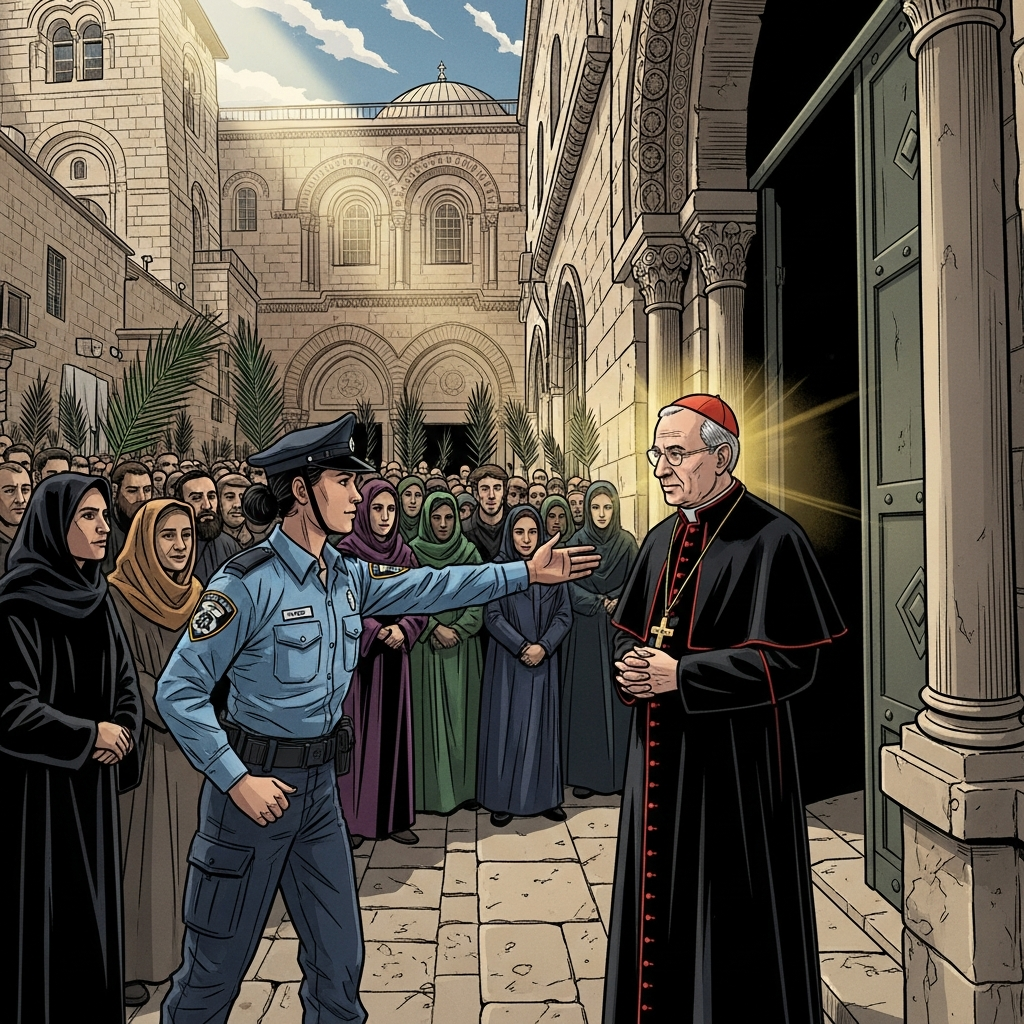
An unprecedented diplomatic and religious incident unfolded in Jerusalem on Palm Sunday, sparking international condemnation before a swift reversal by Israeli authorities. Cardinal Pierbattista Pizzaballa, the Latin Patriarch of Jerusalem and head of the Catholic Church in the Holy Land, was initially prevented by Israeli police from entering the revered Church of the Holy Sepulchre to celebrate mass. This startling blockade, occurring at Christianity’s holiest site during the onset of Holy Week, quickly drew widespread criticism from global leaders and religious authorities alike, highlighting the delicate balance between security concerns and fundamental religious freedoms in the ancient city.
The Unprecedented Palm Sunday Incident in Jerusalem
Palm Sunday marks Jesus Christ’s triumphant entry into Jerusalem, a day of profound significance for Christians worldwide. In 2026, this sacred observance was marred by an unexpected confrontation at the very heart of Christian worship.
A Sacred Site, a Critical Moment
The Church of the Holy Sepulchre is believed to be the site of Jesus Christ’s crucifixion, burial, and resurrection, making it the focal point of Holy Week celebrations. On Palm Sunday, March 29, 2026, Cardinal Pierbattista Pizzaballa, accompanied by Reverend Francesco Ielpo, the official guardian of the Church, attempted to enter the hallowed grounds. Their intention was to conduct a “brief and small private ceremony,” not a public procession, which had already been canceled due to existing restrictions. This intimate gathering was meant to mark the solemn beginning of Holy Week.
The Initial Blockade and Church’s Response
Despite their private intentions, Israeli police stopped Cardinal Pizzaballa and Reverend Ielpo outside the church. This action, according to the Latin Patriarchate of Jerusalem, marked a historic and alarming first. It was “the first time in centuries” that a Latin Patriarch had been turned away from the Holy Sepulchre on Palm Sunday. The Patriarchate quickly condemned the incident as a “grave precedent,” emphasizing its disregard for the “sensibilities of billions of people around the world” who look to Jerusalem during this sacred period. They described the decision as “hasty and fundamentally flawed,” an “extreme departure from basic principles of reasonableness, freedom of worship, and respect for the status quo” – the long-standing international agreements governing holy sites. Church officials reiterated their full cooperation with all security measures since the conflict began, stressing that this particular denial was “manifestly unreasonable and grossly disproportionate.”
Behind the Security Curtain: Israel’s Justification
The Israeli government, through Prime Minister Benjamin Netanyahu’s office and the police, offered security concerns as the primary reason for the initial refusal of entry. These concerns were directly linked to heightened regional tensions.
Regional Tensions and Missile Threats
Prime Minister Netanyahu initially cited “special” safety concerns stemming from recent Iranian attacks. He stated that Christian, Jewish, and Muslim holy sites in Jerusalem’s Old City had been “repeatedly targeted” by Iranian missile strikes in recent days. Disturbingly, missile fragments from one strike had reportedly landed “meters from the Church of the Holy Sepulchre.” Israeli police confirmed that all holy sites in the Old City had been closed to worshippers for security reasons since the “US-Israel war against Iran” began on February 28. This broad closure, they explained, extended to the patriarchate’s request for a Palm Sunday exemption, made due to the general security situation.
Navigating Old City Security Challenges
Police officials elaborated on the inherent complexities of securing Jerusalem’s Old City. They highlighted the difficulty for large emergency and rescue vehicles to access the narrow, ancient streets, posing a “real risk to human life in the event of a mass-casualty incident.” Netanyahu’s office explicitly stated that the police action was “out of special concern for his safety,” assuring that there was “no malicious intent whatsoever” behind the decision. These explanations aimed to frame the incident purely as a necessary security measure in a volatile environment, rather than an intentional infringement on religious practice.
Global Outcry and Diplomatic Pressure
The initial blocking of the Latin Patriarch provoked a rapid and powerful wave of international condemnation, underscoring the global importance of Jerusalem’s religious freedoms and the fragile political dynamics surrounding its holy sites.
International Leaders Condemn Restrictions
The incident triggered sharp reactions from world leaders. US Ambassador to Israel, Mike Huckabee, openly expressed that the blocking was an “unfortunate overreach” and “difficult to understand or justify,” especially given that the clergymen sought private entry, not a large procession. He noted that existing guidelines restricted gatherings to over 50 people, a limit far exceeding the small group involved. Italian Prime Minister Giorgia Meloni deemed the move “an offence not only against believers but against every community that recognises religious freedom,” leading Italy’s Foreign Minister Antonio Tajani to summon Israel’s ambassador for an explanation. French President Emmanuel Macron condemned the decision, placing it within a “worrying increase in violations of the status of the Holy Places in Jerusalem.” The European Union’s top diplomat, Kaja Kallas, denounced the incident as a “violation of religious freedom,” asserting that “Freedom of worship in Jerusalem must be fully guaranteed.” Even Pope Leo XIV, speaking in Rome, paid tribute to “the Christians of the Middle East, who suffer the consequences of a terrible conflict.”
Upholding Religious Freedom and the Status Quo
The widespread criticism centered on the perceived violation of religious freedom and, crucially, the “Status Quo.” This unwritten but deeply respected agreement governs access and administration of various holy sites in Jerusalem, maintaining a delicate balance among different religious communities. Leaders like French President Macron emphasized the necessity of ensuring “freedom to hold religious rites in Jerusalem for all religions.” The incident thus quickly escalated beyond a simple security measure, becoming a significant diplomatic challenge that pressured Israel to reaffirm its commitment to these fundamental principles.
Swift Resolution: Access Granted
Facing a torrent of international criticism and a potential diplomatic crisis, the Israeli government moved quickly to rectify the situation later on Palm Sunday.
Netanyahu’s Intervention and Herzog’s Apology
Late on Sunday night, Prime Minister Benjamin Netanyahu announced a decisive reversal. He instructed relevant authorities to grant Cardinal Pizzaballa “full and immediate access” to the Church of the Holy Sepulchre, allowing him to “hold services as he wishes.” This swift intervention aimed to de-escalate the religious and diplomatic tensions that had erupted throughout the day. Complementing this, Israeli President Isaac Herzog contacted Cardinal Pizzaballa directly. Herzog expressed his “great sorrow” over the “unfortunate incident,” reaffirming Israel’s “unwavering commitment to freedom of religion for all faiths and to upholding the status quo at the holy sites of Jerusalem.”
Reaffirming Commitments to Holy Site Access
The quick resolution, while welcomed, highlighted the ongoing complexities of managing religious freedoms within a highly sensitive security environment. US Ambassador Huckabee applauded the Israeli government’s efforts to address the situation and facilitate other Holy Week activities. The incident ultimately served as a stark reminder of the global scrutiny on Jerusalem and the profound importance placed on ensuring unrestricted access to its sacred sites for all faiths, particularly during their most holy days. The episode underscored the international community’s expectation that Israel balance its legitimate security concerns with its responsibilities to protect religious freedoms and adhere to the established Status Quo.
The Broader Implications for Holy Week and Beyond
The Palm Sunday incident, though quickly resolved, carried significant implications for Holy Week observances and the broader interfaith dynamics in Jerusalem.
Protecting the Multi-Religious Character of Jerusalem
Jerusalem is a city sacred to billions across Christianity, Judaism, and Islam. Incidents like the Palm Sunday blockade inevitably raise concerns about the city’s multi-religious character and the potential for actions, even those based on security, to be perceived as infringements on long-held religious rights. The vigorous international reaction highlighted a collective commitment to safeguarding this unique heritage and ensuring equitable access for all. It reinforced the notion that any disruption to the Status Quo, however minor or temporary, carries substantial weight and can quickly escalate into a diplomatic issue.
Balancing Security with Sacred Observances
The core tension remains the balance between Israel’s legitimate security needs, especially amid regional conflict, and the universal right to freedom of worship. While the immediate crisis was resolved, the incident spurred important discussions about clarifying protocols and enhancing coordination between security forces and religious authorities. Ensuring open communication and developing clear frameworks for handling sacred observances during times of heightened alert will be crucial to prevent similar occurrences in the future. The events of Palm Sunday served as a powerful reminder of the delicate and vital importance of this ongoing dialogue for peace and coexistence in the Holy Land.
Frequently Asked Questions
What is the “Status Quo” governing Jerusalem’s holy sites, and why is it important in this context?
The “Status Quo” refers to a set of unwritten understandings and agreements, largely established in the Ottoman era, that govern the ownership, access, and administration of various Christian, Jewish, and Muslim holy sites in Jerusalem. It dictates which communities have rights to which areas and when, aiming to maintain a delicate balance and prevent conflicts. In the context of the Latin Patriarch’s blockade, the Status Quo is crucial because critics argued the denial of access violated long-standing religious freedoms and established norms, setting a dangerous precedent for future access to sacred sites.
Who is Cardinal Pierbattista Pizzaballa, the Latin Patriarch of Jerusalem?
Cardinal Pierbattista Pizzaballa is the current Latin Patriarch of Jerusalem. This position makes him the highest-ranking Roman Catholic cleric in the Holy Land. As the head of the Catholic Church in Jerusalem, he is responsible for the spiritual well-being of the Catholic community in the region and plays a significant role in interfaith dialogue and the protection of Christian holy sites. His attempt to celebrate Palm Sunday Mass at the Church of the Holy Sepulchre was a fulfillment of his pastoral duties and a key religious observance.
How did international leaders react to the initial blocking of the Latin Patriarch, and what were the immediate diplomatic consequences?
International leaders reacted with widespread condemnation to the initial blocking. US Ambassador Mike Huckabee called it an “unfortunate overreach,” while Italian Prime Minister Giorgia Meloni deemed it an “offence” against religious freedom, leading Italy to summon Israel’s ambassador for an explanation. French President Emmanuel Macron condemned the decision as part of “worrying violations” of holy site status. These strong diplomatic rebukes and calls for clarification from multiple nations highlighted the severity of the incident and pressured the Israeli government to swiftly reverse its decision to prevent further international fallout and reaffirm its commitment to religious freedom.