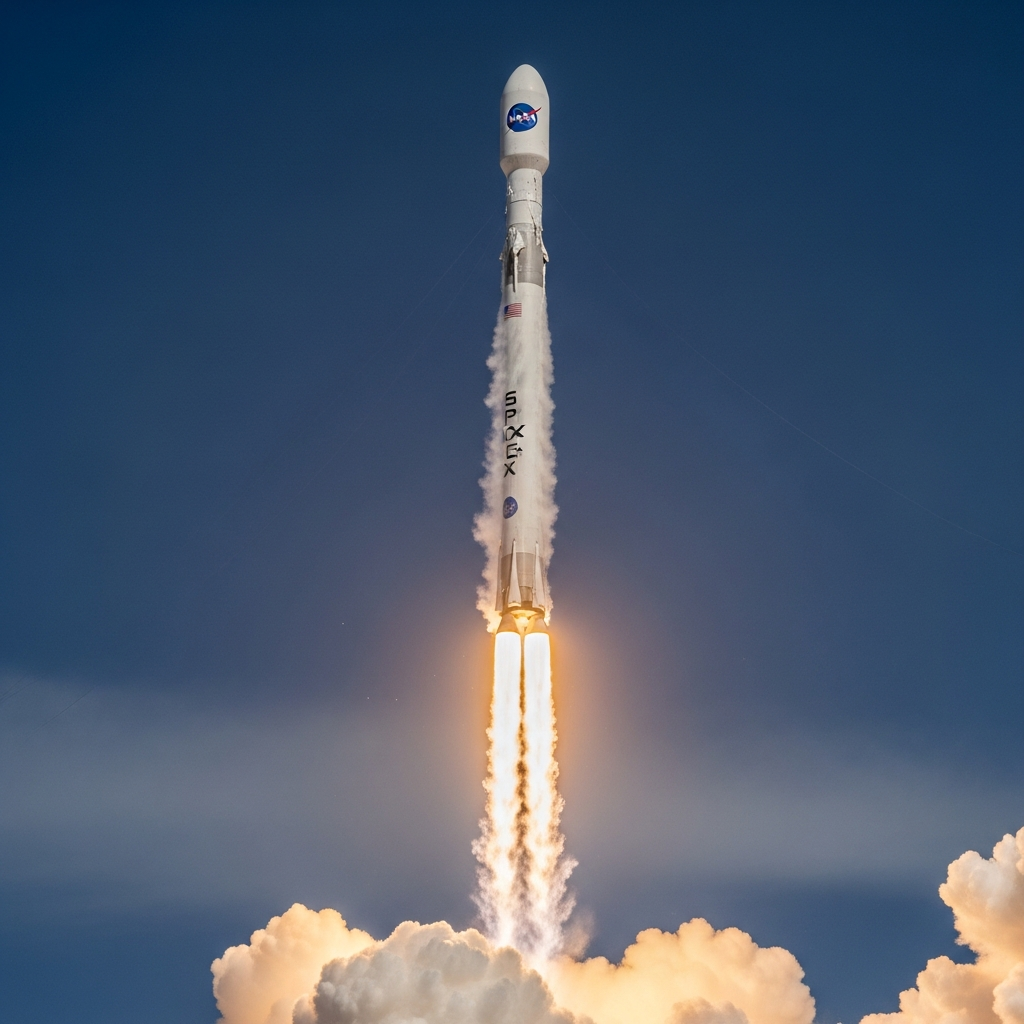
NASA is on the cusp of a groundbreaking mission, launching a suite of innovative technology and science demonstrations to Low Earth Orbit (LEO). This vital initiative, facilitated by a commercial rideshare aboard a SpaceX Falcon 9 rocket, promises to unlock new capabilities for space exploration, enhance our understanding of Earth, and advance critical in-space technologies. Scheduled as part of SpaceX’s Transporter-16 mission, this collaborative effort exemplifies how strategic partnerships can accelerate scientific discovery and technological innovation while maximizing value and reducing costs.
The mission is poised to launch from Space Launch Complex 4 East at Vandenberg Space Force Base in California. With a 57-minute launch window opening at 6:20 a.m. EDT (3:20 a.m. PDT) on Monday, March 30, the world will watch as these cutting-edge experiments begin their journey. SpaceX plans to provide live coverage, ensuring enthusiasts worldwide can witness this pivotal moment in space exploration.
Small Satellites, Big Impact: Revolutionizing Space Research
A cornerstone of this mission involves the deployment of several small spacecraft, particularly CubeSats. These compact, cost-effective platforms offer remarkable flexibility, delivering immense value to NASA and its partners. Their versatility allows for diverse scientific investigations and technology validations, pushing the boundaries of what’s possible in space.
Unraveling Earth’s Atmospheric Mysteries with AEPEX
One such CubeSat, AEPEX (Atmosphere Effects of Precipitation through Energetic X-rays), will embark on a crucial study of energetic particle precipitation. This phenomenon describes how high-energy particles from Earth’s radiation belts transfer energy into our upper atmosphere. Currently, limited observational capabilities hinder a comprehensive understanding of this process across vast regions. AEPEX aims to overcome this challenge by imaging the X-rays generated during these precipitation events, allowing scientists to map and study the phenomenon in unprecedented detail. Gaining a clearer picture of this activity is essential for refining space weather forecasting, which directly impacts vital systems like radio communications, satellite operations, and other sensitive technologies. This work complements other NASA efforts, such as the Carruthers Geocorona Observatory, which recently captured “first light” images of Earth’s geocorona, further advancing our understanding of the planet’s interaction with the space environment.
Mapping Earth’s Magnetic Field for Global Security
Another set of CubeSats emerges from the innovative MagQuest challenge, a collaborative initiative from NASA’s Center of Excellence for Collaborative Innovation and the National Geospatial-Intelligence Agency. These satellites will demonstrate novel techniques for precisely measuring Earth’s magnetic field. The data collected is critical for updating the World Magnetic Model, an indispensable resource for navigation, national security applications, commercial aviation, and even the GPS functionality in everyday mobile devices. Tested at NASA’s Goddard Space Flight Center with support from NOAA, this competition highlights the power of inter-agency cooperation.
Enhancing Small Spacecraft Capabilities with TechEdSat23
The TechEdSat23 CubeSat is a versatile testbed for three key technologies. It will evaluate a specialized radiation sensor, the Radiation Shielding Efficacy Testbed, funded by NASA’s Small Spacecraft and Distributed Systems (SSDS) office. Additionally, it carries a miniaturized NOAA Data Collection System radio and an innovative “exo-brake” designed for rapid deorbiting of spacecraft. These demonstrations are vital for developing advanced radiation shielding, improving satellite communications, and perfecting space weather monitoring. They will equip future small spacecraft for safer and more efficient operations in both LEO and deep space, while also serving as a proving ground for larger-scale applications.
Pioneering In-Space Maneuvers with R5-S10
The R5-S10 (Realizing Rapid, Reduced-cost high-Risk Research project Spacecraft 10) CubeSat, also backed by the SSDS office, pushes the boundaries of small spacecraft utility. Deploying from the Vigoride orbital service vehicle operated by Momentus Space, R5-S10 will demonstrate sophisticated proximity operations and formation flying. These techniques are fundamental for future in-space inspection, repair, and servicing missions, enabling spacecraft to operate safely at close distances. Furthermore, R5-S10 includes a co-aligned event camera and a novel star tracker. This innovative system, offering high dynamic range and rate tolerance, will advance technology for precise spacecraft orientation in the challenging vacuum of space.
Unlocking New Frontiers: Advanced In-Space Technologies
Beyond the innovative CubeSats, the mission will showcase several other transformative technologies crucial for the future of space operations. These advancements address everything from communication to power and return capabilities.
Enabling Seamless Communication: Wi-Fi in Space
After its deployment, the R5-S10 CubeSat will participate in a pioneering demonstration of in-space Wi-Fi. It will transmit data from its various experiments via a Wi-Fi connection to an in-space router. This router, developed by Solstar Space Company in partnership with Momentus, will enable the R5-S10’s data to be downlinked through the Vigoride orbital service vehicle and ultimately transferred to NASA’s Johnson Space Center in Houston. Solstar’s Wi-Fi technology was refined for space applications through suborbital testing supported by NASA’s Flight Opportunities program, managed at Armstrong Flight Research Center. This experiment is a significant step towards enabling more robust and flexible communication pathways for future missions.
Powering Future Space Logistics
The Vigoride orbital service vehicle will also host a critical power processing system from CisLunar Industries. Their Electric Power Intelligent Conversion technology is engineered to efficiently transform power in the 1 to 100-kilowatt range, boasting over 95% efficiency. Crucially, these systems are designed to be smaller and lighter than current state-of-the-art solutions. This innovation holds immense potential for advancing in-space servicing, assembly, and manufacturing (ISAM). It serves both government and commercial markets by enabling more dynamic space operations, including advanced electric and dual-mode propulsion systems. This demonstration marks the first hosted orbital flight test for NASA’s Flight Opportunities program, signaling a new era for space power systems.
Enhancing Earth Re-entry: Advanced Thermal Protection
NASA is also leveraging this flight to gather vital data on hypersonic atmospheric entry. Sensors aboard a capsule from Varda Space Industries, the W-6, will collect unprecedented information during its return to Earth. As part of a series of flight tests, Varda’s capsule heat shield is equipped with instrumented tiles manufactured at NASA’s Ames Research Center. These sensors will meticulously record the heat and pressure experienced as the capsule re-enters the atmosphere. The heat shield itself is crafted from C-PICA (Conformal Phenolic Impregnated Carbon Ablator), a material originally developed at NASA Ames. C-PICA offers superior strength, efficiency, and cost-effectiveness for thermal protection, greatly enhancing the safety and affordability of capsules returning to Earth.
Collaboration: The Key to Accelerated Space Innovation
This mission powerfully demonstrates NASA’s strategic commitment to collaborating with commercial partners. By leveraging cost-effective rideshare opportunities, the agency can significantly accelerate technology development, drive innovation, and expand scientific discovery. Programs like the Small Spacecraft and Distributed Systems office, the Flight Opportunities program, and the Center of Excellence for Collaborative Innovation—all managed by NASA’s Space Technology Mission Directorate—are crucial in fostering these partnerships. Furthermore, the CubeSat Launch Initiative, managed by Kennedy Space Center, ensures that promising small satellite concepts find their way to orbit. This collaborative model is not only transforming LEO missions but also laying the groundwork for future lunar endeavors, such as the PRISM program, which aims to deliver scientific payloads to the Moon’s surface via commercial landers.
Frequently Asked Questions
What specific scientific and technological breakthroughs are expected from NASA’s upcoming Low Earth Orbit mission?
NASA’s Transporter-16 mission to LEO is packed with potential breakthroughs. Scientifically, the AEPEX CubeSat will provide crucial data on energetic particle precipitation, improving space weather forecasts impacting communications and satellites. MagQuest CubeSats will refine Earth’s magnetic field model, vital for global navigation and security. Technologically, the mission will validate advanced radiation shielding, miniaturized communication radios, and rapid deorbiting systems via TechEdSat23. R5-S10 will demonstrate in-space proximity operations and formation flying. Beyond satellites, in-space Wi-Fi (Solstar) and highly efficient power processing (CisLunar Industries) will be tested. Finally, advanced thermal protection materials (C-PICA) on Varda’s capsule will gather data on hypersonic re-entry, enhancing future Earth return missions.
How does NASA collaborate with commercial companies like SpaceX and Varda Space Industries for these Low Earth Orbit missions?
NASA actively partners with commercial entities through initiatives like the commercial rideshare program. For the Transporter-16 mission, NASA leverages SpaceX’s Falcon 9 rocket as a cost-effective launch vehicle. This model allows multiple payloads from various organizations to share a single launch, significantly reducing costs and increasing access to space for NASA’s science and technology demonstrations. Companies like Momentus Space, Solstar Space Company, CisLunar Industries, and Varda Space Industries are integral partners, providing orbital service vehicles, communication routers, power systems, and re-entry capsules. NASA often supports the development of these commercial technologies through programs like Flight Opportunities, then utilizes them for specific mission objectives, fostering a symbiotic relationship that benefits both public and private space endeavors.
What are the long-term benefits and applications of the technologies being tested on NASA’s commercial LEO launches?
The technologies validated on these LEO missions have profound long-term implications. Improved space weather forecasting from AEPEX will protect critical infrastructure, from power grids on Earth to satellites in orbit. Enhanced magnetic field models from MagQuest CubeSats ensure more accurate navigation for everything from defense to everyday GPS. The advancements in radiation shielding and rapid deorbiting (TechEdSat23) contribute to safer, more sustainable operations in LEO and beyond, reducing space debris. Proximity operations and in-space servicing (R5-S10) are foundational for future satellite maintenance, refueling, and even constructing larger structures in space. In-space Wi-Fi and efficient power systems (Solstar, CisLunar Industries) are crucial for robust communications and sustainable power for lunar habitats, Mars missions, and burgeoning space economies. Finally, advanced thermal protection (Varda) makes future sample returns and human re-entry safer and more affordable.
The Future is Launching Now
The upcoming NASA mission aboard the SpaceX Falcon 9 is more than just a launch; it’s a critical step forward in humanity’s journey into space. Each demonstration, from the smallest CubeSat studying Earth’s atmosphere to the powerful new systems enabling in-space logistics, represents a piece of the puzzle for future exploration. By embracing commercial collaboration and pioneering new technologies, NASA continues to push the boundaries of science and innovation, ensuring a brighter, more connected, and more sustainable future in space for all.