The colossal “No Kings” protests of March 28, 2026, saw millions take to the streets, making a resounding statement against the Trump administration’s policies. From the war in Iran and aggressive immigration enforcement to rising living costs and perceived authoritarianism, communities worldwide expressed their collective outrage. But as the signs are put away and the crowds disperse, a critical question emerges for every participant: “Now what?” This ultimate guide explores how to channel that powerful single-day momentum into sustained, impactful social change, drawing on historical lessons and expert insights.
Beyond the March: Sustaining the Movement’s Power
The sheer scale of the March 28, 2026, “No Kings” protests was undeniable. Over 8 million people joined more than 3,300 demonstrations across the U.S. and Europe. From the flagship rally in St. Paul, Minnesota, headlined by Bruce Springsteen, to 5,000 marchers in Austin, Texas, and smaller gatherings in places like Driggs, Idaho, the message was clear: “No kings in America.”
Participants voiced a broad spectrum of grievances. These included the ongoing war in Iran, rising gas and grocery prices, the rollback of transgender rights, and the concentration of economic power. A significant catalyst in Minneapolis was the January federal immigration crackdown, which tragically resulted in the deaths of Alex Pretti and Renee Good. Governors and public figures, like Minnesota’s Governor Tim Walz, condemned the administration’s tactics, praising citizens for standing up for decency.
However, movement scholars and organizers consistently emphasize a crucial point: a single protest, no matter how massive, is merely a launchpad. Leah Greenberg, co-executive director of the Indivisible Project, a key force behind the “No Kings” movement, articulates this perfectly. She sees the demonstrations as “part of a tapestry of defiance” against authoritarianism, stressing that there isn’t just “one way to fight it.” Lasting social change demands diverse, ongoing activism at both local and national levels.
Igniting Change: A Tapestry of Resistance
Historically, successful movements combine various forms of action. Hahrie Han, a political scientist at Johns Hopkins University, highlights that protests build power by capturing public attention and drawing people into action. Change, she notes, often results from people taking varied actions, compelling leaders to negotiate.
A compelling example is Minnesota’s 2023 legislative success. Activists, through multiracial coalitions and strategic engagement, secured progressive laws like paid family leave and driver’s licenses for undocumented residents. This demonstrates how “grassroots energy” can effectively integrate with “institutional politics.” The true success of “No Kings,” organizers suggest, lies in attendees’ commitment to ongoing community organizing, mutual aid, economic non-cooperation, or legislative advocacy.
From Public Outcry to Strategic Occupation: Diverse Protest Forms
Protest, in its broadest sense, is a fundamental tool for demanding justice. Early American resistance included enslaved people covertly slowing work or breaking tools, alongside organized armed rebellions.
Occupation has also proven effective. Indigenous Americans, for example, occupied Alcatraz Island and Mount Rushmore throughout the 1900s to protest treaty violations and demand land rights. More familiar are the iconic street marches, freedom rides, and sit-ins of the 1950s and 1960s Civil Rights movement, which etched protest into the national consciousness.
Recent years have seen a surge in mass street protests. This includes the 2018 March for Our Lives for gun control and the 2020 Black Lives Matter demonstrations after George Floyd’s killing. Even in 2025, the first year of a potential second Trump term, protest numbers exceeded those of 2017, underscoring persistent civic engagement. Hunter Dunn of 50501, a “No Kings” co-founder, notes record participation and enthusiasm for using these large events as a “launchpad” for local organizing on issues like election defense or immigrant rights.
Amplifying Your Voice: Rallies, Marches, and Parades
Rallies, marches, and parades are common forms of public assembly designed to raise awareness. These gatherings often culminate in speeches, music, and the distribution of literature.
The 1913 Women’s Suffrage Parade, for instance, dramatically highlighted the limited voting rights for women. More recently, the 2017 Women’s March, held the day after Trump’s first inauguration, is widely credited with fueling the #MeToo movement and driving record female participation in the 2018 midterm elections. Fatima Goss Graves, president of the National Women’s Law Center, recognized how #MeToo provided a crucial framework for individuals to voice their experiences with gender-based violence.
The Power of Collective Action: General Strikes
While labor unions have a long history of strikes for better working conditions, a general strike represents a far broader economic disruption. It involves a significant portion of a region’s workforce halting work to achieve widespread economic or social change.
The first general strike in North America, in Philadelphia in 1835, saw 20,000 workers successfully demand a 10-hour workday. In a contemporary context, following the deaths of Renee Good and Alex Pretti in Minneapolis due to federal immigration agents, organizers called for a national general strike. This led to thousands participating, businesses closing, and work stoppages across various sectors, backed by labor unions, demonstrating the potent leverage of organized labor. As Kieran Knutson of CWA Local 7250 stated, “We are going to try to use that [leverage] because really there’s nothing else left.”
Economic Leverage: Boycotts and Divestment
Boycotts involve refusing to purchase products or engage with services, applying economic pressure to change corporate or political behavior. Conversely, “procurement” channels resources to entities one wishes to support.
In the 1930s, Black Americans organized “Don’t Buy Where You Can’t Work” campaigns. These boycotts and picketing actions successfully created jobs for Black workers during the Great Depression. Divestment is a related strategy. UC Berkeley students, in 1985, successfully pressured their university to divest $3 billion from companies with ties to apartheid South Africa. More recently, a 2025 boycott of Target over its rollback of Diversity, Equity, and Inclusion (DEI) efforts was acknowledged by the company as a factor in reduced sales. LaTosha Brown of Black Voters Matter noted this as reclaiming power and redirecting spending to resist authoritarianism.
Community Resilience: Mutual Aid Networks
Under the principle of “solidarity, not charity,” mutual aid networks involve volunteers pooling resources like food, housing assistance, and childcare to support community needs.
During the 1980s HIV/AIDS crisis, LGBTQ+ groups formed vital care networks. The COVID-19 pandemic saw local organizations deliver groceries and support to vulnerable families, with one Brooklyn program aiding 28,000 people. In January, during Operation Metro Surge in Minneapolis, these networks were crucial. They distributed food, money, and diapers to immigrant families sheltering in fear of ICE, highlighting the indispensable role of grassroots support when traditional systems falter.
Student and Employee Action: Walkouts
Walkouts empower students and employees to collectively leave schools or workplaces to protest specific issues. The greater the participation, the more impactful the message.
The 1968 East Los Angeles Walkouts, involving 15,000 students, protested educational disparities for Mexican American students. Though initial demands faced resistance, it was one of the largest student protests ever. Today, walkouts remain a powerful tactic for young people, as demonstrated by student actions against ICE. “This was our way to make our voices heard,” shared Lark Jeffers after a Free America walkout in Silver Spring, Maryland, acknowledging the unique power of youth collective action.
Educate and Organize: The Teach-in Tradition
Teach-ins, a longstanding form of protest, focus on sharing knowledge and fostering debate. Activists use them to educate participants about causes, raise awareness, and inspire further action.
Popularized during the Vietnam War, the first teach-in at the University of Michigan in 1965 drew 3,500 students. It significantly boosted the national anti-war movement. More recently, in 2024, teach-ins resurfaced on U.S. college campuses within student encampments. These sessions educated participants on the Palestinian struggle and the Boycott, Divestment, Sanctions (BDS) movement, demonstrating their enduring relevance as tools for intellectual and political mobilization.
Connecting Local Action to National Impact
While the White House, through spokesperson Abigail Jackson, dismissed the “No Kings” protests as “Trump Derangement Therapy Sessions,” organizers offered a powerful counter-narrative. Ezra Levin of Indivisible noted that over half of the registered protest events occurred in Republican-leaning or battleground states, indicating a broad, non-partisan appeal. Lisa Gilbert of Public Citizen affirmed, “To stand up and stand together and say that there aren’t kings in America is not controversial.”
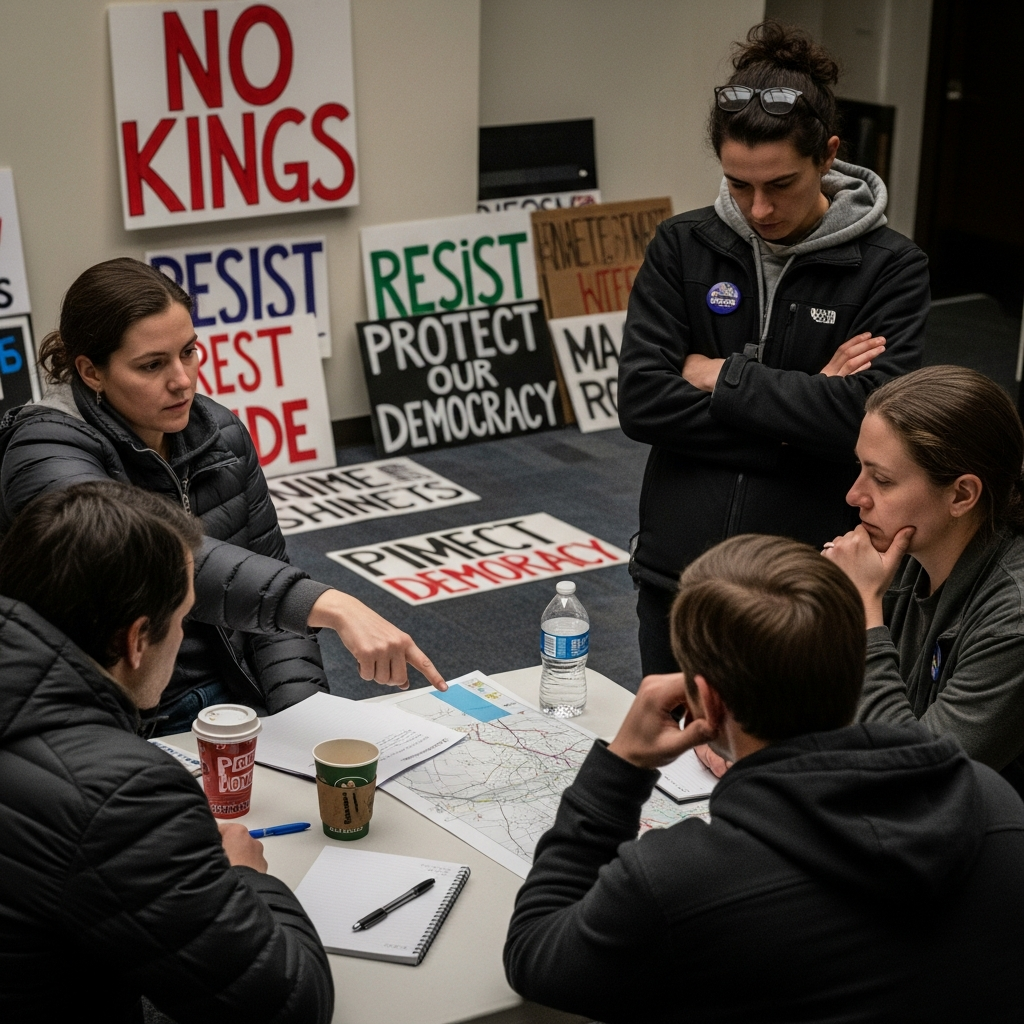
A key strategic shift for the “No Kings” movement is away from solely pursuing record attendance at single, massive rallies. Instead, the focus is on smaller, more accessible local events to foster “ongoing engagement… in civic work.” This encourages citizens to “own their home turf and building power,” rather than just attending sporadic large-scale demonstrations. The goal is to translate protest energy into sustained community organizing, whether it’s defending elections, advocating for immigrant rights, or fighting local issues like AI data centers.
Frequently Asked Questions
What were the primary grievances driving the “No Kings” protests?
The “No Kings” protests, particularly the massive demonstrations on March 28, 2026, were fueled by widespread opposition to several Trump administration policies. Key grievances included the ongoing war in Iran, aggressive federal immigration enforcement (especially after incidents like the deaths of Alex Pretti and Renee Good in Minneapolis), rising costs of gas and groceries, and concerns over authoritarianism, including rollbacks of transgender rights and Diversity, Equity, and Inclusion (DEI) efforts.
How can individuals move beyond a single protest to create lasting social change?
To achieve lasting social change, individuals must transition from one-off protests to sustained, diverse forms of activism. This involves committing to community organizing, participating in “know-your-rights” trainings, engaging in mutual aid networks, and supporting economic non-cooperation through boycotts or divestment. Additionally, advocating legislatively at state or local levels, organizing walkouts, or participating in educational teach-ins are crucial ways to maintain momentum and build power over time.
What was the significance of the “No Kings” protests beyond their attendance numbers?
Beyond their record-breaking attendance, the “No Kings” protests served as a powerful launchpad for deeper civic engagement. Movement scholars and organizers emphasized that these demonstrations were a starting point, part of a broader “tapestry of defiance.” Their true significance lies in the shift towards fostering ongoing local organizing, building community resilience through mutual aid, and inspiring diverse forms of sustained political action, ultimately connecting grassroots energy to institutional change efforts.
Your Role in Shaping Tomorrow
The “No Kings” protests demonstrated the formidable power of collective public expression. Yet, the journey toward meaningful social and political transformation extends far beyond a single day of action. It is a continuous effort, a tapestry woven from diverse threads of resistance, advocacy, and community building.
The call to action is clear: translate protest passion into sustained engagement. Whether through local organizing, mutual aid, boycotts, or legislative advocacy, every individual has a vital role to play. By embracing this broader vision of activism, we can ensure that the momentum sparked on March 28, 2026, continues to fuel genuine, lasting change in America and beyond.