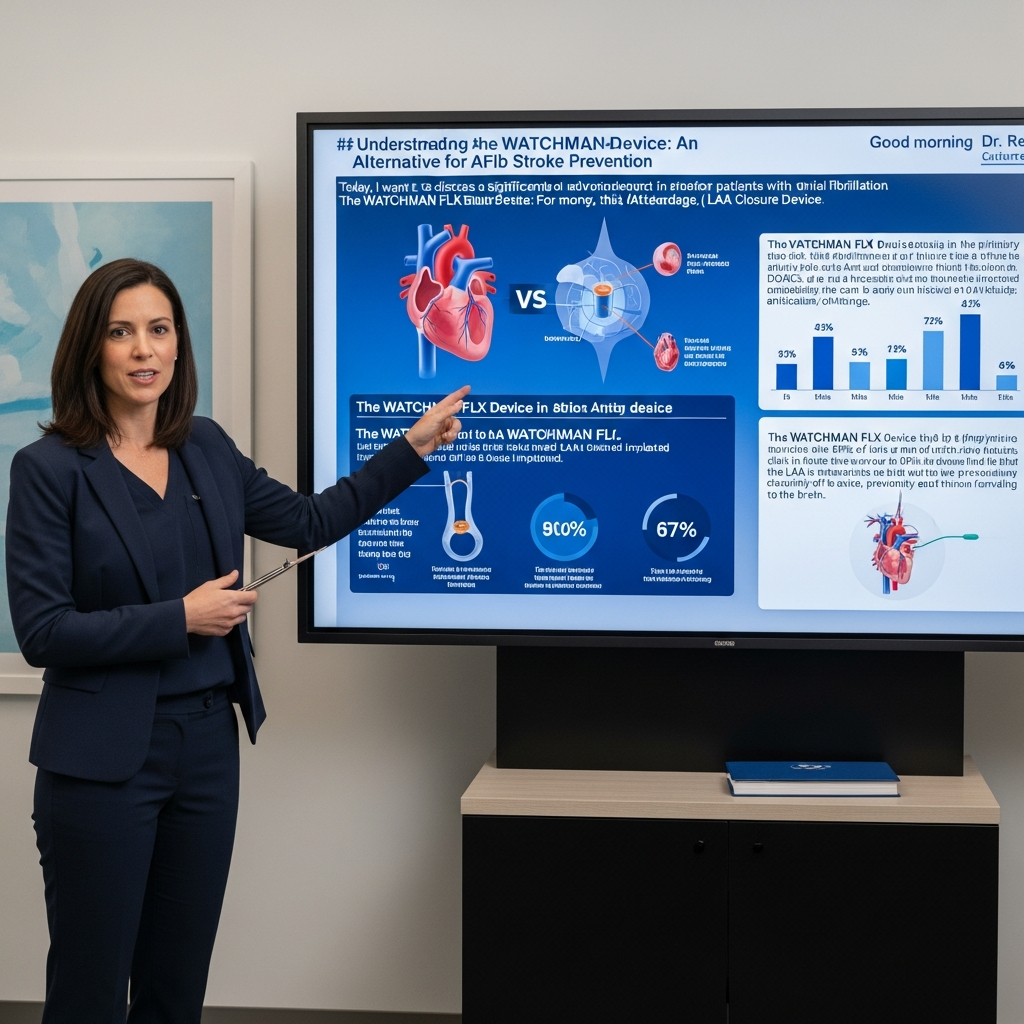
For millions living with atrial fibrillation (AFib), preventing stroke is a paramount concern. Traditionally, oral anticoagulants (blood thinners) have been the cornerstone of this protection. However, these medications come with a persistent risk of bleeding, a worry for both patients and clinicians. Enter the WATCHMAN FLX device, a left atrial appendage (LAA) closure solution designed to offer an alternative. A groundbreaking study, the CHAMPION-AF trial, recently cast new light on this debate, exploring whether LAA closure could truly stand as a viable option for AFib patients who are already good candidates for long-term blood thinners.
Understanding Atrial Fibrillation and Stroke Risk
Atrial fibrillation (AFib) is the most common heart rhythm disorder, affecting approximately 59 million people globally. In individuals with non-valvular AFib (NVAF), over 90% of heart-related blood clots originate in a small pouch connected to the left atrium of the heart, known as the left atrial appendage (LAA). If a clot forms here and breaks free, it can travel to the brain, causing a debilitating stroke.
To counter this, oral anticoagulants (OACs), particularly non-vitamin K antagonist oral anticoagulants (NOACs), are prescribed. While highly effective, NOACs require consistent adherence and carry an inherent risk of bleeding, which can be significant over a patient’s lifetime. This dilemma often drives the search for alternative, non-pharmacological stroke prevention strategies.
Introducing the CHAMPION-AF Trial: A New Paradigm?
The CHAMPION-AF trial stands out as the first prospective, multinational, randomized study directly comparing LAA closure using the WATCHMAN FLX device to long-term NOAC therapy. Crucially, this trial focused on a broad spectrum of AFib patients who were considered suitable for blood thinners, not just those with contraindications. This makes its findings particularly relevant for a wider patient population.
Unveiled at ACC.26 and simultaneously published in the prestigious New England Journal of Medicine, the trial enrolled 3,000 patients with non-valvular AFib. Participants had an average age of 72, with a moderately elevated stroke risk (mean CHA2DS2-VASc score of 3.5) and a low baseline bleeding risk (mean HAS-BLED score of 1.3). These characteristics mean the study rigorously tested LAA closure against NOACs in patients generally considered “good candidates” for blood thinners.
Key Findings: Efficacy and Bleeding Benefits of LAA Closure
After three years of follow-up, the CHAMPION-AF trial reported several significant outcomes:
Primary Efficacy Endpoint: LAA closure was found to be noninferior to NOAC therapy in reducing the combined rate of cardiovascular death, stroke, or systemic embolism. This composite endpoint occurred in 5.7% of the LAA closure group versus 4.8% in the NOAC group. This difference fell within the pre-specified noninferiority margin, suggesting comparable overall stroke prevention.
Primary Safety Endpoint (Non-Procedural Bleeding): A major highlight of the trial was the superiority of LAA closure for pre-specified non-procedure-related bleeding events. Patients undergoing LAA closure experienced a 45% relative reduction in this type of bleeding, with rates of 10.9% compared to 19% in the NOAC group. This demonstrates a significant advantage in reducing bleeding risk unrelated to the device implantation itself.
Net Clinical Benefit: When combining cardiovascular death, stroke, systemic embolism, and non-procedural major and clinically relevant non-major bleeding, the LAA closure group showed statistical superiority (15.1% vs. 21.8%). This suggests an overall clinical advantage for the device group over time.
“Our data suggest that the LAA closure device used in this trial is a potential and reasonable alternative to medication, even among patients who are suitable for long-term blood thinners,” stated Dr. Saibal Kar, co-principal investigator. He emphasized that the findings support including LAA closure in a shared decision-making process with patients.
Diving Deeper: Individual Outcomes and the Ischemic Stroke Nuance
While the composite efficacy endpoint met noninferiority, a closer look at individual components revealed important distinctions. Researchers observed:
No significant differences in overall deaths, systemic embolism, or hemorrhagic strokes between the two groups.
However, the LAA closure group did experience a numerically higher rate of ischemic strokes (3.2% vs. 2%) compared to the NOAC group. This specific finding has drawn attention and discussion among medical experts.
The WATCHMAN FLX Device: A Closer Look
The CHAMPION-AF trial specifically evaluated Boston Scientific’s WATCHMAN FLX™ Left Atrial Appendage Closure (LAAC) Device. This innovative technology aims to permanently seal off the LAA, where most stroke-causing clots originate in AFib patients, eliminating the need for long-term oral anticoagulants. The trial achieved a high procedural success rate of 99%, with patients in the LAA closure arm demonstrating effective closure rates of 98.6%. With over 600,000 people treated globally, the WATCHMAN implant is the most widely adopted and studied LAAC device on the market.
Expert Perspectives and Crucial Caveats
Despite the positive headline findings, the CHAMPION-AF results have been met with a nuanced reception and important considerations from the cardiology community. Several experts, including Dr. Gregory Marcus, author of an accompanying editorial, highlighted key limitations and points of caution:
Noninferiority Margin: Some critics argued that the observed event rates in the trial were lower than anticipated. This made it easier for the device to meet the pre-specified noninferiority margin, which itself was considered “not small” at 4.8 percentage points.
Ischemic Stroke Increase: The numerically higher incidence of ischemic strokes in the LAA closure arm (45 vs. 27 events) is a “concerning endpoint” for many, prompting calls for further investigation into this specific risk.
Prior Trial Context: The CHAMPION-AF trial’s results stand in contrast to the earlier CLOSURE-AF trial, which was not industry-funded and found that LAA closure failed to meet noninferiority and even led to higher adverse events compared to standard care in high-risk patients. This historical context fuels skepticism.
Industry Funding: The CHAMPION-AF trial was funded by Boston Scientific, the manufacturer of the WATCHMAN FLX device. While not inherently problematic, this aspect is noted by experts when evaluating the interpretation of results.
Definition of Safety Endpoint: Questions were raised about the primary safety endpoint’s definition, which specifically excluded periprocedural bleeding. While a secondary analysis that included procedural events still favored LAA closure for overall bleeding, the initial exclusion prompted discussion.
“Indication Creep” Concerns: Some experts voiced apprehension about potential “indication creep,” fearing that positive trial results, coupled with marketing efforts, could lead to LAA closure being offered to “all-comers” rather than carefully selected patients with clear indications.
As Dr. Sanjay Kaul put it, the outcome might be “a win on the scoreboard but a loss as far as delivering meaningful, reliable therapeutic value,” suggesting that while the device met statistical endpoints, its clinical benefit for all NOAC-eligible patients might not be unequivocally positive.
Shared Decision-Making: Weighing the Options
Given the complex picture, a consensus emerged: Left atrial appendage closure offers a valid alternative, but its application requires thorough, independent shared decision-making between patients and their cardiologists. Factors to consider include:
Patient Preference: Some patients may highly value discontinuing long-term oral anticoagulants, even if it entails a minimally invasive procedure with upfront risks.
Bleeding Concerns: Even for patients deemed “low bleeding risk” at baseline, the CHAMPION-AF trial showed NOACs led to increased bleeding over time. For those with a history of bleeding or a strong aversion to bleeding risks, LAA closure could be an attractive option.
Procedural Risks: Patients must understand the upfront risks associated with the LAA closure procedure itself, such as potential perforation, tamponade, and device-related thrombus, though these rates were low (2.3% serious adverse events in CHAMPION-AF).
Long-term Data: While promising, the 3-year data is not the final word. The longer-term effectiveness and safety, particularly regarding ischemic stroke, need further confirmation.
Beyond Three Years: What’s Next for LAA Closure Research?
The CHAMPION-AF research team plans to continue following patients for a full five years. This extended follow-up is crucial to determine the long-term noninferiority of LAA closure for ischemic stroke and systemic embolism, offering more definitive insights into its sustained efficacy and safety.
In parallel, other significant trials, such as LAAOS-4 and CATALYST, are underway. These studies aim to provide further clarity, especially for higher-risk populations and in various clinical contexts. The ongoing research underscores the evolving landscape of AFib management and the commitment to finding optimal, personalized stroke prevention strategies. For now, a dispassionate and objective evaluation of existing evidence remains paramount to ensure appropriate utilization of LAA closure technology.
Frequently Asked Questions
What is the primary benefit of LAA closure with the WATCHMAN FLX device compared to NOACs for AFib?
The CHAMPION-AF trial demonstrated that LAA closure with the WATCHMAN FLX device was statistically superior to NOAC therapy in preventing non-procedure-related major and clinically relevant non-major bleeding events over three years. Patients receiving the device experienced a 45% relative reduction in bleeding risk compared to those on NOACs (10.9% vs. 19%). This significant reduction in bleeding risk is a key benefit, even in patients considered good candidates for blood thinners.
Who are ideal candidates for LAA closure with the WATCHMAN FLX device based on the CHAMPION-AF trial, and what are the important considerations?
Based on CHAMPION-AF, ideal candidates are patients with non-valvular AFib who have a moderately elevated stroke risk (average CHA2DS2-VASc score of 3.5) and were previously deemed suitable for long-term oral anticoagulation. While the device showed noninferiority for overall efficacy and superiority for bleeding, it’s crucial to acknowledge the numerically higher rate of ischemic strokes observed in the LAA closure group (3.2% vs. 2%). Shared decision-making with a cardiologist is essential, weighing the desire to stop long-term blood thinners against the initial procedural risks and this slight increase in ischemic stroke risk.
How does the CHAMPION-AF trial compare to previous LAA closure studies like CLOSURE-AF, and what are the next steps in research?
CHAMPION-AF is the first large, randomized trial to compare LAA closure directly against NOACs in anticoagulation-eligible* patients, which distinguishes it from earlier studies. Notably, it contrasts with the non-industry-funded CLOSURE-AF trial, which did not show noninferiority for LAA closure and reported higher adverse events in a different patient population. These conflicting results highlight the importance of careful patient selection and device-specific data. The CHAMPION-AF team will continue patient follow-up for five years to gain longer-term insights, and other trials like LAAOS-4 and CATALYST are underway to further refine the role of LAA closure.
Conclusion: A Promising, Yet Evolving, Option for AFib Patients
The CHAMPION-AF trial marks a significant step forward in the management of atrial fibrillation. It provides compelling evidence that LAA closure with the WATCHMAN FLX device offers comparable stroke prevention to NOACs, with the added benefit of significantly reduced bleeding risk. This is particularly impactful for patients who are eligible for blood thinners but wish to avoid their long-term bleeding complications.
However, the trial also underscores the complexities of medical innovation. The nuanced findings regarding ischemic stroke rates, the context of previous trials, and the need for continued long-term data necessitate a thoughtful approach. As new evidence emerges, LAA closure will continue to evolve as a vital component of personalized stroke prevention strategies, empowering patients and their healthcare providers to make informed decisions that best suit individual needs and preferences.