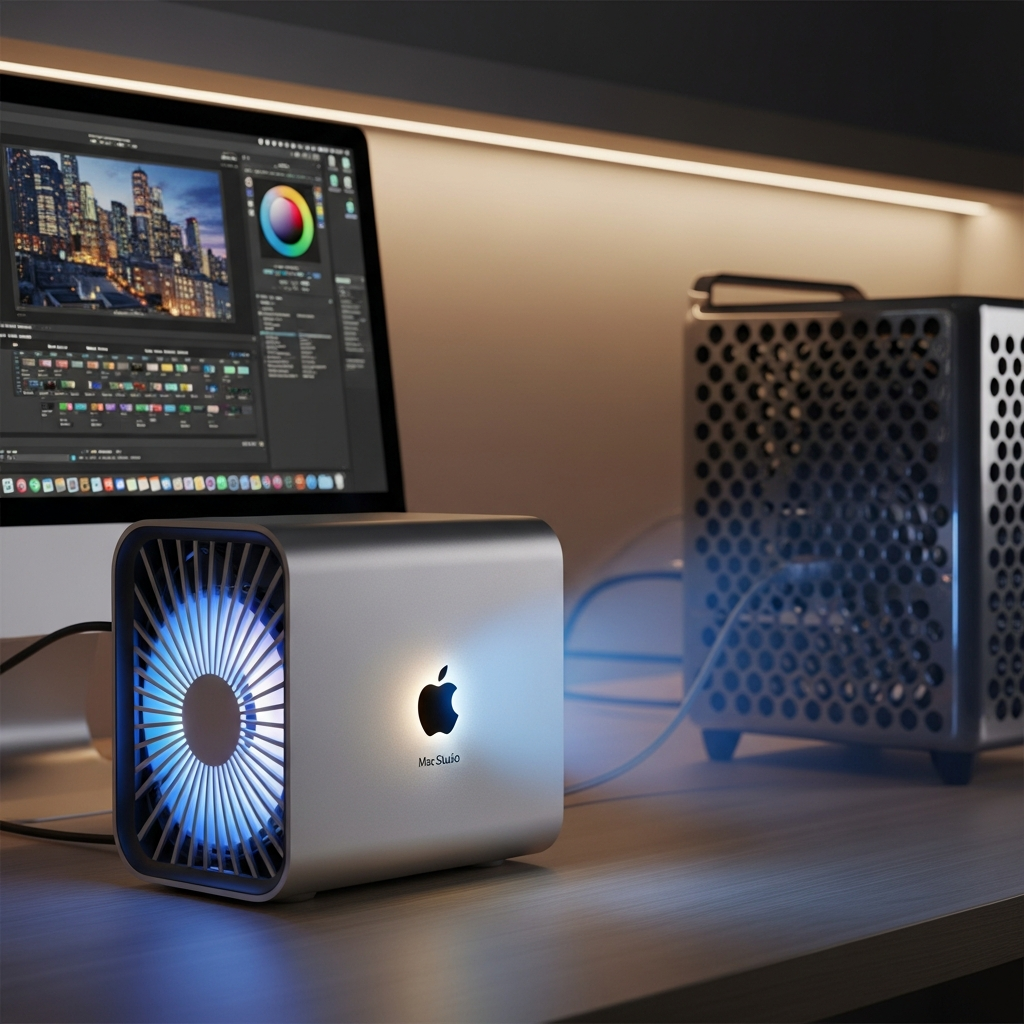
The reign of Apple’s most expandable professional desktop, the Mac Pro, has officially ended. After two decades of serving high-end users, Apple has confirmed the Mac Pro’s discontinuation, signaling a strategic pivot towards the more compact, yet incredibly powerful, Mac Studio. This shift isn’t just about a product lineup change; it underscores Apple’s deep commitment to its custom Apple Silicon architecture, which now delivers workstation-level performance in remarkably efficient new form factors. For professionals seeking cutting-edge power, the Mac Studio with its M3 Ultra and M4 Max chips is now unequivocally Apple’s flagship offering, marking a definitive new chapter for the company’s pro desktop strategy.
The End of an Iconic Professional Workstation
Apple officially informed 9to5Mac that the Mac Pro will no longer be produced, with no plans for future hardware iterations. As of a recent update, the Mac Pro has been removed from Apple’s website, with its former product page now redirecting to the general Mac overview. This move confirms what many industry observers had anticipated for some time, as the Mac Pro had visibly “languished” since its last significant update.
The Mac Pro’s final iteration, updated in June 2023 with the M2 Ultra chip, still featured its 2019 industrial design. Despite this upgrade to Apple Silicon, it struggled to maintain relevance, especially with its premium starting price of $6,999. The core issue was the subsequent arrival of the Mac Studio, which rapidly surpassed the Mac Pro’s capabilities at a lower cost, armed with newer, more potent Apple Silicon.
A Storied and Sometimes Turbulent History
The Mac Pro, and its predecessor the Power Mac tower, represented a cornerstone of Apple’s strategy for professional users since the late 1990s. It was designed for demanding tasks like film editing, 3D rendering, and audio production, earning a dedicated following. However, the product line’s journey wasn’t always smooth.
A notable setback occurred in 2013 with the introduction of the radical cylindrical “trash can” Mac Pro. While lauded by some for its innovative compact design, this model proved inflexible. Its internal component arrangement, centered around a single thermal core, made updates and modifications incredibly challenging. Apple itself acknowledged in 2017 that they had “designed ourselves into a bit of a thermal corner” and that the expected “workloads didn’t materialize” for its dual-GPU architecture. This design limitation effectively halted updates for six years.
Apple attempted to rectify this in 2019 with a return to a more traditional, modular tower design. This iteration brought back much-desired PCIe expansion slots, catering to professionals who needed specialized add-in cards. However, its release came just months before the announcement of Apple Silicon, signaling that the “writing had been on the wall for Intel Macs for a while.”
Apple Silicon: The “Final Nail in the Coffin”
The advent of Apple Silicon proved to be the decisive factor in the Mac Pro’s obsolescence. Apple’s custom-designed chips fundamentally changed the architecture of professional computing, rendering many of the Mac Pro’s unique selling points either irrelevant or significantly diminished.
Key architectural shifts that impacted the Mac Pro include:
Unified Memory Architecture: Apple Silicon’s integrated memory pool on the chip itself drastically reduced the need for user-upgradable memory, a staple of traditional pro desktops.
Integrated GPUs: The powerful graphics cores built directly into Apple Silicon chips eliminated the reliance on external graphics cards from AMD or Nvidia, removing another common upgrade path.
High-Speed Thunderbolt Ports: The proliferation of high-speed Thunderbolt 5 ports minimized the necessity for extensive internal expandability, as external peripherals could handle many expansion needs.
Built-in Video Encoders: Specialized tasks like video encoding, once requiring dedicated Afterburner cards, are now efficiently handled by the media engines within Apple Silicon, rendering such internal cards largely unnecessary.
In essence, the Mac Pro found itself in a paradoxical position. It was trying to fill a niche that no longer aligned with Apple’s modern, integrated chip architecture. The Apple Silicon Mac Pro essentially became a “Mac Studio with PCI Express slots that weren’t compatible with or didn’t need the most important PCI Express accessories,” as one analyst noted. This created a situation where its advantages over the more streamlined Mac Studio were minimal, particularly concerning internal storage and PCIe expansion.
The Ascendancy of the Mac Studio
The Mac Studio, first introduced in 2022, rapidly emerged as the de facto successor to the Mac Pro. Equipped initially with the M1 Ultra chip, it immediately showcased workstation-level performance in a significantly smaller, quieter, and more affordable package. Subsequent updates, including the powerful M3 Ultra chip and newer M4 Max options, have only solidified its position.
The latest Mac Studio configurations are formidable. They offer options with a 32-core CPU, an 80-core GPU, up to 256GB of unified memory, and 16TB of SSD storage. These specifications effectively surpass the capabilities of the now-discontinued Mac Pro, particularly in raw processing power and graphics performance. Its ability to deliver such immense power in a compact desktop weighing only 7.9 pounds represents a paradigm shift.
Apple’s current desktop lineup, post-Mac Pro, is remarkably strong and diverse. It includes the 24-inch iMac with the M4 chip, the Mac mini (available with M4 and M4 Pro chips), and the Mac Studio (offering M4 Max and M3 Ultra chip options). Complementing these are the MacBook Neo, MacBook Air, and MacBook Pro for mobile professionals. This consolidated lineup is praised for offering excellent options across a broad spectrum of price points, configurations, and form factors.
Innovative Solutions for Extreme Workflows
Even for the most demanding users who might miss the Mac Pro’s internal expansion, Apple is exploring new avenues. macOS Tahoe 26.2 introduced a low-latency feature allowing multiple Macs to connect using RDMA over Thunderbolt 5. This enables users to scale performance by networking their devices, effectively creating powerful clusters for extreme tasks like AI workloads. This capability, widely seen as “another nail in the Mac Pro’s coffin,” provides an alternative for those needing beyond-single-machine performance.
While Apple traditionally offered rack-mount solutions for the Mac Pro, the Mac Studio has also found its way into enterprise environments. Numerous IT vendors now provide 3U and 5U mounts, allowing the compact Mac Studio to be deployed in server rooms, further expanding its versatility for professional and enterprise users.
Why This Strategic Shift Makes Sense
The decision to discontinue the Mac Pro reflects a fundamental change in Apple’s product philosophy. Today’s Apple prioritizes efficiency, integration, and delivering workstation-level performance in more accessible and streamlined machines. Continuing to sell an M2 Ultra-powered Mac Pro at a premium price, especially when superior alternatives like the M3 Ultra Mac Studio were available, would have been a disservice to customers.
Although some Mac Pro loyalists will undoubtedly be disappointed by the loss of internal PCIe expansion, the Mac Studio largely fills this void for the vast majority of professional workflows. For highly specialized users requiring specific PCIe cards, external Thunderbolt expansion chassis remain a viable option.
Ultimately, the Mac Pro’s legacy lives on through the remarkable performance gains Apple Silicon has brought to the entire Mac lineup. The Mac Studio is not just a replacement; it’s the embodiment of Apple’s future for high-end professional desktops, offering unparalleled performance, efficiency, and a more integrated ecosystem.
Frequently Asked Questions
Why did Apple discontinue the Mac Pro after 20 years?
Apple discontinued the Mac Pro primarily due to the transformative impact of Apple Silicon. The company’s custom chips fundamentally altered the architecture of professional computing, making many of the Mac Pro’s defining features, like traditional internal memory and GPU upgrades, less relevant. The Mac Studio, with its superior performance-per-watt, compact design, and lower cost, effectively rendered the Mac Pro obsolete. Apple’s strategy shifted towards efficiency and integration, which the Mac Studio embodies much more effectively than the traditional Mac Pro tower.
What are Apple’s current professional desktop alternatives to the Mac Pro?
Apple now offers the Mac Studio as its flagship professional desktop. It comes with powerful M4 Max and M3 Ultra chip options, providing exceptional performance for demanding creative and technical workloads. For users with less extreme needs, the Mac mini, available with M4 and M4 Pro chips, also offers significant processing power in a compact form. These devices, combined with Apple’s comprehensive software and accessory ecosystem, are designed to meet the needs of nearly all professional users.
Should professionals who relied on the Mac Pro’s PCIe slots switch to the Mac Studio?
For most professionals, switching to the Mac Studio is a highly recommended step. The Mac Studio’s M3 Ultra chip often outperforms the final M2 Ultra Mac Pro in raw processing and graphics, and it does so at a lower price point and in a much smaller footprint. While the Mac Studio lacks internal PCIe expansion slots, external Thunderbolt expansion chassis provide a powerful alternative for specialized add-in cards. For extreme needs, macOS Tahoe even allows connecting multiple Mac Studios via Thunderbolt 5 for clustered performance, making the Mac Studio a versatile and forward-thinking choice.
The Future of Pro Desktops: Streamlined Power
The discontinuation of the Mac Pro marks the end of an era for Apple’s most customizable workstation. However, it also signals a clear and confident direction for the company’s professional desktop future. By consolidating its high-end offerings around the Mac Studio, Apple is prioritizing power, efficiency, and integration, all powered by its revolutionary Apple Silicon. This move positions the Mac Studio not just as a replacement, but as the vanguard of a new generation of professional computing, promising even more innovative solutions and capabilities for creators and power users worldwide.