The cosmos often appears fixed and unchanging. Yet, over millennia, stars are born, live, and die in spectacular fashion, leaving behind breathtaking remnants. One such celestial marvel, the Crab Nebula, has once again commanded the attention of the NASA/ESA Hubble Space Telescope. By meticulously comparing new images from 2024 with those captured 25 years prior in 1999, astronomers have uncovered compelling insights into the relentless expansion of this iconic supernova remnant. This long-term study, revealing its dynamic evolution, not only provides crucial data on stellar life cycles but also highlights the unparalleled value of sustained space observations. Prepare to explore the vibrant, ever-changing heart of a cosmic explosion.
The Crab Nebula: A Star’s Explosive Legacy Unveiled
The story of the Crab Nebula began nearly a thousand years ago. In 1054 AD, Chinese astronomers were astonished by the sudden appearance of a “guest star,” so brilliant it outshone everything in the night sky except the Moon. This dazzling phenomenon remained visible even in broad daylight for an incredible 23 days. Records from Japanese, Arabic, and Native American stargazers confirm this historic event, which marked the violent death of a massive star. Today, at the precise location of that ancient supernova, lies the shimmering Crab Nebula.
Also known as Messier 1 (M1), NGC 1952, or Taurus A, this nebula is a true celestial landmark. Located approximately 6,500 light-years away in the constellation of Taurus, it’s bright enough to be glimpsed by amateur telescopes. Its scientific journey officially began in 1731 with English doctor and astronomer John Bevis. French astronomer Charles Messier rediscovered it in 1758, cataloging it as the first object in his famous list of deep-sky objects. The nebula earned its evocative name from Irish astronomer Lord Rosse, whose 1844 drawing strikingly resembled a crab.
At the very heart of this expanding gas cloud lies the dense, rapidly spinning core of the original star: the Crab Pulsar (PSR B0531+21). This stellar remnant continuously injects energy into the surrounding nebula, driving its intricate and unique expansion.
Unveiling Dynamic Cosmic Motion with Hubble
“We tend to think of the sky as being unchanging, immutable,” explains Dr. William Blair, an astronomer at Johns Hopkins University. However, Hubble’s exceptional longevity shatters this perception. Its sustained observations demonstrate that even majestic objects like the Crab Nebula are in constant, vigorous motion, still expanding from an explosion that occurred almost a millennium ago.
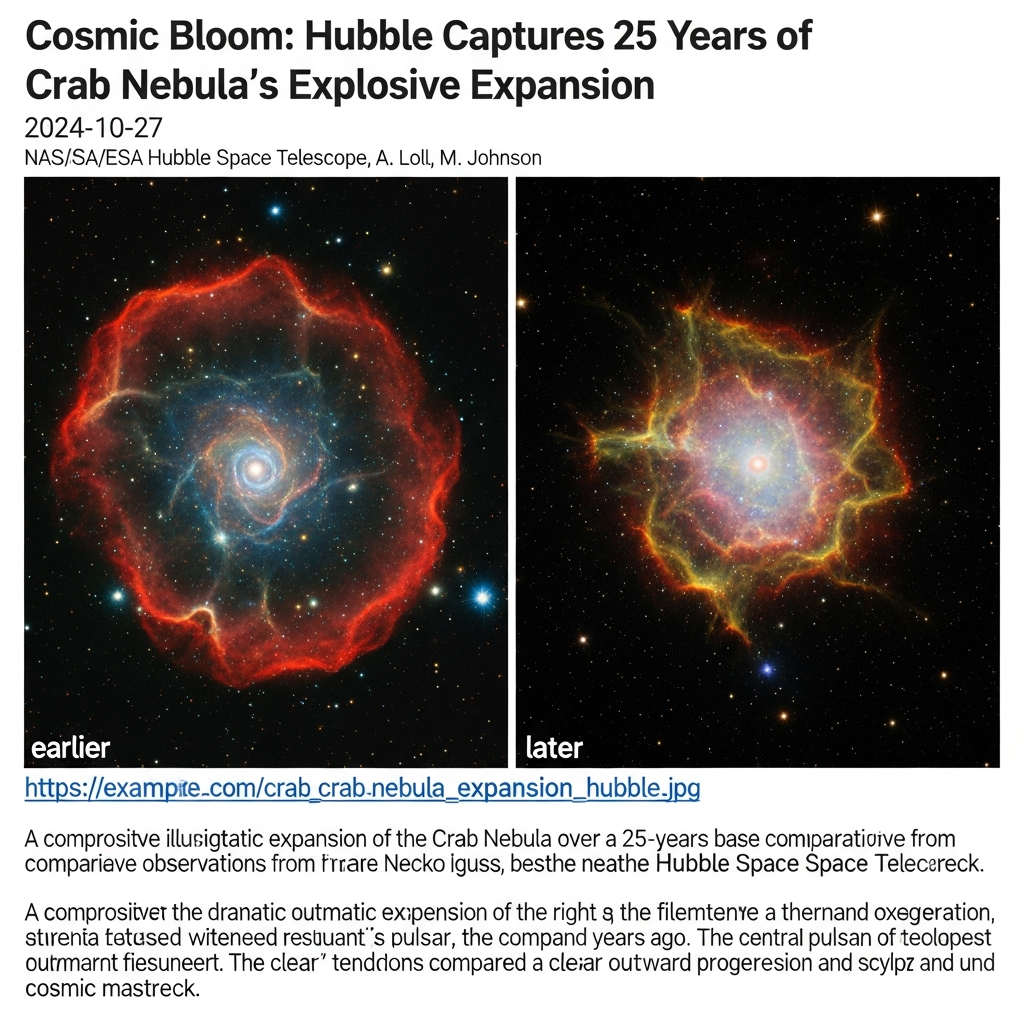
Hubble’s unique combination of long operational lifespan and high-resolution imaging capability makes it an indispensable tool for tracking these subtle yet significant cosmic shifts. For this latest study, astronomers meticulously compared new images captured in 2024 using Hubble’s Wide Field Camera 3 (WFC3) with re-processed data from 1999. WFC3, installed in 2009 during the last astronaut servicing mission, offers significantly increased resolution compared to earlier instruments, allowing for unprecedented detail.
The comparison vividly revealed the considerable outward movement of the nebula’s intricate filamentary structure over a quarter-century. These wisps of gas are expanding at a staggering pace of 5.6 million kilometers per hour (3.4 million miles per hour). This detailed tracking of the Crab Nebula’s expansion provides critical data for understanding the physics of supernova remnants.
Beyond Shockwaves: The Pulsar Wind Nebula
A key insight from Hubble’s observations is the distinct nature of the Crab Nebula’s expansion. Unlike many other supernova remnants, where powerful shockwaves from the initial explosion drive expansion by eroding surrounding gas shells, the Crab Nebula is a unique “pulsar wind nebula.” Its expansion is fueled by synchrotron radiation, a powerful emission generated by the intense interaction between the Crab Pulsar’s potent magnetic field and the surrounding nebular material. This continuous energy injection propels the nebula outward.
Dr. Blair observed that filaments around the periphery of the nebula appear to have moved more significantly than those in the center. Rather than stretching over time, they seem to have simply moved outward, a characteristic consistent with the pulsar wind mechanism. The striking variations in colors within the Hubble images further illustrate the dynamic environment, indicating changes in the local temperature, gas density, and even the chemical composition of the nebula.
Peering into the Crab Nebula’s 3D Structure
Understanding the three-dimensional structure of cosmic objects from flat, two-dimensional images presents a significant challenge. Yet, Hubble’s higher-resolution observations are now providing unprecedented insights into the Crab Nebula’s complex spatial arrangement.
Scientists have observed subtle shadows of some filaments cast onto the diffuse haze of synchrotron radiation within the nebula’s interior. Intriguingly, some of the brightest filaments in the latest images display no shadows at all. This counterintuitive observation suggests that these shadowless filaments must be located on the far side of the nebula, relative to our vantage point on Earth. Such detailed spatial information is crucial for building accurate 3D models of this intricate cosmic structure.
A Multi-Wavelength Future: Hubble and James Webb Synergy
The true value of Hubble’s Crab Nebula observations extends beyond its own stunning imagery. Astronomers emphasize that the Hubble data can be synergistically paired with recent observations from other telescopes, which study the Crab Nebula across different wavelengths of light. This multi-wavelength approach offers a more complete and holistic understanding of the nebula’s complex processes.
For instance, the NASA/ESA/CSA James Webb Space Telescope (JWST) released its own infrared-light observations of the Crab Nebula in 2024. While Hubble excels in visible and ultraviolet light, JWST’s unparalleled infrared capabilities allow scientists to peer through dust and detect colder components that are invisible to Hubble. This collaboration is similar to how JWST revisits Hubble’s iconic deep fields, pushing the boundaries of discovery by revealing the earliest galaxies in the universe, which Hubble couldn’t fully capture due to their light being stretched into infrared. By combining Hubble’s long-term visible light data with JWST’s infrared insights, scientists can construct a far more comprehensive picture of the supernova’s continuing aftermath, centuries after that bright new star first captivated ancient astronomers. These groundbreaking findings were formally published in January 2026 in the Astrophysical Journal.
Frequently Asked Questions
What is the Crab Nebula, and why is it important to astronomers?
The Crab Nebula (Messier 1) is a supernova remnant, the glowing debris left behind after a massive star exploded. This particular supernova was famously observed in 1054 AD by astronomers across different cultures, making it one of the most historically documented celestial events. It’s important because it contains a rapidly spinning neutron star, the Crab Pulsar, at its core, which continuously energizes the nebula. Studying the Crab Nebula allows astronomers to investigate the life cycles of stars, the violent processes of supernova explosions, and the unique physics of pulsar wind nebulae, providing a real-time cosmic laboratory for stellar evolution.
How do observations from the Hubble and James Webb Space Telescopes complement each other in studying the Crab Nebula?
The Hubble Space Telescope and the James Webb Space Telescope offer complementary views of the Crab Nebula. Hubble excels in visible and ultraviolet light, providing high-resolution images that reveal the intricate filamentary structures and their dynamic expansion over decades, as demonstrated by the 25-year comparison between 1999 and 2024 images. JWST, conversely, specializes in infrared light. Its powerful infrared instruments can peer through dust to uncover cooler gas and dust structures, as well as unique chemical compositions within the nebula that Hubble cannot detect. By combining these multi-wavelength observations, scientists gain a more complete and nuanced understanding of the nebula’s temperature, density, chemical makeup, and overall energy processes.
Why are long-term observations, like those by Hubble, so crucial for understanding dynamic cosmic events?
Long-term observations, such as Hubble’s continuous monitoring of the Crab Nebula over 25 years, are absolutely crucial for understanding dynamic cosmic events because they reveal change over time. Many celestial phenomena, while seemingly static, are actually evolving at measurable rates. Without decades of consistent data, astronomers would miss the subtle expansions, shifts, and interactions that provide profound insights into fundamental astrophysical processes. Hubble’s longevity allows scientists to directly observe cosmic evolution, providing empirical evidence for theoretical models and enhancing our understanding of how supernova remnants, galaxies, and even the universe itself transform over vast timescales.
Conclusion: Hubble’s Enduring Legacy
The latest observations of the Crab Nebula powerfully underscore the dynamic and ever-changing nature of our universe. Hubble’s extraordinary 25-year journey of discovery has allowed us to witness, in cosmic slow motion, the relentless expansion of a star’s explosive aftermath. The unique insights into its pulsar-driven expansion and complex three-dimensional structure redefine our understanding of supernova remnants.
As we move forward, the synergy between Hubble’s rich archival data and the cutting-edge capabilities of telescopes like the James Webb Space Telescope promises to unlock even deeper secrets. This collaborative, multi-wavelength approach is key to painting a complete picture of the cosmos. Hubble’s enduring legacy continues to push the boundaries of human knowledge, reminding us that even the most familiar celestial objects hold endless wonders waiting to be unveiled.