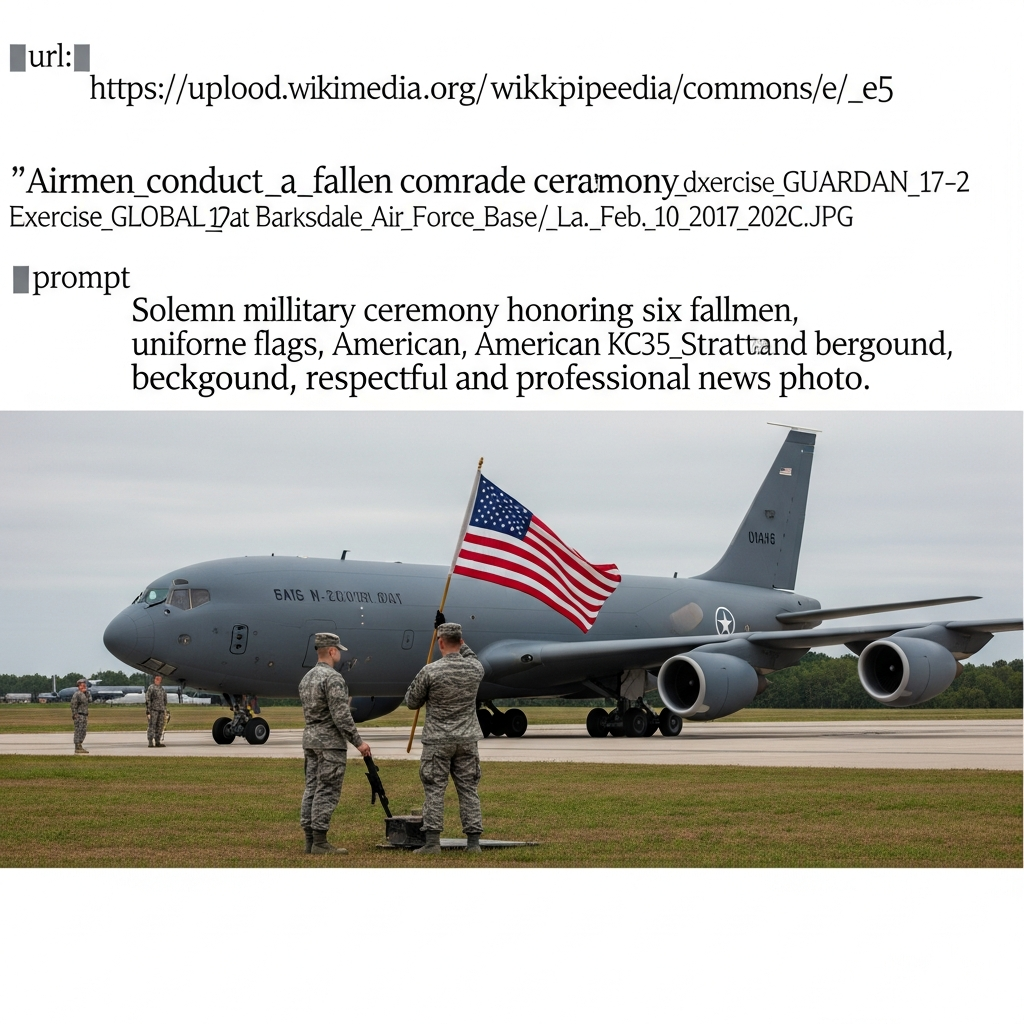
The United States military community mourns the profound loss of six dedicated service members killed in a KC-135 Stratotanker refueling aircraft crash in western Iraq last week. The Department of Defense officially identified these brave individuals as members of the Ohio Air National Guard and a Florida-based crew. This devastating incident, which occurred during critical operations against Iran, serves as a poignant reminder of the immense sacrifices made by men and women in uniform. An ongoing investigation seeks to determine the exact cause of the crash that claimed these American heroes.
Honoring the Six Fallen US Airmen
The lives of six courageous US Airmen killed in the Iraq crash are being celebrated and remembered across the nation. Their identities, released by the Department of Defense, confirm their units and home states, highlighting their diverse backgrounds united by a shared commitment to service.
The fallen service members include:
Capt. Seth R. Koval, 38, from Mooresville, Indiana.
Capt. Curtis J. Angst, 30, from Wilmington, Ohio.
Tech. Sgt. Tyler H. Simmons, 28, from Columbus, Ohio.
Maj. John A. Klinner, 33, from Auburn, Alabama.
Capt. Ariana G. Savino, 31, from Covington, Washington.
Tech. Sgt. Ashley B. Pruitt, 34, from Bardstown, Kentucky.
Captains Koval and Angst, alongside Tech. Sgt. Simmons, were integral members of the 121st Air Refueling Wing at Rickenbacker Air National Guard Base in Columbus, Ohio. This unit, part of the Ohio Air National Guard, plays a vital role in aerial refueling missions. Maj. Klinner, Capt. Savino, and Tech. Sgt. Pruitt were assigned to the 6th Air Refueling Wing, based at MacDill Air Force Base, Florida. While officially MacDill-based, their day-to-day operations stemmed from their squadron at Sumpter Smith Joint National Guard Base in Birmingham, Alabama.
Tributes and Personal Legacies
The news of the crash sent shockwaves through the families and communities of the fallen. Cheryl Simmons, the mother of Tech. Sgt. Tyler H. Simmons, shared a heartbreaking account of uniformed officers delivering the news to their home, a moment of disbelief and profound sorrow. She fondly remembered her son for his “smile that could light up any room” and his strong, comforting presence.
Maj. John “Alex” Klinner, recently promoted and deployed less than a week before the tragedy, leaves behind a devoted wife and three young children: seven-month-old twins and a two-year-old son. His brother-in-law, James Harrill, spoke of Klinner’s quiet strength, humility, and unwavering dedication as a husband and father. Klinner, an Auburn University ROTC graduate, served as a pilot trainer and instructor, accumulating 181 combat or combat support hours across four deployments since 2019, earning three medals, including the Air Medal.
Capt. Ariana G. Savino, a Central Washington University graduate, managed flight schedules and aircrew training as chief of current operations for her Alabama squadron. She completed three deployments to U.S. Central Command operations since 2020, logging 348 combat hours, and received two medals, including the Air Medal. Tech. Sgt. Ashley Pruitt, with over 2,700 flight hours and five deployments since 2018, was the non-commissioned officer in charge of readiness, overseeing vital training and flight operations. She earned three medals, including the Air Medal with silver oak leaf cluster. These personal stories underscore the immense human cost of military service.
The KC-135 Stratotanker and its Crucial Role
The aircraft involved in the incident was a KC-135 Stratotanker, a stalwart of the U.S. Air Force for over 60 years. Valued at almost $40 million each, these robust planes are primarily known for their mid-air refueling capabilities. They extend the flight duration and operational range of other military aircraft. Beyond refueling, the KC-135 also performs medical evacuations, transporting wounded personnel, and conducts surveillance missions. It even has cargo and passenger transport capabilities.
Typically operated by a three-person crew—a pilot, co-pilot, and boom operator—the crew size can expand to five for medical missions. The presence of six service members on board for this particular flight suggests the potential need for backup personnel on extended or complex missions. The Stratotanker, based on the Boeing 707 passenger plane design, is gradually being replaced by the newer KC-46A Pegasus tankers, but remains a vital asset in current operations.
Understanding KC-135 Safety and Investigations
While the KC-135 boasts a generally good safety record and is well-maintained, it has been involved in several fatal accidents throughout its long service history. Notably, a KC-135 crashed in Kyrgyzstan in 2013 due to rudder issues, killing all three on board. A more severe incident occurred in 1966 near Palomares, Spain, involving a midair collision with a B-52 bomber carrying nuclear bombs.
A point of discussion surrounding KC-135 safety involves the absence of parachutes. A 2008 Air Force news release indicated a policy of removing parachutes from KC-135s. The rationale was that it is statistically safer for crew members to remain with the aircraft, particularly over enemy territory, given the low likelihood of mishaps. It remains unclear whether parachutes were present on the aircraft that crashed in Iraq, and military officials have not commented due to the ongoing investigation.
The Incident: Unraveling the Details
The tragic KC-135 crash occurred on March 12, 2026, in western Iraq, near Turaibil, along the Iraqi-Jordanian border. An Iraqi intelligence source confirmed the location to CBS News. The U.S. Central Command (CENTCOM), overseeing Middle East military operations, confirmed the crash. They initially reported four fatalities before updating the count to six, confirming that all aboard perished.
U.S. officials, including Air Force Gen. Dan Caine, Chairman of the Joint Chiefs of Staff, explicitly stated the crash was not due to hostile or friendly fire. The incident involved an “unspecified incident” between two aircraft within “friendly airspace.” While the KC-135 went down, the second aircraft, also identified as a KC-135, managed to land safely in Israel. This detail raises further questions about the nature of the initial collision and potential crew egress options. The Defense Department has confirmed that the incident is under rigorous investigation to determine the precise circumstances.
Operation Epic Fury: A Broader Context
This devastating crash occurred during “Operation Epic Fury,” the ongoing U.S. and Israeli military operation against Iran and its allies in the Middle East. The conflict, now in its second week (having begun on February 28, 2026), has been characterized by intense military actions. President Trump stated the U.S. military had “totally obliterated every MILITARY target in Iran’s crown jewel, Kharg Island.”
This incident significantly elevates the U.S. death toll in Operation Epic Fury to at least 13 service members. Seven others were previously killed in combat, and approximately 140 U.S. service members have been injured, with eight sustaining severe injuries. This underscores the harsh realities and growing human cost of the conflict. Defense Secretary Pete Hegseth honored the lost aircrew as “American heroes,” acknowledging the inherent chaos and tragedy of war, stating, “War is hell. War is chaos. And as we saw yesterday with the tragic crash of our KC-135 tanker, bad things can happen.” Gen. Caine echoed these sentiments, highlighting the “incredible sacrifice” made by service members.
The broader conflict has seen Israeli forces conducting strikes in southern Lebanon and Iran, targeting ballistic missile launchers and air defense systems. Hezbollah and Iranian-backed militias have retaliated with rocket attacks into northern Israel and Iraq’s Kurdistan region. The humanitarian impact is severe, with thousands killed and millions displaced in Iran and Lebanon. This complex and escalating regional dynamic provides the somber backdrop to the loss of these six dedicated airmen.
Frequently Asked Questions
What was the context of the KC-135 crash in Iraq?
The KC-135 Stratotanker crash occurred on March 12, 2026, in western Iraq near the Iraqi-Jordanian border. The aircraft was participating in “Operation Epic Fury,” a joint U.S. and Israeli military operation against Iran and its allies in the Middle East. The incident involved an “unspecified event” between two KC-135 aircraft within “friendly airspace.” While the plane that crashed resulted in six fatalities, the other aircraft involved landed safely in Israel. U.S. officials have confirmed that the crash was not due to hostile or friendly fire.
Who were the U.S. service members killed in the Iraq crash?
Six U.S. service members were killed in the tragic KC-135 crash. They have been identified as Capt. Seth R. Koval, Capt. Curtis J. Angst, and Tech. Sgt. Tyler H. Simmons, all from the 121st Air Refueling Wing, Ohio Air National Guard. The other three fallen airmen were Maj. John A. Klinner, Capt. Ariana G. Savino, and Tech. Sgt. Ashley B. Pruitt, assigned to the 6th Air Refueling Wing, based at MacDill Air Force Base, Florida, though operating day-to-day from a squadron in Birmingham, Alabama.
What is being done to investigate the KC-135 Stratotanker incident?
The Defense Department has initiated a thorough investigation into the KC-135 Stratotanker crash to determine its precise cause. While the U.S. Central Command and senior military leaders have explicitly stated that the incident was not a result of hostile or friendly fire, the exact circumstances remain under review. This investigation will analyze all available data, including communications, flight recorders, and wreckage, to understand what led to the “unspecified incident” involving the two aircraft and the subsequent crash in western Iraq.
A Lasting Legacy of Sacrifice
The tragic loss of these six US Airmen killed in the Iraq crash underscores the inherent dangers and profound personal sacrifices associated with military service. Their dedication to their mission and their country will not be forgotten. As the investigation continues into the circumstances surrounding the KC-135 Stratotanker incident, their memory will serve as a stark reminder of the cost of freedom and the unwavering commitment of America’s service members. The nation stands with their families, units, and communities in mourning, honoring their courage and remembering their invaluable contributions to Operation Epic Fury and beyond.