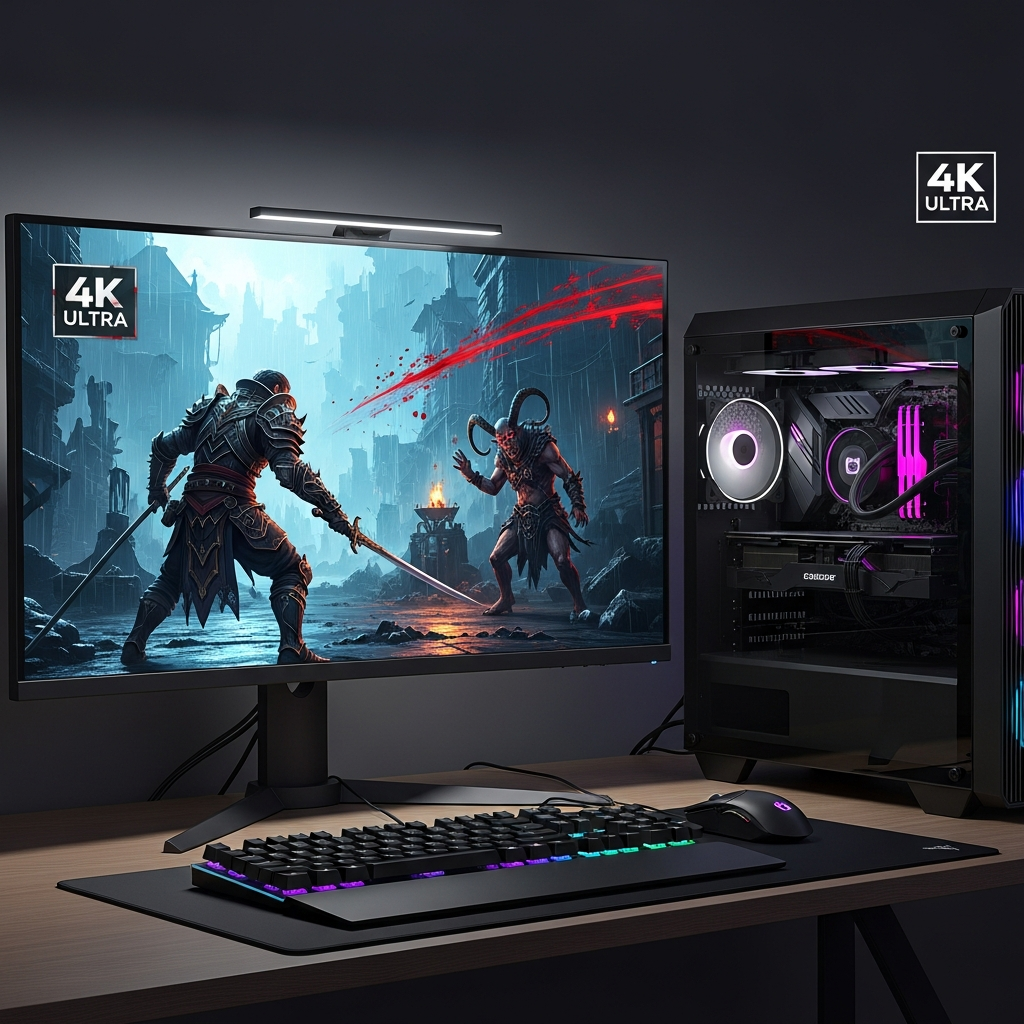
Prepare to delve into the dark, enthralling world of The Blood of Dawnwalker, but be warned: achieving peak visual fidelity on PC will test the limits of your hardware and wallet. Developer Rebel Wolves, a studio boasting former CD Projekt Red talent, has unveiled “extreme” system requirements for its highly anticipated action RPG. While the game promises a rich, non-linear experience, maximizing it at native 4K resolution with Ultra settings demands an unprecedented investment, with the graphics card alone costing upwards of $3,000. This article breaks down exactly what it takes to run this demanding title at its best and explores whether the cutting-edge visuals are worth the formidable price tag.
The Blood of Dawnwalker: A New Benchmark for PC Hardware?
The Blood of Dawnwalker is poised to push graphical boundaries, following a trend seen in other recent, visually stunning titles. Rebel Wolves has released a detailed chart outlining hardware needs across various resolutions, quality presets, and target frame rates. This transparency helps players understand the leap in power needed for higher settings.
Unpacking the Extreme 4K Ultra Requirements
For casual players, The Blood of Dawnwalker‘s minimum requirements are quite reasonable. An RTX 3050 or GTX 1070 will get you started at 1080p, delivering a playable 30 frames per second. However, the story changes drastically for those aiming for the pinnacle of graphical performance. To fully max out the game’s settings at 4K resolution and a smooth 60 frames per second, the system demands an NVIDIA RTX 5090. This specification applies to native 4K rendering, meaning no performance-enhancing upscaling technologies are factored in.
The RTX 5090: The Price of Peak Performance
The RTX 5090 stands as the most expensive consumer graphics card in recent memory. Launched in January 2026 with a hefty $1,999 price tag, its market value has since soared. Current listings on retailers like Newegg show prices starting around $3,699, and often higher. This makes assembling a PC capable of running The Blood of Dawnwalker at its absolute best a significant financial undertaking. Such a high demand raises questions about game optimization versus raw graphical ambition.
Optimizing Your Experience: Native 4K vs. Upscaling Technologies
The hardware demands for native 4K Ultra settings are undeniable. However, modern gaming offers solutions that can significantly reduce the strain on your GPU. Understanding these options is key to enjoying The Blood of Dawnwalker without breaking the bank.
DLSS and FSR: Your Potential Cost-Saver
The developers explicitly state that the RTX 5090 requirement is for native 4K. This is a critical distinction. Technologies like NVIDIA’s DLSS (Deep Learning Super Sampling) and AMD’s FSR (FidelityFX Super Resolution) can dramatically cut down GPU load. These intelligent upscaling methods render the game at a lower internal resolution, then use AI or advanced algorithms to reconstruct a high-quality image at your monitor’s native resolution. This often results in a nearly identical visual experience with a substantial boost in frame rates, making high-end 4K gaming more accessible. It’s highly probable that engaging DLSS or FSR will allow less powerful (and less expensive) GPUs to achieve excellent 4K performance in The Blood of Dawnwalker.
Beyond the Specs: What Makes Dawnwalker So Demanding?
These extreme specifications aren’t just arbitrary numbers. They hint at a game designed with a singular vision: to deliver an incredibly rich, detailed, and immersive experience. The pedigree of Rebel Wolves and the ambition of the game’s world likely contribute to these high demands.
Rebel Wolves’ Pedigree: CD Projekt Red Alumni Influence
Rebel Wolves was founded and is led by Konrad Tomaskiewicz, the development director of The Witcher 3. This strong connection to CD Projekt Red alumni suggests a studio committed to pushing graphical and narrative boundaries. The Witcher 3 was renowned for its stunning visuals and demanding hardware upon its release, a legacy The Blood of Dawnwalker seems poised to continue. This background indicates that the focus on high-end gaming PCs might be a deliberate design choice, aiming for a truly cutting-edge visual and gameplay experience. The game also uniquely acknowledges Intel GPUs in its system requirements, a welcome nod to another player in the hardware space.
The Ambitious World of Vale Sangora
The game is set in a vividly described 14th Century Europe, specifically in Vale Sangora within the Carpathian Mountains. This era is plagued by “bloody conflicts” and the Black Death, creating a fertile ground for vampires and other nocturnal creatures to rise. The world is presented as a diverse land of swamps, forests, mountains, and bustling cities like Svartrau. From the outset, the entire map is visible, though activities must be discovered. Such an expansive and detailed open world, filled with complex environments and a rich narrative, naturally requires significant processing power to render.
Gameplay & Narrative: Why The Hype?
High system requirements aren’t the only draw. The Blood of Dawnwalker promises a deeply engaging and innovative gameplay experience that could justify the hardware investment for many.
Dual Nature: Human vs. Vampire Combat and Exploration
Players embody Coen, a young Dawnwalker who is half-human and half-vampire. This dual nature is central to the gameplay, influencing both combat and exploration across dynamic day and night cycles. During the day, Coen’s human side emphasizes tactical sword combat, utilizing various attack directions, blocks, and parries to build “Activation Charges” for powerful “Active Abilities.” By night, Coen embraces his vampiric powers, gaining enhanced movement abilities like “Shadowstep” and “Clawride” to navigate rooftops, alongside a different set of claw-based combat skills. This fundamental shift in abilities and sensory perception between day and night cycles offers rich strategic depth.
The “No Main Quest” Philosophy & Player Freedom
A standout feature is the game’s radical approach to quest design: there is “no main quest” in the traditional sense. Instead, players “build their experience from the quests they encounter.” The overarching goal—confronting the main enemy—is accessible at any time. This mirrors the freedom of classic RPGs like the original Fallout, allowing players to tackle challenges immediately or spend time developing their character, acquiring items, and forging alliances. This narrative sandbox design promises unparalleled player agency and replayability.
A Ticking Clock and Moral Choices
Coen faces a grim deadline: 30 in-game days to prevent his family’s execution by the vampire monarchy. Crucially, this clock only advances when specific narrative goals are completed or the day/night cycle changes, allowing limitless real-world time for exploration. This mechanic adds urgency without constant pressure. Furthermore, the game delves into profound moral dilemmas, forcing players to choose between fighting for their humanity or embracing cursed powers to save loved ones. The world blurs traditional moral lines, with allies and enemies found in unexpected places.
Understanding the Game’s Release & Future Outlook
The Blood of Dawnwalker is set to launch on September 3, 2026, across PS5, Xbox Series X|S, and PC. While the initial PC requirements appear daunting, early benchmarks will be crucial to understand real-world performance. The developer’s experience and the game’s ambitious design suggest a title that aims to provide a premium experience. As a Hardware and Buying Guides Editor at IGN, Jackie Thomas intends to put the game through its paces on various GPUs upon release, hoping it makes good use of the powerful hardware it demands. The Witcher 3 certainly set a high bar for its era, and expectations are similar for Dawnwalker.
Frequently Asked Questions
What are the core gameplay mechanics of The Blood of Dawnwalker?
The Blood of Dawnwalker features a unique dual gameplay system where protagonist Coen switches between human and vampire forms, influencing combat and exploration based on day and night cycles. As a human, combat is tactical sword-based, building “Activation Charges” for special abilities. As a vampire, Coen uses claws and gains enhanced movement like “Shadowstep.” The game also boasts a “no main quest” design, giving players immense freedom to progress, and an in-game “ticking clock” of 30 days to save his family, which only advances on specific narrative triggers, not constant real-world time.
Is an RTX 5090 truly necessary to enjoy The Blood of Dawnwalker on PC?
While an RTX 5090 is recommended for achieving native 4K resolution at 60 frames per second with Ultra settings, it’s likely not essential for a fantastic experience. The developer states this requirement is for native 4K, meaning without upscaling technologies. Using features like NVIDIA’s DLSS or AMD’s FSR can significantly reduce the GPU load, allowing less powerful (and more affordable) graphics cards to achieve excellent 4K performance with minimal visual compromise. Players can also adjust settings or aim for lower resolutions to enjoy the game.
Who are Rebel Wolves, and what is their vision for The Blood of Dawnwalker?
Rebel Wolves is a game development studio founded by Konrad Tomaskiewicz, known for his role as development director on The Witcher 3. This connection to CD Projekt Red alumni shapes their vision for The Blood of Dawnwalker, which emphasizes a rich, narrative-driven RPG experience with ambitious visuals. Their core design philosophy revolves around player freedom, offering a “no main quest” structure where players build their own experience and tackle objectives at their discretion, reminiscent of classic Fallout games. The game is set in a dark 14th Century European world where vampires rise amidst human conflict and plague.
Conclusion
The Blood of Dawnwalker is clearly set to be a visually stunning and deeply immersive RPG, demanding top-tier PC hardware to experience its full glory at native 4K. While the upfront cost of an RTX 5090 might deter some, the promise of an expansive world, innovative gameplay mechanics, and unprecedented player freedom makes it an enticing prospect for enthusiasts. For most, leveraging advanced upscaling technologies like DLSS or FSR will offer a more accessible path to high-resolution gameplay. As the September 3 launch approaches, the gaming community eagerly awaits performance benchmarks to see if this ambitious title truly delivers an experience worthy of its “extreme” system requirements.