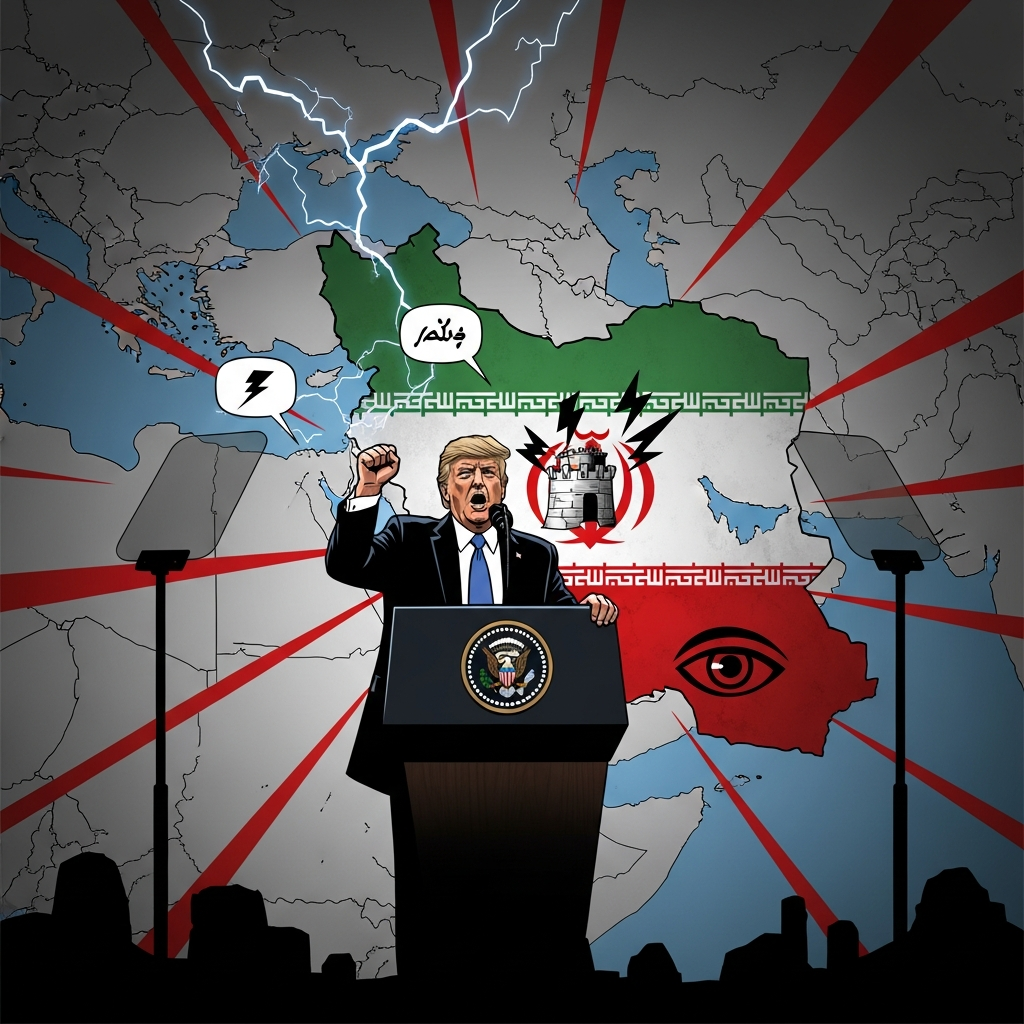
As March 2026 unfolds, the US-Iran conflict has reached a critical juncture, marked by intense escalation across the Middle East. President Trump has vowed “hard strikes” against Iran, emphasizing a firm resolve to dismantle its military capabilities. Concurrently, Tehran maintains a defiant stance, rejecting any notion of surrender despite mounting casualties and regional pressure. This rapidly evolving crisis not only reshapes geopolitical alliances but also sends significant ripple effects through global energy markets and international diplomacy.
The Week’s Escalation: A Shifting Battlefield
The conflict, now in its second week, reveals a complex and dangerous landscape. Contradictory signals from Iranian leadership, combined with unwavering US and Israeli military action, paint a picture of profound instability.
Trump’s “Hard Strikes” & Unyielding Stance
President Trump has made his intentions clear, publicly asserting a commitment to “hit Iran very hard.” Traveling to Dover Air Force Base for the dignified transfer of fallen US service members, including Sgt. Declan Coady, Trump honored them as heroes and pledged to minimize further American war deaths. The President remained “unbothered” by political threats, signaling his unwavering determination to continue the conflict. He articulated a goal of rendering Iran incapable of fighting back, even if “unconditional surrender” wasn’t the immediate objective.
Beyond military action, Trump has indicated he expects a personal role in shaping Iran’s post-conflict leadership. He explicitly rejected Mojtaba Khamenei, son of the recently assassinated Supreme Leader Ayatollah Ali Khamenei, as a potential successor, deeming him “unacceptable” and a “lightweight.” Trump drew parallels to US-backed political transitions elsewhere, aiming to ensure Iran’s next leader would not pose a threat to America. Defense Secretary Pete Hegseth and CENTCOM commander Adm. Brad Cooper affirmed that the US has “no shortage of munitions” and is focused on “systemically dismantling Iran’s missile production capability” and “razing or leveling” its missile industry to prevent a future rebuild. This next phase aims to “clean out everything,” according to Trump, preventing a resurgence over the next decade.
Iran’s Defiance Amidst Division
Within Iran, a complex internal dynamic emerged alongside a public display of defiance. Iranian President Masoud Pezeshkian initially offered an apology to “neighboring countries affected” by Iranian strikes, promising to halt attacks. However, within hours, strikes continued against Qatar, Bahrain, and the United Arab Emirates, prompting a retraction of his earlier remarks. This inconsistency suggested either internal divisions or a rapid shift in strategic messaging.
Despite Pezeshkian’s initial statements, other Iranian bodies presented a united and defiant front. Iran’s Foreign Ministry affirmed its commitment to continue strikes on territories hosting US offensive forces. The Defense Ministry boasted sufficient strategic munitions for a “protracted campaign.” A spokesperson for the Islamic Revolutionary Guard Corps issued a direct challenge to President Trump, declaring, “The ground and the map of the war is in our hands. This will continue.” Pezeshkian himself later rejected Trump’s demand for “unconditional surrender,” calling it “a dream they will take to their graves.” Maj. Gen. Amir Haidari, deputy head of Iran’s central military command, stated Iran is “unrelenting and unready to yield,” vowing not to stop the war until objectives are met. Iran’s government reported over 1,200 casualties from US and Israeli strikes, with a human rights group noting more than 1,100 civilian deaths, including children.
Regional Turmoil: Strikes Across the Middle East
The conflict’s reach has expanded far beyond Iran’s borders, engulfing multiple nations in a surge of missile and drone attacks. The entire region is navigating unprecedented levels of aerial bombardment and naval engagements.
Gulf Nations Under Fire
Several Gulf Cooperation Council (GCC) states have borne the brunt of Iranian missile and drone attacks. Qatar’s Ministry of Defence reported that 10 ballistic missiles and two cruise missiles were fired from Iran on Saturday, March 7. Qatar’s armed forces successfully intercepted six ballistic missiles and both cruise missiles, while two ballistic missiles landed in uninhabited areas and two fell in territorial waters without causing casualties. Qatar also intercepted an Iranian drone targeting the major US Al Udeid airbase and arrested 10 suspected Iranian agents.
Saudi Arabia’s Ministry of Defence announced the interception and destruction of eight drones after they entered Saudi airspace, without providing further details on their origin or location. Bahrain’s capital, Manama, saw one person injured and several shops damaged by falling missile fragments on a public road, with Civil Defence actively securing and evacuating affected areas. The United Arab Emirates reported intercepting seven missiles and 131 drones in a single day, with six people injured by falling debris in Abu Dhabi. A significant incident involved a drone strike hitting Dubai’s world’s busiest airport, temporarily halting flights. Arab states are reportedly rapidly depleting their interceptor supplies and have urgently requested expedited deliveries from the US.
Israel and Hezbollah: A Second Front
The conflict has also reignited hostilities between Israel and Hezbollah, Iran’s allied force in Lebanon, effectively opening a significant second front. Israel launched fresh attacks on Iran while simultaneously facing incoming fire from Hezbollah, which triggered sirens in Tel Aviv. These intensified Israeli strikes in Lebanon, targeting Hezbollah infrastructure, have led to widespread evacuations and “pandemonium” in Beirut’s southern suburbs. Lebanon’s health ministry reported at least 102 fatalities from the Israeli strikes. Israeli Prime Minister Benjamin Netanyahu stated the war fulfills a 40-year ambition to “strike the terrorist regime,” while President Isaac Herzog cited concerns about Iran’s expanding weapons arsenal and a “new secret plan to rush” to develop nuclear weapons as justification.
New Fronts and Naval Engagements
The geographical scope of the conflict continued to broaden. For the first time, Iranian drones struck Azerbaijan, hitting an airport and a school and injuring two people. Azerbaijan condemned this “act of terror and aggression” and threatened “retaliatory measures,” though Iran’s foreign minister denied involvement, blaming Israel.
Naval actions also saw significant developments. The USS Charlotte, a US attack submarine, achieved a rare feat, sinking the Iranian warship IRIS Dena off Sri Lanka’s coast – the first submarine sinking of a surface warship since World War II. Sri Lanka subsequently took control of another Iranian vessel after it sought assistance. Iran’s Foreign Minister Abbas Araghchi called the sinking of the IRIS Dena an “atrocity at sea.”
International Response and Geopolitical Ripple Effects
The escalating crisis has drawn in a wider array of international actors, reshaping alliances and forcing nations to adapt to the new geopolitical reality.
US-Israel Strategic Coordination
US and Israeli officials confirmed that war-gaming for the initial strike, including the assassination of Ayatollah Ali Khamenei, began in June 2023, receiving US consent and support in June 2025. A clear division of labor exists: Israel targets Iranian leadership and launchers, while the US focuses on Iran’s Navy, Revolutionary Guard, and maintaining the openness of the Strait of Hormuz. Officials believe Iran’s missile capacity is now 80% debilitated, and its command and control structures are in disarray. The objective is to degrade Iran’s military capacity and foster new ideologies, rather than immediate regime collapse.
European Allies Join the Fray
Initially cautious, European allies have begun to pledge support for the US war effort. British Prime Minister Keir Starmer reversed his non-interventionist stance after an Iranian drone strike on a British base in Cyprus and broader regional attacks. The UK will deploy additional RAF Typhoon jets, Wildcat helicopters, and the Royal Navy destroyer HMS Dragon to the eastern Mediterranean, while also granting US forces access to British bases. Cyprus, strategically located, has become a critical hub for intelligence, surveillance, and logistics. Italy, Spain, and France have also pledged aid to Cyprus or authorized temporary access to US aircraft on their bases, further increasing US basing options and “firepower over Iran and over Tehran.”
Other Global Players
The conflict’s reach extends further. Ukraine, with extensive experience defending against Iranian-made Shahed drones, has been approached by the US and its allies for “expertise and practical support.” President Zelensky agreed to assist, conditional on it not compromising Ukraine’s own defenses. Meanwhile, Russia, a key ally of Iran with a cooperation pact signed in January 2025, has vowed to “do everything in its power to create conditions to make U.S.-Israeli strikes in Iran impossible.” The US and Israel are also coordinating with Kurdish armed groups along the Iran-Iraq border, a move that could ignite a new ground front, especially after Iranian forces launched missile and drone strikes against Kurdish-controlled areas in northern Iraq. Omani Foreign Minister Sayyid Badr bin Hamad Albusaidi held meetings with ambassadors from non-EU European states, the US, Brazil, Turkiye, and GCC states, Egypt, Iraq, and Jordan, discussing the “utmost priority of continuing and intensifying political and diplomatic pressures to stop the war” and contain its repercussions.
Economic Fallout and Humanitarian Concerns
The geopolitical crisis has profound economic consequences and raises significant humanitarian alarms across the affected regions.
Global Market Impact
The conflict has had a substantial global economic impact, jolting markets and sending oil prices soaring past $80 a barrel. The Dow Jones Industrial Average experienced a significant drop of nearly 800 points. While dismissing short-term concerns about rising gas prices, President Trump claimed that US actions would ultimately boost regional stability, oil prices, and stock markets in the “long term.”
Airspace and Maritime Disruption
The closure of airspace across much of the Gulf region has stranded thousands of travelers. Major carriers like Etihad Airways, Emirates, and Qatar Airways are gradually resuming limited “relief flights.” Israel’s airspace also reopened for limited incoming flights. Maritime activity has also been severely impacted, with the UN’s International Maritime Organization reporting 20,000 seafarers and 15,000 cruise passengers stranded in the Persian Gulf. This disruption highlights the intricate vulnerabilities of global logistics and travel infrastructure to regional conflicts.
Casualties and Emergency Measures
The human toll of the conflict is significant. Iranian officials reported over 1,200 casualties in Iran since the war began. The falling missile fragments in Manama, Bahrain, which injured one person and damaged shops, underscore the immediate danger to civilians. Civil Defence units swiftly moved to secure and evacuate affected areas. Furthermore, the Trump administration controversially bypassed congressional review to approve the sale of over 20,000 bombs to Israel, valued at approximately $650 million. The State Department cited an emergency, waiving the usual review process. A UN report from December 2024 noted that similar heavy munitions had likely been used by Israel in densely populated areas of Gaza during its war on the Palestinian territory, raising questions about international humanitarian law.
Challenges and The Path Forward
As the conflict intensifies, several complex challenges remain, from the future of Iran’s nuclear program to the internal political landscape in the US.
The Nuclear Question
A critical underlying concern remains Iran’s potential nuclear ambitions. Israeli officials explicitly linked their actions to intelligence suggesting Iran had a “new secret plan to rush” to develop a nuclear weapon. This concern persists despite prior US intelligence assessments indicating Iran was not actively building a nuclear weapon, highlighting a potential intelligence gap or differing threat perceptions among allies.
Political Divisions & War Powers
Domestically in the US, efforts to curtail presidential war powers have failed. Both the House and Senate defeated resolutions to withdraw US forces and limit future hostilities, largely along party lines. This political division persists despite a CNN/SSRS poll indicating that 59% of Americans disapprove of the US military action against Iran. Senate Minority Leader Chuck Schumer (D-N.Y.) noted a public sentiment of betrayal, signaling a disconnect between public opinion and legislative action.
The AI and Sanctions Context
In other significant developments, the Pentagon formally designated AI firm Anthropic as a supply chain risk amidst a dispute over AI guardrails, specifically Anthropic’s push to ban military use for mass surveillance or autonomous weapons. Separately, the US temporarily lifted some sanctions to allow India to purchase Russian oil, a move designed to mitigate surging global oil prices in the midst of the conflict. Additionally, NATO increased its ballistic missile defense posture after intercepting a missile heading for Turkey, further indicating heightened regional alert.
Frequently Asked Questions
What triggered the significant escalation of the US-Iran conflict in March 2026?
The current intense escalation, now in its second week as of March 2026, was triggered by sustained military actions by the United States and Israel against Iran, following the assassination of Supreme Leader Ayatollah Ali Khamenei in the conflict’s opening phase. President Trump’s administration has vowed “hard strikes” to dismantle Iran’s military capabilities, while Israel cited concerns over Iran’s expanding weapons arsenal and a “new secret plan to rush” to develop a nuclear weapon. These actions initiated a series of retaliatory missile and drone attacks by Iran across the Middle East.
Where are the primary areas of military engagement and humanitarian concern in the escalating Iran war?
Military engagement is widespread across the Middle East. Key areas include Qatar, Saudi Arabia, Bahrain, and the UAE, which have faced numerous Iranian missile and drone attacks. Lebanon has become a significant second front with intensified Israeli strikes against Hezbollah and retaliatory fire. Azerbaijan also saw Iranian drone strikes for the first time. Humanitarian concerns are high, with over 1,200 casualties reported in Iran, and incidents like falling missile fragments injuring civilians in Bahrain. Airspace closures and maritime disruptions in the Persian Gulf have stranded thousands, highlighting the broad impact on civilian life and regional stability.
How is the ongoing US-Iran conflict impacting global oil markets and regional stability?
The conflict has severely impacted global oil markets, with prices soaring past $80 a barrel and the Dow Jones Industrial Average experiencing a significant drop. This instability reflects market anxieties over supply disruptions in the critical oil-producing Middle East. Regionally, the conflict has exacerbated instability, leading to widespread missile and drone attacks on multiple nations, straining air defenses, and creating new humanitarian crises. Diplomatic efforts by nations like Oman highlight concerns about containing the conflict’s repercussions and underscore the urgent need for political and diplomatic pressures to restore stability.
Conclusion
The US-Iran conflict in March 2026 stands as a defining moment for the Middle East and beyond. With President Trump committed to dismantling Iran’s military capacity and Tehran maintaining a defiant posture, the path forward remains highly uncertain. The widespread regional attacks, significant economic fallout, and complex international responses underscore the profound and lasting implications of this escalating crisis. As events continue to unfold, global attention remains fixed on the unpredictable trajectory of this high-stakes confrontation and its potential to reshape the international order.