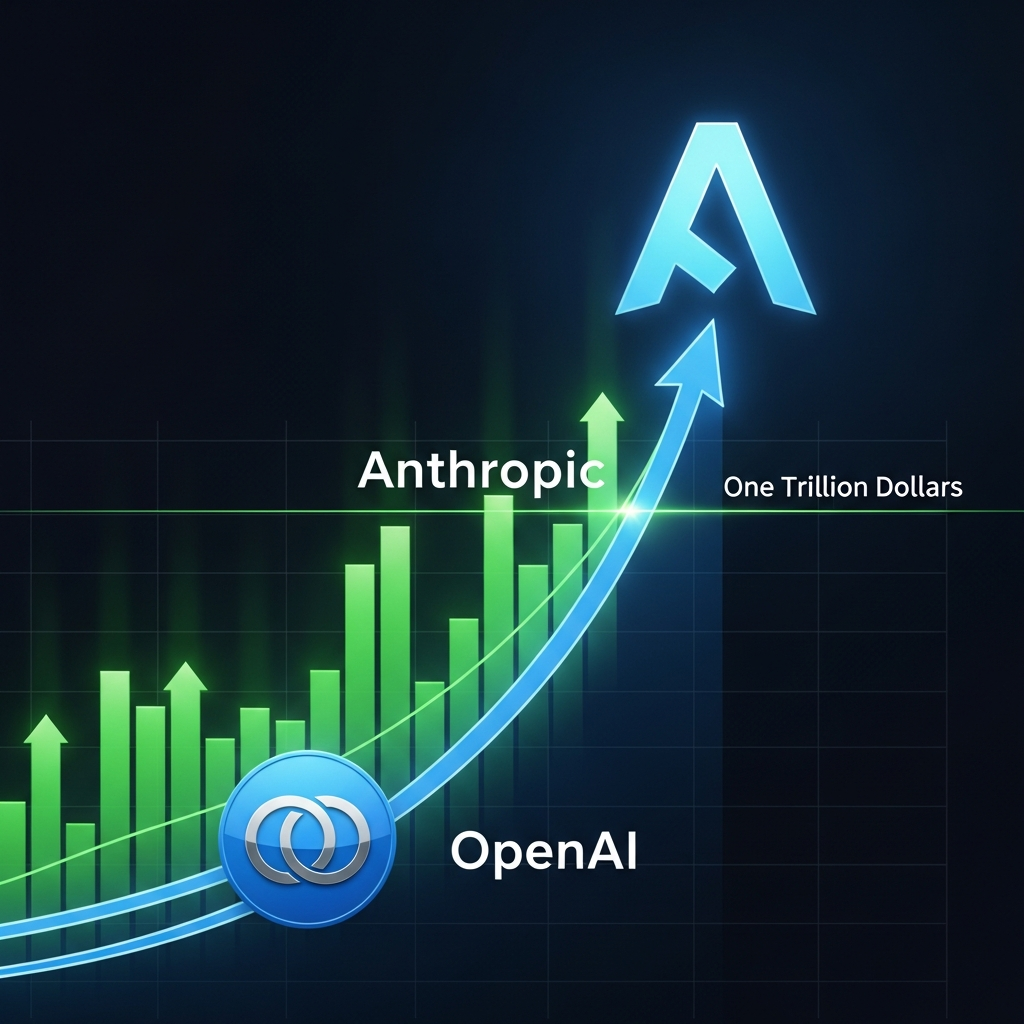
The artificial intelligence landscape is witnessing an unprecedented shift. Anthropic, the innovative AI firm behind the Claude models, has dramatically surged past a $1 trillion valuation on secondary markets, eclipsing its formidable rival, OpenAI. This remarkable ascent, fueled by fervent investor demand, solidifies Anthropic’s position as a frontrunner in the intensely competitive generative AI space. The sudden revaluation highlights a significant shift in market sentiment and a scramble for a piece of what many see as a “generational opportunity.”
Anthropic’s Rapid Ascent to Trillion-Dollar Status
Just a few months ago, Anthropic secured a funding round that valued the company at $380 billion. Today, its valuation on platforms like Forge Global, a leading private marketplace exchange, hovers around $1 trillion. This staggering leap reflects a “feverish demand” from buyers desperate to acquire a dwindling supply of secondary shares. In contrast, OpenAI, previously valued at $852 billion, now sees its shares trading at $880 billion on the same platform, a figure notably surpassed by Anthropic’s recent surge. This dynamic marks a clear re-evaluation within the private investment community.
Dario Amodei, Anthropic’s co-founder and CEO, leads a company that has captured the attention of venture capitalists and family offices alike. This explosive growth is not merely speculative; it’s backed by “torrid revenue growth” and significant momentum. The company’s annualized revenue reportedly soared from $9 billion at the close of 2025 to an impressive $30 billion by March 2026. This exponential increase is largely attributed to the strong adoption of its AI-powered coding assistant, Claude Code, which alone generates over $2.5 billion in annualized revenue.
Driving Forces Behind the Valuation Frenzy
Several factors are propelling Anthropic’s valuation skyward. Investors are particularly impressed by the company’s rapid expansion and its strong product-market fit. Anthropic’s enterprise customer base has expanded dramatically, with the number of businesses spending over $1 million annually doubling in less than two months, now exceeding 1,000 clients. Furthermore, a substantial 80% of its revenue originates from over 300,000 business customers, including eight of the Fortune 10 companies. This strong enterprise focus suggests high retention and robust expansion economics.
The excitement is also fueled by Anthropic’s aggressive product roadmap. The company is preparing to release its next flagship AI model, Claude Opus 4.7, and an innovative AI-powered design tool. This new tool, designed for both technical and non-technical users, aims to simplify the creation of presentations, websites, and landing pages using natural language commands. Such advancements position Anthropic as a direct competitor to established players like Adobe, Figma, and Wix, further justifying investor confidence in its future market share.
Inside the High-Stakes Secondary Market
For Anthropic and OpenAI, both private companies, the vast majority of investment activity occurs on secondary markets. Here, existing shares are bought and sold by current or former employees and early investors. The demand for Anthropic shares has reached unprecedented levels. Ken Sawyer, cofounder of Saints Capital, reported an offer to offload shares at an astounding $1.15 trillion valuation. Jesse Leimgruber of OpenHome recounted a “very well known growth fund” proposing to buy shares at $1.05 trillion, describing the situation as “absolutely wild.” Some desperate buyers have even resorted to offering to sell their homes in exchange for Anthropic shares, a testament to the intense desire to participate in this AI boom.
Glen Anderson, CEO of Rainmaker Securities, a merchant bank specializing in private securities, notes the extreme scarcity of sellers. Offers to buy shares at valuations as high as $960 billion are snapped up within a day. Existing Anthropic shareholders, like Bradley Horowitz of Wisdom Ventures, confirm receiving “daily offers from the ridiculous to the sublime,” but are “playing a long game” and holding onto their investments. Much of this demand is driven by FOMO—the Fear Of Missing Out—with investors feeling compelled to own Anthropic shares, sometimes regardless of the price. The prestige of being an Anthropic investor appears to be a significant motivator, further inflating market prices.
OpenAI’s Shifting Sands and the Investor Dilemma
While Anthropic experiences this frenzied demand, the market for OpenAI shares has been notably “tepid” this year. Anderson reports little enthusiasm, with bids often lower than OpenAI’s last primary valuation. This marks a significant shift in investor sentiment, with the spotlight “certainly shifted to Anthropic.” While OpenAI, led by CEO Sam Altman, made history with its $122 billion fundraising round, skepticism lingers about its ability to maintain its premium valuation against Anthropic’s rapid growth.
OpenAI is strategically pivoting towards enterprise customer reorientation to counter Anthropic’s rising competitive threat. However, Anthropic’s annualized revenue growth of 233% in a single quarter (from late 2025 to early 2026) compared to OpenAI’s more measured expansion, presents a clear challenge. The growing valuation disparity on secondary markets underscores this dilemma, with some investors questioning if OpenAI’s future IPO would need to exceed $1.2 trillion to justify current private market investments, making Anthropic’s valuation seem relatively more grounded.
The Looming IPO Showdown
The competitive intensity between Anthropic and OpenAI is set to escalate further with both companies reportedly eyeing significant Initial Public Offerings (IPOs). Anthropic is preparing for a potential IPO in October 2026, targeting a valuation between $400 billion and $500 billion, with Goldman Sachs and JPMorgan Chase advising. This could be the second-largest AI IPO in history.
Anthropic’s unique Public Benefit Corporation (PBC) structure, established by its founders (former OpenAI researchers Dario and Daniela Amodei due to philosophical disagreements over AI safety), emphasizes prioritizing societal impact alongside shareholder returns. This structure, while reassuring for safety-conscious investors, might require public market investors to adjust their expectations regarding pure profit maximization.
However, Anthropic projects a shorter path to profitability, with positive free cash flow by 2027, despite substantial cash burn ($12 billion for model training and $7 billion for inference in 2026). In contrast, OpenAI reportedly targets breakeven by 2030. As both companies race for institutional allocation budgets, Anthropic’s S-1 filing will be critical, needing to address concerns around revenue recognition (especially regarding cloud computing credits), gross margins, profitability projections, and customer concentration. This IPO showdown will be a defining moment for the commercialization of AI.
Risks and the Road Ahead
Despite the dazzling valuations, significant risks persist. Anthropic’s substantial cash burn, coupled with potential pressure on gross margins due to escalating inference costs, will be closely watched. Fierce competition from other tech giants like Google DeepMind, Meta (Llama), and emerging AI labs also remains a constant threat. Regulatory uncertainty surrounding AI also poses compliance challenges, though Anthropic’s safety-first stance may prove advantageous in this evolving landscape. The outcome of this high-stakes competition will profoundly shape the future of artificial intelligence.
Frequently Asked Questions
How did Anthropic’s valuation reach $1 trillion so quickly on secondary markets?
Anthropic’s valuation surged to $1 trillion primarily due to “feverish demand” for its shares on private secondary markets. This rapid increase is driven by “torrid revenue growth”—from $9 billion to $30 billion annualized revenue in just months—and strong adoption of its AI-powered coding assistant, Claude Code. Investor “FOMO” (Fear Of Missing Out) also plays a significant role, as buyers scramble for limited shares, sometimes offering over $1.15 trillion, far exceeding its last official funding round valuation of $380 billion. The scarcity of sellers further inflates these prices.
Where can investors buy Anthropic shares before an IPO?
Since Anthropic is not yet a public company, the vast majority of investors acquire shares through private secondary markets. Platforms like Forge Global and Caplight facilitate these transactions, allowing existing shareholders (often former employees or early investors) to sell their stock. Accredited investors may also gain indirect exposure through venture secondary firms or, in some cases, through specialized ETFs like the KraneShares AGIX ETF that hold stakes in private AI companies. Post-IPO, shares would become available through standard brokerage accounts.
What are the key differences between Anthropic and OpenAI for investors?
For investors, key differences lie in their market focus, profitability paths, and governance. Anthropic exhibits a stronger enterprise focus, with 80% of its revenue from business customers and a faster path to projected profitability (positive free cash flow by 2027). It emphasizes specialized developer tools and AI safety, operating as a Public Benefit Corporation (PBC). OpenAI, while having a larger consumer user base (e.g., ChatGPT), is strategically pivoting to enterprise solutions and has a longer path to projected breakeven (2030). Investor sentiment has recently shifted, favoring Anthropic’s growth trajectory and specific product-market fit on secondary markets.
Word Count Check: 1045