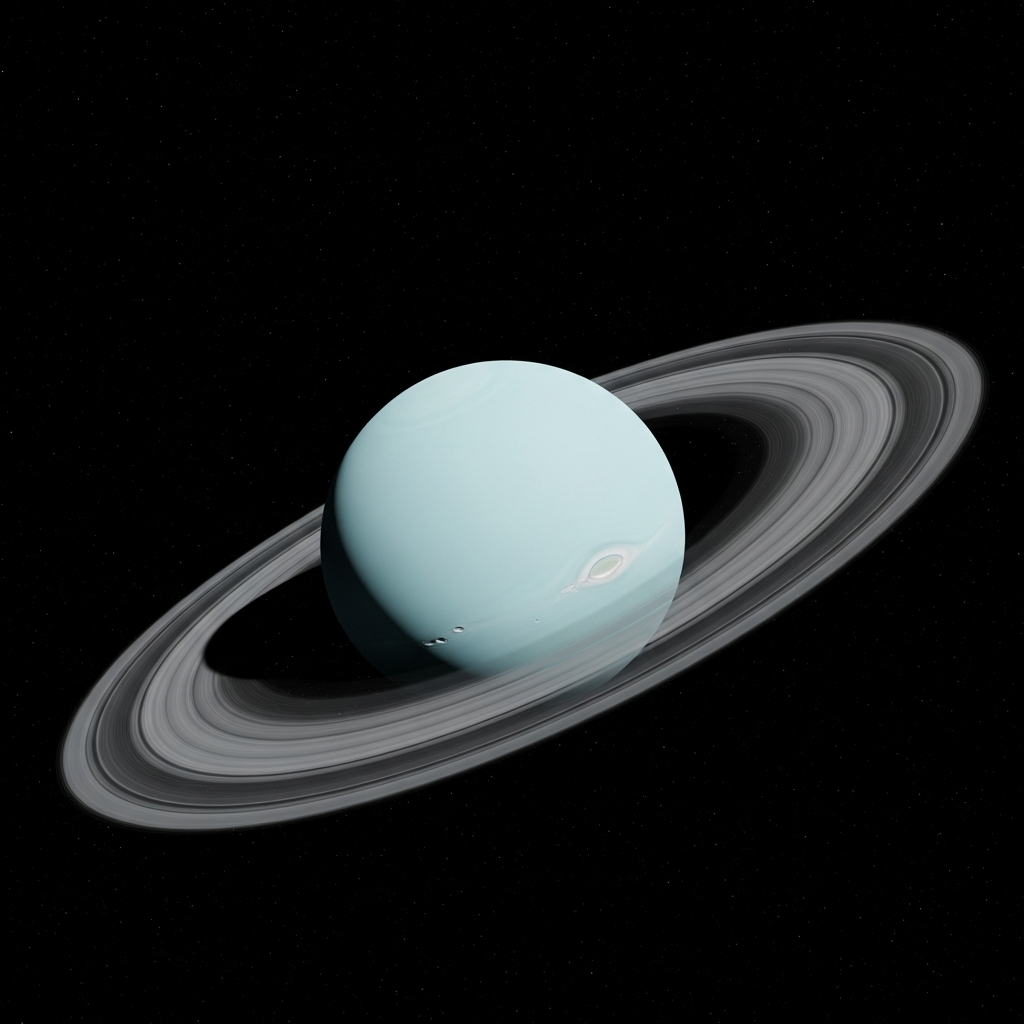
The distant ice giant Uranus, often overshadowed by its flashier ringed sibling Saturn, is increasingly proving to be a world of profound mystery and dynamic activity. New observations, particularly from the cutting-edge James Webb Space Telescope (JWST), are unraveling the enigmatic nature of Uranus’s outer rings. These peculiar features hint at a complex interplay with the planet’s existing satellites and strongly suggest the presence of additional undiscovered moons orbiting the tilted world. This groundbreaking research offers fresh perspectives on the formation and evolution of the entire Uranian system, challenging long-held assumptions about our solar system’s distant realms.
Unveiling the Enigma: Uranus’s Peculiar Ring System
For decades, Uranus remained a relatively obscure figure in our cosmic neighborhood. Its faint ring system, a stark contrast to Saturn’s brilliant spectacle, was only first discovered in 1977. Astronomers detected these rings by observing them block the light of distant background stars during “stellar occultations,” a subtle cosmic ballet. Later, NASA’s Voyager 2 spacecraft provided humanity’s first up-close images during its 1986 flyby, revealing a total of 13 narrow rings. Subsequent observations by the Hubble Space Telescope and the W. M. Keck Observatory in Hawaii further refined our understanding.
The outermost rings, known as mu (µ) and nu (ν), proved especially perplexing. Discovered between 2003 and 2005 by a team led by Mark Showalter of the SETI Institute, these rings exhibited distinct color differences. The mu-ring appeared blue, suggesting it was composed of very small particles, while the nu-ring had a reddish tint, indicative of dustier material. This compositional disparity pointed to incredibly different origins, though the exact mechanisms remained a puzzle until recently.
A Deep Dive into Ring Composition: Icy Clues and Dusty Secrets
The latest scientific efforts have leveraged a powerful combination of infrared data from the JWST, integrated with the historical observations from Hubble and Keck. This synergistic approach allowed a team, spearheaded by Imke de Pater of the University of California, Berkeley, and including Showalter, to produce the first complete reflectance spectrum of these outer rings. This spectrum, which details how the rings reflect sunlight, not only confirmed their unique colors but also provided unprecedented insights into their precise composition and the size distribution of their particles.
“By decoding the light from these rings, we can trace both their particle size distribution and composition, which sheds light on their origins, offering new insight into how the Uranian system and planets like it formed and evolved,” de Pater explained in a statement. This deep analysis reveals two strikingly different stories for the adjacent mu and nu rings.
The Icy Mu-Ring and Moon Mab
The reflectance spectrum unveiled that the mu-ring is primarily made from water-ice particles. This discovery immediately drew parallels to another unique ring in our solar system: Saturn’s E-ring. The E-ring is famously generated by cryovolcanism on Saturn’s moon Enceladus, which constantly erupts geysers of water vapor and ice into space. Remarkably, researchers have now traced the icy particles in Uranus’s mu-ring directly to a specific source: Mab, an irregular, 12-kilometer (7.5-mile) wide moon discovered by Showalter in 2003. This finding presents a fascinating conundrum, as most other inner Uranian moons are generally dustier and rockier, raising questions about Mab’s unusual icy nature.
The Dusty Nu-Ring and Unseen Moonlets
In stark contrast to its icy neighbor, the nu-ring is notably “dirtier.” Its composition includes 10 to 15% carbon-rich organic compounds, typical of the frigid, outer regions of the solar system. Scientists propose that this material originates from micrometeorite impacts on, and collisions between, undiscovered rocky bodies rich in organic materials. These “unseen moonlets” are believed to orbit within Uranus’s inner moon group, continually supplying the nu-ring with dust. The precise reason for such a dramatic compositional difference between the parent bodies of the mu and nu rings, despite their close proximity, remains a profound mystery. There are even subtle hints that the mu-ring’s brightness might be changing, an observation yet to be fully understood.
Uranus’s Strange Ways: Beyond the Rings
Uranus, the seventh planet, is famously unique due to its extreme axial tilt of 98 degrees, causing it to orbit the sun almost entirely on its side. This peculiar orientation also generates a warped and constantly shifting magnetic field. Scientists previously hypothesized that this magnetic field would visibly mark the planet’s moons with radiation damage. However, recent observations from the Hubble Space Telescope, led by Christian Soto, challenged these assumptions.
Instead of the expected darkening on their trailing hemispheres, the outer moons Titania and Oberon exhibited darkening on their leading sides. This surprising finding indicates that the visible darkening is not primarily due to Uranus’s magnetic field, but rather from the accumulation of dust. This dust, originating from Uranus’s distant irregular moons that are constantly bombarded by micrometeorites, slowly spirals inward. As Titania and Oberon traverse this diffuse dust cloud, they collect particles on their leading surfaces, much like “bugs hitting your windshield” during a drive. Interestingly, the inner moons, Ariel and Umbriel, showed no significant brightness differences, suggesting that Titania and Oberon might act as shields, preventing this dust from reaching the innermost parts of the system.
The Icy Temperatures and Missing Particles
Adding another layer of intrigue to Uranus’s rings, astronomers at UC Berkeley have achieved a significant breakthrough: measuring their temperature for the first time. Using data from the Atacama Large Millimeter Array (ALMA) and the Very Large Telescope (VLT), they determined that Uranus’s rings exist at an incredibly cold 77 degrees Kelvin (approximately -321 degrees Fahrenheit). This frigid temperature provides crucial insights into the physical state of the ring particles.
A key distinction identified by researchers, including Imke de Pater and graduate student Edward Molter, is the composition of Uranus’s epsilon ring compared to other planetary rings. Unlike Saturn’s rings, which boast a wide range of particle sizes from micron-sized dust to multi-meter objects, Uranus’s main rings, particularly the epsilon ring, conspicuously lack smaller particles. They are predominantly composed of larger rocks, described as “golf ball-sized and larger.” While other ring systems like Jupiter’s and Neptune’s contain fine particles, Uranus presents a baffling scenario where dust is found between its rings, but the rings themselves are devoid of it. “We already know that the epsilon ring is a bit weird, because we don’t see the smaller stuff. Something has been sweeping the smaller stuff out, or it’s all glomming together. We just don’t know,” Molter noted. This suggests unique, yet unexplained, processes at play in the Uranian ring dynamics.
JWST’s Unprecedented View: Peering Through the Haze
The James Webb Space Telescope continues to revolutionize our understanding of Uranus, dispelling its old reputation as a “boring”, featureless world. A second, even more comprehensive image captured by JWST this year provides an unprecedentedly detailed view of the ice giant. This new portrait combines infrared wavelengths, revealing not only the entire ring system but also the previously elusive and diffuse inner Zeta-ring, closest to the planet. Many of Uranus’s 27 known moons are now visible, with the five largest—Ariel, Miranda, Oberon, Titania, and Umbriel—standing out prominently.
Crucially, JWST’s infrared capabilities penetrate Uranus’s atmospheric haze, revealing the planet’s seasonal north polar cap with striking clarity. Unlike the solid ice caps of Earth, Uranus’s polar caps are hazy haloes of aerosols high in its atmosphere. The image shows the north polar cap almost directly facing the sun, featuring a bright, warmer spot at its center (indicating a massive cyclonic vortex) and a distinct dark collar. Bright storms are also observed circulating around the polar cap, likely driven by seasonal variations amplified by Uranus’s extreme tilt. As the planet approaches its northern summer solstice in 2028, polar weather activity is expected to intensify, offering unique opportunities for further study.
Why Uranus Matters: A Scientific Priority
The ongoing discoveries about Uranus’s mysterious rings and the strong evidence for hidden moons underscore the crucial role this distant ice giant plays in understanding the broader universe. Studying the Uranian system provides invaluable data for planetary scientists seeking to comprehend how planets form and evolve, especially those in the cold, outer reaches of solar systems. It also serves as a critical analog for the countless ice giants now being discovered around other stars (exoplanets).
These intricate mysteries, particularly the stark compositional differences between the mu and nu rings and the puzzling dust dynamics, highlight the limitations of our current understanding. Resolving them will almost certainly require a dedicated spacecraft mission to the ice giant. Fortunately, returning to Uranus has been identified as the top planetary priority in the most recent Decadal Survey from the National Academy of Sciences, pending funding. The wealth of new information from the James Webb Space Telescope is not just satisfying scientific curiosity; it’s actively shaping the future of deep space exploration, paving the way for a future mission that could truly unlock the deepest secrets of this enigmatic world.
Frequently Asked Questions
Why are Uranus’s rings so mysterious and unique compared to other planets?
Uranus’s rings are enigmatic due to their faintness, narrowness, and unusual composition. Unlike Saturn’s broad, icy rings, Uranus’s main rings, like the epsilon ring, surprisingly lack smaller dust particles, containing mostly golf-ball-sized rocks and larger. Meanwhile, distinct outer rings, the mu and nu, are sourced from different materials: icy particles from moon Mab and dusty, carbon-rich compounds from undiscovered moonlets, respectively. Their frigid temperature of 77 Kelvin and the presence of dust between the rings, but not within them, further contribute to their unique and puzzling nature, suggesting unknown mechanisms are at play in their formation and maintenance.
How does the James Webb Space Telescope (JWST) contribute to new discoveries about Uranus?
The JWST is revolutionizing Uranus research by using its advanced infrared capabilities to penetrate the planet’s atmospheric haze, revealing previously unseen details. It has provided the first complete reflectance spectrum of Uranus’s outer rings, allowing scientists to decode their composition and particle sizes, directly linking them to specific moons or moonlets. JWST images also showcase the entire ring system, including the elusive Zeta-ring, and many of Uranus’s 27 moons. Furthermore, it offers unprecedented views of Uranus’s dynamic north polar cap, revealing a massive cyclonic vortex and bright storms, transforming our understanding of this once-considered “boring” ice giant.
What are the future plans for exploring Uranus, and why is it a scientific priority?
Future exploration of Uranus is a top priority for planetary science. Scientists anticipate that a dedicated spacecraft mission will be necessary to fully resolve the intricate mysteries surrounding its rings, moons, and magnetic field. Such a mission is prioritized in the latest Decadal Survey by the National Academy of Sciences, with a potential launch by 2030 to leverage favorable orbital alignments. Uranus is a scientific priority because it serves as a critical analog for the numerous ice giants discovered in other star systems, offering insights into their formation and evolution. Unlocking Uranus’s secrets will significantly advance our understanding of planetary dynamics and the diversity of worlds in our universe.