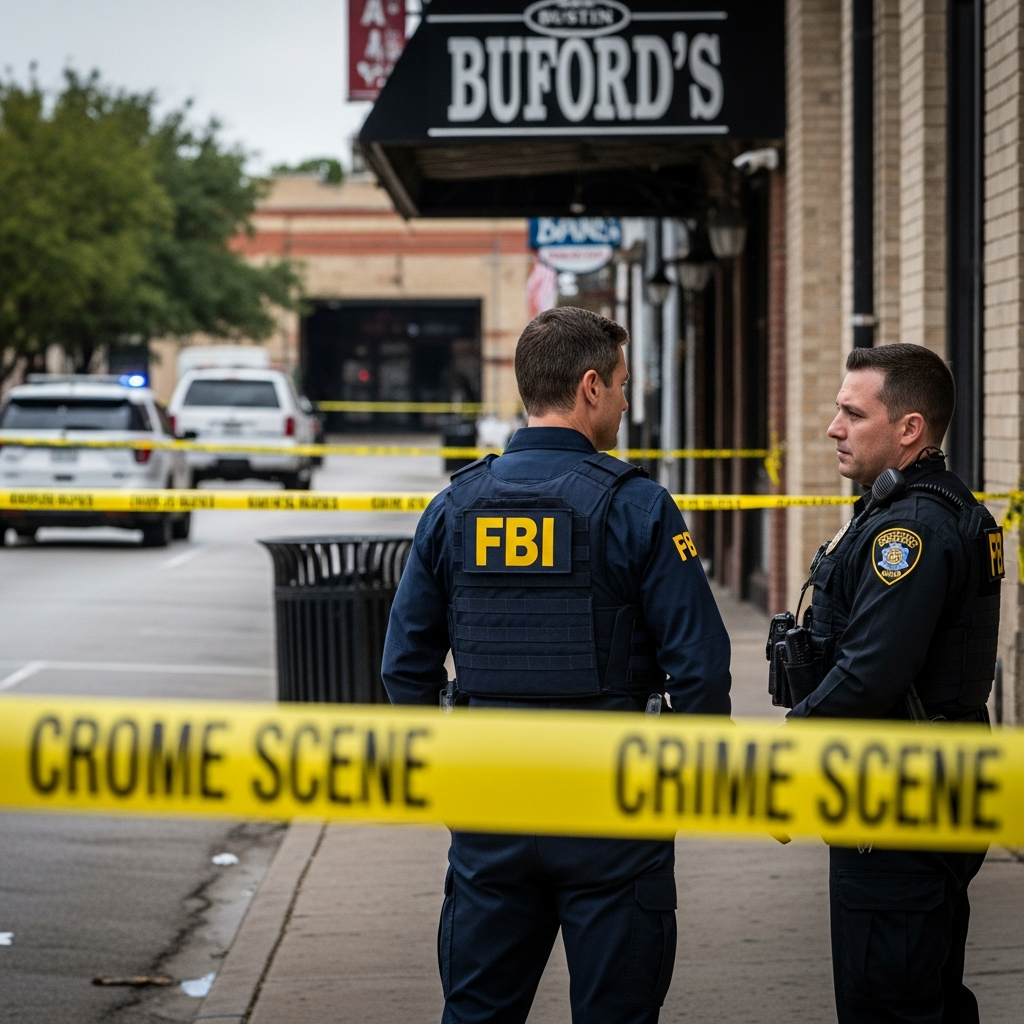
A horrific mass shooting shattered the early morning calm of Austin’s vibrant West 6th Street entertainment district on March 1, 2026. This tragic event at Buford’s bar left three innocent lives lost and over a dozen injured. Authorities quickly identified 53-year-old Ndiaga Diagne as the gunman, who was fatally shot by responding officers. What began as a local crime investigation swiftly escalated into a federal probe, as compelling evidence emerged suggesting a potential nexus to terrorism, marking a disturbing turning point in the city’s ongoing battle against gun violence.
The Horrific Attack Unfolds on Sixth Street
The tranquility of Austin’s popular nightlife hub dissolved into chaos shortly before 2:00 a.m. on Sunday, March 1, 2026. Ndiaga Diagne, identified as the 53-year-old suspect, initiated a calculated and devastating assault. Eyewitnesses and police reports detail Diagne driving a large SUV around the block multiple times, seemingly casing the crowded area.
At approximately 1:58 a.m., Diagne began his rampage. He fired a pistol from his vehicle window, striking patrons gathered on Buford’s patio and in front of the establishment. Without hesitation, he then drove westbound on Sixth Street. After parking his SUV, Diagne exited the vehicle, now armed with a rifle, and continued firing at pedestrians while walking eastbound. This chilling sequence of events unfolded rapidly, leaving a trail of destruction and terror in its wake.
Victims Identified in Austin Shooting Tragedy
The human cost of the Austin 6th Street shooting is immeasurable. Three lives were tragically cut short, and many others sustained severe injuries. The deceased victims were identified as:
Ryder Harrington, 19 years old, a Texas Tech student.
Savitha Shan, 21 years old, a University of Texas at Austin student described as “preparing to change the world.”
- Jorge Pederson, 30 years old, who initially fought for his life in the hospital before being taken off life support.
- cbsaustin.com
- www.kut.org
- www.ms.now
- www.cbsnews.com
- www.nbcdfw.com
In addition to these fatalities, 13 to 14 other individuals were hospitalized, with several in critical condition. The University of Texas at Austin President Jim Davis confirmed that a number of students were among the injured, extending the university’s full support to those affected by this devastating attack. Makeshift memorials quickly appeared outside Buford’s bar, bearing witness to the community’s profound grief.
Unveiling the Suspect: Who Was Ndiaga Diagne?
Ndiaga Diagne, the individual responsible for the Austin 6th Street shooting, presented a complex profile. A naturalized U.S. citizen from Senegal, Diagne’s journey to the United States began in 2000 on a B-2 tourist visa. He became a lawful permanent resident in 2006 after marrying a U.S. citizen and was naturalized in 2013.
While Diagne was not on the radar of federal or local authorities prior to the attack, further investigation into his background revealed several pertinent details. He had a prior arrest in Texas in 2022 following a car crash. Court records also showed his ex-wife filed for divorce in Bexar County in 2022, and a Texas judge had previously found a “pattern of committing family violence” by Diagne. Sources within the government with direct knowledge of the investigation also indicated Diagne had a history of mental illness. The weapons used in the attack were legally purchased by Diagne in San Antonio in 2017, underscoring the legal accessibility of firearms even for individuals with concerning histories.
The Terrorism Investigation: A Deep Dive into Motives
The most unsettling aspect of the Austin 6th Street shooting quickly became the strong indication of a potential terrorism link. Law enforcement officials discovered several crucial pieces of evidence pointing towards ideological motivations. During the attack, Diagne was reportedly wearing a sweatshirt that read “Property of Allah” over another shirt featuring a design similar to the Iranian flag.
A subsequent search warrant executed at Diagne’s residence reportedly uncovered an Iranian flag and pictures of Iranian leaders. A Quran was also found in his vehicle. Crucially, this attack occurred just one day after a joint U.S. and Israeli military strike on Iran, which reportedly resulted in the death of Ayatollah Ali Khamenei.
Given these indicators, the FBI launched a full-scale investigation into the incident as a potential act of terrorism, working closely with the Austin Police Department’s Joint Terrorism Task Force. While officials like FBI Special Agent in Charge Alex Doran initially described it as an act of “targeted violence” and refrained from definitively classifying it as terrorism, he emphasized the difficulty in understanding the perpetrator’s ultimate mindset. The probe remains active, with investigators thoroughly reviewing all evidence and interviewing witnesses, friends, and associates to fully understand Diagne’s motivation and the potential terror nexus.
Rapid Response and Community Resilience
The swift and courageous actions of Austin’s first responders undoubtedly saved countless lives during the chaos. Austin-Travis County EMS Chief Robert Luckritz reported that paramedics received the initial 911 call at 1:59 a.m., with first responders arriving on the scene within an astonishing 57 seconds. Twenty EMS resources were immediately deployed, and all critical patients were transported from the scene within just 24 minutes, with all patients cleared within 47 minutes.
Austin Police Chief Lisa Davis confirmed that officers from the nearby East 6th Street entertainment corridor rapidly transitioned to the scene. They confronted Diagne at an intersection and engaged him, with three officers returning fire and fatally striking the gunman. Mayor Kirk Watson praised the extraordinary speed and coordination of these efforts, emphasizing the city’s collective mourning and unwavering resilience in the face of such a traumatic event. A family resource center was promptly established to provide support to those affected.
Political Reactions and Calls for Action
The Austin 6th Street shooting drew widespread condemnation and prompted immediate political responses. Texas Governor Greg Abbott directed the Department of Public Safety (DPS) to significantly increase patrols in downtown Austin’s Sixth Street area. He stated firmly, “This act of violence will not define us, nor will it shake the resolve of Texans,” issuing a stark warning against anyone attempting to use the Middle East conflict to threaten the state.
U.S. Senator John Cornyn was explicit, declaring, “Radical Islam has no place in Texas and our country. To those who wish to harm Americans or commit acts of terrorism in the name of Islam, you and your beliefs are not welcome here.” Other prominent figures, including Austin Mayor Kirk Watson and Congressman Greg Casar, offered their deepest condolences to the victims’ families. They also commended the rapid actions of first responders for preventing further loss of life and reiterated calls to address the pervasive issue of gun violence. White House press secretary Karoline Leavitt confirmed that President Donald Trump was briefed on the tragedy.
Austin’s Ongoing Struggle with Gun Violence
This devastating incident serves as another grim reminder of the persistent challenge of gun violence, particularly in entertainment districts. Austin’s Sixth Street has tragically experienced at least two other significant shootings in the past five years, including one in 2021 that wounded 14 people. While the March 2026 shooting, with three fatalities, does not strictly meet the definition of a “mass killing” (typically four or more victims excluding the perpetrator), it adds to a disturbing national trend. The FBI’s investigation into the potential terrorism link adds a critical layer of complexity to this already sensitive issue, highlighting the multifaceted nature of threats facing communities today.
Frequently Asked Questions
What is known about the shooter, Ndiaga Diagne, in the Austin 6th Street shooting?
Ndiaga Diagne, the 53-year-old suspect in the Austin 6th Street shooting, was a naturalized U.S. citizen from Senegal. He immigrated to the U.S. in 2000, becoming a lawful permanent resident in 2006 and a citizen in 2013. Investigations revealed a prior arrest in 2022 and a history of family violence. Authorities also cited a history of mental illness. Despite these details, Diagne was not on any federal or local watchlists prior to the tragic event.
Where did the Austin 6th Street shooting occur, and what was the immediate police response?
The shooting took place in the early hours of Sunday, March 1, 2026, at Buford’s bar on West 6th Street, a popular entertainment district in Austin, Texas. The immediate response from Austin Police Department (APD) and EMS was exceptionally swift. First responders arrived on the scene within 57 seconds of the 911 call, and APD officers quickly engaged Ndiaga Diagne at an intersection, fatally shooting him and ending the rampage.
Is the Austin 6th Street shooting being investigated as a potential act of terrorism?
Yes, the Austin 6th Street shooting is actively being investigated as a potential act of terrorism by the FBI, in close collaboration with the Austin Police Department’s Joint Terrorism Task Force. This inquiry began after discovering Diagne was wearing “Property of Allah” clothing and an Iranian flag design, with similar items found at his home and a Quran in his vehicle. The timing, just one day after a U.S./Israel strike on Iran, further supported this line of investigation, though an “ultimate motivation” remains under review.
Conclusion
The Austin 6th Street shooting represents a profound tragedy for the city, leaving a community grappling with loss and fear. The swift response of Austin’s emergency services and law enforcement averted an even greater catastrophe, demonstrating their unwavering commitment to public safety. As the FBI continues its critical investigation into the potential terrorism link, the incident underscores the complex challenges of modern threats, from individual acts of violence to ideologically driven attacks. Austin, like many cities, remains vigilant, committed to healing, and determined to address the underlying issues of gun violence while supporting all affected by this devastating event.