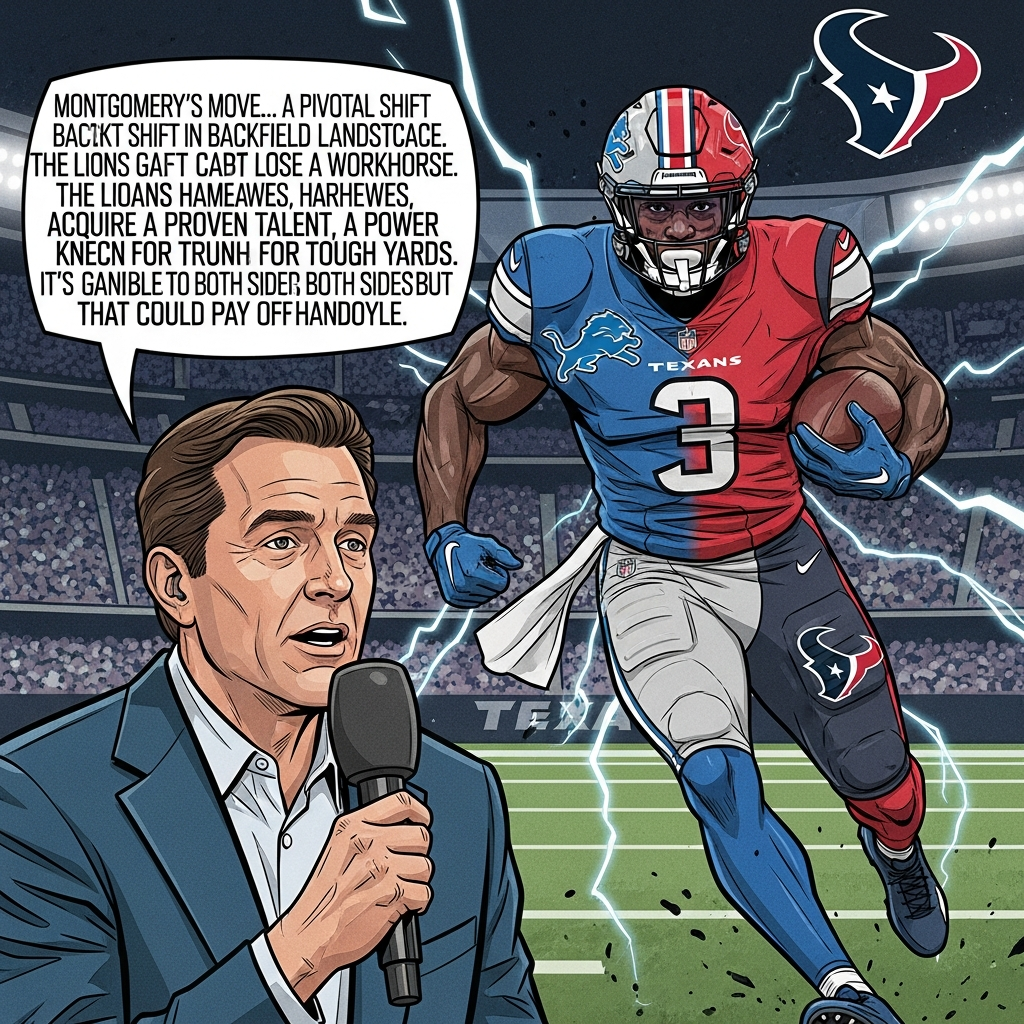
The Detroit Lions have signaled a definitive shift in their roster management strategy, making a challenging yet pragmatic decision to trade running back David Montgomery to the Houston Texans. This move, as described by insiders like Bob Wojnowski, reflects a new financial reality for a team transitioning from underdog to contender. No longer can the Lions afford “luxuries” as their burgeoning stars demand significant contracts and critical roster holes emerge. The trade, while impacting a fan favorite, sets the stage for a pivotal offseason focused on strategic rebuilding and cap flexibility.
The Strategic Shift: Why Montgomery Was Traded
The departure of David Montgomery was less about his performance and more about the evolving landscape of the Lions’ roster and salary cap. Montgomery, a powerful symbol of the team’s “grit identity,” became an “expensive luxury” in a backfield now featuring the electrifying Jahmyr Gibbs. While valuable, Montgomery’s impending 29th birthday and a career-low in rushing totals (158 carries, 716 yards) weighed heavily against his salary demands. Wojnowski noted that Montgomery had also “not so vaguely” indicated a desire for a larger role, which seemed unlikely with Gibbs’ ascendancy.
General Manager Brad Holmes made a “sensible, not sentimental” move, opting for long-term roster health over short-term fan appeal. The trade brought the Lions a fourth-round pick, a seventh-round pick, and interior offensive lineman Juice Scruggs. This return was considered favorable for a running back of Montgomery’s age and mileage, whose trade value typically hovers around mid-round picks. While his “punishing running style” will be missed, this transaction frees up cap space and provides essential draft capital.
Navigating the Salary Cap and Star Contracts
The Montgomery trade is merely the first domino to fall in what promises to be an “enormously critical offseason” for the Lions. Success brings a new set of financial pressures. Quarterback Jared Goff’s massive $212 million extension, which carries a staggering $69 million cap hit for 2026, requires urgent reworking to create immediate flexibility. Similarly, superstar running back Jahmyr Gibbs is entering his option year and is poised to reset the market for his position, demanding a significant raise. Tight end Sam LaPorta, another key offensive weapon, is also due for an extension, despite recent back surgery.
These financial realities mean the Lions must make tough choices, balancing the need to retain core talent with the necessity of addressing weaknesses. The “reality rising” for Detroit is that sustaining success in the NFL demands shrewd financial management and a willingness to make difficult personnel decisions. Every dollar and every roster spot must contribute to the team’s long-term vision.
Rebuilding the Trenches: Offensive Line Concerns
Once a beacon of strength, the Lions’ offensive line has become a primary area of concern. The unit, which once offered the luxury of cohesion and dominance (as seen in a 41-point, 533-yard performance against the Chargers, per Richard Silva’s film review, where David Montgomery himself had a 75-yard touchdown run), has faced significant setbacks. Frank Ragnow’s retirement and Graham Glasgow’s release have created immediate holes. Taylor Decker, turning 33 this August, is battling chronic shoulder and knee issues, casting doubt on his long-term health and likely forcing Holmes to target a tackle high in the draft.
Evidence of the offensive line’s struggles was painfully clear in a 27-13 loss to the Packers, where the unit received a “D” grade. Running backs collectively gained a “putrid” 44 yards on 17 attempts, and Goff was sacked four times. Rookie Tate Ratledge admitted “multiple missed assignments,” while Decker was pushed into Goff for another sack. These performance issues highlight the urgent need for reinforcement.
The acquisition of Juice Scruggs in the Montgomery trade is intended to help shore up the interior line. Scruggs, a 2023 second-round pick from Penn State, has experience at both guard and center. While he started at center for the Texans in 2024, his role later shifted to backup guard. He could compete for a starting center job, but might primarily serve as valuable depth. Further addressing this need, the NFL Combine reports (Silva & Bianchi) mention Florida center Jake Slaughter, praised as “smart as hell” and “a dog,” as a potential Day 2 or early Day 3 draft target, indicating the Lions’ ongoing search for offensive line talent.
Addressing Defensive Realignments and Depth
Beyond the offense, the Lions’ defense is also in a state of flux. Injuries to star safeties Brian Branch and Kerby Joseph, once considered the “best safety tandem in the league,” have thrown the entire unit into disarray. The team’s 9-8 finish, missing the playoffs, was partly attributed to these depth-sapping injuries.
The early season struggles were evident against the Packers, where the defensive line received a “C-” grade due to a “lack of pass rush.” Jordan Love “sat back comfortably,” converting critical third downs with ease. This suggests that despite having decent run defense, the pass rush needs a significant boost.
To address these critical needs, the Lions will likely look to the draft. NFL Combine observations highlighted several potential fits (Silva & Bianchi). Keldric Faulk (Auburn), a powerful edge rusher and stout run defender, is a potential first-round target opposite Aidan Hutchinson. Zion Young (Missouri) also brings high energy and run-stopping prowess to the defensive end position. At linebacker, the Lions could target LSU’s Harold Perkins Jr. for his speed and versatility, or Ohio State’s Sonny Styles, a converted safety with high IQ and coverage skills, who has drawn comparisons to four-time All-Pro Fred Warner. Caleb Banks (Florida) and Kaleb Proctor (Southeastern Louisiana) could provide interior defensive line depth and pass rush later in the draft.
Strategic Drafting and Future Building Blocks
The Lions’ ascent to contenders and division champions (a 45-23 regular-season record since 2022) has largely been built on “shrewd drafting” under Brad Holmes. This includes moving back in the 2023 draft to secure both Jahmyr Gibbs and Sam LaPorta, a move that proved immensely successful. However, the team was “low on picks” prior to the Montgomery trade, having used significant capital to move up for wide receiver Isaac TeSlaa in a prior draft. The newly acquired fourth-rounder is therefore “key” for Holmes to maintain his draft-centric strategy.
The challenge now is “maintaining and growing with fewer and lower picks,” forcing Holmes to be even more precise. Trades and free-agent signings, which weren’t a primary staple of his early strategy, will become more crucial. The Montgomery trade is a prime example of this evolving approach, aiming to create cap flexibility and secure assets for future talent acquisition.
Life After Montgomery: Backfield Outlook
With Montgomery gone, second-year Sione Vaki is the only other “notable back” on the Lions’ current roster. This necessitates further additions to the running back room. The Lions are expected to target “mid-level backs” in free agency, with potential names like Arizona’s Emari Demercado or San Francisco’s Brian Robinson Jr. being floated. This strategy aligns well with new offensive coordinator Drew Petzing, who is known for his “run-heavy play-caller” philosophy. Despite Gibbs’ impressive 1,223 rushing yards and 616 receiving yards last season, the overall attack declined, underscoring the need for robust depth behind him.
Brad Holmes’ Evolving Trade Philosophy
The David Montgomery trade isn’t an isolated event; it fits a pattern in Brad Holmes’ tenure. He previously made significant moves with Matthew Stafford (to the Rams for Goff and picks) and T.J. Hockenson (to the Vikings in 2022). In each case, Holmes balanced player desires with team needs, successfully creating opportunities while simultaneously attempting to fill existing roster gaps. The Stafford deal brought Goff, while LaPorta emerged as Hockenson’s replacement. The Montgomery trade continues this philosophy, sacrificing a respected veteran to gain flexibility and assets to address other critical areas.
The Bottom Line: Equipping for a Brighter Future
Ultimately, the trade of David Montgomery was a pragmatic decision driven by the “nasty realities of the NFL.” It marks a pivotal moment for the Detroit Lions, reflecting their transition from rebuilding to contending. While the immediate impact doesn’t necessarily make the team “better” in terms of current talent, it “better-equipped” them for future improvements. By freeing up cap space, acquiring draft capital, and adding a versatile offensive lineman, Brad Holmes has positioned the Lions to tackle their most pressing offseason challenges, from securing their young stars to fortifying their offensive and defensive lines, all while staying true to their core strategy of building through the draft.
Frequently Asked Questions
Why did the Detroit Lions trade David Montgomery?
The Detroit Lions traded David Montgomery due to a combination of evolving financial realities, his contract becoming an “expensive luxury,” and his desire for a larger role elsewhere. With Jahmyr Gibbs emerging as a superstar who will soon command a significant contract, the team needed cap flexibility. Montgomery, approaching 29 years old and coming off a career-low in rushing yards, provided an opportunity for General Manager Brad Holmes to make a “sensible, not sentimental” move, aligning with the team’s long-term roster management and salary cap strategy.
What did the Lions receive in the David Montgomery trade?
In exchange for David Montgomery, the Detroit Lions acquired a fourth-round pick and a seventh-round pick from the Houston Texans, along with interior offensive lineman Juice Scruggs. This return was considered a solid haul for a running back of Montgomery’s age and mileage. Scruggs, a versatile player with experience at both guard and center, provides immediate depth and competition on an offensive line that has become a key concern for the Lions. The draft picks are crucial for a team that was previously low on draft capital.
How does the David Montgomery trade impact the Lions’ offseason strategy?
The David Montgomery trade significantly impacts the Lions’ offseason strategy by providing crucial salary cap flexibility and additional draft capital. This move allows the team to better navigate upcoming contract extensions for key players like Jared Goff, Jahmyr Gibbs, and Sam LaPorta. It also frees up resources to address critical roster needs, particularly on the offensive and defensive lines, which have faced significant injuries and underperformance. The acquired draft picks empower General Manager Brad Holmes to continue building through the draft, enabling them to target high-impact players to fill existing holes and strengthen their contention window.