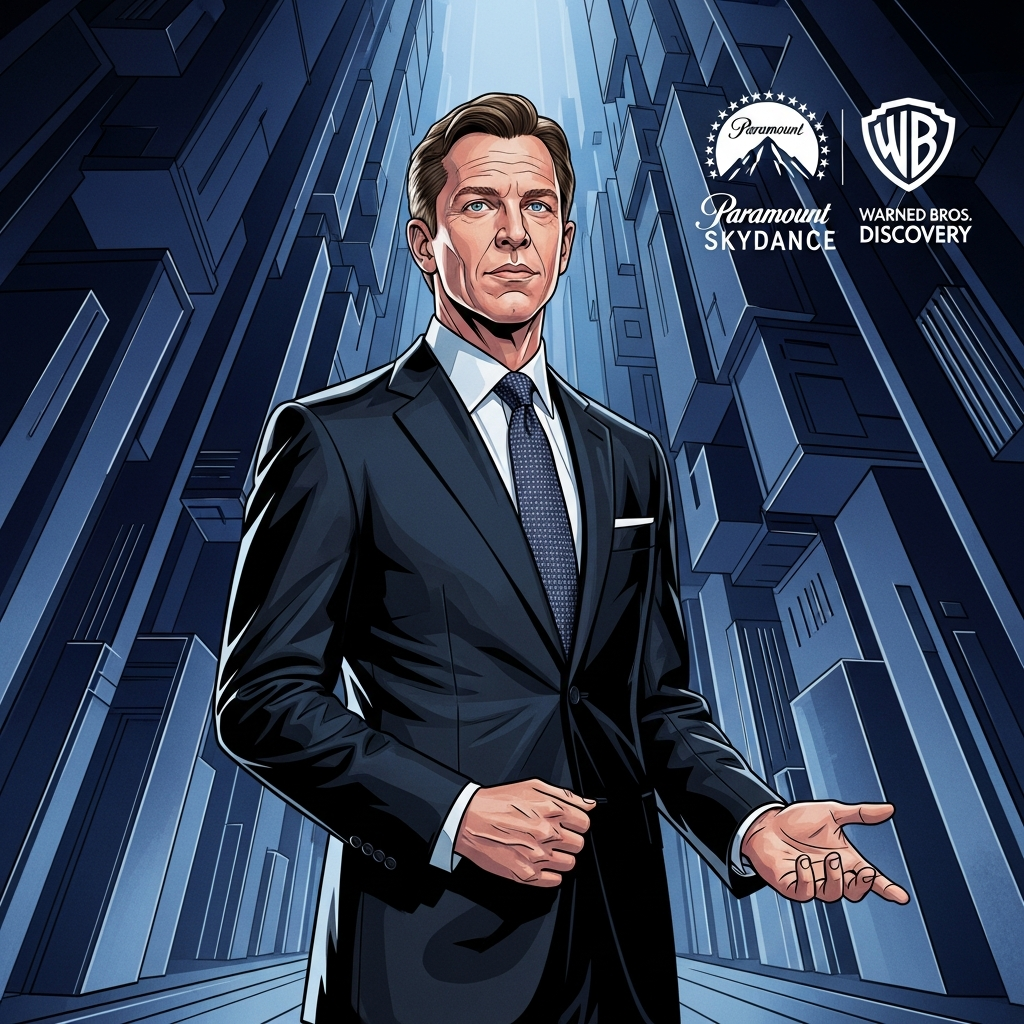
Hollywood is witnessing a seismic shift as David Ellison, CEO of Paramount Skydance, stands on the cusp of creating a formidable new media empire. His company recently emerged victorious in a high-stakes bidding war for Warner Bros. Discovery (WBD), a move poised to reshape the entertainment and news landscape. This acquisition is far more than a corporate maneuver; it reflects the intense pressures facing traditional media, the insatiable demand for scale in the streaming wars, and potentially, the subtle hand of political influence.
Less than a year ago, David Ellison led a relatively modest production company. Now, he is positioned to command one of the industry’s largest conglomerates, integrating major movie studios, streaming platforms, and television networks. The journey to this point has been a complex saga involving industry titans, political figures, and a battle for survival in a rapidly evolving digital world.
The Ascent of a New Media Mogul: How Ellison Outmaneuvered Rivals
David Ellison, son of Oracle founder Larry Ellison, boasts two decades of experience as a Hollywood producer. In 2006, he and his billionaire father established Skydance, financing successful franchises like Star Trek, Mission Impossible, and Top Gun. When Paramount, then a company grappling with financial distress, sought buyers in 2024, Ellison stepped in as a potential savior. Skydance completed its Paramount purchase in August 2025, inheriting a company in dire need of revitalization.
Paramount’s challenges were significant. Its streaming platform, Paramount+, lagged behind competitors, relying heavily on a few fan-favorite franchises and NFL broadcast rights. The movie studio failed to land a single film in the top 10 box office releases of 2025, and its cable networks struggled to produce original content beyond mainstays like South Park and The Daily Show. CBS’s ratings dipped a notable 12% in 2025, according to Nielsen. To compete effectively against giants like Disney, Netflix, Amazon, and even social media platforms such as TikTok and YouTube, Paramount urgently needed to scale up. Ellison’s strategy quickly pivoted towards a major acquisition, setting his sights on Warner Bros. Discovery.
WBD itself sought strategic alternatives, eventually putting itself up for sale. Netflix initially appeared to be the favored bidder, offering a strong cash position and a plan to offload WBD’s cable assets while acquiring HBO Max and Warner Bros. WBD, however, considered Paramount’s offer undervalued despite it encompassing the entire company. Concerns also surfaced regarding the Saudi financing backing part of the Paramount deal and whether Larry Ellison would guarantee the acquisition’s funding. Paramount addressed these concerns by opening its books and making the Saudi investors non-voting, non-board members. Despite these concessions, Netflix remained WBD’s preferred choice for months.
The turning point came when Paramount threatened a hostile takeover, vowing to take its offer directly to shareholders. In a dramatic twist last week, Paramount revised its bid, increasing it by a dollar per share to $31, which swayed WBD’s skeptical board. Hours later, after Netflix’s CEO met at the White House, Netflix abruptly withdrew its bid. The suddenness of Netflix’s exit, knowing Paramount planned to raise its offer, fueled speculation about external pressures and the potential influence of powerful figures, notably former President Donald Trump.
The X-Factor: Donald Trump’s Alleged Influence
Donald Trump emerged as a significant, if unofficial, player in the WBD transaction. While presidents typically avoid direct involvement in antitrust investigations, Trump reportedly indicated a strong preference for a Paramount deal. This inclination stemmed from David Ellison’s evolving political alignment; although Ellison had previously supported Democrats, he recently cultivated a closer relationship with Trump.
This alleged political dimension is critical. Reports suggest David Ellison assured Trump administration officials that if he acquired Warner Bros. Discovery, “sweeping changes to CNN” would follow. This aligns with Trump’s vocal disdain for CNN, which he publicly stated “it’s imperative that CNN be sold.” Furthermore, the Ellisons’ influence has reportedly already been felt at CBS News, a Paramount subsidiary. Since Paramount acquired CBS and David Ellison appointed Bari Weiss as editor-in-chief in 2025 (after buying her outlet, The Free Press), CBS News has reportedly experienced a “right-leaning shift.” This shift has led to accusations of CBS News becoming “Trump-friendly,” with Donald Trump himself criticizing 60 Minutes in December 2025, claiming it had “actually gotten WORSE!” under Ellison’s leadership.
Additional reports highlight Trump’s direct lobbying efforts with Larry Ellison to greenlight Rush Hour 4, marking director Brett Ratner’s return after #MeToo accusations. This illustrates a pattern of Trump’s intervention in media and entertainment decisions. Paramount Global also settled a $16 million lawsuit with Trump in 2025 over a 60 Minutes interview edit, funds designated for his future presidential library. These instances suggest a pattern of the Ellisons engaging with Trump’s interests, adding a complex layer of political implications to their growing media empire, especially concerning news outlets like CNN, which Trump has publicly despised.
Reshaping Hollywood: What the Deal Means for the Industry
If the Warner Bros. Discovery acquisition closes, it will permanently alter Hollywood’s landscape. The movie industry will consolidate, placing one of the five major studios under shared ownership with Paramount, even if Warner Bros. operates separately. Paramount+, which was struggling independently, would suddenly become a formidable streaming contender against Netflix, Amazon, and Disney+ by integrating HBO Max’s robust content library. Additionally, the combined Discovery and Viacom cable networks would gain significant leverage in negotiations with advertisers and cable providers.
This merger is presented as a crucial survival strategy for both companies amidst a media industry in crisis. However, achieving these benefits will come with considerable pain. Paramount has projected $6 billion in synergies and cost savings, a figure almost certainly translating into thousands of layoffs across the combined entities. This prospect has already drawn criticism from unions, who are generally wary of industry consolidation.
Moreover, the new ownership has already impacted key talent relationships. Taylor Sheridan, the prolific creator behind the Yellowstone universe and a major draw for Paramount, is reportedly leaving for NBCUniversal in January 2029 upon his current contract’s expiration. Reports suggest a strained relationship developed after David Ellison’s acquisition of Paramount, with new streaming chief Cindy Holland questioning Sheridan’s substantial production budgets. While Ellison publicly praised Sheridan, the departure of such a pivotal creative force highlights the internal challenges of integrating a new regime.
The lingering questions about political influence, especially concerning CNN, will remain prominent as the company navigates integration. Concerns among employees at both CBS and CNN about potential editorial shifts have already surfaced, prompting CNN CEO Mark Thompson to urge caution and focus on quality journalism.
The Road Ahead: Approvals, Challenges, and Future Implications
Finalizing the Warner Bros. Discovery deal hinges on two critical approvals: shareholder consent and a rigorous regulatory review. While Netflix’s bid might have faced tougher antitrust scrutiny due to its existing market power, the Paramount-WBD merger could face challenges from state attorneys general and international regulators despite the combined entity not yet approaching Netflix’s scale. The approval process could take months, potentially over a year.
Layoffs are a near certainty with the merger, but they were also likely without it, given both companies’ individual struggles in a rapidly changing media landscape. Neither Paramount nor WBD possesses the robust theme park businesses that fortify competitors like Disney and Universal, and the entire industry has been disrupted by the rise of YouTube and social media.
This acquisition could also trigger a wave of copycat mergers, leaving companies like Disney, Comcast, and Sony searching for strategic partners to bulk up and compete with the newly formed media giant. While achieving massive scale may offer a lifeline, the long-term prospects for the combined Paramount-WBD entity remain uncertain. Audiences are increasingly abandoning traditional theaters, scripted content, and linear television for mobile scrolling and digital platforms. Despite these daunting trends, David Ellison’s bold move was arguably the only viable path forward for his burgeoning media empire.
Frequently Asked Questions
What is the primary motivation behind David Ellison’s acquisition of Warner Bros. Discovery?
The core motivation is survival and scale in a rapidly consolidating and digitally transforming media industry. Paramount, under Ellison’s leadership, needed to expand its reach and content library to effectively compete with streaming giants like Netflix, Amazon, and Disney+, as well as social media platforms. WBD, also facing challenges, sought strategic alternatives. The merger aims to combine forces, integrate HBO Max with Paramount+, and gain leverage in a competitive market.
How might the Warner Bros. Discovery acquisition impact CNN’s editorial direction, given previous events?
The acquisition has raised significant concerns about CNN’s editorial direction due to the Ellison family’s perceived ties to Donald Trump and observed shifts at CBS News, another Paramount subsidiary. Reports indicate David Ellison allegedly assured Trump administration officials of “sweeping changes to CNN.” This follows a “right-leaning shift” at CBS News under editor-in-chief Bari Weiss, appointed by Ellison. While CNN CEO Mark Thompson has urged employees not to jump to conclusions, the precedent set at CBS News and Trump’s public statements suggest a potential reorientation towards a more conservative perspective.
What are the major hurdles David Ellison faces in finalizing and integrating the Warner Bros. Discovery deal?
Ellison faces several significant challenges. Firstly, the deal requires approval from Warner Bros. Discovery shareholders and a complex regulatory review process in the U.S. (including from the Department of Justice and state attorneys general) and abroad, which could take over a year. Secondly, integrating the two massive companies will involve substantial pain, including thousands of layoffs to achieve projected cost savings, which could lead to union opposition. Thirdly, retaining key talent like Taylor Sheridan, who is already reportedly leaving for NBCUniversal, will be crucial. Lastly, the combined entity must still navigate broader industry trends of declining linear TV viewership, theater attendance, and increased competition from digital platforms to ensure long-term viability.