The cosmos just became a little less mysterious. On February 25, 2026, the NSF–DOE Vera C. Rubin Observatory launched its groundbreaking real-time alert system, a “Discovery Machine” poised to revolutionize our understanding of the dynamic night sky. This monumental achievement ushers in an unprecedented era of rapid astronomical observation, empowering scientists worldwide to coordinate follow-up studies of unfolding cosmic events like never before. Prepare for an astronomical data deluge, as this system is expected to eventually issue up to seven million alerts nightly, chronicling the universe’s most dramatic changes.
The Dawn of Real-Time Cosmic Discovery
Imagine having a direct line to the universe, receiving instant notifications of exploding stars, newly discovered asteroids, or distant galaxies flaring to life. This is precisely what the Vera C. Rubin Observatory now offers. On February 24, its first scientific alerts hit the global research community, detailing 800,000 celestial events. These early warnings included everything from variable stars flickering to supernovae igniting and active galactic nuclei blazing. This historic milestone is a critical step before the observatory embarks on its ambitious 10-year Legacy Survey of Space and Time (LSST) later this year.
During the LSST, Rubin Observatory will systematically scan the entire Southern Hemisphere sky every few nights. It uses the LSST Camera, the largest digital camera ever built, boasting 3200 megapixels. This marvel of engineering can capture immense detail across a sky area equivalent to 45 full Moons in a single image. In its first year alone, Rubin expects to image more objects than all other optical observatories combined throughout human history. This continuous flow of real-time Rubin Observatory alerts will form an unparalleled time-lapse record, charting every visible change in the cosmos.
Unprecedented Scale and Speed
The sheer volume and velocity of data from Rubin are truly groundbreaking. “By connecting scientists to a vast and continuous stream of information, NSF–DOE Rubin Observatory will make it possible to follow the Universe’s events as they unfold, from the explosive to the most faint and fleeting,” says Luca Rizzi, an NSF program director. This new capability isn’t just about spotting new things; it’s about catching them as they happen. This speed is vital for studying transient phenomena that might otherwise vanish before closer examination.
The initial imagery released by Rubin, even from early test observations, is staggering. In just over 10 hours, it captured millions of galaxies and stars, alongside thousands of asteroids. Remarkably, these initial efforts led to the discovery of 2,104 previously unseen asteroids, including seven potentially near-Earth objects. This rate far outpaces the typical 20,000 asteroids discovered annually by all other observatories combined. This positions Rubin as a game-changer for planetary defense and a powerful tool for spotting rare interstellar objects passing through our solar system.
How Rubin’s “Discovery Machine” Works
The magic behind Rubin’s real-time alerts lies in its sophisticated, automated software. Located on Cerro Pachón in Chile, the observatory continuously captures new regions of the sky every 40 seconds during nighttime operations. This immense data — expected to be 10 terabytes nightly during the LSST — then embarks on a seconds-long journey. It travels from Chile to the U.S. Data Facility (USDF) at SLAC National Accelerator Laboratory in California for immediate processing.
Once at the USDF, Rubin’s data management system springs into action. Each new image is automatically compared against a “template image,” which is a composite of previous observations of the same sky area, taken through the same filter. This difference imaging technique involves subtracting the template from the new image. What remains are only the changes: a new point of light, an object moving, or a change in brightness. Any detected change triggers a public alert, generated within a remarkable two-minute interval of image capture. This rapid identification and notification system is the culmination of years of technical innovation in image processing and data orchestration, much of it developed by the University of Washington’s Alert Production Pipeline Group.
From Chile to California: The Data Pipeline
The journey of cosmic light from Cerro Pachón to global scientific notification is a testament to modern engineering. The 3200-megapixel LSST Camera, weighing approximately 2800 kilograms, is the eye of this “Discovery Machine.” Its unparalleled sensitivity allows it to detect faint and distant objects. Once an image is snapped, the raw data is quickly transmitted across continents. This rapid transit to the USDF at SLAC ensures that processing begins almost instantaneously, maintaining the crucial near-real-time aspect of the Rubin Observatory alerts. Hsin-Fang Chiang, a SLAC software developer, notes the system’s efficiency: “within minutes, with each image, ‘here is everything’ and ‘go’.”
The Role of Alert Brokers and AI
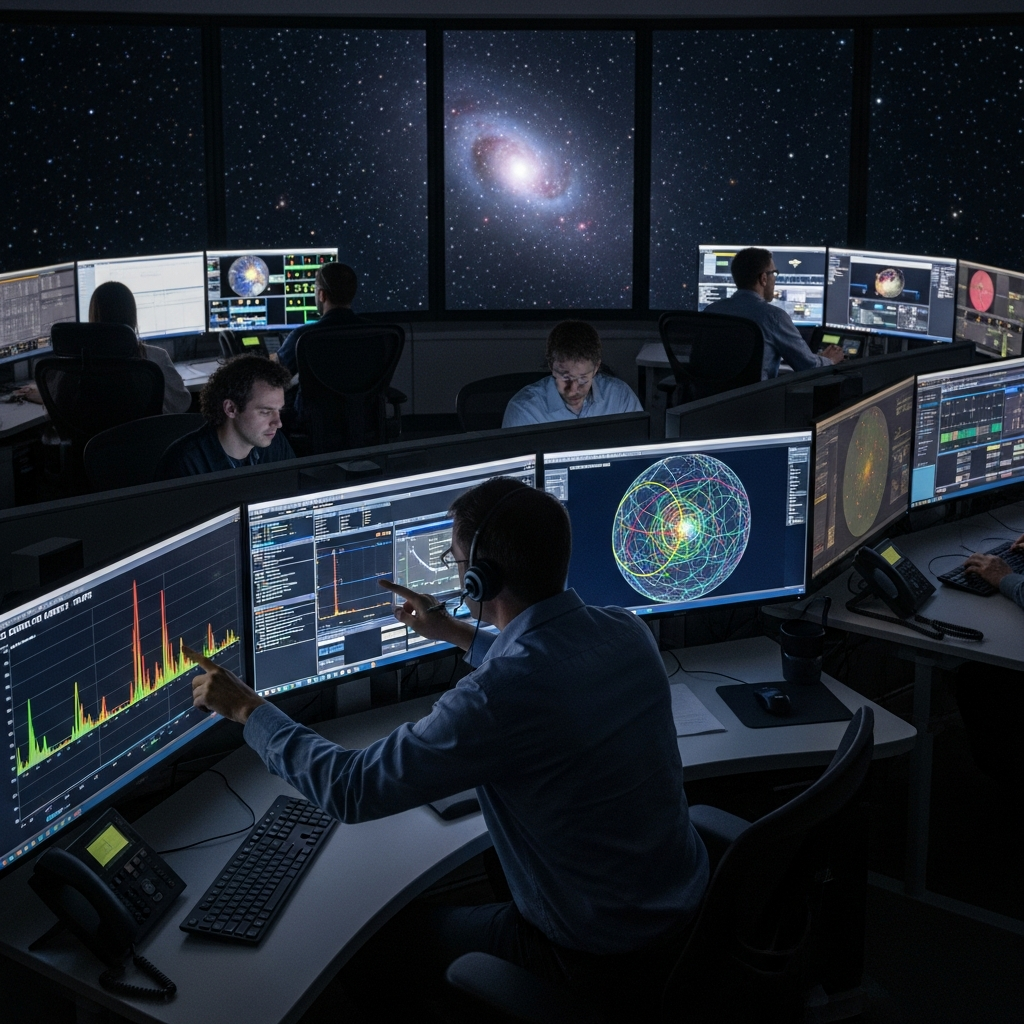
Interpreting the immense data stream from Rubin is a challenge that requires advanced technology. Scientists rely on a sophisticated network of intelligent software platforms known as brokers. These systems, such as ALeRCE, AMPEL, ANTARES, Fink, and Lasair, utilize machine learning algorithms to filter, sort, and classify the alerts. This crucial step distributes relevant information to specialized scientific teams and observatories.
Brokers also cross-reference alerts with vast multi-wavelength astronomical catalogs. Some even specialize in specific types of events, like early supernova identification or the tracking of Solar System objects. This tailored analysis enables quicker responses and more focused follow-up observations. Tom Matheson, Interim Director of the Community Science and Data Center, highlights their importance: “The broker teams have built systems that operate rapidly at scale so that scientists can find all of the objects of interest to them, as well as things we’ve never seen before.” This symbiotic relationship between Rubin’s raw data and the brokers’ intelligence unlocks deeper cosmic insights.
Unveiling the Universe: Scientific Impact
The Rubin Observatory alerts will power discoveries across diverse fields of astronomy, astrophysics, and cosmology. While the night sky may appear serene, it is a canvas of constant motion and transformation. Each alert signals a change, revealing a dynamic universe previously beyond our real-time grasp. This ability to monitor cosmic events as they happen will provide unprecedented data for a wide range of scientific inquiries.
Safeguarding Earth: Asteroid Tracking
One of the most immediate and tangible impacts of Rubin’s capabilities is enhanced planetary defense. The observatory will significantly boost scientists’ ability to discover and track asteroids. This is crucial for assessing potential threats to Earth and developing strategies for mitigation. By identifying new Solar System objects with unparalleled efficiency, Rubin offers an invaluable early warning system, transforming our approach to protecting our planet.
Deciphering Dark Matter & Dark Energy
The Rubin Observatory is named after astronomer Vera C. Rubin, whose pioneering work provided the first convincing evidence for the existence of dark matter. Fittingly, a central focus of Rubin’s mission is to unravel the mysteries of dark matter and dark energy. These enigmatic forces collectively comprise 95% of the universe, yet their properties remain largely unknown. The wealth of data from the LSST will provide crucial insights, aiding scientists in better understanding these fundamental components of our cosmos and the forces shaping its evolution.
Observing Stellar Evolution in Action
Rubin’s revolutionary ability extends to capturing both rapid changes and long-term evolution in the sky. As Rosaria Bonito, a researcher at the Italian National Institute for Astrophysics, explains, “Young stars, for example, are highly dynamic and can experience sudden bursts of brightness caused by infalling matter.” These fleeting events are easily missed without continuous monitoring. Rubin’s alerts will allow astronomers to detect such changes as they happen, and to track the evolution of stars and other celestial bodies over an entire decade, providing a comprehensive view of their life cycles.
A Global Collaboration for Cosmic Science
Perhaps one of the most exciting aspects of the Vera C. Rubin Observatory’s alert system is its public and collaborative nature. The alerts are distributed worldwide, making them accessible to anyone – from professional researchers and students to citizen scientists. This fosters an unprecedented level of global scientific cooperation. Scientists using other ground- and space-based telescopes can rapidly coordinate follow-up observations, enabling fast and detailed studies of unfolding cosmic phenomena.
This international network, formed by seven official community brokers and two downstream services, ensures prompt, real-time data exploration from anywhere on Earth. Furthermore, collaborations with platforms like Zooniverse will empower the global community to classify cosmic events, directly contributing to discovery and bringing the excitement of cutting-edge astrophysics to a broader audience. This truly democratizes access to front-line astronomical research.
Beyond the Data: Public Engagement & Education
The impact of the Rubin Observatory extends beyond raw scientific data. Recognizing the importance of inspiring the next generation of scientists and engaging the public, Rubin has developed online platforms for education and exploration. These resources include an interactive SkyViewer app, allowing guided or free-form exploration of select images, and a unique sonification feature that translates cosmic colors and brightness into immersive soundscapes.
Officials from the White House, NSF, and DOE have lauded the Rubin Observatory as a testament to U.S. leadership in basic science. It stands as a remarkable achievement of collaboration and a critical investment in the future. It promises to drive discovery, inspire future innovators, and ultimately transform astronomy, ushering in a “golden age of American science.”
Frequently Asked Questions
What types of astronomical events will the Rubin Observatory’s real-time alerts detect?
The Rubin Observatory’s real-time alert system will detect a wide array of dynamic celestial phenomena. These include exploding stars (supernovae), variable stars that change in brightness, active galactic nuclei, and objects within our Solar System such as asteroids and rare interstellar visitors. Each alert signifies a change in the sky, providing immediate notice of new light sources, objects moving, or changes in stellar brightness, making it invaluable for studying transient cosmic events.
How can scientists and the public access Rubin Observatory’s real-time cosmic alerts?
Rubin Observatory’s real-time cosmic alerts are publicly accessible to professional researchers, students, and citizen scientists worldwide. Access is provided through a network of official community brokers, including ALeRCE, AMPEL, ANTARES, Babamul, Fink, Lasair, Pitt-Google, SNAPS, and POI Broker, as well as two downstream services. These platforms use machine learning to filter and classify the alerts, ensuring that relevant data reaches interested parties quickly.
What is the long-term impact of Rubin Observatory’s Legacy Survey of Space and Time (LSST)?
The 10-year Legacy Survey of Space and Time (LSST), conducted by the Rubin Observatory, is set to create an unprecedented ultra-wide, ultra-high-definition time-lapse record of the universe. This will generate an immense data archive, including a 15-petabyte catalog and a final dataset of around 500 petabytes containing billions of objects. This data will be instrumental in answering fundamental questions about dark matter, dark energy, and the evolution of the cosmos, providing a resource for countless discoveries for decades to come and revolutionizing fields from planetary defense to stellar astrophysics.
Conclusion
The launch of the NSF–DOE Vera C. Rubin Observatory’s real-time discovery machine marks a profound shift in how humanity observes and understands the universe. With its capacity to generate millions of Rubin Observatory alerts nightly, coupled with its ambitious Legacy Survey of Space and Time, this facility will provide an unparalleled window into the dynamic cosmos. From safeguarding our planet against asteroid threats to deciphering the elusive nature of dark matter and dark energy, Rubin is set to unlock secrets that have long eluded us. This international collaboration, with its public data access and educational initiatives, truly heralds a new era of astronomical discovery, inviting everyone to partake in the grand cosmic adventure.