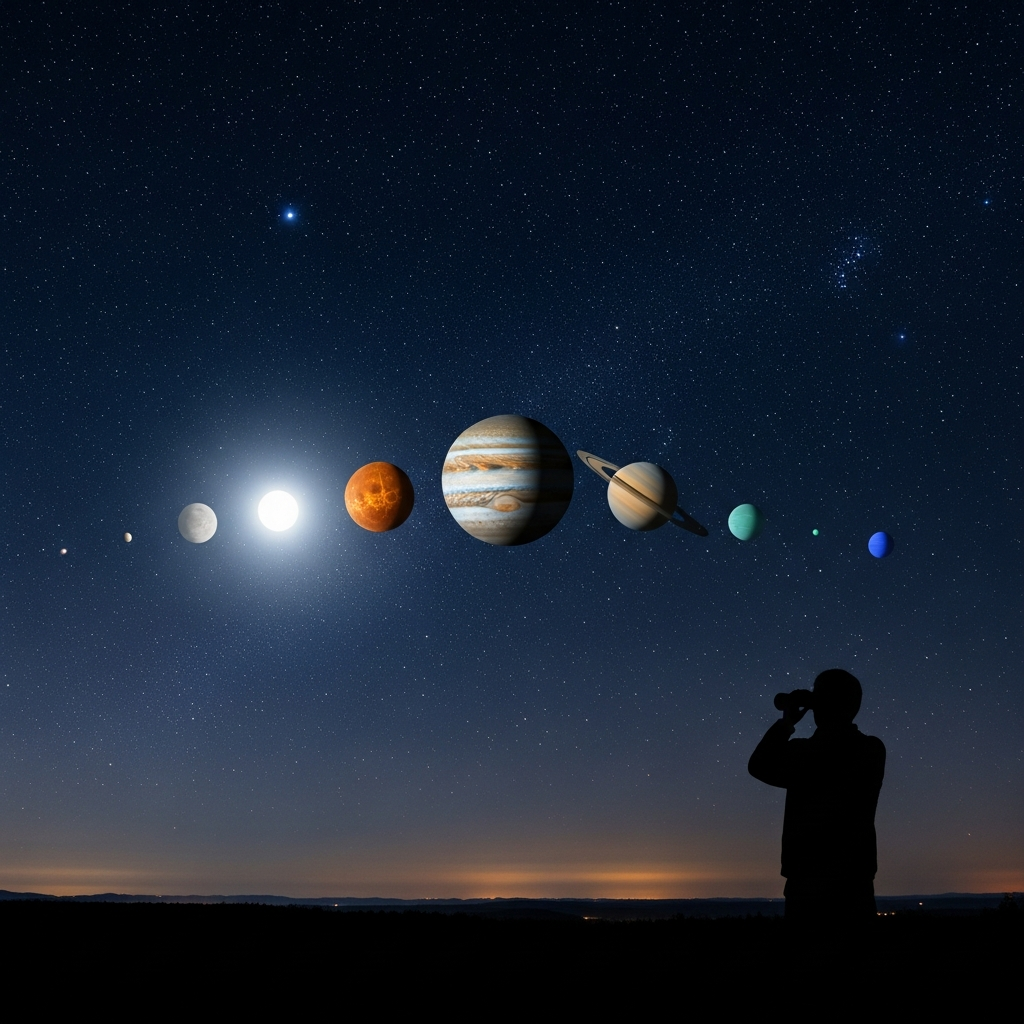
Prepare for an extraordinary celestial event in late February 2026. Skygazers worldwide are buzzing about an upcoming “planetary parade.” This rare alignment will showcase six planets simultaneously in our evening sky. Mercury, Venus, Jupiter, Saturn, Uranus, and Neptune will all be visible. This guide offers everything you need to know. Discover how to best witness this unforgettable astronomical display.
Understanding This Celestial Spectacle
A planetary parade describes multiple planets appearing together. They form a roughly aligned configuration in the sky. While they aren’t physically close in space, from Earth they create a stunning visual line. NASA officially uses the term “planetary parade” for such events. The February 2026 planet alignment promises to be particularly special. It features six of our solar system’s worlds. This makes it a relatively rare occurrence.
The optimal date for global viewing is February 28, 2026. Observers in the UK might find March 1st even better. Mark your calendars for roughly 30 minutes after sunset. This narrow window offers the best chance. You’ll have about an hour to enjoy the show.
Your Planet-by-Planet Skywatching Guide
Spotting all six planets will be a thrilling challenge. Some are easily visible to the naked eye. Others require optical assistance. A clear, unobstructed western horizon is absolutely crucial. Here’s what to look for, planet by planet:
The Naked-Eye Marvels
Three planets are expected to be brilliantly visible without any equipment.
Jupiter: The Brightest Star of the Show
Jupiter will be the easiest planet to locate. It appears spectacularly bright in late February 2026. Look towards the southern sky after dark. You’ll find it near the Orion constellation. Once you spot Orion’s distinctive shape, shift your gaze left. You’ll see a luminous “star” next to two dimmer ones. This bright point is Jupiter. The fainter stars are Castor and Pollux in Gemini. With good binoculars or a small telescope, you might even glimpse Jupiter’s four largest moons.
Venus: The Evening Star and Your Guide
Venus, known as the “Evening Star,” will shine brightly. It sits higher in the sky than Mercury. This provides a longer viewing window. Its unmistakable brilliance makes it an excellent beacon. Look for it in the low western sky. Towards the end of February, Venus will guide you. It will sit near the much fainter Mercury.
Saturn: The Ringed Jewel
Saturn will also be visible to the naked eye. It will appear low in the western sky, near Venus and Mercury. Look for its distinctive yellowish hue. Catch it early in the evening before it sets. Under ideal conditions with a small telescope, you might even observe its iconic rings. However, extreme caution is needed. Only attempt this once the Sun has fully disappeared.
The Challenging Duo: Mercury and Uranus
These two planets require a bit more planning.
Mercury: The Elusive Inner Planet
Spotting Mercury is often tricky due to its proximity to the Sun. However, around February 19, 2026, Mercury reaches its greatest eastern elongation. This positions it further from the Sun. It makes it easier to view after sunset. By February 28, it will still be low in the west. Mercury will appear faint. Binoculars can certainly help improve its visibility. Look for it just to the right of Venus.
Uranus: The Ice Giant
Uranus will be high in the sky after dark. Yet, it’s far too faint for the naked eye. You’ll definitely need binoculars or a telescope. Locate it below the Pleiades star cluster. It’s also not far from the Orion constellation. Patience and a star chart will be beneficial for finding this distant world.
Neptune: The Ultimate Challenge
Neptune: The Faintest Frontier
Neptune presents the greatest challenge. This distant ice giant is only visible with binoculars or a telescope. It will appear very low in the western sky. It will be near Saturn on February 28th. Its proximity to Saturn can assist in its location. Observing Neptune safely requires precise timing. Ensure the Sun has completely set. Using optical aids near the setting Sun is extremely hazardous.
Critical Safety Reminder
Never look directly at the Sun, either with the naked eye or through binoculars or a telescope. Doing so can cause immediate and irreversible severe eye damage. Wait until the Sun has fully disappeared below the horizon before attempting any observations. This is especially true for planets low in the western sky.
A Glimpse into the Future: Photographer’s Preview
To provide a visual reference for this tricky alignment, seasoned photographer Giovanni Passalacqua has offered stunning preview images. These photographs hint at what some planets will look like. They demonstrate just how low some celestial bodies will appear.
From Sicily, Italy, Passalacqua captured Mercury, the Moon, and Venus on February 18, 2026. This was at 18:27 local time. He used a Canon EOS R DSLR with a Sigma 200mm lens. The very next day, February 19, 2026, he photographed Saturn, the Moon, and Mercury. This shot was taken over Punta Secca, Sicily, at 18:48 local time. For this, he used a Canon EOS R DSLR with a Sigma 35mm lens. These images underscore the need for a clear, flat western horizon. They beautifully illustrate the delicate balance of light and darkness required for successful observation.
Why These Alignments Are Rare (and Safe)
Planetary alignments are not “once-in-a-lifetime” events. Opportunities to see several bright planets arise every few years. However, an alignment featuring six planets is indeed uncommon. The infrequency stems from the planets’ varying orbital speeds. Each world travels at its own pace around the Sun. For them to appear aligned from our perspective is a cosmic coincidence.
Despite the spectacle, scientists confirm these alignments have no scientific effect on Earth. They are purely visual phenomena. The February 2026 planet alignment is an opportunity for appreciation, not apprehension. If you miss this one, another comparable five-planet alignment is predicted for October 2028. That one will be visible before sunrise. Another evening alignment similar to 2026 is anticipated for February 2034.
Maximizing Your Viewing Experience
To make the most of the February 2026 planetary parade, thoughtful preparation is key.
Optimal Location and Timing
Choose Wisely: Seek a viewing spot free from light pollution. An open, flat western horizon is essential. Avoid tall buildings, trees, and streetlights. Light pollution near the horizon scatters light. This makes faint objects harder to see.
Check Local Sunset: Be aware of your precise local sunset time. Aim to start observing about 30 minutes afterward.
Dark Adaptation: Arrive at your chosen spot early. Allow your eyes ample time to adjust to the darkness. This improves your ability to discern fainter objects.
Equipment and Persistence
Binoculars are Your Friend: Even basic binoculars can greatly enhance the experience. They reveal Uranus and Neptune. They also bring out Mercury and Saturn more clearly.
Telescope for Details: A small telescope can show Jupiter’s moons or Saturn’s rings. Always exercise extreme caution when pointing any optical device near the horizon around sunset.
Patience is a Virtue: Not all planets will pop out instantly. Take your time. Sweep the western sky slowly and methodically.
Global Considerations: For observers in India, the prime viewing window is expected between 6:15 pm and 8:00 pm IST on February 28, 2026. Always account for local weather conditions. Clear skies are paramount for a rewarding experience.
Frequently Asked Questions
What makes the February 2026 planet alignment so special?
The February 2026 planet alignment is special because it features six planets – Mercury, Venus, Jupiter, Saturn, Uranus, and Neptune – simultaneously visible in the evening sky. While alignments of two or three bright planets are common, seeing six together is a relatively rare event. It’s also conveniently timed shortly after sunset, making it accessible for many skygazers globally, particularly on February 28th. This unique gathering offers an incredible opportunity to observe multiple solar system bodies without waiting decades for a similar display.
How can I best prepare to observe the February 2026 planetary parade?
To best observe the February 2026 planetary parade, first, prioritize safety by never* looking directly at the Sun. Wait until it has completely set. Choose a viewing location with a clear, flat western horizon and minimal light pollution. Plan to be there about 30 minutes after sunset. Allow your eyes to adjust to the darkness. While some planets are naked-eye visible, binoculars or a small telescope will enhance views of Mercury, Saturn, and are essential for Uranus and Neptune. Be patient and persistent, as some planets will appear very low in the sky.
Which planets will be easiest to see during the February 2026 alignment?
Jupiter will undoubtedly be the easiest planet to spot during the February 2026 alignment. It will be spectacularly bright and high in the southern sky. Venus will also be very bright and visible to the naked eye in the western sky. Saturn should also be discernible to the naked eye, though lower on the western horizon. Mercury is visible without aid but will be challenging due to its low position. Uranus and Neptune, however, are too faint for the naked eye and will require binoculars or a telescope for any chance of observation.
Conclusion
The February 2026 planet alignment is truly a spectacular event. It offers a rare chance to connect with our vast cosmos. With careful planning, a clear western horizon, and a little patience, you can witness this magnificent “planetary parade.” Remember the crucial safety advice: protect your eyes from the Sun. Gather your family and friends. Look up to the evening sky in late February 2026. Share your observations and photos with fellow astronomy enthusiasts. This unique display is a beautiful reminder of the intricate dance of our solar system.