Could life’s fundamental ingredients be woven into the very fabric of distant worlds from their genesis? New groundbreaking research suggests that Jupiter’s massive Galilean moons — Europa, Ganymede, and Callisto, renowned for their hidden oceans — might have been born with the crucial chemical precursors for life already embedded within their icy cores. This paradigm-shifting discovery challenges previous assumptions, painting a vivid picture where the seeds of life are not just delivered by chance, but are an integral part of planetary formation. It’s a compelling notion that significantly amplifies the potential for habitability throughout our solar system and beyond, making the search for extraterrestrial life even more exciting.
A Revolutionary Look at Jupiter’s Moons
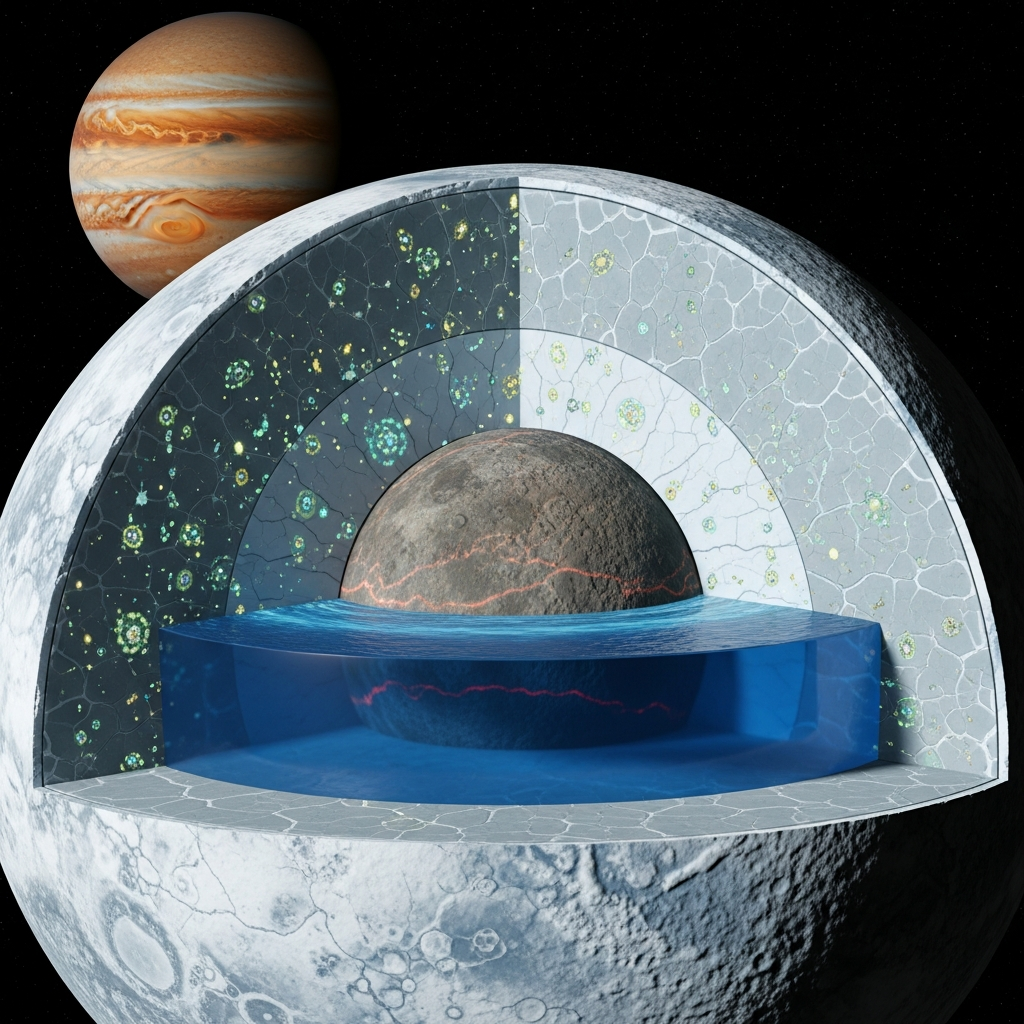
For decades, scientists have scrutinized Jupiter’s Galilean moons, particularly Europa, Ganymede, and Callisto, as prime candidates for harboring life beyond Earth. Recent studies, published in The Planetary Science Journal and Monthly Notices of the Royal Astronomical Society, unveil a surprising narrative: these icy giants may not have started as chemically barren worlds. Instead, they could have inherited a substantial inventory of complex organic molecules (COMs) from the very moment they coalesced.
What exactly are these COMs? They are the intricate chemical precursors to life, including vital components like amino acids and nucleotides. These molecules are the bedrock for proteins and DNA, the molecular machinery of all known life. Dr. Olivier Mousis from SwRI, a lead author of the study, highlights the team’s innovative approach. “By combining disk evolution with particle transport models, we could precisely quantify the radiation and thermal conditions the icy grains experienced,” he explained. This meticulous modeling revealed a credible pathway for these essential molecules to form and be delivered.
The Cosmic Delivery Service: How Moons Get Their Ingredients
The story begins in the vast, swirling protoplanetary disk that once surrounded the young Sun, and later, in Jupiter’s own circumplanetary disk. Here, icy grains containing simple compounds like methanol or ammonia were subjected to a cosmic crucible of ultraviolet radiation and moderate heating. Under these specific conditions, organic chemistry could flourish, leading to the formation of COMs.
Dr. Mousis emphasized that their “simulations were directly compared with other laboratory experiments that produce COMs under realistic astrophysical conditions,” validating that such formation is indeed possible in these harsh environments. These organic-rich icy grains then acted as cosmic delivery vehicles, transporting the newly formed complex molecules from the surrounding disk directly to the nascent moons as they grew. As the moons accumulated material, they captured these valuable organic molecules, effectively being “seeded” with life’s building blocks at birth.
This process isn’t unique to Jupiter’s system. Astronomers have tentatively identified similar precursors in the planet-forming disk around V883 Orionis, a young star 1,305 light-years away. This suggests that the universe might be teeming with these crucial organic building blocks, ready to be incorporated into newly forming planetary bodies.
Echoes from Asteroid Bennu: Life’s Ingredients Across the Solar System
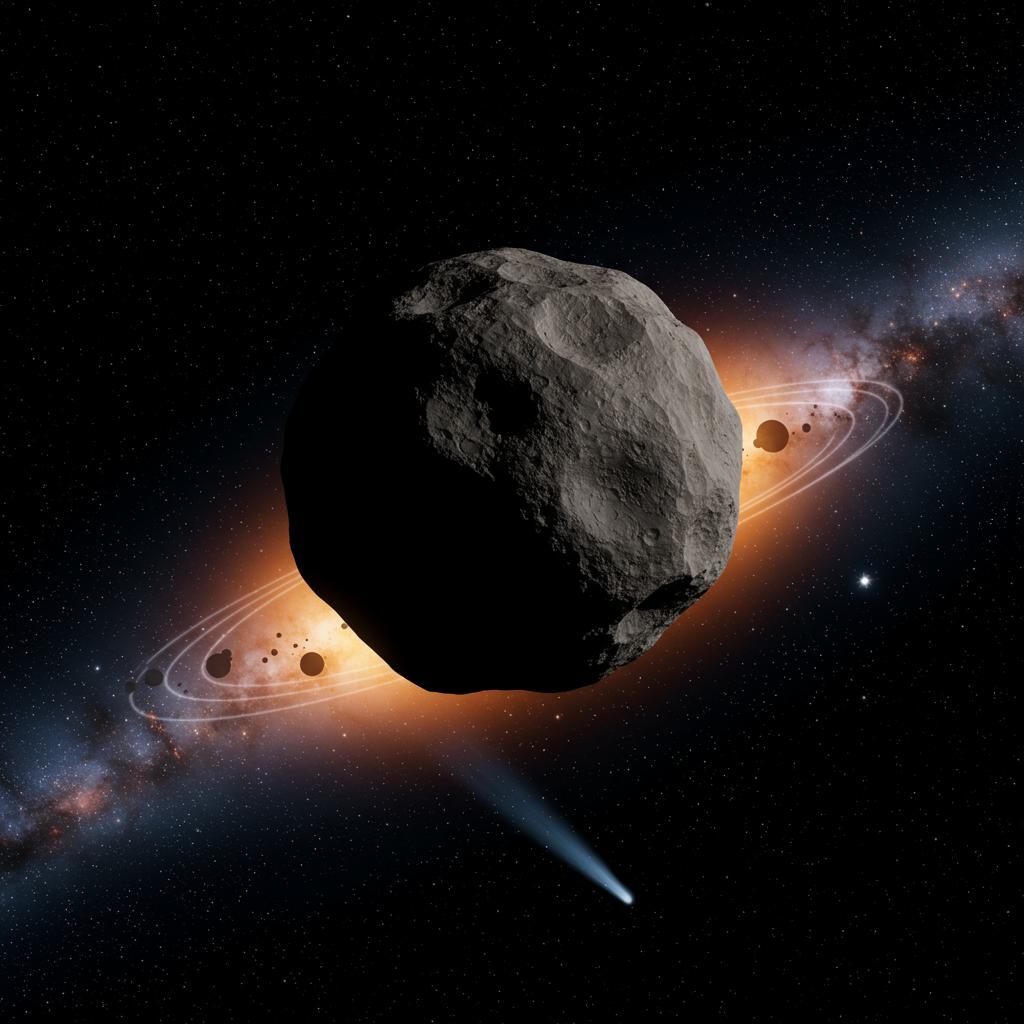
This concept of celestial bodies inheriting life’s ingredients is further bolstered by recent findings from NASA’s OSIRIS-REx mission. In 2023, samples returned from asteroid Bennu, a relic from the early solar system, contained a rich diversity of organic molecules. These included 14 of the 20 amino acids vital for proteins, and all five nucleobases that form DNA and RNA.
The pristine nature of the Bennu samples, collected directly from space, provided high confidence in these discoveries. They confirmed the long-held hypothesis that asteroids and other space debris could have “seeded” early Earth with the raw materials necessary for life to emerge. Dr. Danny Glavin, an astrobiologist at NASA’s Goddard Space Flight Center, noted that the widespread presence of these space-formed chemical building blocks across the solar system significantly increases the probability that life could have originated beyond Earth. Bennu’s parent body also showed evidence of a wet environment, where salty brines could have facilitated prebiotic organic chemistry.
What Makes a World Habitable? Key Ingredients for Life
Understanding why the presence of COMs on Jupiter’s moons is so significant requires a look at the fundamental “ingredients” scientists seek for life beyond Earth. Building on insights into how life thrives on our planet, experts typically highlight several key components:
Water: The universal solvent, essential for chemical reactions. Europa, Ganymede, and Callisto all harbor vast subsurface oceans, making them prime candidates for further study.
Carbon: The backbone of all known organic compounds, forming stable and complex molecular structures. COMs are inherently carbon-based.
Nitrogen: Crucial for amino acids and the genetic material DNA and RNA.
Phosphorus: Key for energy transfer (ATP) and the structural integrity of DNA and cell membranes.
Sulfur: Involved in enzymatic functions and used as an energy source by some extremophile bacteria.
The finding that Jupiter’s moons may have accreted a significant inventory of COMs at birth provides a crucial “chemical foundation.” This foundation can then interact with the liquid water in their interiors, potentially creating conditions ripe for prebiotic chemistry to unfold, moving us closer to life’s origin point.
The Complex Challenge of Detecting Alien Life
While discovering abundant complex organic molecules on Jupiter’s moons is a huge step forward, it’s vital to differentiate between the building blocks of life and life itself. Recent advancements, like the LifeTracer framework developed by computational scientists, highlight the nuanced challenges of detecting extraterrestrial biology.
Studies of asteroid Bennu samples, for instance, showed a near-equal split of “left-handed” and “right-handed” amino acids. On Earth, life predominantly uses left-handed forms. This suggests that while nonliving materials can produce a diverse, organized array of organic molecules, life itself might introduce a specific “molecular asymmetry.” LifeTracer, detailed in PNAS Nexus, tackles this by analyzing the full chemical patterns* within complex organic mixtures, rather than relying on individual diagnostic molecules or assumed Earth-like chiral preferences. This innovative machine learning approach distinguishes between abiotic meteorite samples and biotic terrestrial samples by focusing on the overall distribution of chemical fingerprints. It’s a powerful reminder that while life-friendly chemistry may be widespread, it doesn’t automatically equate to biology.
Implications for Future Missions to Jupiter’s Moons
This new understanding of how Jupiter’s moons may have inherited life’s building blocks provides a critical framework for upcoming missions. NASA’s Europa Clipper mission and the European Space Agency’s JUICE (JUpiter ICy moons Explorer) mission are designed to explore the composition and potential habitability of these moons in unprecedented detail.
“Establishing credible pathways for COMs formation and delivery provides scientists with a critical framework for interpreting upcoming measurements of Jupiter’s surface and subsurface chemistry,” Dr. Mousis affirmed. Data from these missions, investigating Europa’s subsurface ocean and Ganymede’s icy shell, will be interpreted through this new lens. If organic molecules were indeed present in the moons’ primordial material, coupled with liquid water and potential energy sources, the conditions for life could have been established billions of years ago. Europa, with its vast subsurface ocean contacting a rocky core, remains a particularly intriguing target for discovering the elusive signs of extraterrestrial life.
A New Paradigm for Planetary Habitability
This research significantly broadens our perspective on planetary formation and the distribution of life’s essential components. It underscores the importance of an integrated approach, linking laboratory chemistry, disk physics, and particle transport models to unravel how habitable conditions emerge.
By showing that organic molecules can be incorporated into worlds at their earliest stages, this work suggests that the roots of habitability are far deeper and more complex than previously imagined. It opens a new chapter in astrobiology, inviting us to view distant worlds not just as potential future homes for life, but as environments that may have been chemically primed for biology since their very inception. The universe, it seems, might be far more organically rich and potentially life-friendly than we’ve ever dared to believe.
Frequently Asked Questions
How could Jupiter’s moons have acquired life’s building blocks so early?
New research suggests that Jupiter’s moons inherited complex organic molecules (COMs) directly during their formation. In the turbulent circumplanetary disk surrounding early Jupiter, icy grains containing simple compounds were exposed to ultraviolet radiation and moderate heating. This led to the formation of COMs, such as amino acids and nucleotides. These organic-rich grains were then incorporated into the moons as they accreted material, effectively seeding them with life’s essential chemical precursors from birth.
What are “complex organic molecules” and why are they important for life on Jupiter’s moons?
Complex organic molecules (COMs) are intricate chemical compounds containing six or more atoms, including at least one carbon atom. They are critical because they serve as the fundamental building blocks for proteins and DNA, which are essential for all known life. Their presence on Jupiter’s moons, especially in conjunction with subsurface liquid water, suggests that these moons could have had the necessary chemical ingredients to initiate prebiotic chemistry, a crucial step towards the emergence of life.
What do these findings mean for future missions like Europa Clipper and JUICE?
These findings provide a vital “critical framework” for interpreting data from upcoming missions to Jupiter’s moons, such as NASA’s Europa Clipper and ESA’s JUICE. By establishing a credible pathway for the formation and delivery of COMs, scientists will be better equipped to understand the surface and subsurface chemistry observed by these spacecraft. This knowledge will guide the search for biosignatures and help scientists differentiate between abiotic organic chemistry and potential signs of actual life in the moons’ icy oceans.