The death of Nemesio Oseguera Cervantes, known universally as “El Mencho,” stands as a pivotal moment in Mexico’s relentless battle against organized crime. As the elusive leader of the Jalisco New Generation Cartel (CJNG), his demise on February 22, 2026, during a high-stakes military operation, sent shockwaves across Mexico and beyond. This isn’t just a story of a kingpin’s end; it’s a dramatic narrative of intelligence, fierce combat, and the immediate, violent ripple effects that underscore the complex realities of Mexico’s cartel landscape.
The operation to neutralize El Mencho marked the most significant blow to organized crime since the recapture of Joaquin “El Chapo” Guzman almost a decade prior. For years, El Mencho reigned as Mexico’s most-wanted man, his cartel a formidable and ruthless force. His capture and death highlight the strategic efforts of Mexican authorities, supported by international intelligence, to dismantle the structures of powerful criminal enterprises.
The Rise of a Ruthless Kingpin: Who Was El Mencho?
Nemesio Oseguera Cervantes, a former police officer from Michoacan, carved out a notorious criminal empire over three decades. Born in 1966, El Mencho, at 59, had a long history intertwined with the drug trade. His criminal career included a prison sentence in the U.S. in the mid-1990s for heroin trafficking. Upon his return to Mexico, he rapidly ascended through the drug underworld, showcasing a chilling aptitude for violence and organization.
Around 2009, El Mencho founded the Jalisco New Generation Cartel (CJNG). Under his leadership, the CJNG expanded at an alarming rate, quickly becoming one of Mexico’s most powerful and violent criminal organizations. The cartel gained infamy for its sophisticated and brutal tactics, which included deploying military-style operations. They utilized armed drones, improvised explosive devices, and launched direct assaults on security forces, marking a new, aggressive chapter in cartel warfare.
The CJNG’s operations were vast and diversified, extending beyond traditional drug trafficking. They smuggled massive quantities of cocaine, methamphetamine, and fentanyl into the United States. Additionally, the cartel engaged in migrant smuggling, extortion, and various other illicit rackets, corrupting countless police officers, judges, prosecutors, and politicians. With a $15 million U.S. bounty on his head, El Mencho became one of the United States’s most wanted fugitives. His cartel dominated Guadalajara and held significant sway across Jalisco, Colima, Michoacán, and other states, positioning itself as a fierce rival to the remnants of the Sinaloa Cartel.
Tracing the Trail: Intelligence and Surveillance
The intricate operation to apprehend El Mencho began taking shape on February 20, 2026. Mexican authorities received critical intelligence, reportedly from an associate of one of El Mencho’s romantic partners. This crucial tip led them to a secluded property in Tapalpa, a mountain town nestled in central-western Mexico, believed to be the cartel leader’s hiding place. The intelligence was precise, allowing security forces to meticulously plan their approach.
Over the next two days, an elite team of Mexican special forces, backed by the National Guard, military aircraft, and helicopters, moved to seal off the area. The objective was clear: a high-risk raid on one of the most dangerous men in the country. A U.S. defense official later confirmed that a U.S. military-led intelligence task force, specifically focusing on drug cartels, had provided valuable support to the operation, underscoring the bilateral cooperation in the fight against narcotics.
The Tapalpa Raid: Confrontation and Capture
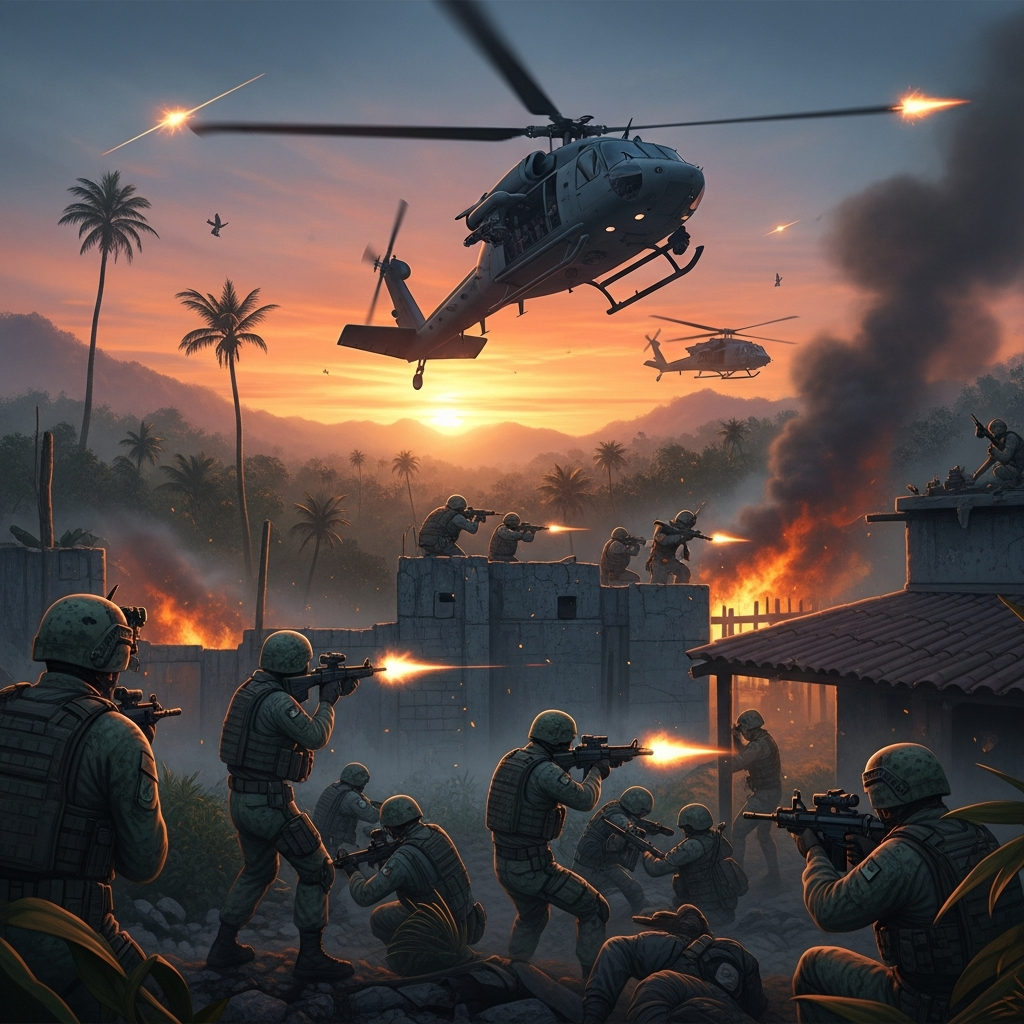
In the predawn hours of Sunday, February 22, the raid commenced. As soldiers advanced on the compound in Tapalpa, they immediately encountered fierce resistance. Cartel gunmen opened fire, triggering an intense firefight. Several suspected CJNG members were killed in the initial confrontation. El Mencho and members of his inner circle attempted a desperate escape, fleeing to a nearby wooded cabin complex.
A second, equally violent exchange of gunfire erupted at the cabin complex. The battle raged for hours. Soldiers eventually located a wounded El Mencho alongside two of his bodyguards. Seriously injured, he was quickly airlifted from the remote location for medical attention. However, despite the rapid response, El Mencho died during the flight. Authorities at the raid site discovered a sophisticated arsenal, including rifles with grenade launchers, rocket launchers, and mortar shells, highlighting the significant threat posed by El Mencho’s security detail.
A Cartel’s Fury: The Immediate Retaliation
El Mencho’s death did not bring immediate peace; instead, it ignited a furious wave of retaliatory violence across Mexico. The defense ministry identified a senior CJNG figure, known as “El Tuli,” as the architect of these coordinated attacks. “El Tuli,” El Mencho’s right-hand man and a key financial operator within the cartel, reportedly offered a bounty of 20,000 pesos (approximately $1,100) for the killing of each military member following the February 22 operation.
Cartel members rapidly mobilized. They orchestrated widespread roadblocks, setting cars ablaze and forcing passengers out of vehicles to create chaos. Arson attacks targeted businesses and government facilities, and highways were blocked in multiple states. The violence brought daily life to a standstill in affected regions. Airlines, including Aeromexico and Air Canada, canceled flights to popular destinations like Puerto Vallarta, a Pacific resort city in Jalisco. Schools and universities suspended classes, and local authorities urged residents to shelter indoors. Plumes of smoke rising over parts of southern Mexico grabbed international headlines, painting a stark picture of the widespread unrest.
The death toll quickly mounted. By Monday, authorities reported at least 30 suspected gang members, 25 National Guard troops, one prison guard, one prosecutor’s office agent, and one civilian had been killed in the ensuing violence. More than 70 people were arrested across seven states, and a staggering 85 cartel-related roadblocks were recorded on Sunday alone. In a separate, related operation later the same day, security forces tracked “El Tuli” to El Grullo, about 180km southwest of Guadalajara. He was killed in a clash with officers while attempting to flee, marking another significant loss for the CJNG.
Government Response and Economic Fallout
In the wake of the intense violence, Mexican President Claudia Sheinbaum swiftly moved to reassure the public and assert control. The government deployed substantial military reinforcements, with Defense Secretary Ricardo Trevilla announcing an additional 2,500 soldiers sent to western Mexico, bringing the total deployment to approximately 9,500 troops since Sunday. President Sheinbaum lauded the military operation, emphasizing her administration’s commitment to guaranteeing peace and security. By Monday morning, authorities reported that the majority of roadblocks had been cleared, signaling a return to some semblance of normalcy.
However, the ripple effects extended beyond immediate security concerns. The U.S. State Department issued a “shelter-in-place” advisory for Americans in Jalisco and several other states, urging tourists to minimize travel and monitor local news. While airports generally remained open, significant flight disruptions occurred in Guadalajara and Puerto Vallarta. The economic impact was immediate, particularly on Mexico’s crucial tourism sector. Airlines experienced flight cancellations, and their share prices dropped. Mexican conglomerate Femsa reported over 200 incidents at its Oxxo convenience stores and gas stations. Experts warned that prolonged unrest could jeopardize Jalisco’s critical industries, including electronics, semiconductor manufacturing, and its substantial agricultural production of eggs, berries, avocados, and tequila.
The Long Road Ahead: Implications for Mexico’s Drug War
The killing of El Mencho undeniably represents a major victory for the Mexican government and a severe blow to the CJNG. For years, U.S. administrations had pressured Mexico to intensify its fight against cartels, with the White House even previously designating the CJNG as a foreign terrorist group. U.S. Ambassador to Mexico Ron Johnson applauded the operation, highlighting the “unprecedented levels” of bilateral cooperation.
Yet, analysts caution that the long-term implications are complex and potentially volatile. While removing a kingpin like El Mencho can weaken a cartel, it often leads to internal power struggles and fragmentation, potentially sparking new waves of violence. Mike Vigil, a former international chief for the U.S. Drug Enforcement Administration, suggested that the cartel’s swift and brutal retaliation was a message: “we are still strong, we are not debilitated.” The absence of a clear successor within the CJNG could create a power vacuum, inviting other violent criminals to vie for control and further destabilizing the organized crime landscape.
The ongoing complexities in U.S.-Mexico anti-drug trafficking efforts also persist. While the U.S. urges Mexico to crackdown on cartels, Mexican authorities consistently call on the U.S. to curb the illegal flow of firearms into Mexico, noting that approximately 70% of illegal arms traced in Mexico originate from the U.S. El Mencho’s death is a significant milestone, yet it underscores that the battle against organized crime in Mexico remains a multifaceted, enduring challenge with no simple solution.
Frequently Asked Questions
How was El Mencho killed, and who was he?
El Mencho, whose real name was Nemesio Oseguera Cervantes, was the notorious leader of the Jalisco New Generation Cartel (CJNG). He was killed on February 22, 2026, during a predawn raid by Mexican special forces in Tapalpa, Jalisco. Mexican authorities, acting on intelligence, tracked him to a secluded property. During a fierce firefight with his bodyguards, El Mencho sustained serious injuries. He subsequently died while being airlifted for medical attention from the remote location.
What was the immediate impact of El Mencho’s death on Mexico, especially for travelers?
The immediate aftermath of El Mencho’s death triggered widespread retaliatory violence across multiple Mexican states. CJNG members orchestrated roadblocks, arson attacks, and assaults on government facilities. This led to significant disruptions, including flight cancellations to cities like Puerto Vallarta and the closure of schools. The U.S. State Department issued a “shelter-in-place” advisory for Americans in affected areas, particularly Jalisco. Travelers were advised to minimize unnecessary travel and monitor local news.
What are the long-term implications of El Mencho’s killing for Mexico’s organized crime landscape?
While El Mencho’s death is a major blow to the CJNG and a victory for the Mexican government, analysts suggest it could lead to increased instability. Historically, removing cartel kingpins often creates power vacuums, potentially fracturing criminal groups and sparking internal struggles for succession. This could result in new waves of violence as rival factions or other cartels vie for control. The incident also highlights the ongoing need for comprehensive strategies that address both law enforcement and the underlying factors contributing to organized crime.
The fall of El Mencho marks a defining moment, but it’s a chapter in an ongoing saga. While the operation demonstrated the resolve of the Mexican state, supported by international intelligence, the fight against complex and deeply entrenched criminal organizations like the CJNG continues. The coming months will reveal how the power dynamics within Mexico’s underworld shift, and whether this significant victory leads to sustained peace or new, unforeseen challenges.