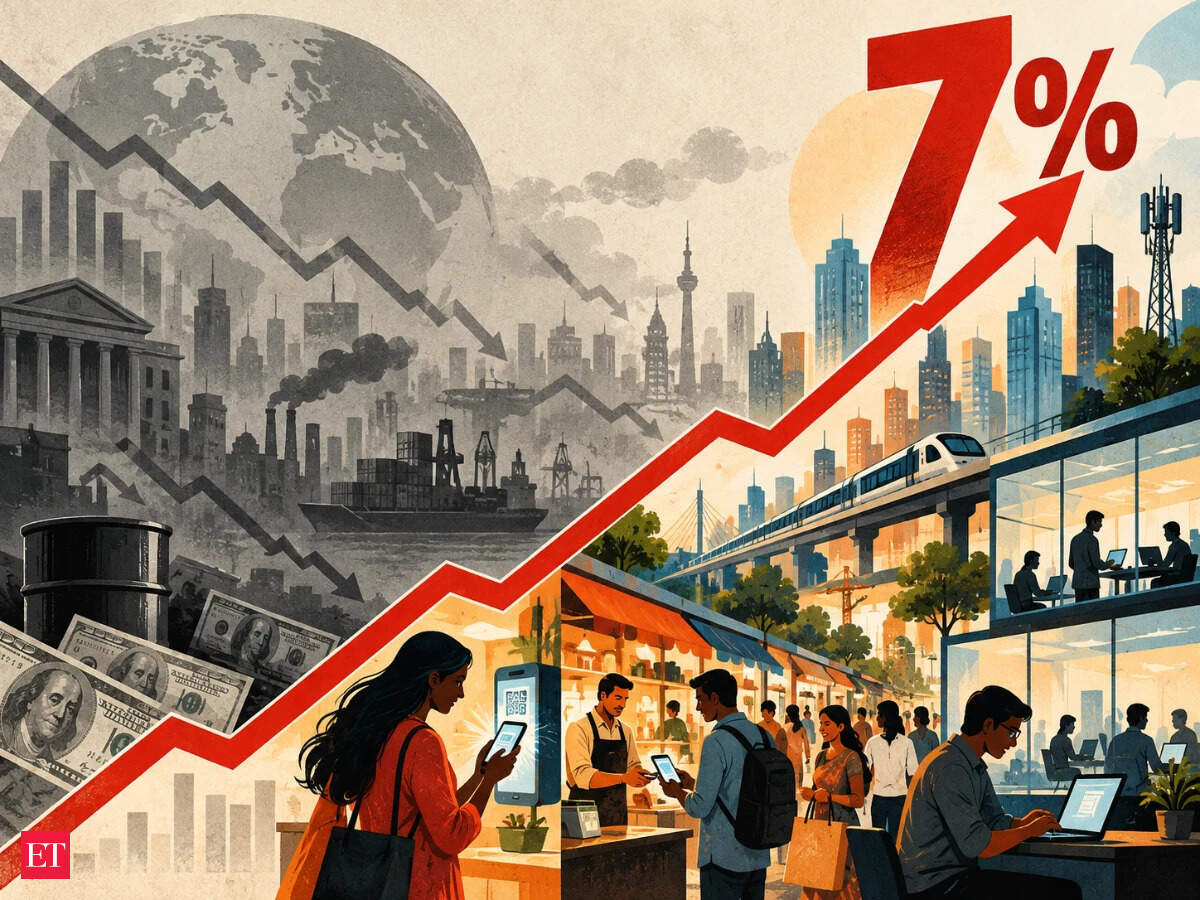
The india economic growth forecast has been significantly upgraded by the International Monetary Fund (IMF), which now projects the nation’s economy will expand by 7% in 2026. This upward revision, announced on October 13, 2026, positions India as a primary engine of global growth, even as other major economies and emerging markets face a period of deceleration and geopolitical instability.
Key Takeaways
- Significant Upward Revision: The IMF raised India’s 2026 growth projection to 7%, a 60 basis point increase from its July 2026 estimate of 6.4%.
- Growth Engines: Robust domestic demand and a flourishing services sector are cited as the primary drivers behind this economic momentum.
- Technological Buffer: The ongoing “AI boom” is credited with helping to offset various macroeconomic headwinds and commodity market volatility.
- Global Divergence: While India’s outlook is brightening, China’s growth is projected to ease to 4.5% in 2026, and global output expansion is expected to slow.
- Critical Risks: High global oil prices and instability in the Middle East remain significant vulnerabilities for the energy-importing Indian economy.
- Geopolitical Assumptions: The IMF’s baseline modeling assumes a reopening of the Strait of Hormuz in March 2027 to stabilize energy markets.
- Energy Market Stability: Watch for news regarding the stability of the Middle East and any developments involving the Strait of Hormuz. Any disruption here will be a primary signal of potential economic volatility.
- Quarterly GDP Data: Monitor India’s quarterly economic releases to see if the actual growth matches the IMF’s projected momentum in the services and technology sectors.
- Global Commodity Prices: Keep a close eye on Brent crude and other energy benchmarks. Sustained high prices will be a test of India’s economic resilience.
- March 2027 Milestone: The IMF’s baseline assumption for the reopening of the Strait of Hormuz will be a critical juncture for global energy markets and India’s fiscal health.
- m.economictimes.com
- www.businesstoday.in
- www.ft.com
What Happened
On Tuesday, October 13, 2026, the International Monetary Fund (IMF) released its latest World Economic Outlook report, titled “Resilience Under Strain, Urgent Choices.” The report contains a major update regarding the trajectory of the Indian economy, officially raising the India economic growth forecast for 2026 to 7%.
According to data compiled by The Economic Times and Business Today, this revision marks a 0.6 percentage point (60 basis points) increase from the IMF’s July 2026 outlook, which had placed growth at 6.4%. This is also a 0.5 percentage point increase from the April 2026 baseline. The optimism extends into 2027, where the IMF has also maintained a 7% growth forecast, a revision that sits 0.5 percentage points higher than the estimate provided in April 2026.
This upward trend is not an isolated occurrence. The IMF’s report highlights that other major international financial institutions, including the World Bank and the OECD, have also moved in alignment with this positive trend, raising their respective forecasts for India. The Asian Development Bank (ADB) has similarly adjusted its growth aims for the country to 7%, further consolidating the consensus among global economists.
Why It Matters
The IMF’s decision to upgrade India’s outlook is significant because it highlights a growing divergence between India and the rest of the emerging world. While many energy-importing emerging and developing economies are facing medium-term downgrades due to geopolitical tensions and fluctuating commodity prices, India is standing out as a resilient exception.
For the global economy, India—alongside China—is being identified as a “big engine of growth.” However, the nature of this growth is changing. While China’s growth is projected to ease to 4.5% in 2026 and 4% in 2027 due to structural headwinds, India’s momentum appears to be accelerating. This shift has profound implications for global investment sentiment, as capital may increasingly flow toward markets demonstrating higher resilience and technological integration.
Comparing Economic Trajectories
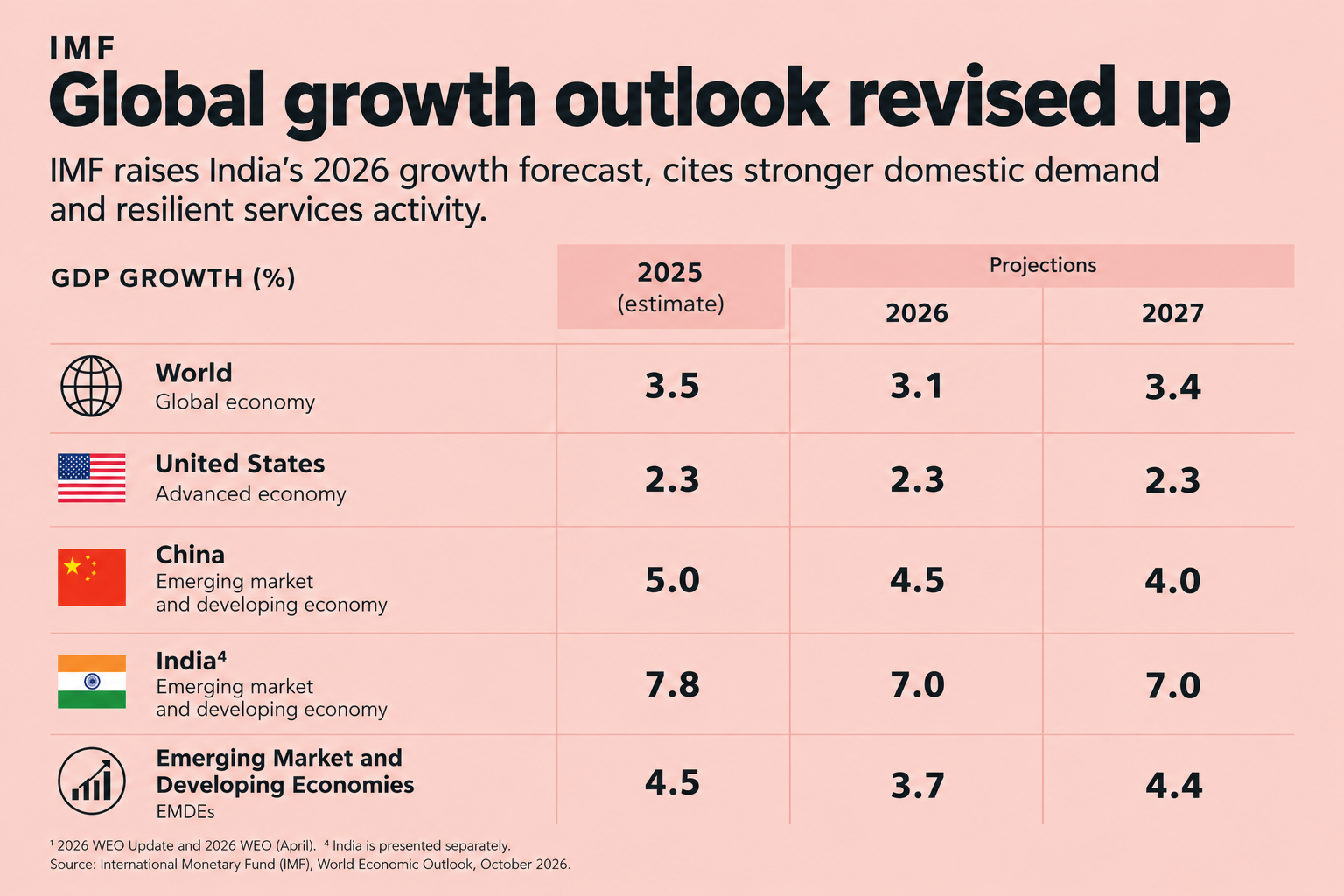
To understand the scale of India’s outperformance, it is necessary to compare its projected growth against both regional peers and the global average. The following table, synthesized from IMF data, illustrates the projected growth rates for various economic sectors and regions.
| Economic Entity | 2025 Forecast (%) | 2026 Forecast (%) | 2027 Forecast (%) |
|---|---|---|---|
| India | 7.8% | 7.0% | 7.0% |
| China | – | 4.5% | 4.0% |
| Emerging Markets & Developing Economies | 4.5% | 3.7% | 4.4% |
| Global World Output | 3.5% | 3.1% | 3.4% |
As the table demonstrates, while the group of emerging markets is expected to see a growth deceleration from 4.5% in 2025 to 3.7% in 2026, India is bucking this trend with its 7% projection. Furthermore, the global growth forecast of 3.1% for 2026 is notably lower than the pre-pandemic average of 3.7% recorded between 2000 and 2019.
Deep-Dive: The Drivers of Resilience
The Services Sector and the AI Boom
One of the most critical factors driving the revised India economic growth forecast is the robust performance of the services sector. The IMF attributes the upward revision to strong domestic demand and a services industry that has shown remarkable adaptability.
Crucially, the IMF notes that the “AI boom” has played a pivotal role in this resilience. Silvana Tenreyro, the IMF Economic Counsellor and Director of the Research Department, stated that while the region has faced challenges as a net importer of energy and commodities, “the AI boom has more than offset the headwinds from commodity markets, with China and India emerging as the big engines of growth.”

This technological tailwind suggests that India’s growth is increasingly being driven by high-value, digital-centric activities rather than just traditional manufacturing or agriculture. This shift provides a buffer against the volatility of physical commodity markets, such as those seen in the oil and gas sectors.
Domestic Demand and Structural Reforms
Beyond technology, the IMF points to fundamental economic strengths. Resilient domestic demand, fueled by a growing internal market and favorable demographic dynamics, provides a stable foundation for growth. The IMF also highlights ongoing structural reforms as a key component of this stability, suggesting that policy-level changes are successfully creating a more conducive environment for business and consumption.
The Geopolitical Equation and Energy Vulnerabilities
Despite the optimistic growth numbers, the IMF’s report, “Resilience Under Strain, Urgent Choices,” carries a heavy warning: India is not insulated from external shocks. As a net importer of energy, India remains highly sensitive to fluctuations in global oil prices.
The Middle East and the Strait of Hormuz
The ongoing conflict in the Middle East is a primary source of concern for the IMF. Geopolitical instability in this region has the potential to cause significant supply shocks and drive up energy costs, which could weigh heavily on India’s growth if not managed.
The IMF’s current economic modeling relies on several high-stakes baseline assumptions regarding the resolution of these conflicts. Specifically, the IMF assumes that the Strait of Hormuz—a critical maritime chokepoint for global energy supplies—will reopen in March 2027. Furthermore, the report assumes a broad return to prewar conditions in the Middle East by October 2027.
If these geopolitical assumptions fail to materialize, the projected stability for 2027 could be compromised. For energy-importing nations like India, any disruption to the flow of goods through the Strait of Hormuz could lead to intense competition for available cargoes and sudden spikes in domestic inflation.
What It Means for You
The shifting India economic growth forecast has practical implications for various stakeholders:
For Investors
If you are looking at emerging markets, the IMF’s data suggests a clear divergence in opportunity. The resilience of India’s services sector and its integration into the global AI cycle may offer more attractive risk-adjusted returns compared to other emerging markets that are currently facing growth decelerations. However, investors must remain vigilant regarding energy-related volatility and geopolitical risks that could impact corporate margins.
For Businesses and Policymakers
For those operating within the Indian market, the focus should remain on domestic consumption and the digital economy. The strength of the services sector indicates that demand for technological integration and digital services will likely continue to grow. For policymakers, the priority must remain on energy security. Mitigating the impact of global oil volatility through strategic reserves and diversifying energy sources will be essential to maintaining this 7% growth trajectory.
Counterpoints and Open Questions
While the IMF’s outlook is overwhelmingly positive, it is not without its critics and unanswered questions.
The Energy Dependency Risk: Some economists argue that the IMF may be underestimating the impact of sustained high energy prices. Because India is a net importer of commodities, a prolonged period of Middle East instability could offset the gains made by the services sector and the AI boom. The “resilience” mentioned by the IMF may be more fragile than the 7% figure suggests if energy costs spike unexpectedly.
The Role of Climate and Food Security: While not the primary focus of the growth revision, other economic indicators suggest that environmental factors like “El Nino” could cloud the food security story. Disruptions in agricultural output can lead to food inflation, which in turn can dampen the very domestic demand the IMF is counting on for growth.
The Unconfirmed Timeline of Geopolitical Resolution: The IMF’s projections are built on the assumption of a return to prewar conditions by late 2027. This is a significant assumption that has not been independently verified by political analysts. If the conflict in the Middle East escalates or becomes a protracted stalemate, the entire economic model for 2027 may require downward revision.
What Happens Next
As we move through the remainder of 2026 and into 2027, several key catalysts and signals will determine whether India can maintain its 7% growth path:
Frequently Asked Questions
Why did the IMF raise India’s growth forecast?
The IMF raised the India economic growth forecast to 7% for 2026 due to stronger-than-expected economic momentum. This is primarily driven by resilient domestic demand, a robust services sector, and the positive impact of the global “AI boom,” which has helped offset the costs of higher commodity prices.
How does India’s growth compare to China’s?
nIndia is currently projected to grow faster than China. While India’s growth is forecasted at 7% for both 2026 and 2027, China’s growth is expected to ease to 4.5% in 2026 and 4% in 2027 due to various structural headwinds and economic uncertainties.
What are the main risks to India’s economic outlook?
The primary risks include high global oil prices and geopolitical instability, particularly in the Middle East. As a net importer of energy, India is vulnerable to supply shocks that could disrupt its growth. Additionally, environmental factors like El Nino could impact food security and inflation.
What is the significance of the “AI boom” in this report?
nThe IMF notes that the “AI boom” has provided a technological tailwind that helps offset the negative impacts of volatile commodity markets. This suggests that India’s economic structure is successfully shifting toward high-value, digital-driven services, providing a layer of protection against traditional economic shocks.
References
Featured image: Image via The Economic Times