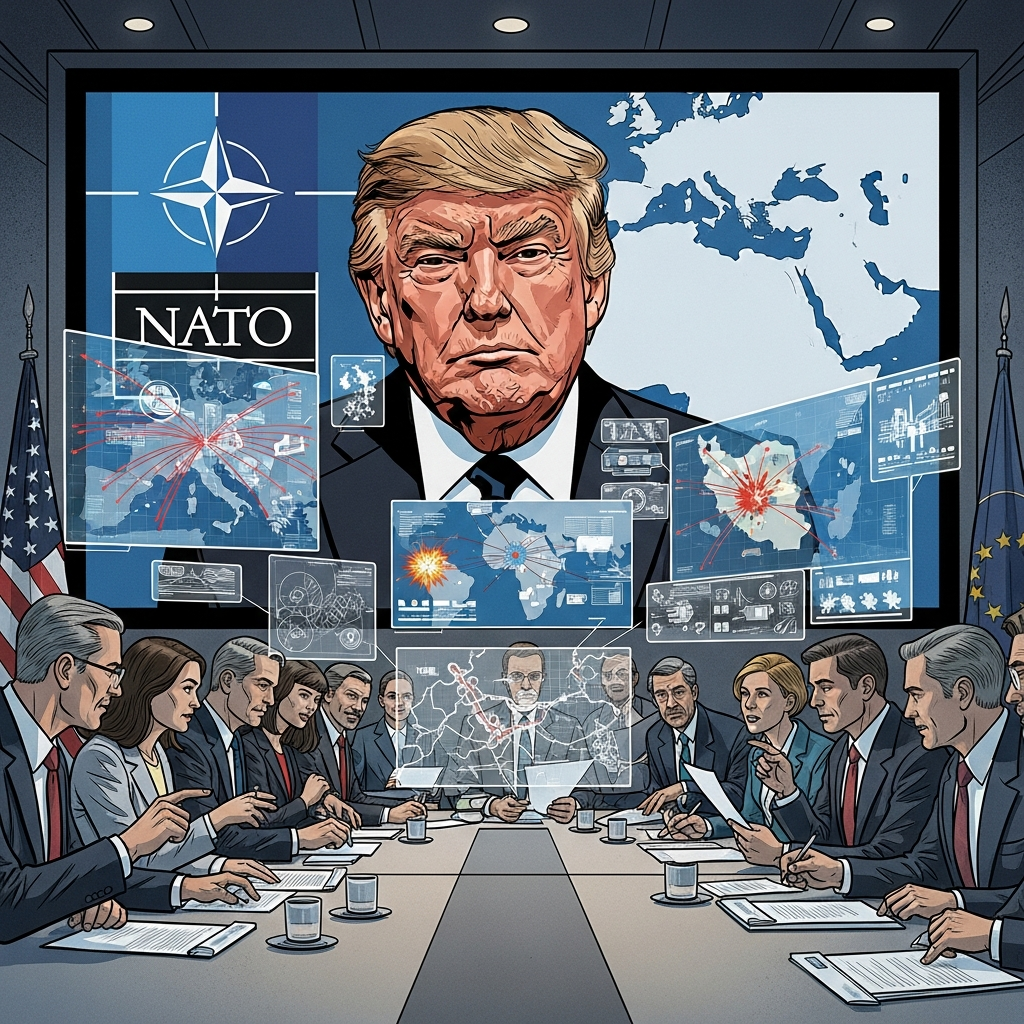
Geopolitical tensions are escalating as the Trump administration’s relationship with NATO faces unprecedented strain. European Union leaders are now actively developing a robust EU defense blueprint. This strategic shift comes amidst President Trump’s open criticism of allied nations and his contemplation of withdrawing the United States from the 77-year-old alliance. The ongoing conflict with Iran further complicates the global security landscape, driving Europe to re-evaluate its collective security posture and explore its own options for mutual assistance. This article delves into these critical developments, exploring both the international and domestic implications of the current administration’s policies.
European Union Prioritizes Independent Defense Strategy
The foundation of transatlantic security is experiencing significant tremors. President Trump has repeatedly expressed his consideration of pulling the US out of NATO, declaring he is “absolutely without question” weighing such a move. This rhetoric, coupled with his criticism of European allies for not joining the “joint war on Iran,” has pushed the alliance to its worst crisis. In response, EU leaders have reached a pivotal agreement. The European Commission is set to “prepare a blueprint” for how the bloc will respond if its little-known mutual assistance clause (Article 42.7 of the EU treaty) is invoked.
This proactive measure was confirmed by Nikos Christodoulides, the President of Cyprus, who hosted the recent discussions. European Council President António Costa further elaborated on the initiative, stating that officials are “designing the handbook” for the clause’s implementation. Costa pointed to a recent “test case” on Cyprus, where a drone strike on a British base during the latest Middle East conflict prompted Greece, France, Italy, Spain, and the Netherlands to mobilize military equipment and forces to aid Cyprus’s defense. This incident also highlighted perceived gaps, as the Royal Navy faced criticism for its limited number of deployable warships. Spain’s Prime Minister, Pedro Sánchez, a vocal critic of the Iran conflict, reaffirmed his nation’s loyalty to NATO while reiterating his condemnation of “the failure of brute force in the Middle East.” The collective sentiment underscores growing concerns about the US’s reliability as a NATO ally in the event of a foreign attack.
Navigating the Volatile Iran Conflict and Global Diplomacy
The eight-week-long conflict with Iran continues to be a central point of global contention. To reignite peace efforts, President Trump is dispatching his Middle East envoys, Steve Witkoff and son-in-law Jared Kushner, to Pakistan. They are scheduled to meet Iran’s Foreign Minister, Abbas Araghchi, in Islamabad. This diplomatic push follows the collapse of earlier negotiations where Vice President JD Vance reportedly walked out after Iran failed to provide “affirmative commitment that they will not seek a nuclear weapon.” Subsequently, Trump imposed a blockade on Iranian ports, though a fragile two-week ceasefire remains in effect, with one week remaining.
The conflict’s ripple effects are widespread. The International Monetary Fund (IMF) has warned that any further escalation could trigger a global recession, with the United Kingdom projected to be disproportionately affected. Domestically, US fuel prices have surpassed $4 a gallon, reaching approximately $4.02, a significant increase directly linked to the war’s impact on oil markets. Several European nations, including France, Italy, and Spain, have actively resisted US pressure to join military actions against Iran. This has “soured transatlantic relations” even as the UK, despite deeming the conflict illegal, has allowed the US to use its military bases. Amidst the conflict, an F-15E Strike Eagle fighter jet was shot down over Iran, and the leader of Catholic chaplains in the US armed forces questioned whether the campaign met “just war theory” standards. Vice President JD Vance also publicly admonished Pope Leo for criticizing the White House over the Iran war, asserting the Vatican should “stick to matters of morality.”
Key Domestic Policy Shifts Under the Trump Administration
The administration’s domestic agenda remains dynamic, marked by significant policy changes and legal challenges across various sectors.
Immigration and Border Security Initiatives
A pivotal development saw an appeals court block Trump’s executive order suspending asylum access, a core component of his post-White House immigration crackdown. This aligns with broader concerns, as law enforcement and local officials have expressed worries that immigration operations are impeding police work and creating threats. The administration also saw the release of a woman and her five children after over 10 months of detention, marking the longest family detention period under Trump’s second term. Separately, an executive order aimed at restricting mail-in ballots by requiring states to notify the USPS of voters and compile lists of verified citizens, described as “probably unconstitutional,” faces a lawsuit from over 20 Democratic attorneys general.
Justice Department Actions and Legal Battles
The Department of Justice (DoJ) has been active on several fronts. It notably dropped its criminal investigation against Federal Reserve Chair Jerome Powell, clearing the path for Trump’s new nominee. The DoJ also announced steps to “strengthen the federal death penalty,” including the controversial reintroduction of firing squads and the lethal injection protocol used during Trump’s first administration. Furthermore, the DoJ intervened in a lawsuit filed by Elon Musk’s xAI, challenging a Colorado law designed to regulate artificial intelligence systems. Meanwhile, three former FBI agents have initiated a class-action lawsuit, claiming wrongful termination due to their involvement in criminal cases related to Donald Trump.
Economic Rescue and Regulatory Changes
In a dramatic move, the Trump administration is reportedly preparing a comprehensive rescue mission for the struggling Spirit Airlines, proposing to transform the commercial carrier into an operational extension of the US military. This plan, potentially invoking the Defense Production Act, would see the airline transport government employees and cargo, with the government possibly acquiring up to a 90% ownership stake through a $500 million financing package. Commerce Secretary Howard Lutnick is a key proponent of this state-sponsored aviation asset model. The administration attributed Spirit Airlines’ financial woes, including two Chapter 11 bankruptcies, to the Biden administration’s blocking of its merger with JetBlue. Beyond commercial aviation, an executive order aimed at accelerating access to psychedelic medication for “serious mental illnesses” has been largely deemed symbolic by experts, expected to have more cultural than legal impact.
Global Reactions and Political Controversies
The Trump administration’s actions have elicited varied international and domestic reactions, often sparking controversy.
International Relations Under Scrutiny
India’s government strongly denounced a social media post shared by Donald Trump that described India as a “hellhole,” calling the comments “inappropriate and in poor taste.” The post featured remarks from a conservative podcast host criticizing birthright citizenship. Relations with key European allies also remain strained. Trump reportedly mocked UK Prime Minister Keir Starmer at a White House lunch, implying Starmer lacked decisive leadership and calling the UK “not our best” ally, marking a “new low for UK-US relations.” Similarly, Trump publicly criticized Italy’s Giorgia Meloni, a close ally, for her refusal to join the US in attacking Iran, expressing shock at what he perceived as her lack of “courage.”
Domestic Political Dynamics and Challenges
Domestically, the administration faces internal and external challenges. Trump appointed Vice President JD Vance as “fraud czar,” announcing a broad crackdown on alleged “massive and pervasive” fraud, particularly targeting Democratic states like California, Illinois, and New York. This initiative quickly led to arrests in Southern California under “Operation Never Say Die.” Trump’s cabinet saw further shake-ups, with Attorney General Pam Bondi dismissed due to mounting frustration over her performance, especially concerning the release of files related to Jeffrey Epstein. This marked the second woman fired from his cabinet, leading to accusations of a “misogynistic administration.” House Democrats have proposed forming a commission, to be led by JD Vance, to assess Trump’s fitness for office and potentially explore his removal via the 25th Amendment.
Other High-Profile Incidents
Controversial projects also gained attention. A US District Judge blocked a $400 million White House ballroom project involving the razing of the East Wing, citing a lack of congressional approval. Separately, ambitious plans for a Donald J. Trump presidential library in Miami, featuring a “gaudy” gold-decked structure with a giant statue and a Boeing “flying palace,” drew widespread ridicule. Even a seemingly innocuous “DoorDash Grandma” delivery to the White House was revealed to be a “stunt” to lobby for Trump’s “no tax on tips” policy.
Other Notable Developments Across the Nation
Beyond the immediate actions of the Trump administration, several other significant developments have captured attention. Concerns are growing over gambling addiction, which a leading campaigner warns is “spiraling out of control” across the US, prompting calls for stricter regulation. In the UK, police investigating former Prince Andrew and Peter Mandelson are preparing to interview witnesses, but fear prosecutors will be “reluctant” to bring charges without the Trump administration handing over original Epstein files. California lawmakers have introduced a bill to allow lawsuits against social media companies for failing to detect or remove child sexual abuse material. Additionally, two US representatives, Democrat Eric Swalwell and Republican Tony Gonzales, resigned from the House amid bipartisan furor over sexual misconduct allegations. Elon Musk’s artificial intelligence company is facing a new lawsuit alleging it is illegally polluting Black neighborhoods bordering Tennessee and Mississippi.
Frequently Asked Questions
What is the EU’s “mutual assistance clause” and why is it being prioritized now?
The EU’s “mutual assistance clause,” found in Article 42.7 of the EU treaty, is a provision allowing member states to come to the aid of another member state that is the victim of armed aggression. It is being prioritized and a “blueprint” developed due to the deteriorating relationship between the Trump administration and NATO, fueled by President Trump’s explicit consideration of withdrawing the US from the alliance. This situation has prompted EU leaders to strengthen their independent defense capabilities and ensure collective security without relying solely on the United States. A recent drone strike in Cyprus served as a “test case” highlighting the clause’s potential importance.
How are global diplomatic efforts addressing the ongoing Iran conflict?
The Trump administration is attempting to de-escalate the nearly eight-week-long conflict with Iran by sending envoys Steve Witkoff and Jared Kushner to Pakistan to resume negotiations. They are scheduled to meet Iran’s Foreign Minister, Abbas Araghchi, in Islamabad. This follows earlier failed talks and a fragile two-week ceasefire. Economically, the conflict has led to a significant surge in US fuel prices and prompted warnings from the IMF about a potential global recession. Diplomatically, several European nations have resisted US pressure to join military actions against Iran, further complicating transatlantic relations.
What are the key domestic policy changes impacting the US economy and citizens under the Trump administration?
The Trump administration has enacted several significant domestic policy changes affecting the US economy and its citizens. An appeals court blocked a key executive order suspending asylum access, while another order aimed to restrict mail-in ballots. The Justice Department dropped its investigation into Jerome Powell and announced steps to “strengthen the federal death penalty.” Economically, the administration is planning a dramatic rescue for Spirit Airlines, potentially turning it into a government-owned entity, citing job preservation and national security. Additionally, a new “fraud czar” initiative targets alleged fraud in Democratic states, leading to arrests and investigations impacting various communities.
Conclusion
The current geopolitical and domestic landscape is marked by significant uncertainty and shifts. The European Union’s proactive move to bolster its EU defense capabilities represents a crucial response to the challenges posed by the Trump administration’s evolving stance on NATO and its broader foreign policy. From the ongoing Iran conflict and its global economic repercussions to wide-ranging domestic policy changes impacting immigration, justice, and the economy, the current period demands close attention. As leaders navigate these complex issues, the implications for international alliances, national security, and daily life for citizens worldwide remain profound and are subject to continuous evolution.