
Key takeaways
- A University of Chicago-led team posted a paper on September 1, 2026, presenting a South Pole Telescope mass map built from gravitational lensing of the cosmic microwave background.
- The map measures how gravity bends ancient light, which lets researchers reconstruct the matter that light passed through on its way to Earth.
- The researchers describe it as the most sensitive lensing measurement of its kind yet made. That claim has not been independently verified in coverage so far.
- The team says the map agrees with Planck and Atacama Cosmology Telescope results. It may also help study neutrinos and primordial gravitational waves, but neither goal has been reached.
A University of Chicago-led team has released a South Pole Telescope mass map that traces matter across the universe by measuring how gravity bends the oldest light in the cosmos. The paper describing the map was posted to the arXiv preprint server on September 1, 2026. Its lead author is Yuuki Omori, a research scientist at the university.
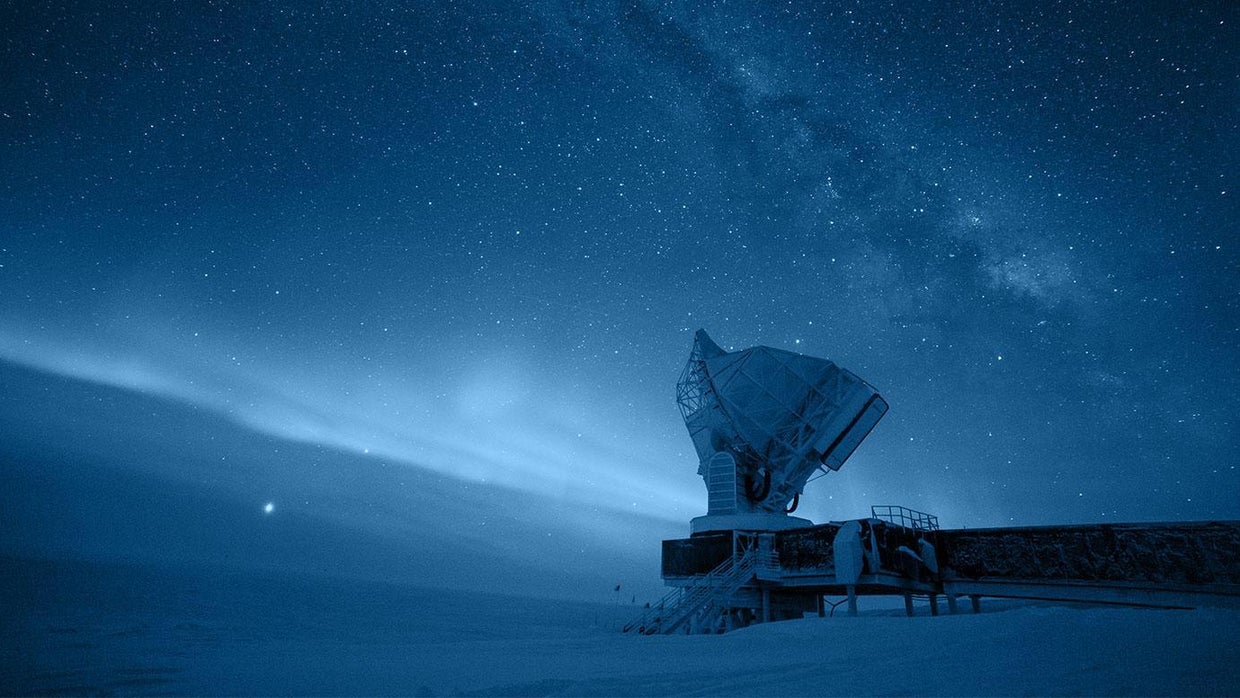
The team, drawn from 30 institutions, used data from a telescope at the National Science Foundation’s Amundsen-Scott South Pole Station in Antarctica. The university published its account in a UChicago News story on September 3, 2026. CBS Chicago reported on the work on September 6, 2026, citing the university’s release. Both describe the map as the sharpest and clearest ever made of mass in the universe. That description comes from the researchers and the university, not from outside scientists quoted in the coverage.
How the South Pole Telescope mass map is built
The telescope records the cosmic microwave background, which the university calls the afterglow of the Big Bang. The light has been traveling since the early universe. The South Pole Telescope takes advantage of the extraordinarily clear skies of Antarctica to record it. The instrument is funded mainly by the National Science Foundation and the U.S. Department of Energy. A collaboration led by the University of Chicago runs it.
A separate UC Davis account of related South Pole Telescope work says this light was released about 400,000 years after the Big Bang, once the universe had cooled enough for photons to travel freely.
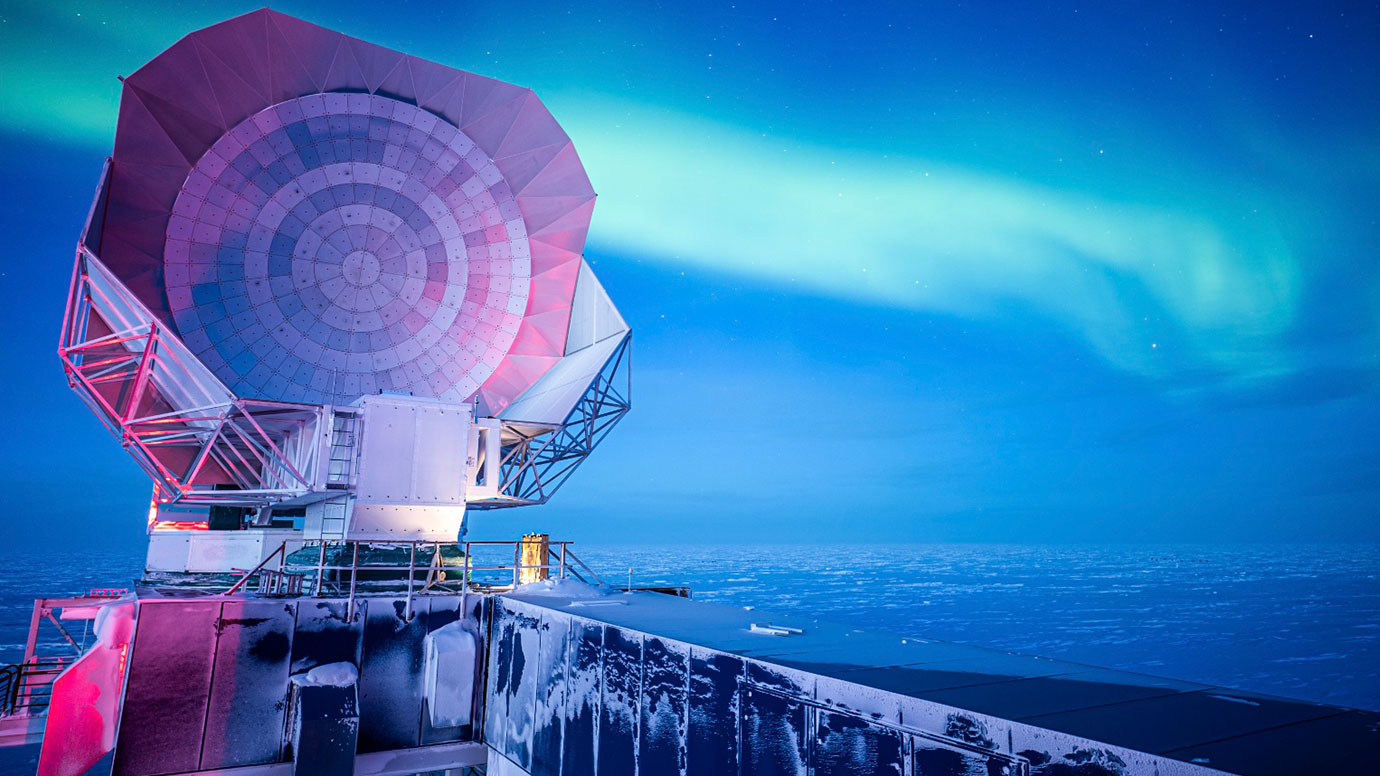
The mapping method relies on gravitational lensing. Light from the microwave background normally travels in a straight path. If it passes near the gravitational pull of a galaxy or a cluster of galaxies, its path bends slightly. By cataloguing these tiny distortions across the sky, scientists can reconstruct a map of the matter between Earth and the point where the light was emitted, according to the university.
Gravity acts on all mass, including matter that gives off no light. That is why lensing can reveal structure that optical telescopes cannot see directly. The method is therefore useful for studying how matter is distributed across cosmic history.
Omori described the work in cartographic terms. “It’s like cartography—we are making a literal map of the universe,” Omori said. Omori also compared the data quality to photography. “This is the deepest map of the universe we have so far—it’s like taking a photograph with very low background noise exposure,” Omori said in the university release.
What the map says about the universe’s middle years
One of the key measurements is how “clumpy” the universe is. That means where matter is lumped together and how tightly. According to the university, this pattern shows how the universe grew over time.
Omori said scientists have a reasonably good account of the universe’s beginning and of its present state. The middle period is less well understood. “We have a pretty good story about the beginning of the universe and a pretty good one about today, but less about the middle years,” Omori said.
The university says this middle period matters because stars and galaxies began forming in earnest then, and much of the structure visible today can be traced back to it.
When the new map is combined with data from the Dark Energy Survey, the university says the results are the best yet at narrowing down how the universe’s structure formed over time. Wai Ling Kimmy Wu, an assistant professor at Caltech and a co-author, said the work “provides a window to the younger state of the universe that we have few other ways to see.”
Cross-checks against Planck and the Atacama Cosmology Telescope
The team compared the map with other measurements of the cosmic microwave background. The reason is to rule out the possibility that an unknown factor is causing an error in one experiment. According to the university, the new data agrees very well with the Planck satellite and the Atacama Cosmology Telescope. The university says this agreement boosts confidence in the results.
The map can also be compared with a different kind of measurement called baryon acoustic oscillations. These are used to measure how the universe’s expansion has changed over time. The university says this comparison can help find potential holes in the best current models of the universe. The release does not say whether any such holes have been found.
Neutrinos and primordial gravitational waves: the longer-term goals
The university describes the map as a step toward two larger goals. The first concerns neutrinos. CBS Chicago reported that neutrinos are the most abundant particles with mass in the universe, and that their mass is so small it was once thought to be zero.
Wu explained how the map could help. “By weighing all of the mass in the universe and studying the structure, we can probe the effects neutrinos had on the growth of structure,” Wu said. “It’s a unique probe of neutrinos, and could even give us a way to measure the mass of neutrinos very precisely.” The university presents this as a possibility, not a result.
The second goal concerns primordial gravitational waves. These are ripples in gravity that the university says date from the first nanoseconds of the universe. If detected, they could provide the first concrete experimental measurement of cosmic inflation, the very rapid expansion thought to have occurred early in the universe’s history. The university says they could also point toward reconciling gravity with quantum mechanics, a long-standing puzzle in physics. That link is speculative.
To search for these waves, South Pole Telescope data will be used to clean data from the BICEP experiment. BICEP is also funded by the National Science Foundation and is located at the South Pole. Omori explained the role of the map. “Essentially, our map can be used to reduce the noise they see and locate the true signal,” Omori said.
Related South Pole Telescope studies
Two other recent South Pole Telescope papers help show the wider program. They are separate studies and are not the mass map.
A galaxy cluster catalog, described on a University of Chicago news page adapted from an Argonne National Laboratory article, draws on five years of South Pole Telescope observations. The page does not give a publication date. It reports 8,892 possible galaxy clusters, of which 7,190 were confirmed using optical and infrared data. About 20% of the confirmed clusters do not appear in any earlier catalog. The survey covers about 4% of the sky, or 1,600 square degrees, and includes about 1,800 clusters dating back more than 7.8 billion years.
Lindsey Bleem, the lead study author, is a physicist at Argonne National Laboratory and a senior associate at the UChicago Kavli Institute for Cosmological Physics. Bleem said the analysis “open[s] a new window onto the ancient universe.” Sebastian Bocquet of the Ludwig Maximilian University Observatory in Munich said the sample will allow scientists to probe the evolution of cosmic structure over the past 10 billion years. That is a forecast, not an achieved result.
A UC Davis-led study uses polarized light from the same microwave background to test the standard model of cosmology. It uses 2019 and 2020 South Pole Telescope data covering 1,500 square degrees, and it has been submitted to Physical Review D. According to the article, it has not yet been published there.
The study addresses the Hubble tension, a disagreement over how fast the universe is expanding. Estimates based on the microwave background have generally come in lower than direct measurements using stars and supernovae. The polarization-based prediction matches the result from the Planck satellite’s intensity maps. According to the article, it disagrees with supernova measurements “at very high statistical significance.”
Lloyd Knox, a UC Davis cosmology professor and co-author, said the team has “a largely coherent, detailed, and successful model describing these 14 billion years of evolution.” Knox added that the cause of the initial departures from uniformity remains unknown. Tom Crawford, a University of Chicago research professor and co-author, called the result “especially exciting” because it represents the first competitive constraints on cosmology using only the polarization of the microwave background.
What is confirmed and what remains open
Several points are established. The paper was posted on arXiv on September 1, 2026. The team includes researchers from 30 institutions. The map uses South Pole Telescope data and measures gravitational lensing of the microwave background. The team is also analyzing six years of data from the South Pole Telescope 3G project.
Several other points are not yet verified. The descriptions “sharpest,” “deepest” and “most sensitive” come from the researchers and the university. Coverage has not tested them independently. Because arXiv is a preprint server, the paper had not gone through formal journal peer review when it was posted.
The coverage also has gaps. It quotes only University of Chicago researchers and includes no outside experts or funders. It does not name the other 29 institutions. It gives no technical details such as map resolution or statistical significance. The neutrino and gravitational-wave goals are plans and possibilities, not results.
The university has not given a completion date for the six-year analysis. Crawford said the next upgrade to the instrument “will be even more powerful,” which gives the team “an even better shot at detecting this signal.”
References
- South Pole Telescope analysis releases new catalog of more than 7,000 galaxy clusters — news.uchicago.edu
- University of Chicago researchers lead effort to map mass in universe using data from South Pole Telescope — cbsnews.com
- Latest findings from the South Pole Telescope bolster our model of the universe — news.uchicago.edu
- South Pole Telescope releases clearest map ever of matter in the distant universe — news.uchicago.edu
Featured image: Daniel Michalik — via CBS News