
Key takeaways
- A fuel tanker crash on Cairo’s Ring Road set off a fire that killed at least 31 people, according to Egypt’s health ministry.
- The health ministry reported 21 people injured, after an earlier figure of 25 was revised down.
- Egyptian officials say DNA testing is under way to identify the dead, and the death toll is preliminary.
- Officials have not publicly explained how the fire started, and the reported cause of the crash comes from media sources, not an official finding.
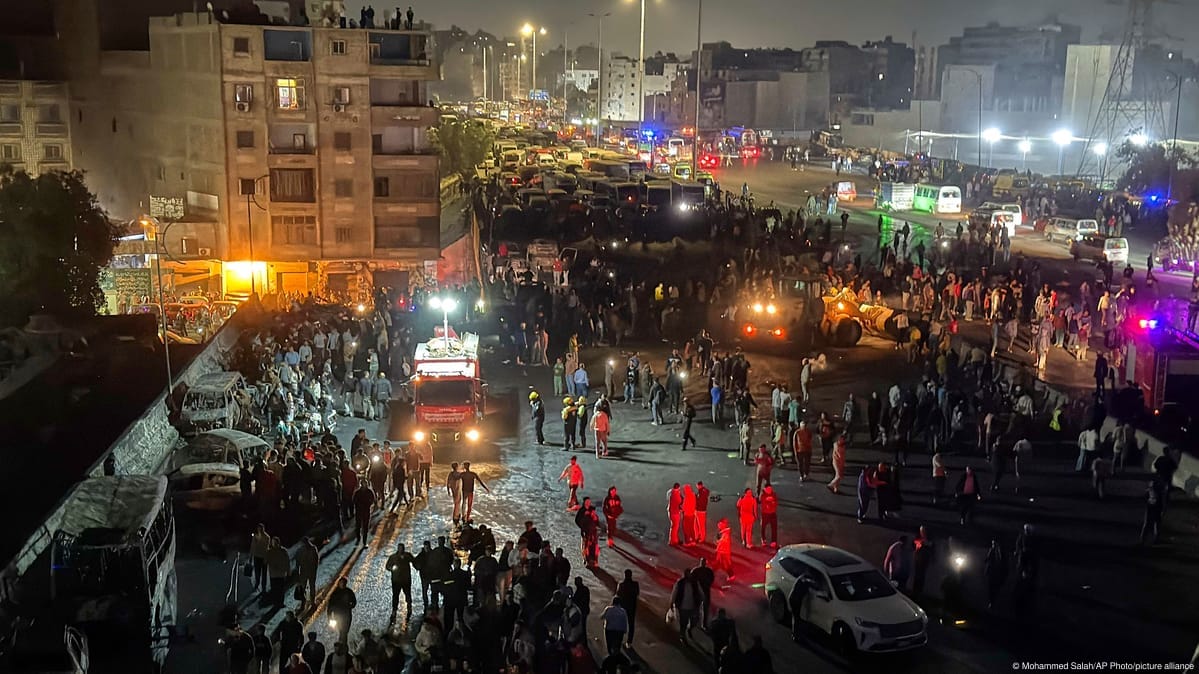
An Egypt fuel tanker crash on Cairo’s Ring Road started a fire that killed at least 31 people on Wednesday, November 25, 2026, Egyptian authorities said. The blaze also injured at least 21 people and left more than two dozen cars and motorcycles charred, according to the latest figures from the Health Ministry, as reported by the Associated Press and CBS News.
The Ring Road is a major highway that encircles the Egyptian capital. The crash happened on a stretch in Warraq, a densely populated neighbourhood in Giza, which is part of Greater Cairo, the Health Ministry said. The death toll is preliminary, and officials have warned it could rise.
Why the casualty figures differ between reports
The figures have changed across early reports, and readers should treat the current numbers as provisional. The Health Ministry’s count of 31 dead is the figure used in most reports, including CBS News, the BBC and Deutsche Welle (DW). The New York Post used “at least 30” in its own headline, and it later appeared in a second headline as 31, which the Post suggested likely reflects a later update.
The injury count has also moved. Early statements put the number of injured at 25. CBS News reported that this figure was later revised to 21. The New York Post’s report gave 25 injured and attributed that figure to the Public Prosecutor’s office, while the Health Ministry’s later count was 21. Health Minister Khaled Abdel Ghaffar said the death toll was preliminary and that he was concerned it could rise.
The number of damaged vehicles is also described in different ways. The Public Prosecutor’s office, as reported by the New York Post, said more than two dozen cars and motorcycles were burned. DW, citing Egyptian authorities, said at least 27 vehicles were charred. The phrasing “at least” in both reports means these are minimum counts.
How the crash unfolded, and what is still unconfirmed
The available reports agree on the basic sequence: a fuel tanker crashed on the Ring Road, and a fire spread to nearby vehicles. The details of how it happened are less settled.
The BBC reported that the crash took place on Wednesday evening. It said the tanker was travelling along a section of the ring road when a high-voltage cable fell in front of it, causing the driver to lose control. This account comes from Al-Ahram, which cited sources familiar with the investigation. The BBC said officials had not confirmed it. A high-voltage cable is a power line that carries electricity at high voltage, and it would be a serious hazard on a road if it came down.
State-owned media, according to the BBC, reported that the tanker crossed the central reservation, which is the median strip that divides the two directions of a highway, before overturning and catching fire. State media also said the tanker spilled petrol onto nearby vehicles, which were then torched. The BBC described this as the reported account rather than a verified one. Its description of the fire’s scale, including “billowing flames” and multiple vehicles torched, partly relies on social media footage that has not been independently verified.
DW described the sequence more simply. It reported that the fuel tanker overturned on a crowded section of the Ring Road and that the crash set off a large blaze. DW did not identify why the tanker overturned, and it said the cause is presumably what the investigation will examine. The Public Prosecutor’s office has not publicly described the cause in the reports reviewed.
The BBC also reported that officials have not explained how the fire started. The tanker belonged to a private contractor, according to the BBC. None of the reports say how much fuel the tanker was carrying, what type of fuel it was, or how many vehicles were involved in total.
Rescue work in a crowded district
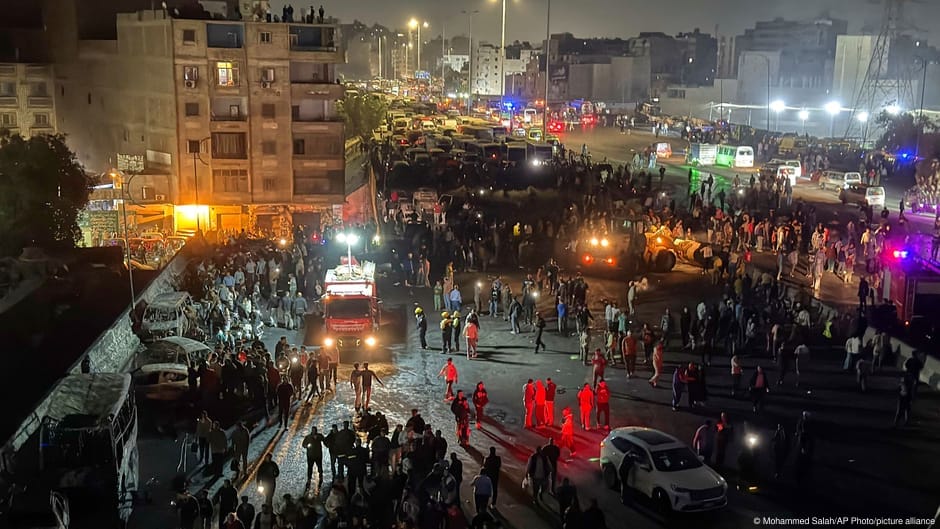
Rescue workers pulled people out of burning cars at the scene, the Associated Press reported. An AP video showed firefighters working to put out flames spreading among the vehicles. Hundreds of people gathered near the scene in the Warraq district of Imbaba, a Cairo suburb, according to CBS News and the New York Post.
Ahmed Sameer was stuck in traffic when the road was blocked after the accident. He told the AP that he saw the fuel truck and many cars on fire. He said he saw at least eight bodies being removed from burned cars. “It was a huge fire; the cars got stuck together because of the fire,” he told the AP, describing the panic that followed. “It was a shocking scene.”
The Health Ministry said 39 ambulances were dispatched, according to both the BBC and DW. Health Minister Khaled Abdel Ghaffar said the injured had been taken to nearby hospitals and that he would go to the scene himself. The BBC reported that hospitals in the area treated patients for burns and smoke inhalation. Images released by the health ministry, according to the BBC, showed the minister overseeing treatment of the injured at a Cairo hospital.
After the fire was put out, a large crowd gathered on the highway while emergency services blocked entry routes, the BBC reported. A bulldozer cleared the wrecks of burnt-out vehicles. The state news agency NMA said emergency responders then cleared the highway, and it reopened. The reports do not give a time for when the road reopened.
Identifying the dead
The Public Prosecutor’s office said DNA investigations were under way to identify the victims, the New York Post and CBS reported. The BBC said the regional public prosecutor opened an investigation and asked that DNA samples be taken from the bodies of the dead. DW reported that DNA tests were being carried out to identify badly burned victims.
The need for DNA testing suggests that some bodies were too damaged to identify by sight. Identification by DNA usually takes longer than visual identification, so families may wait longer for names and remains to be released. The reports do not say how long this process will take, and none gives a date for when the final toll will be confirmed.
The BBC said that the prosecutor’s inquiry, and any identification results, will shape the final death toll. The inquiry will also decide whether the cable, the driver’s conduct, the condition of the vehicle or the contractor bears any responsibility. The BBC reported that the article it summarised does not say whether the cable belonged to a particular utility. No responsibility has been assigned in the reports reviewed.
The tanker’s private contractor has not been reported to have made a public statement. The BBC said no statement from the company or the driver had been reported. The reports do not name the driver.
Egypt’s road safety record and the risks of fuel transport
The reports place this crash within a wider pattern of deadly road accidents in Egypt. CBS News, citing the Associated Press, said deadly traffic accidents claim thousands of lives every year in the country, which has a poor transportation safety record. It named speeding, bad roads and poor enforcement of traffic laws as the main reasons behind most crashes. These are general observations and are not attributed to a specific study in the reports.
The BBC cited official figures showing that nearly 6,000 people died on Egypt’s roads last year. That was a rise of several hundred on the year before. The BBC said road collisions are often blamed on lax maintenance and widespread disregard for traffic laws.
CBS News also gave a comparison from earlier in the year. In January, 21 people were killed and 16 were injured in a massive multicar pileup on a road near the southern province of Beni Suef. The CBS report did not give the year of that incident in the text reviewed, so the reference should be read as January, not a specific year.
The crash also raises questions about how fuel tankers are regulated, the BBC reported. A fuel tanker that burns on a crowded urban highway can spread fire quickly among closely packed vehicles, as the New York Post noted. The reports do not say whether the tanker had any special permit or whether crash-response procedures exist for this stretch of road. They also do not report any policy announcement in response to the crash.
Reactions from Egypt and abroad
Egyptian President Abdel-Fattah el-Sisi expressed his condolences to the victims in a statement, according to CBS News and the New York Post. DW reported that he expressed his deepest condolences and sympathy and directed the relevant authorities to support the families of the dead and the injured. DW paraphrased his remarks and did not give his exact wording.
DW also reported reactions from abroad. Italian Foreign Affairs Minister Antonio Tajani said he extended his “deepest solidarity to the victims’ families,” and to Egyptian Foreign Minister Badr Abdelatty “and to the Egyptian people, whom I count as friends, at this tragic time.” The Algerian Ambassador to Egypt, Mohamed Sofiane Berrah, said the Embassy of Algeria in Cairo extended “its deepest condolences and heartfelt sympathy to the sisterly Arab Republic of Egypt.” DW did not give dates for these statements.
What the reporting has not yet established
Several basic questions remain open in the reports reviewed. The final death toll is not confirmed, and the health minister has said it could rise. The cause of the tanker overturning has not been officially determined. The cable account is a media report based on unnamed investigation sources. The time of the crash is not given beyond “Wednesday,” and the New York Post and DW did not give a clock time either.
The reports also do not name the driver or any of the victims. They do not give the type or quantity of fuel the tanker was carrying. None of the reports says whether officials have announced compensation for families or changed tanker safety rules.
Readers should look for updates from the Health Ministry and the Public Prosecutor’s office, which have released the main official figures so far, for the confirmed toll and the findings of the investigation.
Frequently asked questions
How many people died in the Egypt fuel tanker crash?
Egypt’s health ministry reported that at least 31 people were killed, and the health minister said the figure was preliminary and could rise. Some early headlines reported 30 deaths, which the New York Post said likely reflects a later update. The official count has not been confirmed as final.
Where did the Egypt fuel tanker crash happen?
The crash happened on the Ring Road, the highway that encircles Cairo, in the Warraq area of Giza, part of Greater Cairo, according to the Health Ministry. The BBC described the location as a neighbourhood north of the old city centre. The reports describe the area’s boundaries differently, so the exact administrative location is not fully clear.
What caused the Egypt fuel tanker crash?
Officials have not publicly explained the cause. Al-Ahram, citing sources familiar with the investigation, reported that a high-voltage cable fell in front of the tanker and the driver lost control. The BBC said officials had not confirmed this account.
References
- Thirty-one killed in massive fire as fuel tanker crashes on Cairo highway — bbc.com
- Egypt: Over 30 dead after fuel truck flips near Cairo — dw.com
- At least 30 dead after fuel tanker crash ignites massive fire on Egyptian highway — nypost.com
- Egypt fuel tanker crash ignites highway fire that kills at least 31, authorities say — cbsnews.com
Featured image: Image: Mohammed Salah/AP Photo/picture alliance — via dw.com