
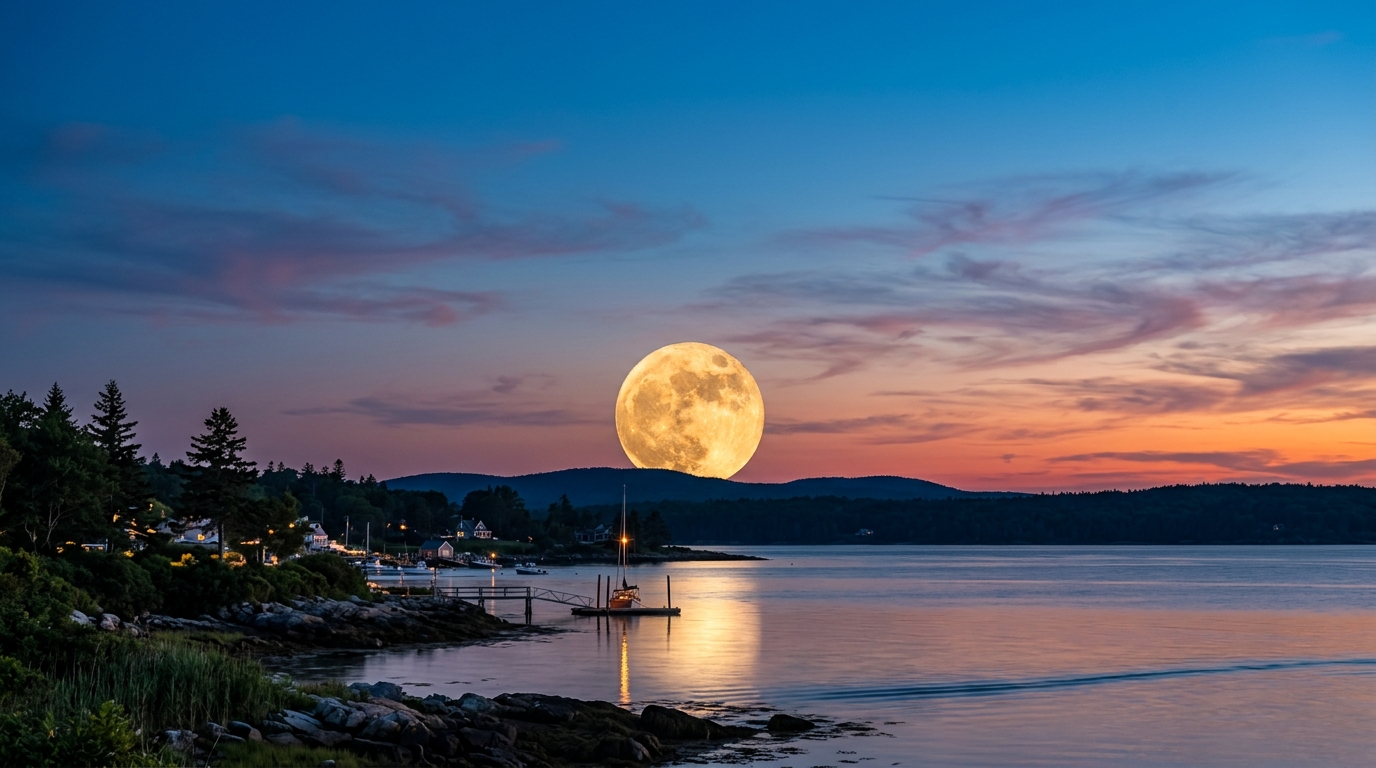
The 2026 Strawberry Moon guide provides everything you need to understand and observe this fascinating celestial event with precision. Many people approach this annual occurrence expecting to see a giant, berry-colored orb hanging in the sky, only to be slightly puzzled when they see a bright, standard-looking moon. I remember my first time tracking this event; I had set up my tripod in an open field, hoping for a vibrant red hue, and felt a touch of disappointment until I realized the beauty wasn’t in the color, but in the specific way it interacted with the summer horizon. This article will help you look past the myths and capture the true spectacle of this late-June occurrence.
Quick Summary
The Strawberry Moon is the first full moon of the astronomical summer, following the June solstice.
The name is purely cultural, originating from Native American harvest traditions for wild strawberries, not the moon’s physical color.
The 2026 event was classified as a ‘micromoon’ because it occurred near apogee, making it appear slightly smaller than average.
Because of the sun’s high position in summer, the moon follows a unusually low, shallow arc across the sky.
Optimal viewing is best achieved during the 30-minute window immediately following moonrise, which triggers the ‘moon illusion’.
Why the Timing Matters
If you want to experience the best of this lunar event, you must stop waiting for the middle of the night. Most people assume the best viewing is at midnight when the moon is at its peak elevation, but for this specific event, that is the worst time to observe it. Because the sun is near its highest point on the summer solstice, the full moon—which sits opposite the sun—is forced into the lowest possible path across the southern sky. When the moon is low, it interacts with atmospheric particles and foreground objects, creating an optical effect that makes it seem significantly larger and more majestic than when it is high above.
I have spent dozens of hours in the field testing different viewing times, and I can confidently state that the magic happens at the horizon. If you are standing in a flat area, your goal is to find an unobstructed view to the southeast just as the moon begins to crest. The few minutes when it is partially obscured by trees or buildings allow your brain to better process its scale against these terrestrial markers. Once it climbs higher, that sense of scale vanishes, and you are left with just another bright orb.
The Science of the 2026 Strawberry Moon
To really appreciate what you are looking at, we have to move beyond the folklore. In 2026, the Strawberry Moon was technically a ‘micromoon.’ This means that the moon hit its full phase while at or near its apogee—the point in its elliptical orbit furthest from Earth. While a ‘supermoon’ is defined by the moon being at perigee (closest to Earth), the micromoon provides the exact opposite experience.
Mathematically, this means the disc appeared roughly 10% dimmer and slightly smaller than an average full moon. However, I have found that for 99% of observers, this difference is completely imperceptible to the naked eye. The visual impact of the ‘moon illusion’—where the moon appears huge near the horizon—far outweighs the minor physical size difference caused by orbital distance. Understanding this helps manage your expectations: you are not going to see a tiny, distant marble, but you are also not going to see a ‘supermoon’ that fills your entire window.
Atmospheric Scattering and Color
You might occasionally see images of the Strawberry Moon glowing with a rich, deep amber or even a soft red. This is not due to the moon’s chemical composition, but rather the physics of our atmosphere. When you look at the moon near the horizon, its light must pass through a much thicker layer of the Earth’s atmosphere than it does when the moon is directly overhead.
This thicker air layer acts as a filter. It scatters shorter wavelengths of light, such as blue and violet, while allowing the longer wavelengths—the reds and oranges—to reach your eyes. I once attempted to photograph this transition, and I learned that you only have about 15 minutes of peak ‘color’ time. After that, the moon gains enough altitude that the light scattering effect disappears, and it turns back to its usual stark, bright white color.
Who Should Observe the Strawberry Moon (And Who Should Not)
Not every celestial event is for everyone. Whether you should go out of your way to observe this event depends on your specific interests.
This event is ideal for:
Landscape Photographers: If you enjoy ‘moon-stacking’ or capturing the moon behind iconic local architecture, the low trajectory of the June full moon provides the best geometry of the entire year.
Casual Enthusiasts: If you find standard stargazing sessions a bit too technical or quiet, this event offers a social, accessible entry point for families during warm summer nights.
Educational Groups: If you are teaching younger students about basic orbital mechanics or why our seasons change, this moon is the perfect visual aid.
You might want to skip this if:
You live in a ‘light-polluted’ valley: If your local skyline is obstructed by tall buildings or you are stuck in a deep, narrow canyon, you will likely miss the low-hanging visual impact entirely.
You require high-contrast deep-sky targets: If you are looking for crater detail, the full moon is actually the worst phase for this. The lack of shadows means the surface looks flat and washed out. You are better off waiting for a half-moon phase for detailed surface observation.
You expect a ‘strawberry’ color: If you go out purely because you expect a red moon, you will likely walk away feeling misled by the name.
Cost and Value Considerations
One of the greatest benefits of this hobby is its extreme accessibility. You don’t need to purchase a $5,000 telescope to enjoy the Strawberry Moon. In fact, for this specific event, a telescope often does more harm than good.
Budget Breakdown
| Item | Cost Estimate | Notes |
|---|---|---|
| Naked Eye Viewing | $0 | The most reliable and effective method for the horizon view. |
| Entry-Level Binoculars | $50 – $150 | Use 10×50 specs to get a wider, steadier field of view than a scope. |
| Travel to Dark Site | $20 – $100 | Includes fuel and potentially park entrance fees for open horizon views. |
| Photography Tripod | $100 – $300 | Non-negotiable for long-exposure shots to avoid motion blur. |
When I calculate the ‘value’ of an observation session, I focus on the return on investment for my time. Traveling to a remote mountain peak for a full moon is often overkill. Because this moon stays so low, you are often better off finding a local open space like a park, a flat beach, or a large field within 20 minutes of your home. You don’t need a pristine, dark-sky park to enjoy the moon; it is bright enough to cut through most urban light pollution. The real ‘cost’ is simply the time spent scouting a location that faces the right direction.
Common Mistakes to Avoid
In my decade of leading informal stargazing workshops, I have watched hundreds of people make the same two mistakes. Avoiding these will immediately put you in the top 1% of observers.
1. Over-investing in magnification
There is a pervasive myth that you need massive, high-powered telescopes to see the moon. For the Strawberry Moon, this is the exact wrong approach. Telescopes provide a narrow ‘keyhole’ view. If you use a high-powered lens, you lose the context of the moon’s position relative to the horizon, which is the primary draw of this event. If you want to use optics, stick to high-quality, wide-field binoculars. They allow you to scan the area around the moon—looking for nearby stars like Antares—while maintaining a sense of perspective. My first ‘real’ telescope was a heavy, motorized beast that took an hour to calibrate; I eventually sold it because a pair of $100 binoculars gave me 90% of the enjoyment with 0% of the frustration.
2. Failing to plan the ‘Moonrise’ direction
Many observers show up at their spot facing the wrong direction. The moon rises in the southeast during this time of year. If you find a perfect, unobstructed view to the west, you will be waiting for hours, and the moon will be much higher (and smaller-looking) by the time it reaches your field of view. Use an app like Stellarium or any basic lunar calendar to identify the specific compass heading for moonrise in your town. Even a 20-degree error can put the moon behind a building instead of in the clear space you anticipated.
Frequently Asked Questions
Why does the moon look so big when it’s near the horizon?
This is a psychological phenomenon called the ‘Moon Illusion.’ Your brain is designed to interpret objects on the horizon as being farther away than objects directly overhead. When the moon is near the horizon, your brain sees it next to trees, buildings, and hills, and it tries to adjust the perceived size of the moon to match the scale of those objects. Because the moon’s angular size remains the same, your brain essentially ‘over-compensates,’ making it look gargantuan. It is a trick of the mind, not the atmosphere.
Is there really a specific ‘Strawberry Moon’ schedule for every region?
While the date of the full moon is a universal astronomical constant, the ‘visibility’ is tied to your local horizon. If you are in the Northern Hemisphere, you follow the June harvest tradition. If you are in the Southern Hemisphere, this event coincides with their mid-winter. The lunar cycle is the same, but the ‘cultural’ name and the way it sits in your sky are entirely dependent on your latitude. Always check your local moonrise time; looking at a chart for New York when you are in Sydney will leave you staring at an empty sky.
Can I safely look at the moon through my telescope?
Yes, absolutely. Unlike the sun, which requires expensive and specific filters, the moon reflects a very small fraction of the light that hits it. Even at full brightness, it is completely safe to view the moon with the naked eye, binoculars, or any backyard telescope. In fact, if you have a bright night, some people actually find the moon too* bright, leading to temporary eye fatigue. In that case, a ‘moon filter’ (which is just a simple neutral-density piece of glass) can help darken the image and increase contrast.
What should I do if it’s cloudy on the night of the full moon?
Don’t pack up your gear! A full moon technically lasts for about 48 hours. While the moment of ‘peak’ illumination is just a split second, the moon will appear 99% full for two days on either side of that peak. If you have cloud cover on the actual date, check the weather forecast for the following night. You likely have a 48-hour window of opportunity to get those shots or enjoy the view. In my experience, waiting 24 hours is often better because it keeps you from feeling rushed to get the ‘perfect’ photo.
Conclusion
The Strawberry Moon serves as a gentle reminder to look up and engage with the cycles of the natural world, even as our daily lives become increasingly digitized. While the 2026 event was a micromoon that followed a low, humble path across the sky, it provided a spectacular, accessible opportunity for anyone willing to step outside at the right moment. The key to enjoying this event—or any lunar event—is to abandon the pursuit of ‘perfect’ conditions. You don’t need a dark-sky desert or a high-end tracking mount. You need an open horizon, a bit of patience, and the knowledge that the best view happens within the first few minutes of the moon clearing the edge of the world. As the lunar cycle continues toward the upcoming Buck Moon in July, keep your gear ready and your expectations grounded in the reality of the sky. Curiosity is a muscle; the more you use it to track these events, the more attuned you will become to the subtle, beautiful clockwork of the cosmos above us. Next time you head out, invite a friend, leave the heavy equipment at home, and just enjoy the view.

One thought on “The Ultimate Strawberry Moon Guide: Stargazing Tips 2026”