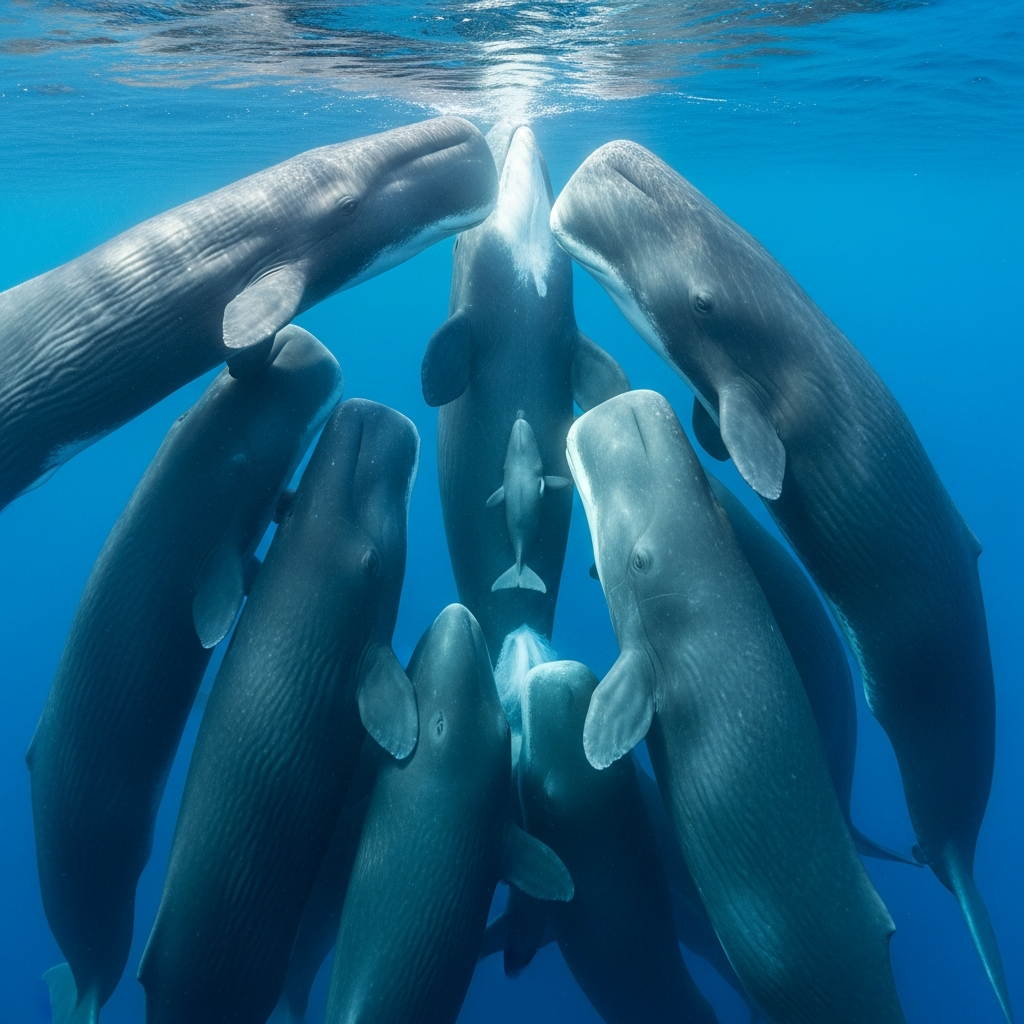
The vast, mysterious ocean holds countless secrets, but every so often, nature grants us an unprecedented glimpse into its wonders. In a groundbreaking scientific first, an international team of researchers has captured extraordinary footage of a sperm whale giving birth in the wild, showcasing a remarkable and never-before-seen level of cooperative support from her pod. This rare observation challenges our understanding of animal intelligence, social structures, and the profound bonds within marine mammal communities.
Imagine witnessing a dramatic natural event unfolding beneath the waves, an event so rare that it’s only been documented nine times across 93 cetacean species. But this particular birth was even more exceptional. It revealed that not only family members but also unrelated whales actively assisted the mother and her vulnerable newborn, demonstrating a sophisticated social altruism previously thought to be unique to primates, including humans.
An Unprecedented Glimpse into the Deep: The July 2023 Observation
The historic event unfolded on July 8, 2023, off the Caribbean island of Dominica. A team from Project CETI (Cetacean Translation Initiative), a non-profit dedicated to deciphering whale communication, was monitoring a pod of 11 sperm whales. Among them was Rounder, a 19-year-old female preparing for the birth of her second calf.
For over five and a half hours, scientists meticulously documented the pod’s behavior. Using drones above the surface and specialized hydrophones below, they captured video footage and recorded the whales’ vocalizations. What they observed during the 34-minute birth and its immediate aftermath was truly astonishing. The data collected from this single event has since been published in prestigious journals, Scientific Reports and Science, underscoring its immense significance.
Birth Assistance in a Complex Cooperative Society
The moment the calf’s tail emerged, signaling a tail-first birth — a unique adaptation for aquatic mammals — the entire pod sprang into action. Other adult females were seen diving under Rounder’s dorsal fin, often on their backs, with their heads oriented towards her genital slit. This supportive posture suggests direct assistance during labor.
Immediately after the birth, the atmosphere within the pod shifted dramatically. Every adult whale became intensely active, crowding around the newborn. Researchers described them “squeezing the newborn’s body between theirs,” “touching it with their heads,” and gently “pushing it around, under the water, and on to and across their bodies above the surface.” This was no mere curiosity; it was a coordinated, life-saving effort.
Shane Gero, a lead marine biologist with Project CETI, emphasized the profound nature of this discovery. He called it the “first evidence of birth assistance in non-primates.” This observation, he noted, showcased “intergenerational support from the grandmother to her labouring daughter, and the support from the other, unrelated females.” The fact that roughly half of the assisting whales were not directly related to Rounder challenges the long-held assumption that such intense cooperation is solely driven by genetic ties. Gero suggests it points to a “complex cooperative society” with a “richer” societal expectation of reciprocal help.
Evolutionary Adaptations and Survival Strategies
The intricate cooperative birthing behaviors observed in sperm whales have deep evolutionary roots, stretching back over 36 million years. Cetaceans are the only mammals whose distant ancestors returned to the ocean after adapting to life on land. This extraordinary evolutionary journey necessitated unique biological and behavioral adaptations to survive in the marine environment.
One such adaptation is the tail-first birth, which minimizes the risk of drowning for the calf during delivery. However, even with this trick, newborn sperm whales face a critical challenge: they are negatively buoyant. Unlike adults, they lack the fully developed, oil-filled sac in their nose that helps with flotation. This means that immediately after birth, a calf will naturally sink.
This is where the pod’s assistance becomes absolutely vital. The other whales take turns actively lifting the newborn calf to the surface, ensuring it can take its crucial first breaths. While a sperm whale calf can become a talented swimmer within hours, those initial hours are precarious. The cooperative lifting act prevents drowning and facilitates its survival. This highlights a fascinating parallel with primates, where birth assistance is also a known behavior.
The Role of Communication in Crisis and Care
Beyond physical support, the scientists also recorded significant changes in the whales’ vocalizations during this critical period. Sperm whales, known for their complex click-based communication, altered their “vocal style” during key moments, such as the labor itself or when a group of pilot whales approached the pod after the birth.
These shifts in vocalization suggest that the group was actively coordinating their efforts, whether to support Rounder through labor, protect the vulnerable newborn, or perhaps both. Research by Project CETI, which utilizes AI to decipher whale sounds, is currently exploring these vocal patterns. Understanding how whale “conversations” adapt to urgent situations, much like human communication, offers profound insights into their cognitive abilities and social cohesion.
The Long Journey to Adulthood: A Community Effort
Sperm whales have one of the animal kingdom’s longest pregnancies, with gestation periods lasting up to 16 months. Calves are born impressively large, measuring around 4 meters (13 feet) long, and remain dependent on their mother’s milk for at least two years.
As they grow, young whales become central to their pod’s social unit. The entire community often pitches in with “babysitting” duties, allowing the mother to forage for food, which involves deep dives to hunt squid. This collective care underscores the matriarchal and highly social nature of sperm whale society, where knowledge and support are passed down across generations and even shared among unrelated females.
The successful observation of Rounder’s calf surviving its first year, spotted with other young members of the pod (Accra and Aurora) in July of the following year, is a strong indicator of its likelihood of reaching adulthood. This survival is a testament not only to the mother’s strength but also to the profound, life-sustaining cooperation of her extended whale family.
Frequently Asked Questions
Why do newborn sperm whales need help breathing after birth?
Newborn sperm whales are born tail-first, an evolutionary adaptation for aquatic delivery. However, they are negatively buoyant, meaning they naturally sink because their oil-filled sac (spermaceti organ) in the nose, which helps with flotation in adults, is not yet fully developed. For the critical first few hours after birth, other whales in the pod must actively take turns lifting the calf to the surface to enable it to take its vital first breaths and prevent drowning.
Who are the scientists behind the groundbreaking sperm whale birth observation?
The unprecedented observation was made by a team from Project CETI (Cetacean Translation Initiative), an international non-profit research group dedicated to understanding whale communication. Marine biologist Shane Gero was a lead researcher involved in documenting the event. Their findings were subsequently published in the prestigious scientific journals Science and Scientific Reports, highlighting the significance of this discovery.
What does the cooperative sperm whale birth reveal about animal intelligence and social structures?
The observation of extensive cooperative birth assistance, especially by unrelated whales, significantly broadens our understanding of animal intelligence and social structures. It challenges the long-held belief that such complex altruism is solely driven by genetic relatedness or unique to primates. This finding suggests a “complex cooperative society” among sperm whales, where a “richer” societal expectation of reciprocal help exists, demonstrating sophisticated social bonds and a capacity for collective action to ensure the survival of their young.
Conclusion: A Testament to Marine Life’s Wonders
The filming of Rounder’s birth is more than just a scientific first; it’s a powerful narrative of cooperation, survival, and the intricate social dynamics that thrive beneath the ocean’s surface. It reinforces the incredible intelligence and empathy present in the animal kingdom, particularly among these majestic marine giants. As Project CETI continues its work, using advanced technologies like AI to decipher whale communication, we are poised to uncover even more secrets from these enigmatic creatures. Understanding these complex behaviors is not just about scientific curiosity; it’s crucial for the ongoing conservation efforts of endangered sperm whales and for fostering a deeper appreciation for the wonders of our planet’s oceans.