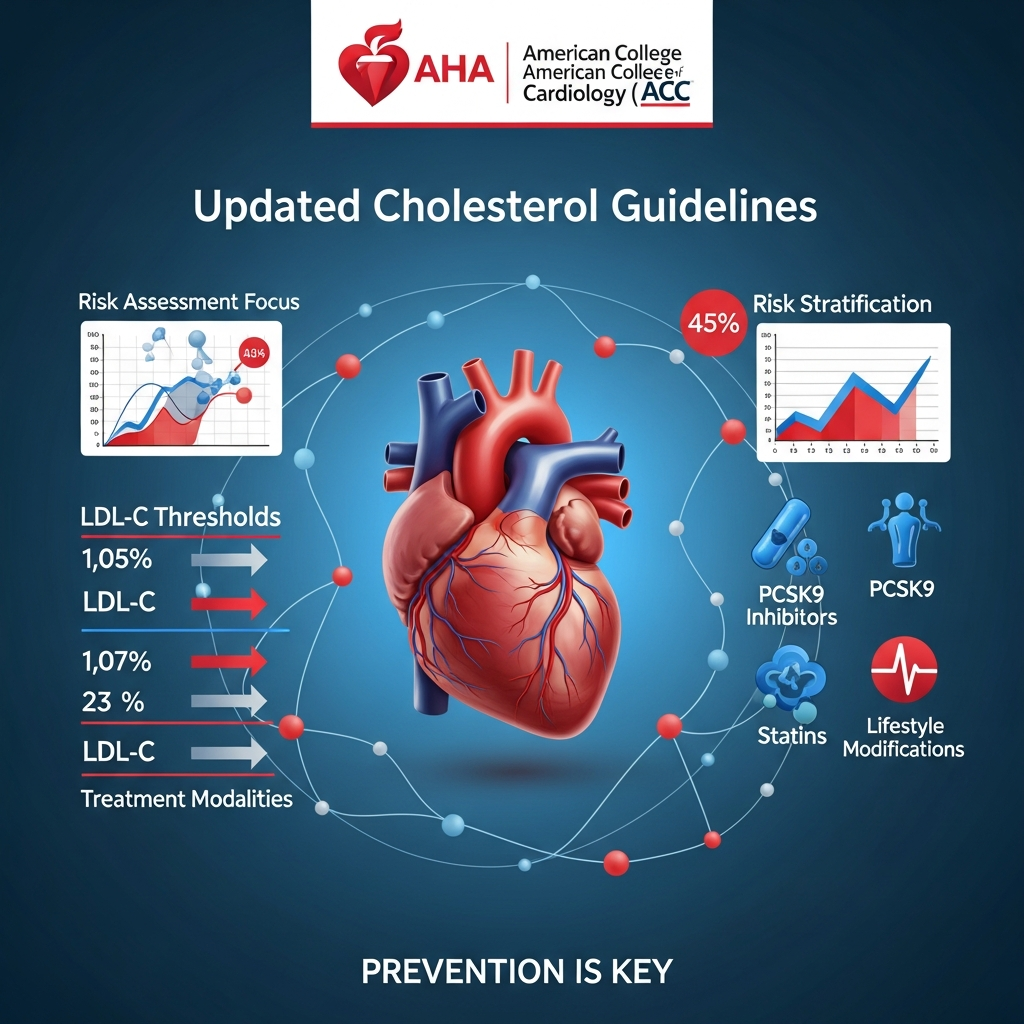
Cardiovascular disease remains the leading cause of death globally and in the United States, yet experts say over 80% of cases are preventable. For years, managing cholesterol has been a cornerstone of heart health, but how we assess and treat it has just received a major overhaul. The American Heart Association (AHA) and American College of Cardiology (ACC), along with nine other medical associations, have released groundbreaking, updated guidelines for managing cholesterol and other blood lipids (dyslipidemia). These new recommendations mark a significant shift, advocating for earlier, more personalized, and aggressive intervention to protect your heart throughout your lifetime. Published in Circulation and the Journal of the American College of Cardiology, these updates are critical for anyone looking to reduce their risk of heart attack and stroke.
A Sea Change in Heart Disease Prevention
The updated guidelines, the first major revamp since 2018, introduce a profound shift in philosophy. Instead of primarily focusing on a patient’s immediate 10-year risk of cardiovascular events, the new framework emphasizes a lifelong approach to prevention. Experts like Dr. Steven Nissen, a preventive cardiologist at Cleveland Clinic, call this a “sea change,” noting that “a person’s lifetime risk is what counts.” This means doctors are now encouraged to consider cholesterol management much earlier in adulthood, even for patients who might not seem “high risk” in the short term. The goal is to limit long-term exposure to elevated levels of harmful low-density lipoprotein (LDL) cholesterol, often called “bad” cholesterol, which gradually contributes to plaque buildup in arteries (atherosclerotic cardiovascular disease, or ASCVD).
The Shift to Earlier, Lifelong Prevention
One of the most crucial takeaways is the necessity of beginning heart disease prevention earlier. Dr. Christopher Kramer, president of the American College of Cardiology, stressed this, saying it’s about viewing heart disease as a lifelong condition. With approximately one in four U.S. adults having high LDL cholesterol, these early interventions are designed to prevent irreversible damage before it starts. The new guidelines recommend considering screening and treatment as early as age 30, especially for individuals with persistently high LDL-C or significant risk factors. If lifestyle modifications aren’t enough, cholesterol-lowering medications may be considered sooner than in previous guidelines.
Reinstated LDL Targets: Lower is Better
A significant change welcomed by many cardiologists is the reinstatement of specific LDL cholesterol targets. Previous U.S. guidelines had moved away from rigid numbers, but the new recommendations provide clear goals tailored to individual risk levels. Dr. Pamela B. Morris, vice-chair of the guideline committee, affirmed that “lower LDL is better,” citing compelling clinical trial evidence.
Here are the key LDL-C goals:
For most individuals without risk factors: LDL cholesterol should be less than 100 mg/dL.
For high-risk individuals: The target is reduced to less than 70 mg/dL. This applies to patients with multiple risk factors like high blood pressure, diabetes, or a strong family history.
For patients with existing ASCVD at very high risk: The aim is even lower, at less than 55 mg/dL. This category includes those who have already experienced a heart attack or stroke, or have other very high-risk conditions.
These aggressive targets reflect the understanding that lowering LDL cholesterol dramatically reduces the likelihood of future cardiovascular events.
Enhanced Risk Assessment Tools for Personalization
The updated guidelines provide doctors with a more sophisticated arsenal of tools to personalize cardiovascular risk assessment beyond just traditional cholesterol levels. This aims to uncover hidden risks that might be missed by older methods.
Introducing the PREVENT Calculator
A cornerstone of the new risk assessment is the Predicting Risk of Cardiovascular Disease EVENTs (PREVENT) calculator. This contemporary tool replaces older scores like the Pooled Cohort Equations, which were found to overestimate risk by 40%-50%. The PREVENT calculator is designed for adults aged 30-79 years who don’t have known ASCVD or subclinical atherosclerosis, and have LDL-C between 70–189 mg/dL. It estimates both your 10-year and 30-year risk of heart attack or stroke.
The new risk categories are defined as:
Low risk: Less than 3%
Borderline risk: 3% to less than 5%
Intermediate risk: 5% to less than 10%
High risk: 10% or higher
This calculator considers factors like BMI, cholesterol levels, blood pressure, and tobacco use, offering a more accurate and comprehensive projection of future cardiovascular events.
Unmasking Hidden Risks: Lp(a), ApoB, & CAC
Beyond the PREVENT calculator, the guidelines recommend integrating additional biomarkers and imaging to refine individual risk profiles. These insights are crucial for tailoring treatment decisions.
Lipoprotein(a) [Lp(a)] Testing: This is perhaps one of the most significant new recommendations. The guidelines now advocate for measuring Lp(a) at least once in adulthood for all individuals. Lp(a) is a type of cholesterol not typically included in standard lipid panels. It’s largely genetically determined, remaining stable throughout life, and is not significantly impacted by diet or exercise. High Lp(a) levels (≥125 nmol/L or ≥50 mg/dL) are a significant, independent risk factor for heart attack and stroke. While there isn’t a widely available treatment to lower Lp(a) itself yet, knowing your level helps doctors assess your overall risk more accurately and may lead to more intensive management of other risk factors.
Apolipoprotein B (apoB): This blood test may be used to assess residual ASCVD risk and guide treatment, especially in individuals with cardiovascular-kidney-metabolic syndrome, Type 2 diabetes, or high triglycerides. ApoB is a protein found on “bad” lipoproteins, and it can sometimes provide a more accurate picture of risk than LDL-C alone, particularly when LDL levels appear healthy but other risk factors are present.
Coronary Artery Calcium (CAC) Scan: A non-contrast CAC scan is recommended for men age 40+ and women age 45+ with borderline or intermediate 10-year risk, especially if there’s uncertainty about initiating statin therapy. This non-invasive scan quantifies calcified plaque in the arteries, providing direct evidence of atherosclerosis. A detectable CAC score often supports an LDL-C goal of less than 100 mg/dL, with even lower targets for higher calcium amounts. It serves as a powerful “tiebreaker” in treatment decisions.
The guidelines also introduce “risk enhancers” to further personalize assessment. These include family history of heart disease, chronic inflammatory conditions (e.g., lupus), cardiometabolic conditions (e.g., obesity, diabetes), higher-risk ancestry (e.g., South Asian), and reproductive risk markers (e.g., early menopause).
The Role of Medication: Statins & Beyond
While lifestyle modifications remain foundational, the guidelines emphasize the importance of medication when lifestyle changes are insufficient, often suggesting earlier intervention.
Statin Therapy: The Foundation
Statins continue to be the cornerstone of lipid-lowering and risk reduction therapy. These medications are highly effective, and generic versions are widely available and affordable, costing as little as $3 per month. The guidelines recommend statins for adults aged 30 and older with LDL cholesterol levels of 160 mg/dL or higher, or for younger adults with specific conditions like heterozygous familial hypercholesterolemia. The goal is to achieve at least a 50% reduction in LDL-C for high-risk patients.
Non-Statin Options & Hypertriglyceridemia
If LDL cholesterol levels are not adequately lowered with statins, or if patients are statin-intolerant, the guidelines recommend adding non-statin therapies. Evidence-based options include:
Ezetimibe: An oral medication that reduces cholesterol absorption.
Bempedoic acid: A newer oral agent.
PCSK9 monoclonal antibodies: Injectable therapies offering significant LDL reduction.
Inclisiran: Another injectable option currently under clinical trial evaluation, which may be reasonable if PCSK9 inhibitors are not tolerated or preferred due to dosing frequency.
For hypertriglyceridemia (high triglycerides), lifestyle changes and statins are also the primary treatment. Other therapies are considered based on individual ASCVD and pancreatitis risk.
Lifestyle Remains Key for Heart Health
Despite the advancements in risk assessment and medication, the updated guidelines firmly underscore the enduring and critical importance of lifestyle modifications. Dr. Leslie Cho, another preventive cardiologist at Cleveland Clinic, summarized this perfectly: “The cornerstone of good cardiac prevention is diet and exercise.”
Recommendations include:
Maintaining a healthy weight: Obesity is a significant risk enhancer.
Regular physical activity: Crucial for overall cardiovascular health.
Avoiding tobacco: Smoking is one of the most detrimental factors for heart disease.
Prioritizing healthy sleep: Adequate sleep contributes to better metabolic health.
Adopting a heart-healthy diet: Emphasizing fruits, vegetables, whole grains, and lean proteins while limiting saturated fats, trans fats, and added sugars.
These habits can prevent heart disease and stroke in up to 80% of individuals, making them invaluable partners to any medical therapy.
Special Populations and Considerations
The guidelines also outline specific considerations for various adult populations:
Children and Adolescents: High cholesterol can begin impacting heart disease risk early. Universal cholesterol screening is recommended for all children aged 9-11 years who haven’t been screened previously.
Chronic Kidney Disease (CKD): Individuals aged 40+ with stage 3 or higher CKD should initiate intensive lipid-lowering therapy to achieve an LDL-C of less than 55 mg/dL.
HIV and Type 1 or 2 Diabetes: Statin therapy is recommended for HIV patients aged 40-75 on stable antiretroviral therapy and for diabetics without ASCVD.
Cancer Patients: Therapy should generally continue unless contraindicated.
Pregnancy and Lactation: Most lipid-lowering therapies are deferred during conception, pregnancy, and lactation, requiring nuanced discussions about individual ASCVD risks and benefits.
These specialized recommendations ensure comprehensive and tailored care across diverse patient groups.
Why These Updates Matter to You
These updated AHA cholesterol guidelines represent a powerful step forward in preventing heart disease and stroke. They arm healthcare providers with more precise tools to assess your personal risk and offer effective, personalized strategies for management. By emphasizing earlier intervention, utilizing advanced calculators like PREVENT, incorporating new biomarkers like Lp(a) and apoB, and reinstating clear LDL targets, the medical community aims to significantly reduce the burden of cardiovascular disease.
Understanding your cholesterol levels, your unique risk factors, and discussing these new guidelines with your doctor is more important than ever. Don’t wait for symptoms to appear; take proactive steps to protect your heart health for a longer, healthier life.
Frequently Asked Questions
What are the major changes in the new AHA cholesterol guidelines?
The updated guidelines introduce several key shifts. They emphasize earlier, lifelong prevention of heart disease, moving beyond just 10-year risk assessments. Key changes include the use of the new PREVENT calculator for personalized risk assessment, the reinstatement of specific LDL cholesterol targets (e.g., less than 55 mg/dL for very high-risk patients), and the recommendation for new biomarker tests like lipoprotein(a) [Lp(a)], apolipoprotein B (apoB), and coronary artery calcium (CAC) scans to uncover hidden risks. Statins remain the first-line treatment, but non-statin therapies are now more clearly integrated for achieving lower LDL targets.
How can I get my personal cardiovascular risk assessed with the new tools?
To understand your personal cardiovascular risk under the new guidelines, your first step should be to consult your doctor. They can use the PREVENT calculator to estimate your 10-year and 30-year risk of heart attack or stroke based on your health profile. Your doctor may also recommend a one-time lipoprotein(a) test, which is a genetic marker for heart disease. For some individuals with borderline or intermediate risk, a non-contrast coronary artery calcium (CAC) scan might be suggested to provide direct evidence of plaque buildup and further refine treatment decisions.
Should I be concerned about my lipoprotein(a) levels?
Lipoprotein(a), or Lp(a), is a significant new focus in the guidelines. Unlike LDL cholesterol, Lp(a) levels are largely determined by your genetics and are not significantly influenced by diet or exercise. High Lp(a) levels indicate an increased, often “hidden,” risk for heart attack and stroke. While there are currently no medications specifically approved to lower Lp(a), knowing your level is crucial because it helps your doctor tailor your overall cardiovascular risk management more aggressively. If your Lp(a) is high, your doctor may recommend stricter control of other risk factors like LDL cholesterol and blood pressure. It’s recommended to be tested at least once in adulthood.