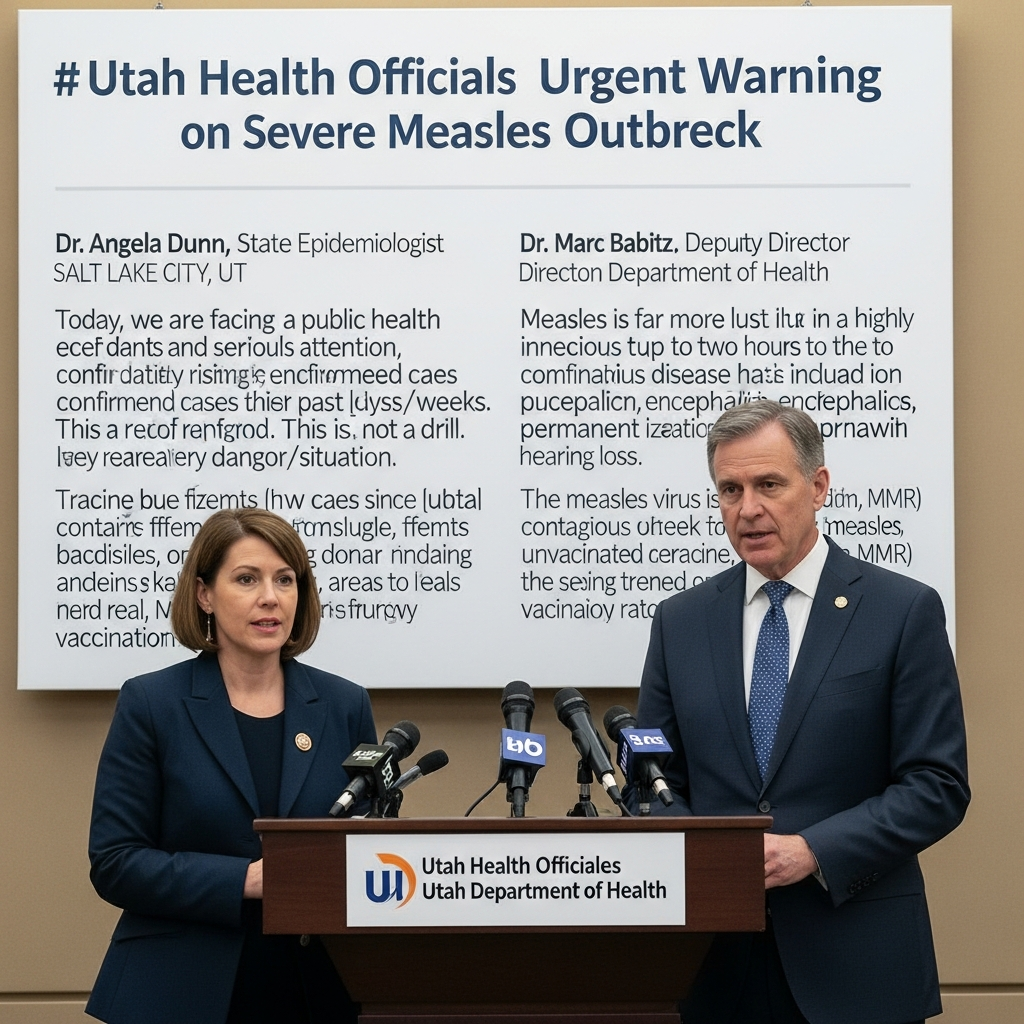
An urgent health alert has been issued across Utah as measles cases continue their alarming ascent, prompting state health officials to deliver a stark message: this is far from a mild childhood illness. Recent reports from March 2026 highlight a significant misunderstanding of measles severity, with medical professionals emphasizing the severe impact it has on patients and families. The rapid spread across the Beehive State underscores the critical need for heightened awareness and community action against this highly contagious virus.
Unpacking the Reality of Utah’s Measles Crisis
In southern Utah, nurse practitioner Amanda Jocelyn, who specializes in pediatric care, has witnessed firsthand the devastating effects of the current measles outbreak. For years, Jocelyn educated patients about measles without directly treating a case. That changed dramatically in recent months, as she has since cared for over a dozen severely ill children. Her experience directly challenges the common perception that measles is a benign virus, easily overcome by healthy children. Instead, she describes seeing “very, very ill” children and their caregivers, who also often fall sick.
State epidemiologist Dr. Leisha Nolen echoes this sentiment, sharing similar observations during a visit to a southern Utah community heavily affected by the illness. Dr. Nolen noted a consistent refrain from both patients and providers: “measles is so much worse than what they expected.” Both experts are unequivocal in their warning that measles is a severe illness, not merely a mild infection or a passing virus. This crucial message aims to correct dangerous misconceptions that could hinder effective public health responses and individual precautions.
Why Measles Hits So Hard: The Body’s Response
The variability in how individuals experience viral infections, from a simple sniffle to severe complications, is a complex area of medical research. Studies, such as those from Yale, indicate that the severity of a viral disease like measles is often less about the virus’s inherent power and more about the body’s initial immune response. The innate defense mechanisms within cells lining the nasal passages, particularly the interferon response, play a critical role. When this crucial antiviral defense is robust and rapid, it can effectively contain the virus, limiting infection and inflammation.
However, if this interferon response is weakened or delayed, the body may trigger a more aggressive inflammatory reaction. This can lead to exacerbated symptoms and significant airway damage, turning a potentially manageable infection into a severe illness. This insight helps explain why some individuals, especially those with developing immune systems like young children or compromised systems, face a much higher risk of severe measles complications, aligning with the “very, very ill” patients observed in Utah.
Tracking the Measles Surge: Numbers and Risks
The current measles outbreak has led to a significant public health challenge for Utah. Since its onset, 358 Utahns have received a measles diagnosis. The severity of these cases is reflected in the demand for urgent medical care: over 120 individuals sought treatment in an emergency room, 31 required overnight hospitalization, and three critically ill patients needed intensive care. Fortunately, as of these reports, no fatalities have been recorded in Utah from the disease.
While most cases are concentrated in southwestern Utah, the virus has reached other areas, including a recent spike in Salt Lake County. Health officials there have urged residents experiencing illness symptoms to stay home, helping curb further transmission. This widespread impact highlights measles as a statewide concern, requiring collective vigilance from all Utahns.
Recognizing Symptoms and Understanding Transmission
Measles typically manifests with symptoms appearing seven to 14 days following exposure. Initially, these symptoms often mimic a common cold, including fever, cough, a runny nose, and red, watery eyes. This early stage is particularly dangerous for transmission. Dr. Nolen warns that individuals are most likely to spread the virus during these first few days when they may not even realize they have measles.
After approximately four days of these general symptoms, the characteristic measles rash appears. While the rash typically prompts recognition of the disease, by this point, individuals may have already unknowingly infected numerous others. The highly contagious nature of measles, spreading through respiratory droplets via coughing and sneezing, underscores the importance of early detection and isolation. This rapid pre-symptomatic spread is also observed with other common respiratory viruses like RSV, making robust public health messaging and quick action vital.
The Power of Prevention: The MMR Vaccine
The most effective protection against measles remains the Measles, Mumps, and Rubella (MMR) vaccine. Public health officials consistently emphasize its importance in safeguarding individuals and communities. Dr. Nolen notes that most of those who have contracted measles in this outbreak were unvaccinated.
However, she also acknowledged that about 8% to 10% of reported cases involved individuals who had received at least one dose of the MMR vaccine. While this can be concerning, it’s crucial to understand that no vaccine offers 100% protection. As highlighted by CDC information regarding flu vaccines, immune protection can wane, and viruses can subtly change. Even if a vaccinated person contracts the illness, vaccination significantly reduces the risk of severe illness, hospitalization, and death. This underlines the ongoing value of vaccination, even with a small percentage of breakthrough cases. The collective immunity provided by widespread vaccination is essential to protect vulnerable individuals who cannot be vaccinated.
High-risk groups for serious illness include pregnant women, children under age 5, and individuals with weakened immune systems. These populations particularly benefit from the herd immunity provided by broader community vaccination. Moreover, outbreaks are frequently linked to school activities and large gatherings, emphasizing the ease of transmission in crowded environments.
Measles and Post-Acute Infection Syndromes (PAIS)
The immediate severity of measles is well-documented, but growing research into post-acute infection syndromes (PAIS) adds another layer of concern. Conditions like Long COVID and the emerging concept of “long cold” demonstrate that persistent, debilitating symptoms can linger long after the initial infection has cleared. While the prevalence of PAIS following measles specifically is still being researched, the general principle applies to various viral, bacterial, and parasitic infections.
Potential causes of PAIS, explored by Yale researchers, include persistent viral reservoirs, autoimmune responses triggered by the infection, reactivation of latent viruses (like Epstein-Barr), or chronic inflammation leading to tissue damage. The implications for measles are significant: even after recovery from the acute phase, some individuals could experience prolonged fatigue, cognitive issues, or other chronic health challenges. This emphasizes that avoiding infection through vaccination isn’t just about preventing immediate illness, but potentially protecting against long-term health consequences as well. Preventing infections through recommended vaccinations, alongside standard hygiene practices, is crucial for mitigating the risk of both acute and chronic post-viral complications.
Frequently Asked Questions
What makes the current measles outbreak in Utah so concerning to health officials?
The Utah measles outbreak is highly concerning because health officials are observing unusually severe illness, contradicting the common misconception of measles as a mild virus. Nurse practitioners and state epidemiologists report that patients, particularly children, are “very, very ill,” with a significant number requiring emergency room visits, hospitalizations, and even intensive care. The rapid spread and the underestimation of its severity among the public amplify the risk to vulnerable populations.
How does the body’s immune response contribute to the severity of measles symptoms?
The severity of measles symptoms can be significantly influenced by an individual’s initial immune response, particularly the rapidness and strength of their interferon response. A swift and robust interferon defense can contain the virus effectively, leading to milder symptoms. Conversely, a weak or delayed response may lead to a more aggressive inflammatory reaction, causing more severe symptoms and complications. This explains why some individuals experience severe illness while others may have a less intense course, as discussed by Yale’s research on viral infections.
What are the best steps Utah residents can take to protect themselves and their communities from measles?
The best protection against measles for Utah residents is to receive the Measles, Mumps, and Rubella (MMR) vaccine. Health officials strongly recommend vaccination for everyone eligible to create herd immunity and protect vulnerable individuals. Additionally, recognizing early symptoms like fever, cough, and runny nose, and staying home when sick, especially before a rash appears, can help prevent transmission. Practicing good hand hygiene and avoiding large gatherings during outbreaks are also important preventative measures.
A Collective Call to Action
The evolving measles situation in Utah demands our collective attention and cooperation. The unequivocal message from health officials is clear: measles is a severe illness with the potential for serious complications and even long-term health challenges. While diligent medical teams work tirelessly to manage the ongoing outbreak, their efforts alone are not enough.
As Utahns, we share the responsibility to protect our families and communities. Understanding the true nature of this highly contagious virus, recognizing its symptoms, and — most importantly — ensuring up-to-date vaccination with the MMR shot are the most powerful steps we can take. Let’s work together to control this outbreak and safeguard public health.