For eons, the enigmatic Red Planet has held a profound secret: did it once host a vast ocean, teeming with liquid water? New, compelling geological evidence suggests an emphatic “yes.” Researchers have identified a distinct, flat band of land across Mars’ northern hemisphere, strikingly similar to a “bathtub ring” left behind when water drains. This discovery represents the strongest indication yet of a colossal ancient Mars ocean, potentially covering a third of the planet billions of years ago.
This groundbreaking finding dramatically shifts our understanding of Mars’ past climate and its potential for ancient life. While signs of a watery history — like dried riverbeds and lakebeds — have long been established, the existence of a stable, long-lived ocean remained a hotly debated topic. Now, a novel approach, using Earth as a planetary Rosetta Stone, provides a convincing answer, turning an intriguing hypothesis into a highly testable reality for future missions.
Decoding Mars’ Watery Past: From Puddles to a Planetary Ocean
Scientists have pondered Mars’ aqueous history for decades. Early missions detected features resembling ancient shorelines, particularly in the northern plains. However, these previous observations were often ambiguous. Their varying elevations, unlike the consistent sea levels expected from a stable ocean, fueled skepticism. Michael Lamb, a professor of geology at Caltech, noted the difficulty: any ancient Mars ocean would have vanished billions of years ago, leaving subtle, heavily eroded traces. This inconsistency made it challenging to confirm a unified, planet-spanning ocean.
The question wasn’t just if water existed, but how much and for how long. A planet with scattered lakes and rivers implies a very different environmental history than one with a vast, enduring ocean. The latter would have offered a far more stable environment, potentially critical for the emergence and sustenance of life. Resolving this “ocean debate” is paramount for astrobiology.
Earth’s Lessons: Unmasking the Continental Shelf
To overcome the inconsistencies of past Martian shoreline interpretations, the research team, led by Abdallah Zaki of the University of Texas at Austin and Michael Lamb, adopted a clever strategy: they looked to Earth for a robust geological signature. They ran computer simulations to model what Earth would look like if its oceans were drained, identifying the most persistent and stable features left behind.
Their models revealed that the most enduring evidence of an ancient ocean isn’t the fluctuating shoreline itself, but rather the continental shelf. This broad, gently sloping region, often hundreds of kilometers wide, forms where land meets the ocean. It’s a vast sedimentary sink, built up over geological timescales by rivers depositing sediment and by wave action. Crucially, while Earth’s sea levels have risen and fallen, these continental shelves remain as stable, long-lasting records of ocean presence. This insight provided a powerful new lens through which to examine Mars.
A Martian “Bathtub Ring” Emerges: Evidence of a Grand Ocean
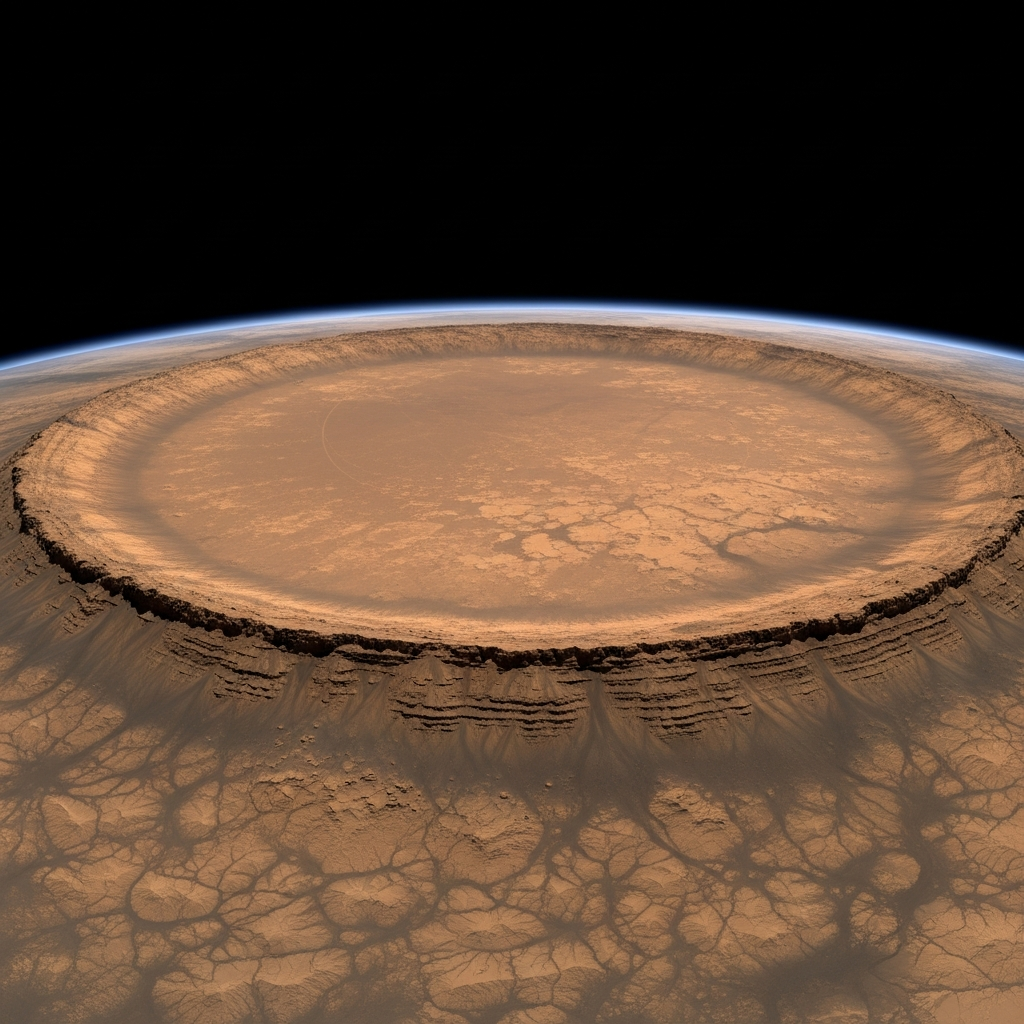
Applying this Earth-derived understanding to the Red Planet, Zaki and Lamb meticulously analyzed high-resolution topographic data from NASA’s Mars Orbiter Laser Altimeter (MOLA). What they found was a striking analogous feature: a distinct, broad, flat band of terrain in the Martian northern hemisphere. This geological formation, aptly dubbed a “bathtub ring,” strongly suggests the presence of a coastal shelf from an ancient ocean.
This Martian coastal shelf is estimated to be approximately 200 to 400 meters (650 to 1,300 feet) wide, marking a clear transition between higher ground and the lower northern plains. It would have existed roughly 1,800 to 3,800 meters (5,900 to 12,500 feet) below the theoretical ancient Martian sea level. Its continuous nature and substantial size are critical. Such a massive landform would require millions of years of stable ocean presence to develop, differentiating it from features left by smaller, temporary bodies of water. Zaki emphasizes that “If there is an ocean, there must be a shelf. This is a more stable topographic signature.”
Bolstering the Case: Multi-pronged Evidence
The evidence for this ancient Mars ocean extends beyond just the topographic “bathtub ring.” Several other geological indicators align perfectly with this newly identified coastal shelf:
River Deltas: Ancient river deltas, vast sediment plains formed where rivers empty into larger bodies of water, consistently align with this proposed ocean boundary. This pattern, also seen on Earth’s continental shelves, helps confirm the feature as a true, continuous ocean margin rather than isolated water bodies.
Sedimentary Layers: The same zone contains thousands of layered sediment deposits, some hundreds of meters thick. These closely resemble water-formed structures on Earth, indicating prolonged interaction with liquid water.
Mineral Traces: The presence of clay minerals and altered rocks within these layers further points to extended exposure to liquid water, a hallmark of long-lived aqueous environments.
Rover Discoveries: China’s Zhurong rover, which landed on Mars in 2021, detected evidence of ancient beaches within underground sedimentary layers in the northern plains – precisely the area where the coastal shelf is proposed. NASA’s Perseverance rover is also exploring “bathtub ring” deposits rich in carbonate minerals at the margin of Jezero Crater, another area indicative of ancient shallow water.
These converging lines of evidence collectively paint a robust picture of a vast, stable ocean that once covered approximately one-third of the Red Planet’s surface, significantly strengthening the long-held hypothesis.
Navigating the Challenges and Future Horizons
While compelling, the new study acknowledges ongoing debates. James W. Head, a professor at Brown University not involved in the study, noted that Mars lacks plate tectonics, which plays a significant role in forming Earth’s continental shelves. Brian Hynek from the University of Colorado Boulder also highlighted that comparing Mars’ shelf to Earth’s is “a bit of an apples to oranges comparison” due to differences in geological processes and expected ocean dynamics.
However, Lamb maintains that key elements like rivers, waves, and sea-level changes, which shaped Earth’s shelves, were also likely present on ancient Mars. Bryony Horgan of Purdue University underscores the critical nature of this debate for understanding Mars’ ancient climate, geology, and habitability, noting it’s “one of the longest lived controversies in Mars science.” She appreciates that this study offers a “very testable hypothesis.”
This brings us to the future. Confirming this ancient Mars ocean would profoundly deepen our understanding of why the Red Planet changed so dramatically. It could illuminate how Mars transitioned from a potentially warm, wet world to its current cold, dry state. More importantly, a long-lived ocean provides an “important ingredient for life,” making the search for biosignatures far more promising.
Upcoming missions are poised to provide definitive answers. The European Space Agency’s Rosalind Franklin rover, expected to launch in late 2028, will explore the northern hemisphere with advanced subsurface probing capabilities. Abdallah Zaki confidently states, “It will give us a definitive answer.” NASA’s Perseverance rover is already meticulously collecting samples from ancient shoreline environments within Jezero Crater, searching for chemical clues of past microbial life. These missions will allow scientists to investigate the mineralogy and geology of the proposed marine shelf in unprecedented detail, helping to settle this enduring scientific mystery.
Frequently Asked Questions
What exactly is the “bathtub ring” on Mars and what does it prove?
The “bathtub ring” on Mars refers to a newly discovered, distinct, flat band of terrain found across the planet’s northern hemisphere. Identified through topographic data, it closely resembles Earth’s continental shelves – broad, stable landforms left behind when oceans recede. This feature is considered the strongest evidence yet for a vast, ancient Mars ocean that covered approximately one-third of the planet billions of years ago. Unlike previous ambiguous shoreline evidence, this coastal shelf suggests a long-lived, stable body of water due to its size and formation process.
Which space missions are exploring this Martian coastal shelf and its implications?
Several current and future space missions are vital to confirming and exploring the implications of this Martian coastal shelf. NASA’s Perseverance rover is currently investigating similar “bathtub ring” deposits rich in carbonate minerals at the margin of Jezero Crater, searching for evidence of ancient microbial life. The European Space Agency’s Rosalind Franklin rover, part of the ExoMars mission, is expected to launch in late 2028. It will specifically explore the northern hemisphere of Mars, including areas within the proposed coastal shelf, with advanced tools to probe both the surface and subsurface, potentially providing definitive confirmation.
Why is the discovery of an ancient Mars ocean important for the search for life?
The discovery of an ancient Mars ocean is critically important for the search for life beyond Earth because a large, stable body of liquid water is considered a fundamental requirement for life as we know it. A long-lived ocean, persisting for potentially millions of years, would have provided a much more consistent and favorable environment for life to emerge and evolve compared to transient lakes or rivers. Sedimentary deposits within these ancient coastal shelf regions are considered prime locations to preserve biosignatures, similar to how Earth’s coastal sediments contain fossils, making them high-priority targets for astrobiological exploration.
The identification of Mars’ “bathtub ring” marks a pivotal moment in planetary science. By applying Earth’s geological lessons to our celestial neighbor, scientists have unveiled compelling evidence for an ancient Mars ocean that challenges previous notions and opens new avenues for exploration. This breakthrough not only deepens our understanding of the Red Planet’s dramatic evolution but also intensifies the tantalizing prospect that Mars, once a water-rich world, may indeed have harbored life. As rovers prepare to probe these ancient coastal zones, humanity stands on the cusp of potentially uncovering one of the universe’s most profound secrets.