The quest for the perfect foldable smartphone has long been hampered by a persistent challenge: the visible crease on the internal display. However, groundbreaking developments at CES 2026 have unveiled a future where this unsightly line is a thing of the past. Samsung Display, a pioneer in flexible screen technology, showcased a prototype OLED display that is remarkably crease-free, offering a truly seamless visual experience. This revolutionary creaseless foldable screen immediately sparks speculation about its profound implications for the highly anticipated Apple iPhone Fold, promising an era of truly refined flexible devices.
The Persistent Problem of the Foldable Crease
Since their inception, foldable phones have made remarkable strides in design, durability, and performance. Devices have become thinner, more robust, and significantly more powerful, evolving rapidly from their initial iterations. Yet, one major design hurdle has remained stubbornly constant: the visible crease or indentation along the fold line of the inner display. This subtle, or sometimes not-so-subtle, disruption has been a compromise for early adopters, affecting both the aesthetics and the user experience of otherwise futuristic devices. For many, it represented a clear distinction from the perfectly flat screens of traditional smartphones.
CES 2026: Samsung Display’s Breakthrough Revelation
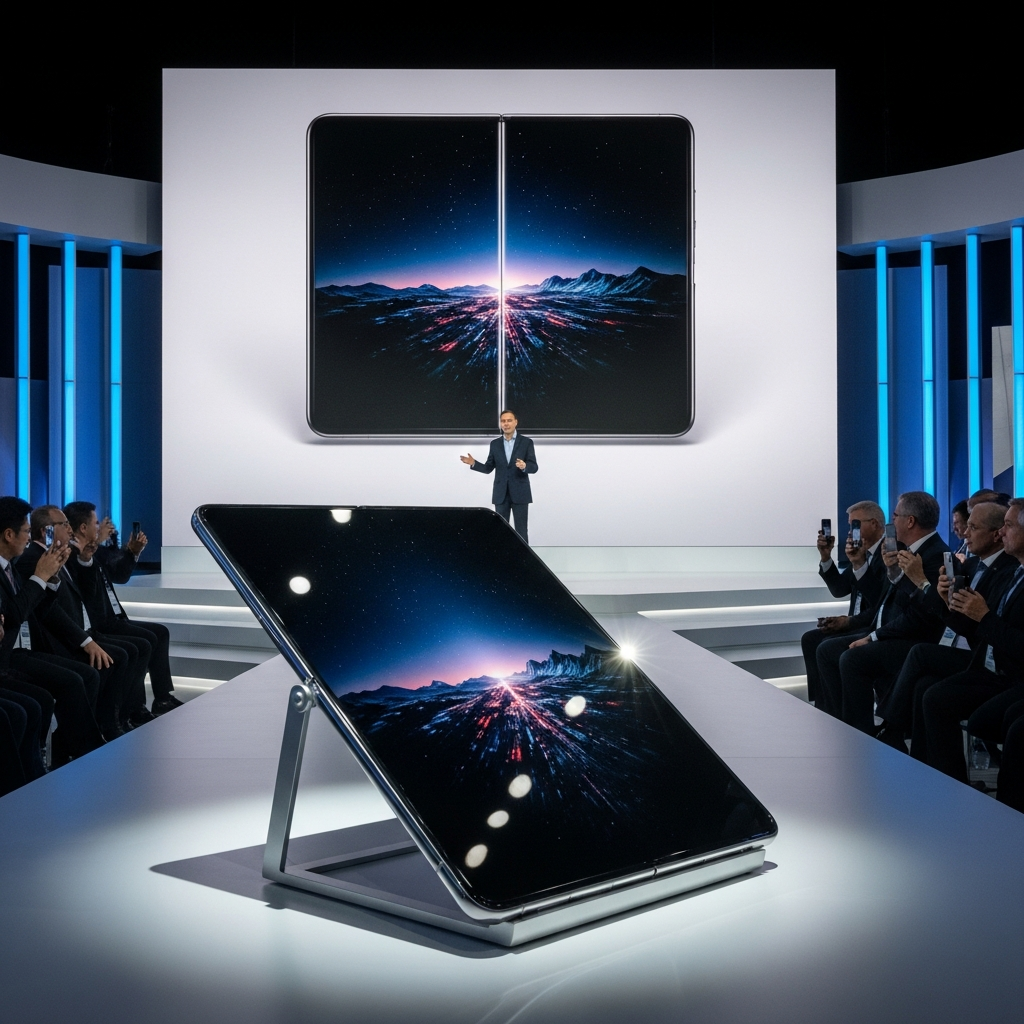
At CES 2026, Samsung Display offered a tantalizing glimpse into a creaseless future. The company, renowned for showcasing cutting-edge concepts that often hint at future consumer products, demonstrated an advanced OLED foldable display prototype that completely eliminates the central fold line. The demonstration was particularly striking: two foldable phone models were placed side-by-side. One, labeled as a “current” device (speculated to be a Galaxy Z Fold 7), still exhibited the familiar crease. The other, the new concept, presented a perfectly smooth, unblemished surface.
Observers, including CNET’s Senior Technology Reporter Abrar Al-Heeti, noted that the difference was “immediately noticeable.” Whether viewed head-on or at an angle, the concept screen showed no discernible crease, making the “current” phone instantly appear outdated. This “production-ready” appearance of Samsung Display’s innovation suggests it’s far beyond a mere laboratory experiment, signaling a major turning point for the entire foldable phone industry.
Unpacking the Technology: How Samsung Achieves the Crease-Free Display
Achieving a truly creaseless foldable screen is a complex engineering feat. Samsung Display’s breakthrough involves significant modifications to the traditional layering of OLED panels. Historically, foldable screens relied on polyethylene terephthalate (PET) film for structural backing, contributing to the visible crease. The new technology introduced at CES 2026 leverages a sophisticated combination of materials and design.
The core innovations include:
Metal Reinforcing Plate: Samsung Display has ingeniously replaced the traditional PET film with a laser-drilled metal display plate. This specially engineered plate enhances stability and, crucially, more effectively spreads out the stress generated during the folding process. By distributing this stress across a wider area, the panel can bend smoothly without forming visible indentations.
Modified Optical Clear Adhesive (OCA): The company has also refined its optical clear adhesive (OCA) layer, which binds various components of the OLED panel. This modified OCA layer reduces stiffness, creating more flexible cushioning between the OLED element and the Ultra-Thin Glass (UTG) layer. This critical adjustment plays a key role in minimizing visible creases when the screen is folded.
These combined advancements create a screen that is not only visually seamless but also capable of transforming a foldable display to appear indistinguishable from a traditional, flat glass screen. This significant leap promises “seamless text across the fold,” elevating the user experience to new heights.
Enhanced Durability: A Tougher Foldable Future
Beyond mere aesthetics, Samsung Display’s creaseless foldable screen concept is also engineered for enhanced durability. Addressing concerns about the long-term resilience of flexible displays, the company conducted a compelling demonstration at CES 2026. A robotic arm was set to repeatedly hurl a basketball at a “backboard” constructed from several of these foldable concept phones. Despite the forceful impacts, none of the phones cracked or dented. This suggests a significant improvement in structural integrity, indicating that the new design contributes not only to visual appeal but also to a more robust device, a critical factor for mainstream adoption.
The iPhone Fold Connection: Apple’s Crease-Free Ambition
The unveiling of Samsung Display’s creaseless technology holds immense significance for Apple’s long-rumored entry into the foldable smartphone market. Reports have consistently indicated that Apple is working closely with Samsung Display to develop its own foldable iPhone, often dubbed the “iPhone Fold.” A primary reason for Apple’s cautious approach and delayed entry has been its stringent requirement for a nearly, if not entirely, crease-free display.
While some initial reports speculated that the exact technology shown by Samsung Display at CES could directly power Apple’s device, more nuanced details have emerged. SamMobile, citing industry insights, clarifies a key distinction:
Samsung’s Approach: For devices like the rumored Galaxy Z Fold 8, Samsung Display utilizes a metal reinforcing plate beneath the OLED layer.
Apple’s Approach: Apple is reportedly opting for glass as the primary supporting material for its foldable OLED panel.
Despite these differing structural choices, the underlying OLED layer itself is noted to be identical in both Apple’s and Samsung’s advanced panels. This suggests that while Apple will pursue its own specific structural design, it benefits from Samsung Display’s core OLED innovation to achieve its creaseless goal. The strong implication is that a version of this advanced, crease-minimizing technology will indeed be integral to Apple’s first foldable iPhone.
Galaxy Z Fold 8: Samsung’s Potential Pioneer
The excitement around Samsung Display’s innovation naturally leads to questions about its first commercial appearance. All signs point to the upcoming Galaxy Z Fold 8 as the likely pioneer within Samsung’s own lineup. Reports from ZDNet Korea suggest Samsung is targeting a summer 2026 release for the Galaxy Z Fold 8, incorporating this screen innovation. This would represent a significant leap for the company, further solidifying its leadership in the foldable segment.
However, the path isn’t entirely clear. A report from 9to5Google highlights a crucial potential hurdle: anticipated price increases across the tech industry due to a surge in RAM prices. Integrating such an advanced and new screen into the Galaxy Z Fold 8 could lead to a significant price hike, potentially making the device prohibitively expensive. This suggests Samsung is approaching the decision cautiously, weighing the innovative feature against market and cost considerations, with a final panel decision expected around the end of Q1 2026, ahead of production.
Beyond the Fold: Other Innovations at CES 2026
While the creaseless foldable screen undoubtedly stole the spotlight, Samsung Display also showcased other futuristic OLED concepts at CES 2026, underscoring its broad commitment to display innovation. These included:
Automotive Displays: A vehicle mock-up featured multiple OLED displays, including a striking curved, 18.1-inch L-shaped center screen. This innovative display is designed to control climate, navigation, and various other vehicle functions seamlessly. Additionally, a 13.8-inch passenger display could retract into the dashboard for storage, with an option to prevent the driver from viewing its content, thus minimizing distraction and enhancing safety.
Teaching Assistant Robots: The company also presented charming robots envisioned as teaching assistants. These robots featured circular screens as their “faces” and were designed to guide students to classrooms, share information about professors, and display assignments. Although a full command execution demo wasn’t provided, their potential to revolutionize educational environments was evident.
Despite the allure of these other concepts, the creaseless display resonated most strongly with observers due to its immediate practicality and direct impact on current smartphone pain points.
The Future Market: Samsung vs. Apple in the Foldable Arena
The impending arrival of creaseless foldable technology sets the stage for intensified competition between tech giants Samsung and Apple. Both companies are anticipated to launch their respective flagship foldable devices, the Galaxy Z Fold 8 and the inaugural iPhone Fold, in the second half of 2026. This will be a fascinating battle for market share and innovation.
Industry speculation suggests:
Apple’s Strengths: The iPhone Fold is expected to excel in UI design and app optimization, leveraging Apple’s renowned ecosystem and user loyalty. Experts widely anticipate Apple to capture a substantial share of the foldable smartphone market upon entry, driven by its massive existing user base.
Samsung’s Strengths: Samsung is predicted to retain an advantage in areas such as advanced camera hardware, with rumors of a 200MP primary sensor for the Fold 8, and potentially faster charging speeds.
Furthermore, there’s speculation that Samsung might introduce a variant of the Galaxy Z Fold 8 with a wider screen, possibly mirroring the dimensions of the rumored foldable iPhone, indicating a direct competitive strategy. Regardless of the individual strengths, the collective push for crease-free designs by both titans signifies a maturing foldable market, ready for mainstream adoption.
Frequently Asked Questions
What is the key technology behind Samsung’s new creaseless foldable display?
Samsung’s groundbreaking creaseless foldable display, showcased at CES 2026, employs a multi-faceted technological approach. At its core, it integrates a laser-drilled metal reinforcing plate beneath the OLED layer. This plate effectively distributes stress when the screen folds, preventing creases. Additionally, a modified Optical Clear Adhesive (OCA) layer is used, which is less stiff and provides flexible cushioning between the OLED and Ultra-Thin Glass (UTG) layers. These innovations work in tandem to create a truly seamless, wrinkle-free visual experience.
When can consumers expect to see phones with this creaseless display, like the Galaxy Z Fold 8 or iPhone Fold?
Consumers can anticipate seeing devices with this advanced creaseless display technology in the second half of 2026. Samsung’s Galaxy Z Fold 8 is widely rumored to be the first to feature this innovation, with a potential summer 2026 release target. The Apple iPhone Fold is also expected to launch in late 2026, likely utilizing a similar crease-reducing OLED panel. However, market considerations like anticipated price hikes due to RAM shortages could influence Samsung’s final decision regarding the Fold 8’s display.
How does Samsung’s creaseless display technology differ from what Apple might use for its rumored iPhone Fold?
While both Samsung’s Galaxy Z Fold 8 and Apple’s rumored iPhone Fold are expected to feature creaseless OLED panels, their underlying structural support materials differ. Samsung Display, for its own devices, uses a metal reinforcing plate beneath the OLED layer to enhance stability and distribute stress. In contrast, Apple is reportedly opting for glass as the primary supporting material for its foldable OLED panel. Despite these differing reinforcement choices, the core OLED layer itself is noted to be identical in both manufacturers’ advanced panels.
The Future is Seamless
The unveiling of Samsung Display’s creaseless foldable screen at CES 2026 marks a monumental moment in smartphone innovation. It addresses one of the most significant compromises of early foldable devices, ushering in an era where the dream of a truly seamless, flexible display becomes a reality. This breakthrough not only promises to elevate Samsung’s own foldable lineup but also provides a clear path forward for Apple’s long-awaited iPhone Fold. As we look towards 2026, the prospect of a perfectly smooth, durable foldable phone is no longer a distant vision but an imminent reality, poised to redefine how we interact with our mobile technology.