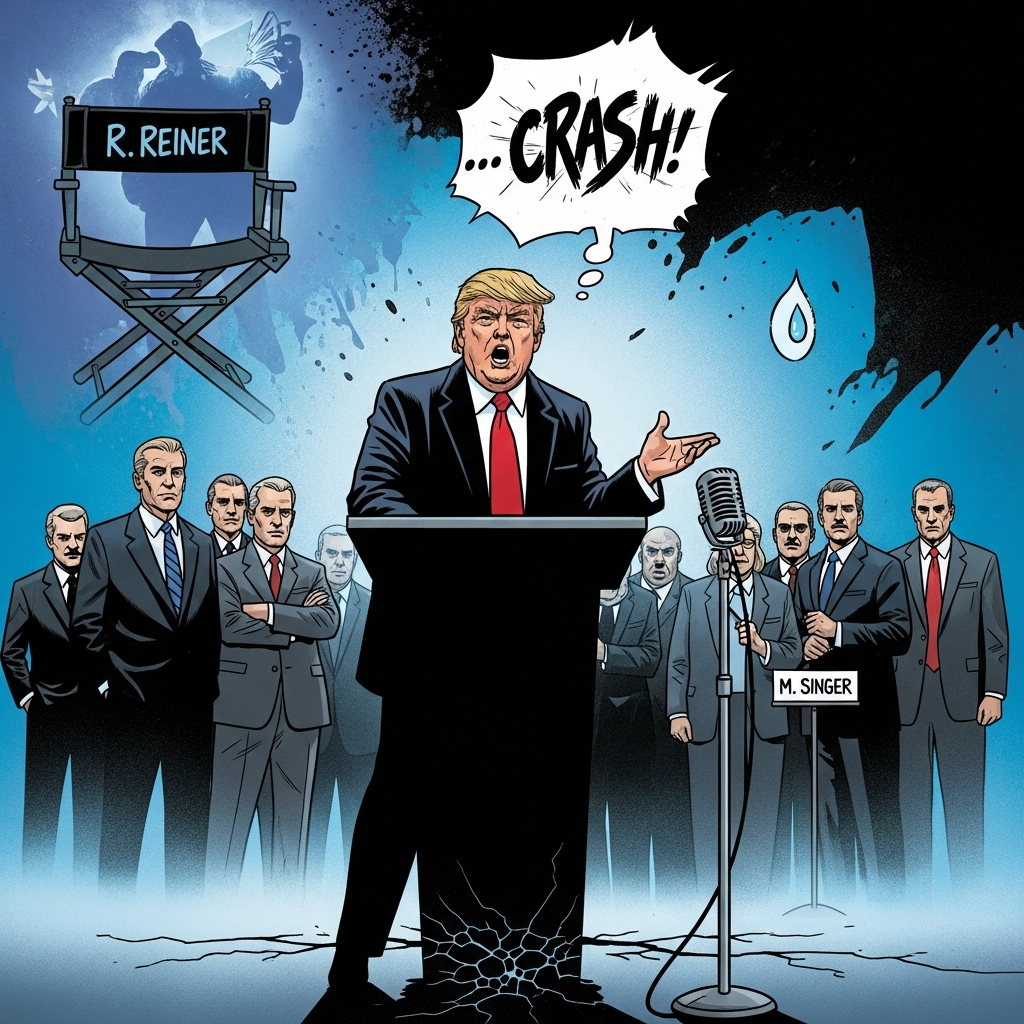
The tragic murder of acclaimed actor and director Rob Reiner and his wife, Michele Singer, took a startling turn when former President Donald Trump issued a social media statement that sparked an unusual wave of condemnation from within his own Republican party. Trump’s controversial remarks, made in the immediate aftermath of the Reiners’ deaths, stirred a national debate about empathy, political decorum, and the limits of public discourse, even in times of profound personal tragedy. This incident highlights a rare moment when prominent Republicans publicly distanced themselves from the former president’s unsparing rhetoric.
A Hollywood Tragedy and a Family’s Grief
On a somber Sunday evening, the entertainment world and beyond reeled from the news that Rob Reiner and his wife, Michele Singer, had been found stabbed to death in their Brentwood home in Los Angeles. The Los Angeles Police Department quickly took their 32-year-old son, Nick Reiner, into custody on suspicion of murder. He is currently held without bail and is expected to face formal charges, according to authorities. The sudden loss of the beloved couple sent shockwaves, leaving their remaining children in deep mourning and heartbreak. This devastating event quickly transcended the personal, drawing an unexpected and sharp political spotlight.
Trump’s Unsparing Commentary Ignites Outrage
Shortly after the news broke, former President Donald Trump took to social media, posting a message that swiftly drew widespread condemnation. Trump attributed Rob Reiner’s death to what he termed “TRUMP DERANGEMENT SYNDROME.” He wrote that Reiner’s demise was “reportedly due to the anger he caused by others through his massive, unyielding, and incurable affliction known as TRUMP DERANGEMENT SYNDROME.” Trump further characterized Reiner as “a tortured and struggling, but once very talented movie director and comedy star.”
Rob Reiner, celebrated for directing cinematic masterpieces like “The Princess Bride” and “A Few Good Men,” was also a fervent and outspoken critic of Trump. He had publicly stated his concerns that “our Democracy is being taken away from us” under the former administration. When later questioned about his social media post in the Oval Office, Trump doubled down on his remarks. He declared, “Well, I wasn’t a fan of his at all. He was a deranged person as far as Trump is concerned,” adding, “I thought he was very bad for our country.” These statements quickly fueled a firestorm, challenging traditional norms of public conduct, especially regarding a recent death.
Rare Republican Pushback Emerges
The former president’s unreserved comments about a public figure’s murder, particularly one allegedly committed by his own son, prompted an unusual and significant public backlash from within the Republican party. This pushback stood out as a rare instance of prominent GOP figures openly criticizing Trump’s statements on a sensitive matter.
Voices of Condemnation from Within the GOP
Several Republican lawmakers stepped forward to denounce Trump’s post, highlighting a notable fracture in the party’s typical alignment with the former president:
New York Rep. Mike Lawler, a GOP moderate, explicitly called the entirety of Trump’s post “wrong.” He emphasized, “Regardless of one’s political views, no one should be subjected to violence, let alone at the hands of their own son. It’s a horrible tragedy that should engender sympathy and compassion from everyone in our country, period.”
Kentucky GOP Rep. Thomas Massie described the post as “inappropriate and disrespectful discourse about a man who was just brutally murdered.” Massie further challenged his “elected GOP colleagues, the VP, and White House staff” to defend the comments, suggesting fear might prevent them from speaking out.
Even Rep. Marjorie Taylor Greene of Georgia, a figure previously aligned with Trump, acknowledged the deaths as a “tragedy.” She unequivocally stated, “This is a family tragedy, not about politics or political enemies.”
Speaker Mike Johnson, while refraining from directly criticizing Trump, offered prayers for the Reiner family. He characterized the murders as “not only an unspeakable family tragedy” but also “a reminder of the senseless violence and evil that is so rampant in our society.” Johnson concluded his statement with a reference to Scripture.
These collective condemnations from diverse Republican voices represented a significant departure from the party’s usual public silence or defense of Trump’s more controversial statements. The incident underscored a division within the GOP on how to navigate the intersection of personal tragedy and political rhetoric.
Broader Reactions and the “Us-Versus-Them” Presidency
The controversy surrounding Trump’s remarks on Rob Reiner’s death resonated far beyond the immediate political sphere, drawing sharp contrasts in public responses and igniting a broader discussion about the nature of political leadership. Former First Lady Michelle Obama, for instance, offered a starkly different reaction, sharing that she and former President Barack Obama were long-time friends of the Reiners. She had plans to see them the very night they were killed. During an appearance on “Jimmy Kimmel Live!”, Obama paid tribute to the couple, describing them as “some of the most decent, courageous people you ever want to know,” and stressing that “they are not deranged or crazed.”
Journalists and commentators also weighed in. Mark Z. Barabak, a columnist for the Los Angeles Times, analyzed Trump’s response as epitomizing a “profoundly us-versus-them” approach to the presidency. Barabak argued that Trump consistently views the nation through a “black-and-white, red-versus-blue” lens, selectively applying presidential grace and resources based on political loyalty. This, he suggested, was a new low in cruelty, where the nation’s chief executive used his platform to “revel in the pain” of political opponents. This selective empathy, Barabak noted, was evident in past instances, contrasting Trump’s extensive mourning for a conservative figure with his refusal to offer condolences for a Democratic official.
The ripple effects of Trump’s comments extended into other public spheres. Legendary professional wrestler Mick Foley announced his decision to cease all appearances with World Wrestling Entertainment (WWE) for a minimum of three years, citing the company’s close association with Donald Trump as the primary reason. Foley expressed his unwillingness to “represent a company that coddles a man so seemingly void of compassion” and explicitly stated that Trump’s “incredibly cruel comments” regarding Rob Reiner’s death were the “final straw.”
Analyzing the Significance of the GOP Pushback
The Republican party’s public criticism of former President Trump over his remarks on Rob Reiner’s murder marks a rare and telling moment in contemporary American politics. For years, many GOP figures have either defended or remained silent in the face of Trump’s provocative statements, even those widely deemed insensitive or divisive. This particular incident, however, crossed a line for several, suggesting a shifting dynamic or perhaps a recognition of a moral imperative.
Some political analysts suggest that the unusual GOP pushback may stem from a desire to maintain a “moral high ground,” particularly after previous instances where political figures were perceived to show callousness during tragedies. For many, politicizing a family tragedy—especially one involving such horrific circumstances—was simply unacceptable, regardless of political affiliation. This collective condemnation, while not widespread enough to signal a complete break from Trump, highlighted that even within his party, there are boundaries to what will be publicly tolerated, particularly when human empathy is so starkly absent. The incident underscores the ongoing tensions between loyalty to a political figure and adherence to broader societal norms of compassion and respect.
Frequently Asked Questions
What did Donald Trump say about Rob Reiner’s death?
Following the murder of Rob Reiner and his wife, Michele Singer, former President Donald Trump posted on social media that Reiner’s death was “reportedly due to the anger he caused by others through his massive, unyielding, and incurable affliction known as TRUMP DERANGEMENT SYNDROME.” He also called Reiner “a tortured and struggling, but once very talented movie director and comedy star” and later reiterated that he considered Reiner a “deranged person” and “very bad for our country.”
Which Republican lawmakers criticized Trump’s remarks on Rob Reiner?
Several Republican lawmakers publicly condemned Trump’s comments. These included New York Rep. Mike Lawler, who called the post “wrong” and emphasized the need for sympathy, and Kentucky GOP Rep. Thomas Massie, who found it “inappropriate and disrespectful.” Additionally, Georgia Rep. Marjorie Taylor Greene stated it was a “family tragedy, not about politics.” While not directly critical, Speaker Mike Johnson offered prayers and acknowledged the “unspeakable family tragedy.”
Why was the Republican pushback to Trump’s comments considered rare?
The Republican pushback was considered rare because many GOP figures have historically been reluctant to openly criticize former President Trump’s more controversial statements. This instance, however, involved politicizing a personal tragedy—the murder of Rob Reiner and his wife, allegedly by their own son. For many, this crossed a line of basic human empathy and decorum, prompting a stronger and more public condemnation from within his party than typically seen, highlighting a significant break from usual party alignment.
Conclusion
The aftermath of Rob Reiner’s tragic death and former President Trump’s subsequent remarks revealed deep fissures in American political discourse and a rare moment of introspection within the Republican party. Trump’s unsparing commentary, attributing Reiner’s murder to political affliction, prompted an unusual and public wave of condemnation from several Republican lawmakers who emphasized compassion over partisan division. This incident serves as a stark reminder of the ongoing struggle to balance intense political rivalries with fundamental human empathy, particularly in the face of profound personal tragedies. The controversy underscored the persistent debate over the tone of public rhetoric and the expectations of decorum from national leaders, signaling that even in a polarized landscape, some lines remain that even staunch political allies are unwilling to cross.