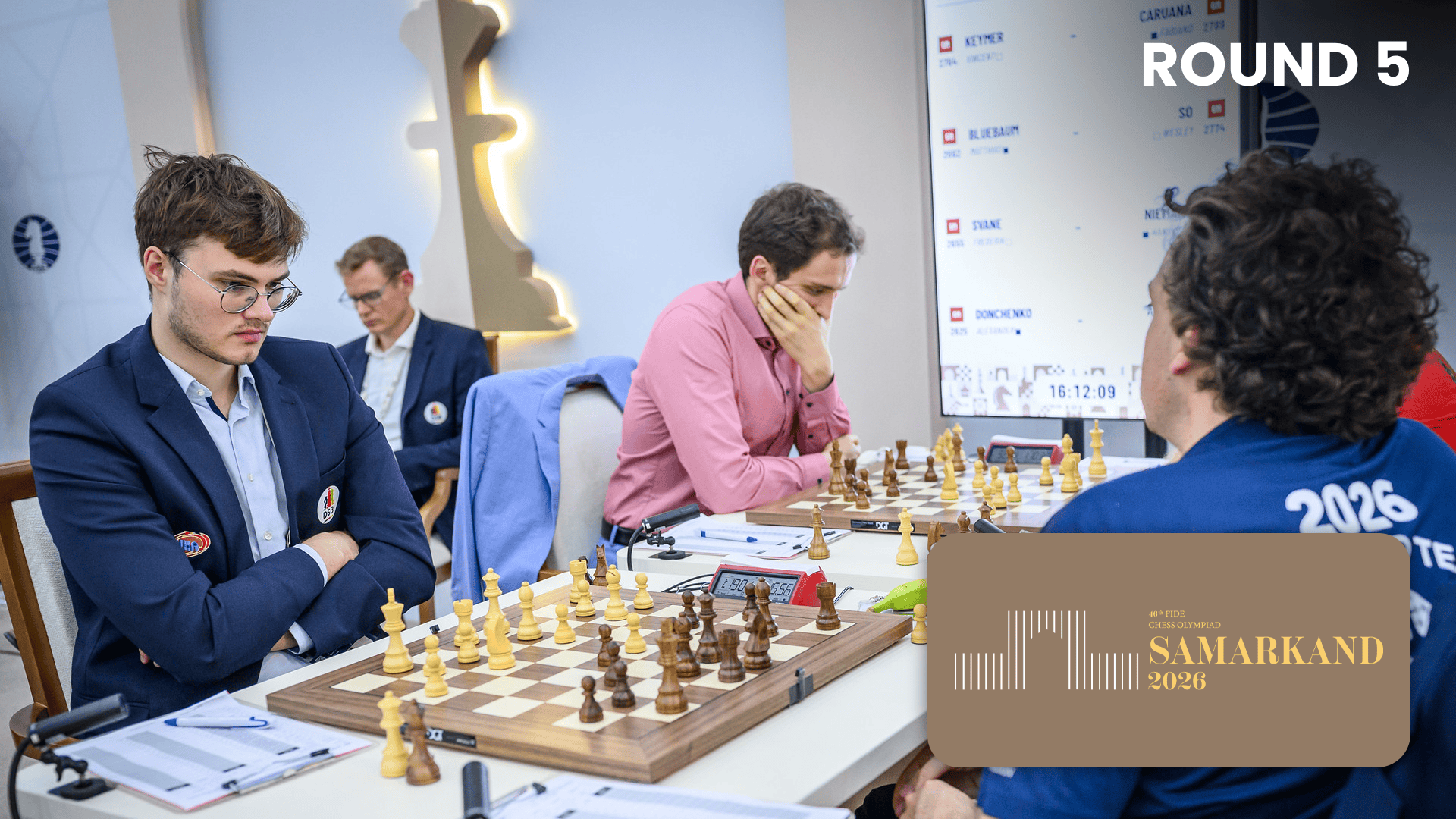
The 46th FIDE chess Olympiad underwent a dramatic transformation on September 20, 2026, as the top-seeded United States team suffered a major defeat against Germany, triggering a three-way tie for the lead in the Open section.
Key Takeaways
Major Upset: The top-seeded United States team lost to Germany 2.5-1.5, ending their perfect run.
Open Section Leaders: Uzbekistan, India, and Germany are now tied for first place with perfect 10/10 match points.
Women’s Section Shift: Defending champion India lost to Poland, marking Poland’s third consecutive Olympiad victory over the Indian side.
Rating Milestone: Uzbekistan’s GM Nodirbek Yakubboev has officially crossed the 2700 live rating threshold.
- Standings Update: Poland, China, Kazakhstan, and Azerbaijan lead the Women’s section with perfect scores.
- The Uzbekistan-India Clash: A battle for pure dominance in the Open section.
- The Women’s Leaderboard Stability: Whether Poland, China, Kazakhstan, or Azerbaijan can maintain their perfect 5/5 records.
- The U.S. Recovery: Whether the American teams can stabilize their performance after the Round 5 shock.
- www.chess.com
What Happened in Samarkand
On September 20, 2026, the 46th FIDE Chess Olympiad in Samarkand, Uzbekistan, reached a critical turning point during Round 5. The day was defined by unexpected results that reshaped the competitive landscape of both the Open and Women’s sections. The most significant development occurred in the Open section, where the United States, entering the round as the tournament favorite, failed to secure a win against Germany.
According to reports from Chess.com, Germany’s victory was secured by GM Frederik Svane, who delivered a decisive win against GM Hans Niemann. This result was enough to hand Germany a 2.5-1.5 match victory over the Americans. While GM Wesley So attempted to stabilize the U.S. position with a draw against Germany’s GM Matthias Bluebaum, the damage was already done. The loss meant the U.S. could no longer claim sole possession of the top spot.
Simultaneously, the host nation, Uzbekistan, maintained its flawless record by crushing Hungary with a 4-0 scoreline. India also remained undefeated, securing a 3-1 victory over the Netherlands. As a result of these outcomes, Uzbekistan, India, and Germany all moved into a three-way tie for the lead with perfect match scores of 10 points each.
In the Women’s section, the momentum shifted toward Poland. In a result that has become a recurring theme in recent years, Poland defeated the defending champion, India. This loss left the Indian women’s team trailing a group of four teams—Poland, China, Kazakhstan, and Azerbaijan—that all held perfect 5/5 match scores following the completion of the round.
The Open Section: A Shift in Global Power
The Fall of the United States
The defeat of the United States by Germany represents one of the most significant upsets of the tournament thus far. Entering Round 5, the U.S. team was widely expected to dominate the field, given their high seeding and roster of elite grandmasters. However, the German team demonstrated exceptional tactical precision.
GM Frederik Svane’s performance was the centerpiece of the match. In a game that many analysts, including those at Chess.com, labeled the “Game of the Day,” Svane utilized a powerful knight maneuver, 27.Nc5!!, to dismantle the position of GM Hans Niemann. Svane later remarked that the win was particularly satisfying because he had previously played a similar opening against GM Michael Adams, noting, “I had really good memories!”
German team captain Jan Gustafsson expressed significant relief following the match. He noted that the tension was high throughout the encounter, admitting that he had been “pretending to read my book” to mask his nerves before the decisive moment. The victory has placed Germany in a position to challenge for the gold medal, a feat that seemed unlikely before this round.
Uzbekistan’s Flawless Momentum
The host nation is currently playing with the confidence of a team that knows it is at home. Uzbekistan’s 4-0 victory over Hungary was characterized by both dominance and slight logistical friction. GMs Richard Rapport and Peter Leko reportedly arrived five minutes late for their scheduled games, but this did not disrupt the Uzbekistani momentum.
The match was decided by aggressive play and tactical errors from the Hungarian side. A pawn drop by Rapport (17.g4?) proved costly, and an aggressive opening attempt by GM Benjamin Gledura failed to yield results. Amidst this success, the tournament witnessed a personal milestone for GM Nodirbek Yakubboev, whose live rating has officially ascended past the 2700 mark, cementing his status among the world’s elite.
India’s Resilience Under Pressure
India’s path to the top of the leaderboard has been anything but smooth. Their 3-1 victory over the Netherlands was described by observers as a “rollercoaster.” The highlight of the match was GM Praggnanandhaa Rameshbabu’s victory over GM Anish Giri.
Praggnanandhaa had to navigate intense time trouble to secure the win. He noted that he had to make a difficult decision during the game, weighing a draw offer against the potential for a win. “I felt Gukesh was pushing, but it was not really clear to me,” Praggnanandhaa said regarding the tension. Ultimately, his decision to keep the game going proved successful. This win, combined with a victory by World Champion Gukesh Dommaraju following an error by GM Erwin l’Ami, kept India’s perfect record intact.
The Women’s Section: Poland’s Growing Dominance
The Indian Struggle Against Poland
The Women’s section has seen a repeating pattern that has become a major talking point among commentators. Poland’s victory over India is the third consecutive Olympiad where the Polish team has defeated the defending champions. This result was particularly difficult for the Indian side, as IM Aleksandra Maltsevskaya secured the decisive win against GM Vaishali Rameshbabu.
GM David Howell, a prominent commentator, suggested that Poland has effectively become “India’s kryptonite” in this format. For the Indian women, who have been a powerhouse in recent years, this loss is a significant setback in their quest to maintain their championship status.
The Leaders and the U.S. Rescue
While India struggled, other teams maintained their perfect trajectories. Poland now shares the top of the standings with China, Kazakhstan, and Azerbaijan. Kazakhstan, in particular, showed strength with a 2.5-1.5 win, bolstered by the performance of IM Meruert Kamalidenova. Alua Nurman of Kazakhstan expressed the team’s singular focus, stating, “Gold, of course!”
The United States women’s team narrowly avoided a second loss of the day, managing a 2-2 draw against the host nation, Uzbekistan. The match was a high-stakes affair where the U.S. faced early deficits on both the top and bottom boards. IM Alice Lee provided the necessary rescue with a victory over IM Gulrukhbegim Tokhirjonova. Lee expressed her enthusiasm for the event, noting the unique experience of playing alongside the top American women.
Statistical Overview of the Standings
Open Section Standings (Top 10 after Round 5)
| Rank | Team | Match Points | Record (W-D-L) |
|---|---|---|---|
| 1 | Uzbekistan | 10 | 5-0-0 |
| 2 | India | 10 | 5-0-0 |
| 3 | Germany | 10 | 5-0-0 |
| 4 | China | 9 | 4-1-0 |
| 5 | France | 9 | 4-1-0 |
| 6 | Iran | 9 | 4-1-0 |
| 7 | Armenia | 9 | 4-0-1 |
| 8 | England | 9 | 4-0-1 |
| 9 | Romania | 8 | 3-2-0 |
| 10 | Spain | 8 | 4-0-1 |
Women’s Section Standings (Top 5 after Round 5)
| Rank | Team | Match Points | Record (W-D-L) |
|---|---|---|---|
| 1 | Poland | 10 | 5-0-0 |
| 2 | China | 10 | 5-0-0 |
| 3 | Kazakhstan | 10 | 5-0-0 |
| 4 | Azerbaijan | 10 | 5-0-0 |
| 5 | USA | 9 | 4-1-0 |
Why These Results Matter
The shifts observed in Round 5 have profound implications for the remainder of the FIDE Chess Olympiad. For the first time in the tournament, the clear hierarchy of the Open section has been disrupted. The United States, once considered the heavy favorite, must now fight to recover points in a field where three other teams are playing flawless chess.
For the host nation, Uzbekistan, the momentum is a psychological asset. Playing in Samarkand, the team is not only competing for gold but also for national prestige. The rise of players like Yakubboev into the 2700+ rating bracket signals a generational shift in chess power toward Central Asia.
In the Women’s section, the rivalry between India and Poland has become a central narrative. As India seeks to reclaim its dominance, the tactical consistency of the Polish team presents a significant hurdle. The fact that four teams are currently tied at the top suggests that the Women’s gold medal will likely be decided by the final rounds through tiebreaks or narrow margins in the upcoming matches.
What It Means for Readers
For Competitive Chess Players
If you are an active competitive player, the Round 5 results serve as a masterclass in managing pressure and time trouble. The games played by Praggnanandhaa and Svane highlight the importance of tactical alertness even when the clock is low. Furthermore, the rise of the 2700-rated players in the Uzbekistani squad demonstrates the increasing depth of talent in non-traditional chess regions.
For Casual Sports Fans
For those following the FIDE Chess Olympiad as a general sporting event, the tournament has just entered its most exciting phase. The “leaderboard clog”—where multiple teams hold perfect scores—means that every single game in the upcoming rounds will have massive consequences. The unpredictability of the current standings makes for a highly engaging spectator experience.
Counterpoints and Open Questions
While the current standings suggest a dominant run by several nations, several questions remain unanswered. Is the United States’ loss to Germany a temporary setback or a sign of vulnerability in their roster’s depth? While the U.S. has elite talent, the consistency required for an Olympiad run is notoriously difficult to maintain.
Additionally, the dominance of Poland over India in the Women’s section raises questions about preparation and matchup styles. Is there a specific tactical approach the Polish team uses that neutralizes the Indian style, or is this simply a statistical anomaly in a high-variance tournament?
Finally, with the tournament scheduled to conclude on September 27, 2026, the question of fatigue remains. As players face high-intensity games with a 90-minute time control plus increments, the ability to maintain accuracy into the final week will be the ultimate decider.
What Happens Next
All eyes will turn to Round 6, which is scheduled to begin on September 21, 2026, at 6:15 a.m. ET / 3:45 p.m. IST. This round will feature one of the most anticipated clashes in the Open section: a direct confrontation between the leaders, Uzbekistan and India.
The outcome of this match will likely determine which team maintains its perfect score and moves closer to a guaranteed medal. For the United States and Germany, the goal will be to capitalize on their respective positions to prevent the leaders from pulling away.
As the tournament moves toward its conclusion on September 27, fans should watch for:
Frequently Asked Questions
How many points are awarded for a win in the FIDE Chess Olympiad?
In the FIDE Chess Olympiad, match scoring is based on a system where a win earns 2 points and a draw earns 1 point. This scoring system is applied to individual games within the match to determine the overall match winner. In Round 5, for example, Uzbekistan’s 4-0 win over Hungary was a decisive victory that maximized their match points.
Who is currently leading the Open section?
After the completion of Round 5 on September 20, 2026, there is a three-way tie for the lead in the Open section. Uzbekistan, India, and Germany all hold perfect scores of 10 match points. This tie was caused by Germany’s upset victory over the top-seeded United States.
Why is the Poland vs. India match significant in the Women’s section?
This match is significant because Poland has defeated the defending champion, India, in three consecutive Olympiads. This has led commentators to describe Poland as a major obstacle, or “kryptonite,” for the Indian women’s team. Poland currently sits at the top of the standings alongside China, Kazakhstan, and Azerbaijan.
What is the time control used in these games?
The games in the 46th FIDE Chess Olympiad utilize a time control of 90 minutes per player for the entire game, with an additional 30 minutes added after move 40. To prevent time pressure from becoming unmanageable, there is a 30-second increment per move. This format tests both the deep calculation and the speed of the grandmasters.
As the tournament progresses toward its final day on September 27, the pressure on the leaders will only intensify. The Samarkand stage has already proven to be a place of high drama and significant upsets, ensuring that the conclusion of the 46th Olympiad will be one of the most watched events in the chess world.
“,
“imagegenerationprompt”: “An editorial news photograph of a professional chess match in a grand hall in Samarkand. The focus is on a high-quality wooden chessboard with pieces mid-game. In the background, two grandmasters are seated, partially out of focus, intensely studying the board. The lighting is dramatic, with soft spotlights on the boards and a slightly dim, atmospheric background of the tournament hall
References
Featured image: Image via Chess.com