
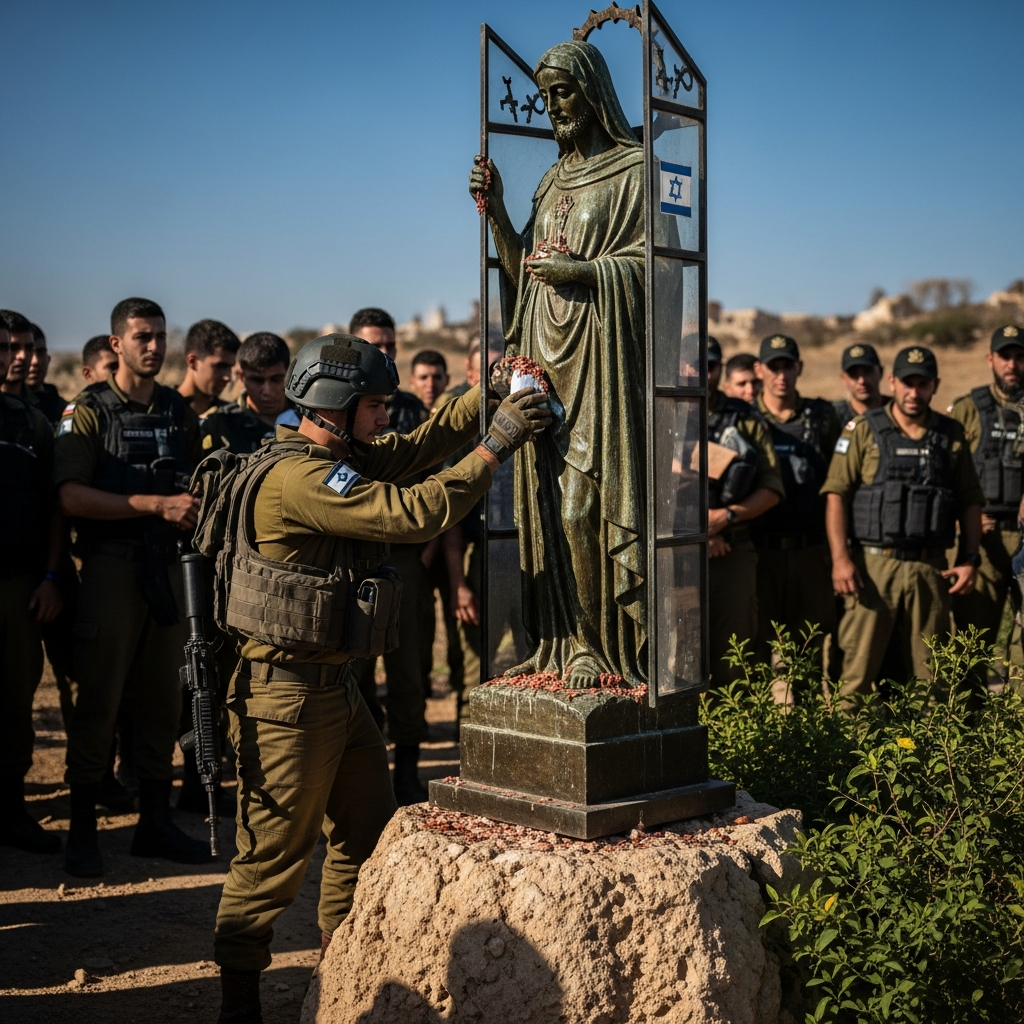
A shocking image depicting an Israeli soldier smashing a statue of Jesus Christ with a sledgehammer in southern Lebanon has ignited a firestorm of global condemnation. The viral photograph, widely circulated online, immediately triggered outrage from religious leaders, international diplomats, and political figures, casting a harsh light on the ongoing conflict and escalating interfaith tensions in the Middle East. This brazen act of religious desecration has forced swift apologies from the highest levels of the Israeli government and intensified scrutiny of the US-Israel alliance.
Viral Vandalism in Debel: The Incident Unfolds
The incident occurred in Debel, a small village in southern Lebanon, where the statue of Jesus stood on a crucifix outside a family home. Debel is one of the few communities still inhabited despite the continuous hostilities between Israel and the Shia Muslim armed group Hezbollah. The image, showing an Israeli soldier engaged in the destructive act, was quickly authenticated by the Israel Defense Forces (IDF). The IDF stated it viewed the soldier’s actions “with great severity,” emphasizing that such conduct was “wholly inconsistent with the values expected of its troops.” The military further pledged “appropriate measures” against those involved and committed to working with the local Christian community to restore the damaged sacred symbol.
Immediate Reactions and Official Apologies
The Israeli Prime Minister, Benjamin Netanyahu, expressed being “stunned and saddened” by the vandalism. Foreign Minister Gideon Saar promptly issued an apology, stating, “We apologize for this incident and to every Christian whose feelings were hurt.” This rapid response underscores the gravity of the incident and its potential for broad international repercussions. Locally, Father Fadi Flaifel, who leads Debel’s congregation, unequivocally condemned the desecration. Speaking to the BBC, he asserted, “We totally reject the desecration of the cross, our sacred symbol, and all religious symbols. It goes against the declaration of human rights, and it doesn’t reflect civility.” He also claimed that similar acts had occurred in the past, suggesting a pattern rather than an isolated event.
International Outcry and Political Ramifications
The viral image quickly transcended regional boundaries, drawing sharp criticism from the international community, particularly in the United States. US Ambassador to Israel, Mike Huckabee, a Baptist minister, publicly demanded “swift, severe, & public consequences” for the soldier’s actions. Several prominent right-wing US commentators and politicians also denounced the act. Matt Gaetz, a former advisor to President Donald Trump, called the act “Horrific.” Former US congresswoman Marjorie Taylor Greene used the incident to question the US-Israel alliance, highlighting the billions in US tax dollars and weapons provided to Israel annually, ironically labeling it “‘Our greatest ally’.”
Declining US Support and Shifting Narratives
This Israeli soldier vandalism Jesus statue incident further fuels a growing skepticism towards the close US-Israel alliance within segments of the American public and political spectrum. A recent Pew Research Center survey indicated a notable decline in US support for Israel, with 60% of US adults holding an unfavorable view, up from 53% just last year. Commentators like Tucker Carlson have asserted that such incidents are “not rare,” claiming the Israeli government has permitted its soldiers to act like “barbarians” for decades, often funded by the US. He noted that social media now powerfully exposes this behavior, which was previously less visible. Independent journalist Glenn Greenwald further satirized potential defenses, suggesting absurd justifications from Christian Zionists. This public discourse highlights the complex interplay of religious values, political alliances, and financial aid in shaping international perceptions.
A Disturbing Pattern: Attacks on Christian and Religious Sites
The vandalism of the Jesus statue in Debel is not an isolated incident but part of a broader, disturbing trend of attacks on religious sites and symbols across the region. Various reports and statements point to a systemic issue. The Rossing Center, a Jerusalem-based organization fostering inter-faith relations, noted a “recent surge in overt animosity towards Christianity” in its 2025 report, attributing it to “a continued deepening of polarisation and ultra-nationalist political trends.”
Documented Incidents and Calls for Accountability
Other recent examples include:
Church of the Holy Sepulchre: Last month, Israeli police prevented Jerusalem’s top Roman Catholic leader from entering for a private Palm Sunday Mass, citing “safety concerns,” which Ambassador Huckabee called an “unfortunate overreach” that was “difficult to understand or justify.”
Deir Mimas and Yaroun: In 2024, Israeli troops reportedly filmed a mock wedding and vandalized a church in Deir Mimas, Lebanon. Last year, an Israeli tank allegedly demolished a statue of Saint George in Yaroun, Lebanon.
Gaza and West Bank: Local officials report the destruction of over 1,000 mosques and three churches in Gaza during the recent conflict, including an attack that killed at least 18 people in a Palestinian church in 2023. The Palestinian Authority’s Ministry of Religious Affairs documented 45 incidents of mosque vandalism or attack by settlers in the occupied West Bank in the past year alone.
Violence Against Christians: The Religious Freedom Data Center (RFDC) recorded at least 201 incidents of violence against Christians between January 2024 and September 2025, primarily committed by Orthodox Jews in Jerusalem’s Old City. These included spitting, verbal abuse, vandalism, and physical assaults targeting clergy or those displaying Christian symbols.
Palestinian Knesset members Ayman Odeh and Ahmad Tibi have openly criticized the perceived lack of accountability for such acts. Tibi specifically argued that individuals who face no punishment for blowing up mosques and churches would not hesitate to destroy a statue of Jesus. Palestinian pastor Munther Isaac urged that the “real outrage” should extend beyond the statue to the broader targeting of civilians and assault on human dignity. The Council on American-Islamic Relations (CAIR) called for US intervention, warning that continued US support for Israel makes it complicit in “persistent Israeli attacks on churches and Christians.”
Regional Conflict and Israel’s Counter-Narrative
The religious desecration in Debel occurred against a backdrop of ongoing conflict. A US-brokered ceasefire had recently paused six weeks of intense fighting between the IDF and Hezbollah, though both sides have accused each other of violations. Thousands of Israeli troops continue to occupy areas of southern Lebanon. The broader conflict escalated after Hezbollah began firing rockets at Israel in support of Iran, following what is described as a joint Israel-US war on Tehran. Lebanese authorities report over a million displaced and more than 2,290 killed since a military campaign began on March 2nd. In contrast, Israeli officials state 13 Israeli soldiers and two civilians have been killed by Hezbollah attacks in the same period.
In an English-language post, Prime Minister Netanyahu sought to counter the narrative of rising anti-Christian sentiment, asserting that “the Christian population in Israel thrives unlike elsewhere in the Middle East.” He claimed, “Israel is the only country in the region that the Christian population and standard of living is growing. Israel is the only place in the Middle East that adheres to freedom of worship for all.” This statement aims to position Israel as a protector of religious freedom amidst mounting criticism over the treatment of Christian holy sites and communities.
Frequently Asked Questions
What exactly happened in Debel, Lebanon, with the Jesus statue?
An image showing an Israeli soldier using a sledgehammer to smash a statue of Jesus Christ on a crucifix outside a family home in the village of Debel, southern Lebanon, went viral online. The Israeli military confirmed the authenticity of the image, condemned the soldier’s actions as inconsistent with their values, and promised an investigation and “appropriate measures.” The incident sparked immediate, widespread outrage from local religious leaders and international figures alike.
How has the international community reacted to the statue’s vandalism?
The international community, especially in the United States, reacted with strong condemnation. Israeli Prime Minister Benjamin Netanyahu and Foreign Minister Gideon Saar issued apologies. US Ambassador Mike Huckabee called for “swift, severe, & public consequences.” Prominent US commentators and politicians denounced the act, contributing to a broader discussion about declining US support for Israel and the accountability for actions during the Israel-Hezbollah conflict. This incident highlights existing tensions in US-Israel relations.
Is this an isolated incident, or part of a larger trend of religious site desecration in the region?
Evidence suggests this is not an isolated incident but rather part of a troubling trend. Reports from organizations like the Rossing Center and the Religious Freedom Data Center document a “surge in overt animosity towards Christianity” and numerous acts of violence and vandalism against Christian and other religious sites in recent years. These include incidents at the Church of the Holy Sepulchre, in Deir Mimas and Yaroun, and extensive destruction of mosques and churches in Gaza and the West Bank. This pattern raises significant concerns about religious desecration and interfaith tensions.
Conclusion: A Call for Respect and Accountability
The Israeli soldier vandalism Jesus statue incident in Lebanon has sent ripples of anger and concern across the globe. It serves as a stark reminder of the profound sensitivity surrounding religious symbols and the potential for individual acts to ignite international crises. While the Israeli government has moved quickly to apologize and promise action, the widespread condemnation and evidence of a broader pattern of disrespect for holy sites demand deeper introspection and systemic changes. Ensuring genuine accountability and fostering respect for all faiths remains paramount in a region frequently marked by conflict and division, underlining the critical need for dialogue and understanding to safeguard religious heritage.


One thought on “Breaking: Israeli Soldier Vandalizes Jesus Statue Sparks Fury”