The NASA dragonfly mission is officially inviting the public to participate in a journey to the outer solar system, offering a rare opportunity for citizens to have their names carried to Saturn’s moon, Titan.
Key Takeaways
- Public Participation: NASA’s “Journey to Titan” campaign allows individuals to submit their names to be carried to Titan on a mission microchip until January 15, 2027.
- Dragonfly Objectives: The eight-rotor drone will explore Titan’s surface to search for signs of prebiotic chemistry and habitability.
- lunar Expansion: NASA has formally invited the Indian space Research Organisation (ISRO) to join its permanent Moon Base program near the lunar south pole.
- Strategic Partnerships: The Israel Space Agency is launching a call for proposals to integrate Israeli scientific payloads into upcoming Artemis III, IV, and V missions.
- Global Cooperation: These initiatives reflect a broader strategic shift toward international, multi-national space infrastructure and long-term habitation.
- For Industry Leaders: The move toward a permanent lunar base and the integration of international partners like ISRO creates a massive market for space infrastructure, including power systems, habitation modules, and autonomous robotics.
- Technical Complexity: Operating an eight-rotor drone in the thick, hazy atmosphere of Titan is an unprecedented engineering challenge. The environmental conditions are extreme, and any mechanical failure during the six-year transit or the initial landing could end the mission prematurely.
- Strategic Pivots: NASA’s decision to pause the Gateway space station development to prioritize surface-based lunar infrastructure has raised concerns among some experts. There is a risk that focusing too heavily on the surface may leave gaps in orbital infrastructure needed for long-term deep-space transit.
- The Cost of Presence: With estimates suggesting a USD 20 billion plan for a permanent Moon Base, the financial sustainability of long-term lunar habitation remains an open question, especially as missions transition from robotic to crewed phases.
- Geopolitical Friction: While the Artemis Accords aim to create a unified framework, the competition for lunar resources (such as water ice) could lead to diplomatic tensions if international standards for “resource utilization” are not clearly defined and universally accepted.
- January 15, 2027: The deadline for the public to submit names for the Dragonfly microchip.
- 2028: The scheduled launch of the Dragonfly rotorcraft and the deployment of NASA’s small, hopping robots to scout the lunar south pole.
- 2029–2032: The critical Phase 2 period for the NASA-ISRO lunar collaboration, aiming for initial operating capability of the Moon Base.
- 2034: The arrival of Dragonfly at Titan, marking the beginning of its three-year surface exploration mission.
- www.nasa.gov
- www.space.com
- www.rediff.com
- www.space.gov.il
- www.newser.com
What Happened: A Voyage to Titan and Beyond
NASA has announced the launch of the “Journey to Titan” campaign, a public engagement initiative tied to the upcoming Dragonfly mission. According to a NASA news release issued on October 29, 2026, members of the public can submit their names to be etched onto a microchip that will fly aboard the Dragonfly rotorcraft. Those who participate will receive a digital “boarding pass” containing their name, launch details, and an image of the spacecraft, per reports from WION and Popular Science.
The deadline for name submissions is set for 11:59 p.m. EST on January 15, 2027. Once the window closes, the names will be integrated into the mission hardware currently being assembled at the Johns Hopkins Applied Physics Laboratory (APL) in Laurel, Maryland.
While the public focuses on the microchip, the scientific community is preparing for a massive technological leap. The Dragonfly rotorcraft, the fourth mission in NASA’s New Frontiers Program, is scheduled to launch no earlier than 2028. It is expected to arrive at Titan in 2034, following a six-year transit through the solar system.

Why It Matters: The Search for Life and Habitability
Titan represents one of the most significant scientific targets in the solar system. Unlike the barren surfaces of many other moons, Titan possesses a thick atmosphere and a complex cycle of liquid methane and ethane that mimics Earth’s water cycle. Scientists believe that beneath Titan’s frigid surface—which sits at approximately -290 degrees Fahrenheit—there may exist a massive ocean of water or slush that could potentially support microbial life.
The Dragonfly mission is designed to address this possibility. As an eight-rotor drone, the spacecraft will be able to “hop” across the moon’s surface, sampling between 20 to 30 different sites over a period of roughly three years. This mobility allows the mission to cover approximately 70 miles of terrain, searching for clues regarding prebiotic chemistry—the chemical precursors that lead to biological life.
“NASA’s Dragonfly mission will simply blow your mind,” said Nicky Fox, Associate Administrator for the Science Mission Directorate at NASA Headquarters. Fox noted that by flying the first-ever rotorcraft science mission, NASA aims to explore a world that is uniquely similar to Earth in its potential for habitability.
The Expanding Frontier: NASA, ISRO, and the Lunar Base
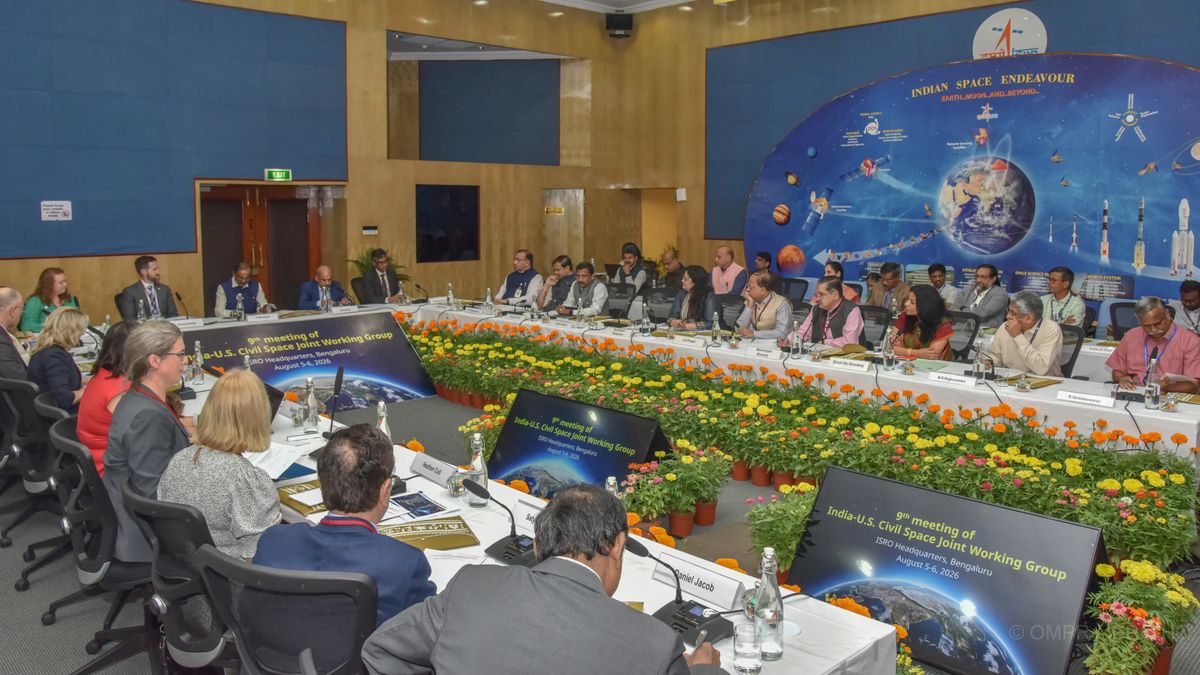
While Dragonfly heads for the outer solar system, NASA is simultaneously strengthening its grip on the lunar surface through new international alliances. Following the ninth meeting of the U.S.-India Civil Space Joint Working Group (CSJWG) held in Bengaluru, India, on August 5–6, 2026, NASA formally invited the Indian Space Research Organisation (ISRO) to join its ambitious Moon Base program.
This invitation marks a transition from purely scientific collaboration to shared infrastructure. NASA’s vision for the Moon involves a “city-like” permanent base located near the lunar south pole. This region is of critical importance because its permanently shadowed craters are believed to contain significant deposits of water ice, a resource essential for sustained human life and fuel production.
NASA’s Phased Lunar Roadmap
To mitigate the extreme risks of the lunar environment, NASA has outlined a tiered development strategy:
| Phase | Timeline | Primary Objective |
|---|---|---|
| Phase 1 | 2028 onwards | Information gathering and robotic scouting via small, hopping robots. |
| Phase 2 | 2029–2032 | Establishment of the base’s initial operating capability. |
| Phase 3 | 2032 onwards | Achievement of a semi-permanent human crew presence on the lunar surface. |
According to reports from Space.com and Rediff.com, this lunar architecture will utilize hilltop habitats to maximize sunlight exposure and station nuclear power systems at a distance from crew quarters to minimize radiation exposure.

Strengthening the Artemis Alliance: The Israeli Connection
The reach of the Artemis missions continues to expand through strategic agreements with smaller, highly specialized space nations. On May 11, 2026, the Israel Space Agency issued a call for proposals inviting Israeli academia and industry to participate in the Artemis III, IV, and V missions.
This initiative follows a strategic agreement led by Minister Gila Gamliel to integrate Israeli-developed scientific experiments into 6U and 12U CubeSats (nanosatellites). These small satellites will be deployed into various environments, including Earth orbit, lunar orbit, and even heliocentric (sun-centered) orbits.
Ran Livne, Director of the Israel Space Agency, emphasized that this is a “short turnaround call” designed to leverage Israel’s expertise in satellite miniaturization and precision instrumentation. Unlike many traditional NASA contracts, this collaboration operates on a “no-exchange-of-funds” basis, focusing on shared scientific advancement and access to NASA’s flight infrastructure rather than direct financial transfers.
“The strategic agreement I led with NASA opens doors for Israeli researchers and Israeli industry to the world’s most critical space missions,” Gamliel stated, describing the opportunity as a way to cement Israel’s status as a civil space powerhouse.
Analysis: A Geopolitical Shift in Space Governance
The simultaneous expansion of the Dragonfly mission, the NASA-ISRO partnership, and the Artemis-Israel alliance suggests a fundamental shift in how space is explored and governed. We are moving away from an era of isolated national missions toward a period of international space cooperation and shared lunar economies.
This shift is heavily influenced by the Artemis Accords, a diplomatic framework for responsible space exploration that now includes 70 signatory nations. By inviting India and Israel into these programs, the United States is building a coalition of spacefaring nations that adhere to a rules-based framework, which serves as a strategic counterweight to the growing lunar ambitions of competitors like China.
Furthermore, the decision to prioritize a permanent lunar base over the development of the Gateway space station indicates that NASA is pivoting its resources toward surface-centric operations. The goal is no longer just to orbit the Moon, but to occupy it.
What It Means for You
For the General Public: You have a direct, albeit symbolic, way to participate in deep-space exploration. By submitting your name to the Dragonfly mission, you become a literal part of the hardware that will explore Titan.
For Scientists and Researchers: The era of “small-sat” science is accelerating. Whether through the Israeli CubeSat program or the upcoming robotic scouting of the lunar south pole, there are increasing avenues to deploy precision instruments into extreme environments.

Counterpoints and Open Questions
Despite the optimism, these ambitious plans face significant hurdles and criticisms:
What Happens Next
Several key milestones will serve as indicators of the success and trajectory of these programs:
Frequently Asked Questions
How can I participate in the Dragonfly mission?
To add your name to the microchip traveling to Titan, you must visit the official NASA submission portal at https://go.nasa.gov/dragonfly-names. The deadline for submission is January 15, 2027, at 11:59 p.m. EST. Participants will receive a digital boarding pass as a commemorative item.
What is the primary goal of the NASA-ISRO partnership?
The partnership, facilitated through the Civil Space Joint Working Group (CSJWG), aims to collaborate on the establishment of a permanent human outpost near the Moon’s south pole. This includes sharing scientific data under the Artemis Accords and working toward long-term lunar habitation and resource utilization.
How can Israeli companies join the Artemis missions?
The Israel Space Agency has issued a call for proposals for scientific payloads to be integrated into 6U and 12U CubeSats. These payloads will be part of the Artemis III, IV, and V missions. The program is a “no-exchange-of-funds” initiative, focusing on scientific cooperation and access to NASA’s flight infrastructure.
Why is Titan a target for NASA’s Dragonfly mission?
Titan is a high-priority target because it is one of the few worlds in our solar system with a thick atmosphere and liquid on its surface. The mission seeks to investigate prebiotic chemistry and determine if the moon’s environment, including its potential subsurface ocean, could support microbial life.
NASA’s current trajectory suggests a future where space is not just a place for brief visits, but a domain for permanent human presence and international scientific industry. From the microchips of the Dragonfly mission to the lunar bases of the 2030s, the boundaries of human reach are expanding through unprecedented global cooperation.
References
Featured image: (Image credit: ISRO) — via Space