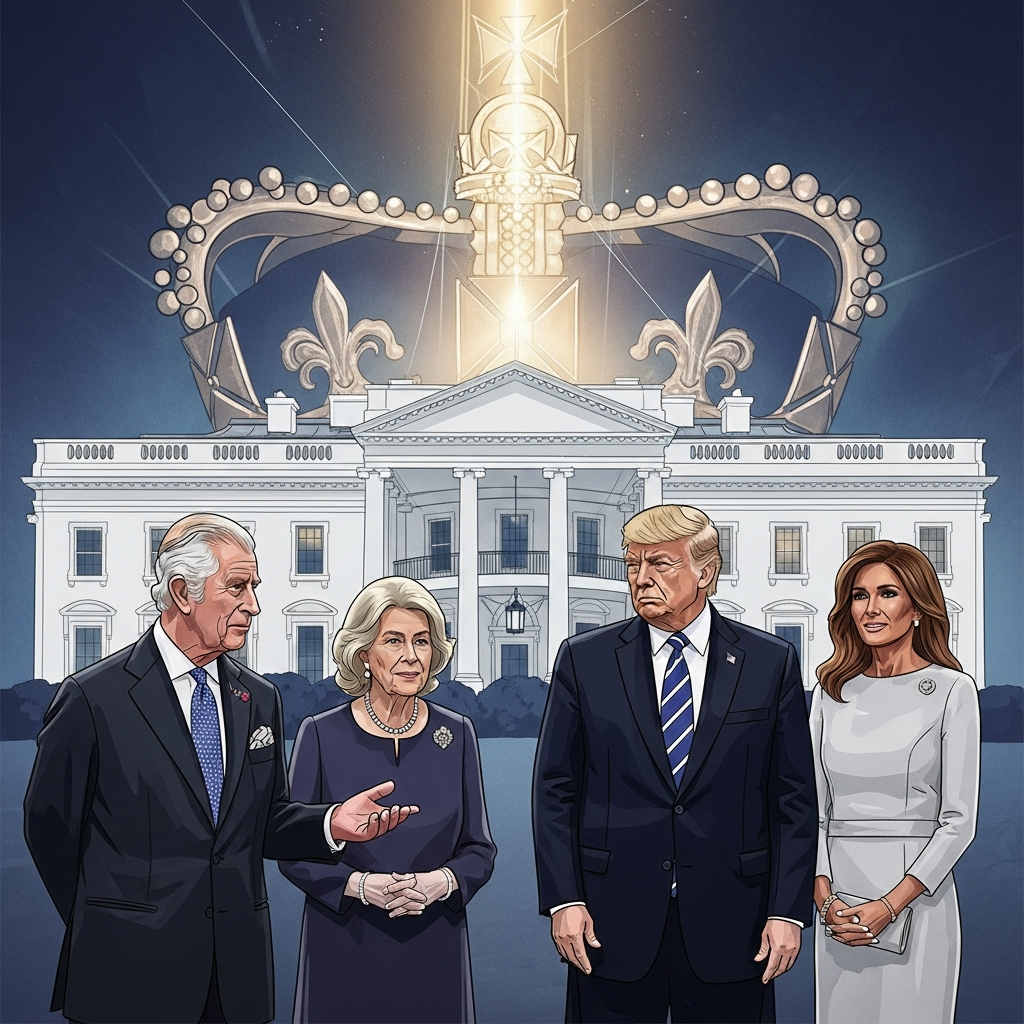
In a significant diplomatic event, His Majesty King Charles III and Her Majesty Queen Camilla embarked on a state visit to the United States in April 2026. This landmark occasion, hosted by President Donald J. Trump and First Lady Melania Trump at the White House, marked the first visit by a British monarch in nearly two decades. Occurring as America prepared to celebrate its 250th anniversary of independence, the visit underscored the enduring cultural, historical, and strategic alliance between the United States and the United Kingdom, navigating a complex backdrop of both shared heritage and contemporary diplomatic challenges.
A Grand Welcome and Bilateral Dialogues
The four-day state visit commenced with a grand arrival ceremony on the White House South Lawn. Dignitaries, military personnel, and media gathered as King Charles and Queen Camilla were greeted with a full military salute and a flyover, signaling the importance of the Anglo-American bond. President Trump, reflecting on the “special relationship” between the two nations, praised King Charles as “a fantastic person” and “a very elegant man.” This initial warmth set a tone of personal rapport, even amid underlying governmental tensions.
Following the ceremonial welcome, President Trump and King Charles III engaged in substantive bilateral discussions in the Oval Office. President Trump later characterized these conversations as “really good,” hinting at productive dialogue on shared global interests and concerns. The discussions served as a critical platform to address areas of mutual cooperation, reaffirming the strategic partnership that defines the US-UK alliance.
President Trump’s Homage to Shared Heritage
During his remarks at the arrival ceremony, President Trump offered a provocative historical perspective, emphasizing the deep roots of American identity in British heritage. He acknowledged the seeming paradox of honoring a British monarch while approaching America’s 250th anniversary of independence. However, he argued that this tribute was “more appropriate” than it appeared. Trump posited that America’s core “culture, a character, and a creed,” along with its “moral courage,” originated from Great Britain, predating its nationhood and Constitution.
He further elaborated that American Patriots of 1776 were “heirs to this majestic inheritance,” possessing “Anglo-Saxon courage” and an “English faith.” Trump challenged the idea of America as merely “an idea,” asserting that the pursuit of freedom was a culmination of centuries of “thought, struggle, sweat, blood, and sacrifice on both sides of the Atlantic.” He drew a direct historical line from England’s Runnymede to Philadelphia, suggesting that American liberties were rooted in the British principle of justice. His speeches often highlighted the post-independence friendship, unified by shared language, values, and a common defense of civilization.
King Charles III’s Historic Address to Congress
A pivotal moment of the state visit was King Charles III’s address to a joint meeting of the U.S. Congress at the U.S. Capitol. This marked only the second time a British monarch had addressed Congress, the first being Queen Elizabeth II in 1991. The King’s nearly 30-minute speech received a standing ovation from a packed House chamber, underscoring the weight of his words and the significance of his presence.
King Charles used this platform to emphasize the global influence of the United States, stating, “America’s words carry weight and meaning… The actions of this great nation matter even more.” While conveying a message of reconciliation and partnership, his address also contained subtle diplomatic undertones, gently touching on issues that had been points of contention with the Trump administration. He underscored shared values like “executive power subject to checks and balances,” and highlighted NATO’s historical role in defending the U.S. after 9/11, a point seen as a subtle counter to President Trump’s frequent criticisms of the alliance. The King also invoked Abraham Lincoln’s Gettysburg Address, calling for both nations to “rededicate ourselves to each other in the selfless service of our peoples and of all the peoples of the world” on America’s upcoming 250th birthday.
State Dinner: Toasts, Gifts, and Diplomatic Jabs
The state dinner at the White House East Room was a glitzy affair, themed around cherry blossoms, attracting a high-profile guest list. Attendees included Supreme Court justices, tech leaders like Amazon founder Jeff Bezos and Apple CEO Tim Cook, as well as key administration officials like Vice President JD Vance and Secretary of State Marco Rubio, alongside the President’s family.
Toasts to an “Unbreakable Friendship”
At the dinner, President Trump toasted the “unbreakable friendship,” reiterating that it was natural to honor the UK, which Thomas Jefferson famously called America’s “mother country,” as the US approached its 250th anniversary. He asserted that America’s founders viewed themselves as “free men, carrying forward the ancestral liberties and ancient rights of the Anglo-Saxons,” and that the War for Independence was fought “not to reject this heritage, but to reclaim it and perfect it.” Trump thanked the United Kingdom for the “richest inheritance that any nation has ever given to another,” calling for the two countries to stand together forever.
King Charles, in his remarks, emphasized the 250-year relationship since America’s “audacious and visionary act of self-determination.” He declared his presence was “to renew an indispensable alliance,” stressing that “Our people have fought and fallen together in defense of the values we cherish.”
A Unique Gift and Humorous Exchanges
A memorable highlight of the dinner was King Charles III’s personal gift to President Trump: the original bell from the conning tower of HMS Trump, a British submarine launched in 1944. The King noted that this AUKUS predecessor played a critical role in the Pacific War, presenting the bell as a “testimony to our nation’s shared history and shining future.” This thoughtful and personalized gift underscored the deep military and historical ties.
Amid the formal proceedings, both leaders injected humor. King Charles playfully referenced Britain’s “small attempt at real estate development in the White House in 1814” (a nod to the War of 1812) and humorously retorted to President Trump’s comments on European defense spending. He quipped, “Dare I say that, if it wasn’t for us, you’d be speaking French,” referencing Anglo-French colonial skirmishes. He also joked about the Artemis II mission and, as King of Canada, declared himself and Trump “joint hosts” of the upcoming North American World Cup.
However, a moment of diplomatic tension arose when President Trump appeared to breach protocol. He publicly revealed details of a private conversation with King Charles, stating, “Charles agrees with me even more than I do — we’re never going to let that opponent have a nuclear weapon,” seemingly referring to Iran. This statement was sensitive given Britain’s government had distanced itself from direct military involvement in an Iran conflict, potentially compromising the King’s political neutrality.
Navigating a Strained “Special Relationship”
The state visit unfolded against a backdrop of significant diplomatic strain between the U.S. and U.K. governments. President Trump had publicly criticized then-British Prime Minister Keir Starmer and other NATO allies regarding defense spending and military actions against Iran. Concerns were also raised about a potential reassessment of U.S. support for U.K. sovereignty over the Falkland Islands. Despite these governmental frictions, President Trump consistently maintained a positive personal view of King Charles, considering him “fantastic” and “brave.”
For King Charles, the visit was seen as a “royal charm offensive” – a strategic deployment of the monarchy’s soft power to help mend strained diplomatic ties and reinforce long-term alliances. Experts suggested that for the King, the trip was about “reinforcing long-term ties, showcasing the monarchy’s soft power and reminding the world that Britain still carries diplomatic weight.” For Trump, some viewed it as primarily “a media event,” focusing on the optics of two “gilded monarchs” meeting.
Security concerns were heightened following an attempted security breach at a Washington dinner attended by President Trump just days prior. Buckingham Palace confirmed the trip would proceed, with King Charles emphasizing resolve against violence and the enduring strength of democratic values in a statement, underscoring the importance of a strong U.S.-British alliance in the face of shared challenges. The King’s known passions for environmentalism and interfaith harmony, often contrasting with some administration policies, also suggested a potential for subtle yet meaningful messages during his engagements.
Beyond Washington: New York and Virginia Engagements
Following their engagements in Washington D.C., King Charles III and Queen Camilla continued their tour to New York City and Virginia. In New York, their itinerary included a visit to the 9/11 memorial, a symbol of shared grief and resilience. The King also engaged with a community center, while the Queen visited the New York Public Library.
Their journey concluded in Virginia, where they participated in a 250th birthday block party, further commemorating America’s impending anniversary of independence. Critically, King Charles, a renowned environmentalist, met with Indigenous leaders involved in nature conservation, reinforcing his long-standing commitment to global ecological stewardship. This engagement highlighted the King’s ability to transcend political divides through his charitable and environmental work, demonstrating the diverse facets of the monarchy’s influence.
The state visit, King Charles’s first to the U.S. as monarch, successfully blended grand pageantry with intricate diplomatic messaging. It served as a powerful reminder of the deep historical ties and ongoing strategic importance of the U.S.-U.K. alliance, even as it navigated contemporary political complexities.
Frequently Asked Questions
What were the key highlights of King Charles III’s state visit to the US in 2026?
The state visit of King Charles III and Queen Camilla to the U.S. in April 2026 featured several major highlights. These included a grand arrival ceremony at the White House, substantive bilateral discussions with President Trump, and a high-profile state dinner. A pivotal moment was King Charles’s historic address to a joint meeting of the U.S. Congress, a rare honor for a British monarch. The King also presented President Trump with a unique gift: the original bell from the HMS Trump submarine, symbolizing shared history. Beyond Washington, the royals visited New York City (including the 9/11 memorial) and Virginia, where King Charles met Indigenous leaders to discuss conservation.
What was the significance of King Charles III’s address to a joint meeting of the US Congress?
King Charles III’s address to a joint meeting of Congress was highly significant as it was only the second time a British monarch had been granted this honor (the first being Queen Elizabeth II in 1991). His speech underscored the global importance of the U.S., emphasizing that “America’s words carry weight and meaning… The actions of this great nation matter even more.” Beyond reaffirming the enduring US-UK alliance, the King subtly conveyed messages about shared democratic values like checks and balances and highlighted NATO’s historical cooperation, skillfully navigating sensitive diplomatic territory while upholding his role as a non-political head of state.
How did the state visit navigate underlying diplomatic tensions between the US and UK?
The state visit occurred amidst notable governmental strains, particularly concerning President Trump’s criticisms of British foreign policy and NATO allies. However, the visit effectively leveraged the monarchy’s “soft power” and the personal rapport between King Charles and President Trump to help mend ties. While Trump maintained a positive personal view of the King, King Charles subtly used his speeches, particularly to Congress, to emphasize shared democratic principles and alliances, even as Trump made a diplomatic gaffe by publicly revealing details of a private conversation. The visit ultimately reinforced the cultural and historical bonds, demonstrating the resilience of the “special relationship” despite political differences.