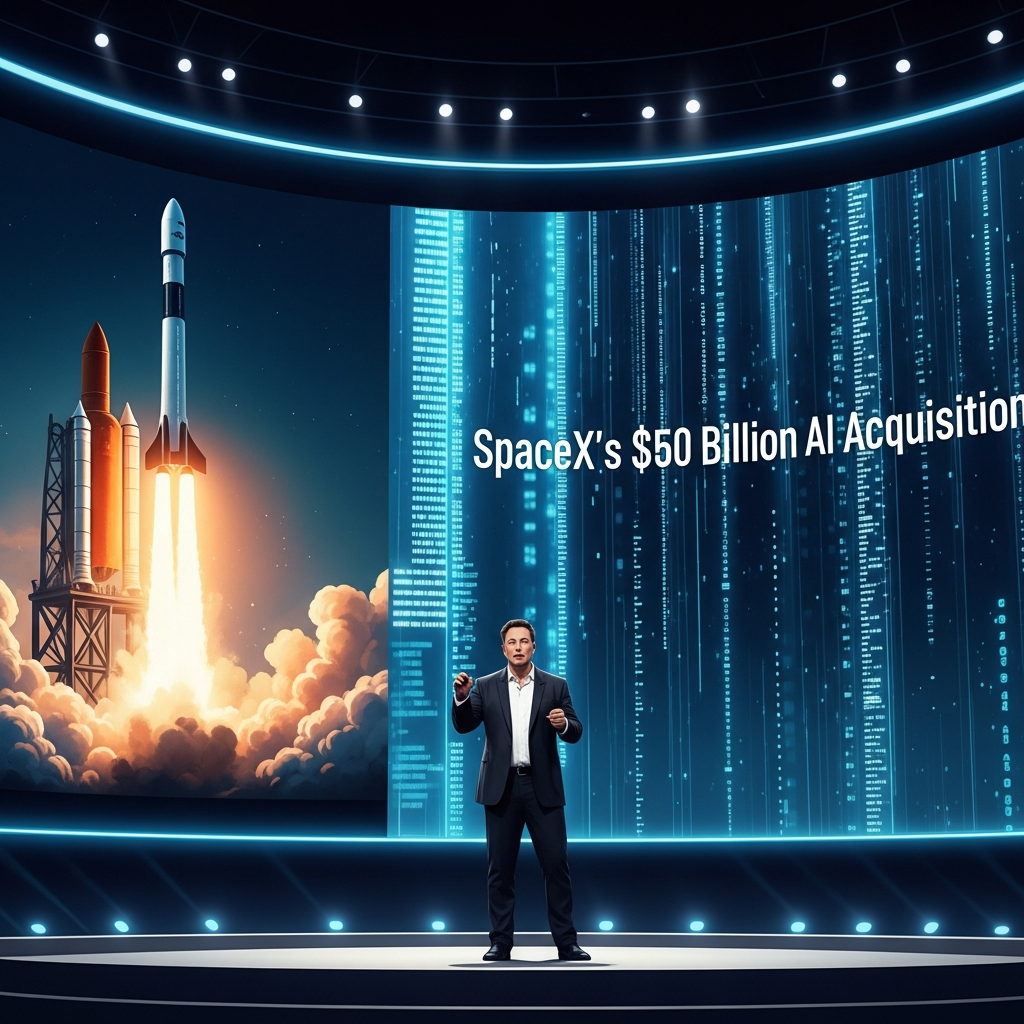
Elon Musk’s SpaceX is making a monumental move into the artificial intelligence arena, securing a groundbreaking option to acquire AI coding startup Cursor for a staggering $60 billion. This strategic maneuver, announced by SpaceX on April 22nd via X, positions the aerospace giant at the forefront of AI development. It signals a deep commitment to leveraging cutting-edge AI for both its internal operations and the broader tech landscape. The deal is more than a simple acquisition; it’s a carefully orchestrated partnership aiming to fuse Cursor’s innovative AI capabilities with SpaceX’s formidable computing power. This collaboration is set to redefine how software is built and knowledge work is approached, with profound implications for the future of technology.
The Groundbreaking $60 Billion Option: What It Means for AI
SpaceX’s deal with Cursor, the San Francisco-based AI coding assistant developed by Anysphere, is designed with remarkable foresight. Rather than an immediate buyout, SpaceX has secured an exclusive option to fully acquire Cursor for $60 billion later this year. This structure provides flexibility, allowing both companies to collaborate intensely before finalizing such a massive transaction. This isn’t just a potential acquisition; it’s a strategic alliance.
A Strategic Partnership with a Massive Buyout Clause
Under the terms of the agreement, if the full acquisition doesn’t materialize, SpaceX is committed to paying Cursor an alternative sum of $10 billion. This payment acts as a substantial breakup fee, reflecting the significant value placed on the ongoing development work. This initial collaboration is already underway. It focuses on developing “next-generation coding and knowledge work AI.” The announcement specifically highlights the synergy between Cursor’s product distribution to expert software engineers and SpaceX’s powerful computing infrastructure. This dual-path approach underscores the high stakes involved.
Combining Minds and Machines: SpaceX Colossus Meets Cursor AI
The heart of this partnership lies in the fusion of Cursor’s AI expertise with SpaceX’s unparalleled computational resources. SpaceX will leverage its “Colossus” supercomputer, which it claims possesses the equivalent power of one million Nvidia H100 chips. This immense processing capability, combined with Cursor’s innovative AI models, aims to achieve a singular objective. Their joint effort under SpaceXAI and Cursor intends to create “the world’s most useful models” and “the world’s best coding and knowledge work AI.” This collaboration is expected to accelerate development across various complex systems at SpaceX, from rocket guidance to satellite networks.
Why Cursor is Valued So Highly: A Meteoric Rise
Cursor’s journey from a startup to a potential $60 billion acquisition target is nothing short of astonishing. Its rapid ascent underscores the intense demand and strategic importance of advanced AI coding assistants in today’s tech ecosystem. Cursor has quickly become one of the fastest-growing developer tools in technology history, capturing significant market share.
From Startup to AI Titan: Cursor’s Astonishing Growth Trajectory
Just over a year ago, in January of last year, Cursor was valued at a modest $2.5 billion. Its valuation surged to $9 billion by May and then to an impressive $29.3 billion post-money valuation after closing $2.3 billion in Series D funding in November. Most recently, reports indicated Cursor was aiming for a $50 billion valuation in an upcoming private fundraising round. This dramatic growth trajectory speaks volumes about its perceived value and disruptive potential. The company’s annualized revenue surpassed $2 billion by early 2026. Projections indicate it could exceed $6 billion by the end of the year, driven by robust product-led adoption and increasing enterprise demand.
Cursor currently boasts over 1 million daily users. It has achieved adoption across more than half of the Fortune 500 companies. This level of market penetration and user engagement firmly establishes Cursor as a leader in the AI coding assistant space. It competes directly with offerings from tech giants like Microsoft’s GitHub Copilot, Anthropic’s Claude Code, and OpenAI’s models. This strong position validates the substantial valuation SpaceX is considering.
The FTX Connection: A $50 Billion Missed Opportunity
An intriguing subplot to Cursor’s success involves the defunct cryptocurrency exchange FTX. In April 2022, FTX’s trading arm, Alameda Research, invested $200,000 in Anysphere (Cursor’s parent company) for approximately 5% equity. During FTX’s subsequent bankruptcy proceedings, this stake was unfortunately sold off for the same initial price. Based on Cursor’s current valuation projections, that very same 5% stake is now estimated to be worth over $50 billion. This makes it one of the largest missed investment opportunities stemming from the FTX collapse, highlighting the unpredictable nature of early-stage tech investments.
Elon Musk’s Grand AI Strategy: Beyond Rockets and Cars
The potential Cursor acquisition is not an isolated event. It fits seamlessly into Elon Musk’s broader, aggressive strategy to dominate the artificial intelligence landscape. This involves consolidating top AI talent and technology across his various ventures, including Tesla and xAI.
Fortifying the Ecosystem: xAI and the AI Talent Grab
This move comes after SpaceX’s earlier landmark acquisition of xAI in an all-stock deal in February. This established xAI as the world’s most valuable private company, with a valuation of approximately $1.25 trillion. Following the xAI acquisition, the company underwent significant restructuring, including targeted hiring and the recruitment of talent from Cursor. Notably, two of Cursor’s most senior engineering leaders, Andrew Milich and Jason Ginsberg, departed to join xAI last month, reporting directly to Musk. This pattern indicates a decisive and hands-on approach by Musk. He aims to leverage the resources of his entire conglomerate to achieve leadership in the artificial intelligence domain. While Musk has voiced public concerns about AI safety, he simultaneously ensures his ventures have access to cutting-edge AI capabilities. Acquiring Cursor would grant him direct control over a crucial AI infrastructure layer.
The IPO Play: Strategic Timing for a Trillion-Dollar Company
The timing and structure of the Cursor deal are also highly strategic, given SpaceX’s massive ambitions for a public offering. SpaceX is reportedly preparing for a potential Initial Public Offering (IPO), aiming for an ambitious $1.75 trillion valuation. This IPO could raise a record-setting $75 billion. Executing such a large acquisition, like the $60 billion Cursor deal, prior to an IPO would necessitate updating financial filings and disclosures. This could potentially delay the entire listing timeline, a scenario SpaceX clearly wants to avoid.
By securing an option to acquire later, SpaceX can maintain a clean IPO process. This allows it to tap into freshly raised public capital for the acquisition. Meanwhile, the option secures its strategic position in the competitive AI coding market, preventing rivals like OpenAI (which reportedly considered acquiring Cursor earlier) from making a similar move. This creative deal structure showcases leverage on both sides: SpaceX’s immense scale and strategic value to Cursor, and Cursor’s innovative technology and competitive market position.
Impact and Implications: Reshaping the AI Landscape
The potential acquisition of Cursor by SpaceX sends powerful ripple effects across the technology sector. It redefines the M&A landscape for AI startups and pre-IPO giants alike. This deal sets new precedents for strategic investments and the valuation of AI-powered developer tools.
The Future of Software Development: AI as Core Infrastructure
For SpaceX, a company that employs thousands of engineers to develop complex systems for Starship and Starlink, best-in-class development tools are mission-critical. Integrating Cursor is not just an enhancement; it’s seen as essential infrastructure. Cursor’s ability to use large language models to accelerate code writing, editing, and debugging – effectively translating natural language into functional software – can dramatically boost developer productivity. This partnership also addresses a strategic need for Cursor. The startup currently relies on using and selling access to Claude and GPT models. This “awkward arrangement” makes developing its own competitive, proprietary AI models crucial. The collaboration with SpaceX’s Colossus supercomputer provides a direct path to transcend this reliance.
A Precedent for Future Tech Acquisitions
This transaction sets a new precedent for the startup ecosystem. It demonstrates that major acquisitions don’t always adhere to traditional timelines or methods. The use of options, earnouts, and other creative deal structures can bridge the gap between private company ambitions and potential public market capital constraints. This approach allows a company like Cursor to continue its operations and grow into its valuation while offering its founders and investors significant financial certainty. If exercised, the $60 billion acquisition would stand as one of the largest AI acquisitions ever, underscoring the ascendant strategic importance of developer tools. It could become a template for other late-stage private companies looking to secure strategic assets without conventional constraints.
Frequently Asked Questions
What is the core nature of the SpaceX and Cursor deal?
The core of the deal is a strategic partnership where SpaceX has secured an exclusive option to acquire the AI coding startup Cursor (Anysphere is its parent company) for $60 billion by the end of the year. If SpaceX chooses not to exercise this option, it will instead pay Cursor $10 billion for their collaborative development work. This arrangement allows SpaceX to integrate Cursor’s AI expertise and distribution to engineers with its own “Colossus” supercomputer, aiming to develop “the world’s best coding and knowledge work AI.”
How does this acquisition option align with SpaceX’s broader business and IPO plans?
This deal is strategically timed with SpaceX’s ambitious plans for an Initial Public Offering (IPO), targeting a $1.75 trillion valuation and a $75 billion capital raise. By opting for a delayed acquisition, SpaceX avoids the complexities and potential delays that a $60 billion buyout would impose on its pre-IPO financial filings and disclosures. This strategy allows SpaceX to maintain a clean IPO process while still securing crucial AI technology and talent, potentially using freshly raised public capital for the eventual acquisition. It also prevents rivals from acquiring Cursor.
What makes Cursor such a valuable AI startup in the current market?
Cursor’s immense value stems from its rapid growth, strong market position, and innovative AI coding assistant technology. The company has seen its valuation skyrocket from $2.5 billion to nearly $50 billion in just over a year, with annualized revenue exceeding $2 billion and projections of $6 billion by year-end. With over 1 million daily users and adoption across more than half of Fortune 500 companies, Cursor has established itself as a leading player in the competitive AI developer tools market. Its technology significantly enhances developer productivity, making it a critical asset for any tech-forward enterprise like SpaceX.
Conclusion: A New Era for AI-Powered Innovation
The potential $60 billion acquisition of Cursor by SpaceX represents a pivotal moment in the evolution of artificial intelligence and software development. It highlights Elon Musk’s aggressive, multi-faceted approach to dominating the AI sector, strategically aligning innovative startups with the vast resources of his tech empire. This deal, structured with a unique option clause, allows SpaceX to navigate its ambitious IPO plans while securing a mission-critical asset. For Cursor, it signifies a meteoric rise and a pathway to developing proprietary AI models with unparalleled computational backing. As the collaboration deepens, the tech world will keenly watch how this powerful synergy reshapes the future of coding and knowledge work, ushering in a new era of AI-powered innovation.