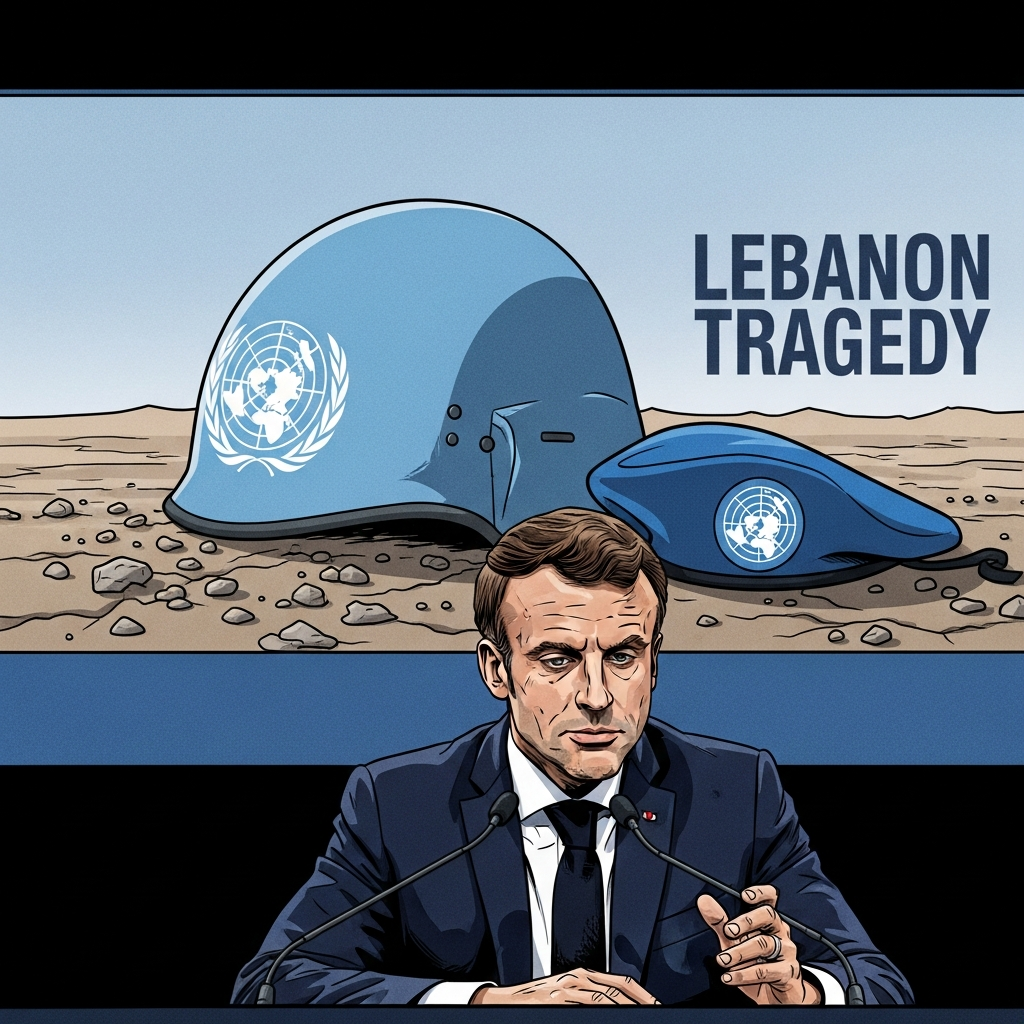
A French UN peacekeeper was tragically killed, and three comrades wounded, in a southern Lebanon ambush on April 18, 2026. This deadly incident immediately sparked outrage and strong accusations from French President Emmanuel Macron, who pointed to the Iran-backed group Hezbollah as responsible. Hezbollah, however, swiftly denied involvement, calling for a thorough investigation by Lebanese authorities. The attack unfolds amidst a fragile ceasefire between Israel and Lebanon, adding severe tension to an already volatile Middle East.
Deadly Ambush: Details of the Attack Unfold in Southern Lebanon
The fallen French UN peacekeeper was identified as Sergeant Major Florian Montorio of the 17th Parachute Engineer Regiment. He was ambushed during a critical mission in the village of Ghandouriyeh, southern Lebanon. Montorio’s patrol was working to clear explosive ordnance and re-establish access to a UNIFIL post. This post had been isolated for several days due to heavy fighting between Hezbollah and Israeli forces.
French Armed Forces Minister Catherine Vautrin confirmed the patrol came under direct small-arms fire. Sergeant Major Montorio was hit immediately and could not be resuscitated by his comrades. Three other peacekeepers were injured in the attack, with two reported to be in serious condition. UNIFIL (United Nations Interim Force in Lebanon) launched its own investigation, describing the incident as a “deliberate attack” by “non-state actors.”
UNIFIL’s Vital but Perilous Mission
UNIFIL, initially deployed in 1978, plays a crucial role in monitoring the ceasefire along the Blue Line. This de facto border separates Lebanon and Israel. Its mandate, strengthened after the 2006 war by UN Security Council Resolution 1701, tasks it with ensuring peace and assisting the Lebanese government. Despite its humanitarian efforts, peacekeepers often face grave dangers. This tragic event highlights the ongoing risks for the approximately 10,000 personnel from 49 countries serving in the mission.
Macron’s Strong Condemnation and Demands for Justice
French President Emmanuel Macron reacted to Montorio’s death with an unusually firm statement. He declared on social media that “everything suggests that responsibility for this attack lies with Hezbollah.” Macron spoke with Lebanese President Joseph Aoun and Prime Minister Nawaf Salam. He urged Lebanese authorities to immediately arrest the perpetrators and fully cooperate with UNIFIL’s investigation.
France has consistently affirmed its unwavering commitment to Lebanon’s sovereignty and regional stability. Macron emphasized that UNIFIL soldiers “must under no circumstances be targeted.” This incident marked another casualty for French forces in the region. It came less than a month after Chief Warrant Officer Arnaud Frion was killed in a drone attack in Iraq.
Hezbollah Denies Involvement Amidst Rising Accusations
Hezbollah swiftly rejected Macron’s accusations, calling them “hasty” and “baseless.” The Iran-backed group issued a statement urging caution in assigning blame. They insisted on waiting for the Lebanese army’s investigation to determine the full circumstances. Hezbollah also suggested that peacekeepers should coordinate closely with the Lebanese army in their operations.
The group expressed surprise at what it perceived as a double standard. They noted the silence of some parties when the “Israeli enemy attacks UNIFIL forces.” This denial sets the stage for a complex and potentially prolonged investigation, intensifying geopolitical tensions.
A Fragile Ceasefire and Broader Regional Conflict
The attack occurred just days after a 10-day Israel-Lebanon ceasefire took effect on April 16. This truce was brokered by the US to halt renewed fighting between Hezbollah and Israel. The wider context involves a US-Israel war on Iran, which escalated following the killing of Iranian Supreme Leader Ali Khamenei in February.
This complex backdrop casts a long shadow over the ceasefire’s effectiveness. Israel had accused Hezbollah of ceasefire violations, citing militants approaching a “Yellow Line” buffer zone. Israeli Prime Minister Benjamin Netanyahu stated his long-term goal of “dismantling Hezbollah.” US President Donald Trump announced that the US would not permit continued bombings in Lebanon. He indicated the US would “deal with the Hezbollah situation in an appropriate manner.” The attack on the French UN peacekeeper underscores the extreme fragility of any peace efforts.
Escalating Risks for International Peacekeeping
The killing of Sergeant Major Montorio is not an isolated incident. Attacks on peacekeepers in southern Lebanon have unfortunately become a disturbing pattern. In December 2022, Irish soldier Sean Rooney was killed during a UN peacekeeping mission. Furthermore, just weeks before Montorio’s death, two Indonesian peacekeepers died in a roadside explosion, and another was killed when a projectile hit a UNIFIL base.
UN Secretary-General António Guterres has repeatedly condemned such attacks. He emphasized that deliberate assaults on peacekeepers constitute “grave violations of international humanitarian law” and “may amount to war crimes.” The escalating violence raises serious concerns about the safety of UN personnel. It also challenges the viability of future peacekeeping missions in volatile regions.
Lebanon’s Response and the International Community’s Stance
Lebanese President Joseph Aoun and Prime Minister Nawaf Salam condemned the attack. They ordered an immediate investigation to bring the perpetrators to justice. Lebanon’s Military Tribunal initiated its own probe, coordinating with army intelligence. This swift internal response highlights the serious implications for Lebanon’s international standing and relations with allies like France.
The international community, including the UN, consistently urges all parties to respect the cessation of hostilities. There is a strong call to cease fire and ensure the security of UN personnel. France’s firm stance and potential for a military response, underscored by the presence of its aircraft carrier Charles de Gaulle in the eastern Mediterranean, add another layer of complexity. This incident demands accountability and a renewed commitment to international law.
The Geopolitical Chessboard: Implications for Regional Stability
This tragic event significantly complicates efforts to de-escalate regional tensions. The direct accusation against Hezbollah by a major global power like France could trigger unforeseen consequences. France’s historical engagement in Lebanon, combined with its expressed frustration, suggests a potential for more decisive action. This could range from diplomatic pressure to more direct measures.
The continued targeting of UNIFIL soldiers undermines the foundation of international peacekeeping. It also challenges the authority of the Lebanese state. The incident serves as a stark reminder of the volatile nature of the Middle East. It highlights the intricate web of alliances and conflicts that threaten to unravel fragile peace agreements. The question now looms whether this attack will be a “red line” that finally leads to significant repercussions for those responsible.
Frequently Asked Questions
What specific events led to the attack on the French UN peacekeeper in Lebanon?
The attack occurred on April 18, 2026, when French Sergeant Major Florian Montorio was part of a UNIFIL patrol. The team was clearing explosive ordnance to reconnect an isolated UNIFIL post near Ghandouriyeh in southern Lebanon. This post had been cut off due to recent fighting between Hezbollah and Israeli forces. The patrol came under direct small-arms fire in an ambush by non-state actors, resulting in Montorio’s death and injuries to three other peacekeepers.
Where is UNIFIL primarily deployed and what is its core mission in southern Lebanon?
UNIFIL (United Nations Interim Force in Lebanon) is primarily deployed in southern Lebanon, particularly along the Blue Line, which acts as the de facto border with Israel. Its core mission, established in 1978 and expanded under UN Security Council Resolution 1701 in 2006, is to confirm Israeli withdrawal, restore international peace and security, and assist the Lebanese government in regaining its authority in the south. UNIFIL monitors the cessation of hostilities, prevents violations, and supports the Lebanese Armed Forces.
What are the broader implications of this attack for regional stability and international peacekeeping efforts?
This attack carries significant implications for regional stability and peacekeeping. It directly threatens a fragile 10-day ceasefire between Israel and Lebanon, potentially escalating the broader US-Israel-Iran conflict. The incident undermines UNIFIL’s critical mission and highlights the extreme dangers faced by peacekeepers, prompting calls for greater accountability and respect for international humanitarian law. France’s firm accusation against Hezbollah and potential for a strong response could further complicate the already volatile geopolitical landscape in the Middle East.
Conclusion
The tragic death of French Sergeant Major Florian Montorio in southern Lebanon serves as a somber reminder of the enduring volatility in the Middle East. The direct accusation by France against Hezbollah, met with the group’s swift denial, creates a complex and dangerous diplomatic challenge. As investigations proceed, the international community watches closely. The integrity of the fragile ceasefire and the very future of international peacekeeping efforts in the region hang in the balance. Justice for Sergeant Major Montorio and enhanced security for all peacekeepers must be paramount to uphold peace and stability.