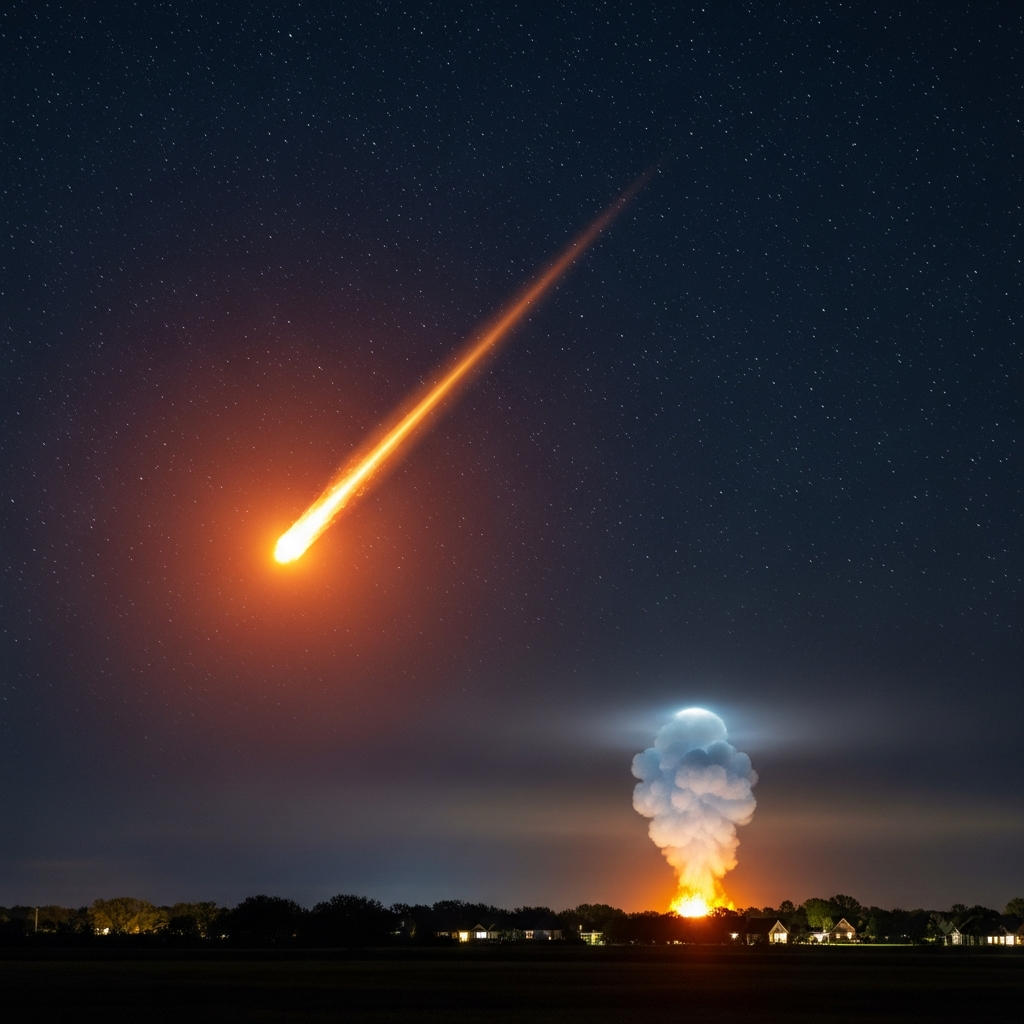
A deafening boom reverberated across Southeast Texas on a recent Saturday, startling residents and sparking widespread speculation. Was it an earthquake? A distant explosion? NASA swiftly stepped in to clarify the mystery: the sky had delivered a spectacular show, confirming that a meteor was the cause. This celestial event generated a powerful pressure wave, creating the loud “sonic boom” heard for miles. Beyond the incredible sound, this Texas meteor boom carried a fascinating possibility: fragments, known as meteorites, might have landed north of Houston, offering a rare glimpse into our solar system’s ancient history.
Unpacking the Texas Celestial Event
The incident unfolded dramatically over the Greater Houston area. NASA’s Meteoroid Environments Office confirmed that a significant meteor entered Earth’s atmosphere, captivating and perplexing those below. Traveling at an astounding speed of approximately 35,000 miles per hour, this cosmic visitor was estimated to weigh around one ton and measured roughly three feet in diameter. Its fiery journey culminated in a spectacular disintegration event.
This breakup occurred at an altitude of about 29 miles above the Bammel area, just west of Cypress Station. As the meteor fragmented, it created an intense “pressure wave.” This powerful wave propagated through the atmosphere, generating the widespread audible booms that many residents reported. NASA’s explanation ingeniously addressed initial public debate, clarifying that the answer was “both” a meteor and a sonic boom – the meteor’s atmospheric entry and subsequent breakup were precisely what caused the sonic effects.
The Hunt for Houston Meteorite Fragments
Following the meteor’s dramatic atmospheric demise, scientific analysis indicated that potential meteorite fall zones lie north of Houston. Specifically, areas between Willowbrook and Northgate Crossing are considered prime locations for discovery. This assessment gained substantial support from a compelling eyewitness account and physical evidence.
North Harris County resident, Sherrie James, reported a suspected meteorite crashing through her roof shortly before 5 p.m. on that Saturday, aligning perfectly with the timing of the widespread booms. The Ponderosa Fire Department responded to her call. Captain Tyler Ellingham, who attended the scene, described the rock found within James’s home as “unusual.” Crucially, firefighters noted the absence of any nearby construction or large trees that could have been the source of a falling object. Based on this observation, the fire department concluded that the mysterious rock was highly likely a fragment of the meteor. This fascinating incident underscores the tangible impact of such rare celestial events.
Understanding Meteors, Bolides, and Cosmic Booms
To fully grasp the phenomena of the Texas meteor boom, it’s helpful to understand the terminology. A “meteoroid” refers to a small asteroid or rocky/icy debris traveling in space. When a meteoroid enters Earth’s atmosphere, the friction generates intense heat, causing it to glow brightly. This visible streak of light is what we call a “meteor” or, if exceptionally bright, a “fireball.” Should any fragments survive this fiery descent and strike the ground, they are then called “meteorites.”
The distinctive loud booms heard are known as sonic booms. These occur when an object, like a meteor, travels through the air faster than the speed of sound. As it compresses the air in front of it, it creates a continuous shockwave that trails behind it. When this shockwave reaches the ground, it manifests as a powerful, often thunderous, sound. The energy unleashed during a meteor’s fragmentation can be immense. For instance, a similar recent event in Northeast Ohio saw a meteor release energy equivalent to 250 tons of TNT upon breaking apart, generating not just a single boom, but a series of explosive noises.
A Broader Context: Ohio’s Recent Bolide Event
The Houston meteor event is not an isolated incident. Just days prior, a similar, equally dramatic celestial occurrence captivated residents across Northeast Ohio. On a recent Tuesday morning, a loud boom prompted widespread reports, which NASA also confirmed as a meteor. Experts characterized this particular object as a bolide—a less common type of meteor that explodes in the atmosphere.
The Ohio meteor was larger, estimated at approximately six feet in diameter and weighing around seven tons (or 17,000 pounds). It traveled even faster, at an astonishing 40,000 to 45,000 miles per hour. This massive object became visible at 50 miles altitude over Lake Erie before fragmenting 30 miles above Valley City, near Medina. The extreme rarity of witnessing such a bright fireball during daylight hours, coupled with its widespread sonic booms, led experts to describe it as a potentially once-in-a-lifetime event. Ryan Connor, an astronomy enthusiast operating an American Meteor Society (AMS) station in Ohio, captured the distinctive “successive sonic booms,” noting their unique character compared to a single jet boom.
While fragments from the Ohio event are believed to have fallen in Medina County, no confirmed finds have been publicly reported yet. This comparison highlights that while rare, these cosmic impacts are a recurring, albeit infrequent, phenomenon across populated regions, underlining the dynamic nature of our solar system.
Are These Celestial Visitors Dangerous? Expert Reassurance
Understandably, the sound and spectacle of a Texas meteor can raise concerns about safety. However, experts consistently offer reassurance. Dr. Ralph Harvey, a planetary science professor, notes that while meteors hit Earth frequently—averaging a couple of times a day—it is exceptionally rare for one to traverse such a densely populated region. The chances of fragments hitting something specific are “pretty slim.”
Bill Cooke, lead for NASA’s Meteoroid Environment Office, further clarifies that meteorites, upon landing, are typically cold to the touch and can be safely picked up. This dispels popular myths of “smoking rocks in craters.” While the impact from the pressure wave can shake houses, there were no reports of direct damage or injuries in the Lorain County area during the Ohio event. This scientific consensus underscores that the primary impact is typically auditory and visual, rather than physical harm.
Responsible Meteorite Hunting: Respecting Nature
The excitement surrounding a potential meteorite fall often leads to a surge of “meteorite chasers.” If you find yourself in the designated fall zones in north Houston, or any other area, it’s crucial to approach the search responsibly. Drawing lessons from the Medina County Park District in Ohio, which issued guidelines following their meteor event, here are key considerations:
Stay on Designated Trails: Protect fragile ecosystems and prevent soil erosion by sticking to established paths.
Seek Permission: If you plan to use metal detectors or venture off-trail on private property or in parks, always obtain explicit written permission from landowners or park authorities.
Observe Park Rules: Respect all local regulations regarding disturbing or removing natural elements, including rocks, minerals, and plant life. The goal is to balance scientific curiosity with environmental preservation.
Documentation: If you believe you’ve found a meteorite, document its location with photos and GPS coordinates before moving it. This information is invaluable for scientific study.
Remember, finding a genuine meteorite is incredibly rare. Ohio, for instance, has only 14 officially confirmed meteorite finds in its history, with none discovered since the year 2000. Any new discovery is exceptionally significant.
Frequently Asked Questions
What exactly caused the recent loud boom in Southeast Texas?
The loud boom heard across Southeast Texas was caused by a meteor entering Earth’s atmosphere. NASA confirmed that this meteor, estimated to be three feet in diameter and weighing one ton, traveled at 35,000 miles per hour before disintegrating 29 miles above the Bammel area. This disintegration created a powerful “pressure wave,” which generated the “sonic boom” heard by residents, clarifying that the event was both a meteor and its resulting sonic effect.
Where are meteorite fragments most likely to be found in the Houston area?
Based on NASA’s analysis, potential meteorite fragments from the recent Texas event are most likely to be found north of Houston. Specific areas identified include between Willowbrook and Northgate Crossing. A Houston resident, Sherrie James, reported a suspected fragment impacting her roof, which the Ponderosa Fire Department confirmed as “unusual” and highly likely a meteor fragment. Searching these northern Houston locales, especially for rocks that appear “out of place,” could yield discoveries.
Is it safe to search for and handle potential meteorite fragments?
Generally, it is considered safe to search for and handle potential meteorite fragments. Experts from NASA’s Meteoroid Environment Office confirm that meteorites are typically cold upon landing and pose no immediate danger. They can be safely picked up. However, when searching, it’s crucial to prioritize safety by respecting private property, staying on designated trails in public parks, and obtaining necessary permissions before venturing into restricted areas or using specialized equipment like metal detectors to protect both yourself and the environment.
Conclusion: A Sky Full of Wonders
The recent Texas meteor boom was more than just a startling noise; it was a potent reminder of the dynamic and awe-inspiring universe we inhabit. From the scientific precision of NASA confirming its trajectory and impact to the anecdotal thrill of a potential meteorite landing on a roof, these events bridge the gap between our everyday lives and the cosmos. While rare, such celestial spectacles provide invaluable opportunities for scientific learning and spark a sense of wonder. As we continue to look up, these cosmic encounters remind us that sometimes, as experts aptly put it, “space comes to you.”