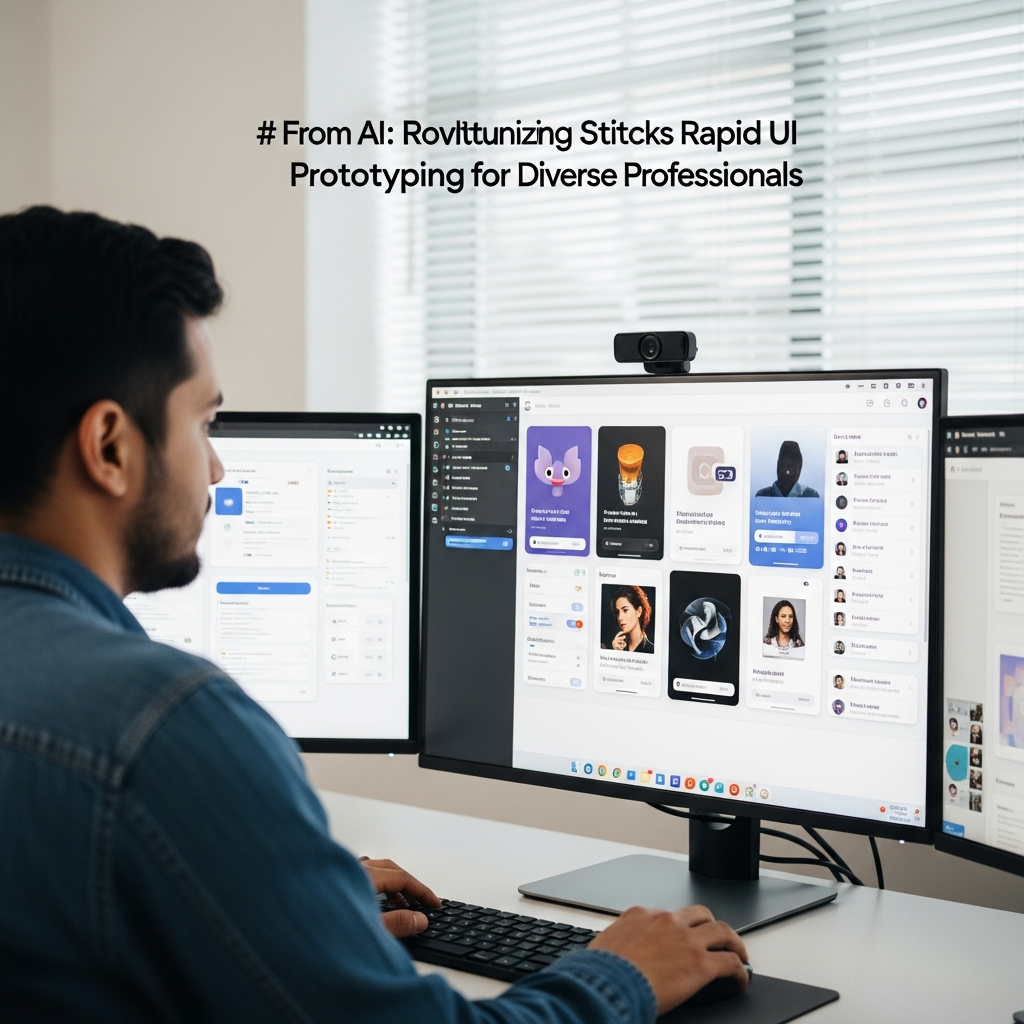
The world of software design is undergoing a profound transformation. Google is at the forefront of this revolution with its significantly upgraded Google Stitch AI, an innovative AI-powered UI design tool. This advanced platform empowers designers, developers, and even non-technical founders to rapidly move from abstract ideas to functional, high-fidelity user interfaces. Google Stitch AI aims to democratize UI creation, making sophisticated design accessible to everyone. It promises to compress design timelines from weeks into mere minutes, fundamentally altering how digital products are conceptualized and built.
Unpacking Google Stitch AI: A Paradigm Shift in Design
Google Stitch AI, initially launched in May, has evolved into an AI-native software design canvas. This major update from Google Labs allows users to create, iterate, and collaborate on complex UI designs using natural language commands. Gone are the days of manual pixel-pushing. Stitch leverages Google’s flagship Gemini large language models, translating design intent directly into production-ready HTML and CSS. This not only accelerates development but also enhances the consistency of design systems across projects.
The Power of “Vibe Design”: From Concept to Creation
A groundbreaking concept at the heart of the new Google Stitch AI is “vibe design.” Instead of starting with traditional wireframes or detailed mockups, users articulate their business objectives, desired user feelings, or provide inspirational examples. The AI then interprets this “vibe” to generate diverse design directions. This intuitive approach fosters quicker exploration of ideas, leading to higher quality and more innovative outcomes. It’s a fundamental shift from assistive AI to fully generative tools.
According to Rustin Banks, Product Manager for Google Labs, Stitch enables anyone to bring their software visions to life. It bridges the critical gap between a non-designer’s initial concept and their ability to build a tangible interface. This innovative method drastically cuts down the time spent on early-stage ideation and iteration cycles.
Key Features That Define Google Stitch AI’s Prowess
Google Stitch AI is packed with cutting-edge features designed to streamline and enhance the entire UI development workflow. These advancements position it as a formidable force in the design tool market.
An Infinite, AI-Native Design Canvas
The platform boasts a completely redesigned, AI-native infinite canvas. This versatile workspace accommodates ideas at every stage, from nascent thoughts to fully functional prototypes. It supports various input forms including text, images, and even code. All inputs serve as direct context for the AI, enabling it to understand and execute design intentions with remarkable accuracy. This holistic view allows designers to experiment freely without losing sight of the overall project goals.
Intelligent Design Agents and Project Management
At the core of Stitch is a sophisticated new design agent. This agent can reason across a project’s entire evolution, offering intelligent suggestions and variations. For complex projects requiring multiple design directions, the innovative Agent Manager tracks progress efficiently. It helps users maintain organization, allowing teams to explore different avenues simultaneously without confusion. This embedded intelligence frees designers to focus on higher-level problem-solving rather than routine tasks.
Rapid Prototyping and Iteration at Your Fingertips
Google Stitch AI excels in facilitating real-time testing and refinement. It instantly transforms static designs into interactive prototypes, allowing users to experience the user journey immediately. Users can “Stitch” screens together effortlessly and click “Play” for quick previews of app flows. The AI can even automatically generate logical next screens. This capability significantly accelerates the feedback loop and validation process, ensuring designs meet user needs effectively.
Seamless Design-to-Code Transition
One of Stitch’s most powerful aspects is its ability to bridge the gap between design and development. Through the recently released Stitch MCP server and SDK, users can leverage Stitch’s capabilities via “skills.” Designs can be exported directly to developer tools such as AI Studio and Antigravity. This ensures a smooth, synchronized workflow, reducing the traditionally arduous task of translating design mockups into functional HTML and CSS code. Stitch also supports Tailwind, a popular development framework.
Enhanced Collaboration and Voice Capabilities
Collaboration is central to Google Stitch AI. The platform features new voice capabilities, allowing users to speak directly to the canvas. The AI agent provides real-time design critiques, generates new landing pages by interviewing the user, and makes immediate updates based on voice commands. Imagine adjusting menu options or color palettes simply by speaking. This dynamic dialogue helps uncover and refine ideas while maintaining creative flow.
Robust Design System Toolkit with DESIGN.md
Maintaining consistency across projects is crucial. Stitch offers broadened capabilities for design systems. Users can extract a design system from any URL or utilize DESIGN.md, an agent-friendly markdown file. This file allows users to export or import design rules between Stitch and other design or coding tools. This feature promotes reusability and ensures a consistent aesthetic across all design assets.
Multi-Screen Generation: Building Flows in Parallel
A significant enhancement to Google Stitch AI is its ability to generate multiple screens simultaneously. While the original version focused on one screen, the updated tool can generate up to five screens at once. For example, an e-commerce developer could instruct Stitch to create a product catalog, checkout page, and purchase confirmation screen all at once. This drastically speeds up the creation of entire user flows.
Stitch’s Impact on the Design Industry and Beyond
The launch of the upgraded Google Stitch AI has sent ripples through the competitive design tool market. Its emergence as a direct challenger to established players like Figma and Adobe is undeniable. Following Google’s announcement, Figma Inc. shares saw a significant decline, highlighting the potential disruption Stitch could bring. This suggests a strategic move by Google to control a critical “chokepoint” in the evolving landscape of creative knowledge work.
By automating the time-consuming process of UI generation and code conversion, Stitch allows professional designers to shift their focus. They can concentrate on higher-level system thinking and user psychology, rather than routine “pixel-pushing.” For engineers and product managers, Stitch means they can mock up interfaces directly, speeding up the entire product development lifecycle. Its integration with Google Workspace tools like Docs and Drive further lowers switching costs for businesses already in the Google ecosystem.
Addressing Challenges and Looking Ahead
While the promise of Google Stitch AI is immense, some skepticism remains. The idea that “AI will democratize X” often overlooks crucial nuances. Design encompasses more than just visual arrangement; it involves user psychology, accessibility, and brand consistency. These elements are difficult to “vibe into existence” solely through AI. The gap between aesthetically pleasing mockups and usable, scalable design systems is still a challenge for many AI tools.
Google’s history with experimental products from Google Labs also warrants a “wait-and-see” approach. Critical details like technical architecture, pricing models, and deeper integration capabilities with Google Workspace and Cloud ecosystems are still largely unaddressed. Its long-term viability will depend on its ability to evolve beyond an experimental offering into a mainstream, impactful product that consistently delivers quality and usability at scale.
Frequently Asked Questions
What is Google Stitch AI, and how does “vibe design” work?
Google Stitch AI is an advanced, AI-native UI design tool from Google Labs. It allows users to rapidly create, iterate, and collaborate on high-fidelity user interfaces using natural language. “Vibe design” is Stitch’s core workflow, where users describe their desired business objectives, user feelings, or provide inspirational examples rather than traditional wireframes. The AI then interprets this intent to generate diverse, interactive UI designs, democratizing access to professional-grade design tools.
How can developers and designers access and leverage Google Stitch AI’s features?
Google Stitch AI is currently available for free through Google Labs, Google’s platform for testing experimental products. Users can access its AI-native infinite canvas, new design agents, and rapid prototyping capabilities. Key features include multi-screen generation, voice-based commands for real-time adjustments, and seamless design-to-code transitions via the Stitch MCP server, SDK, and tools like AI Studio. The DESIGN.md format also allows for exporting and importing design rules, promoting consistency.
How does Google Stitch AI compare to established design tools like Figma, and what are its potential impacts?
Google Stitch AI is positioned as a direct challenger to market leaders like Figma and Adobe. Its generative AI capabilities allow users to go from natural language prompts to interactive UI designs and front-end code, bypassing traditional manual coding. This approach offers unprecedented speed and accessibility, potentially disrupting the industry by shortening design timelines. While Stitch could free professional designers for higher-level work, its long-term impact on market share and its ability to handle complex design systems consistently remain areas of ongoing observation.
The Future is Designed with AI
Google Stitch AI represents a bold leap forward in the design and development landscape. By empowering users to articulate their vision through natural language and transforming it into functional software, Google is truly closing the gap between idea and reality. While challenges and questions remain, Stitch’s potential to redefine workflows, accelerate innovation, and make sophisticated design accessible to a broader audience is undeniable. As AI continues to integrate into creative processes, tools like Google Stitch AI will shape the very future of how we build digital experiences.