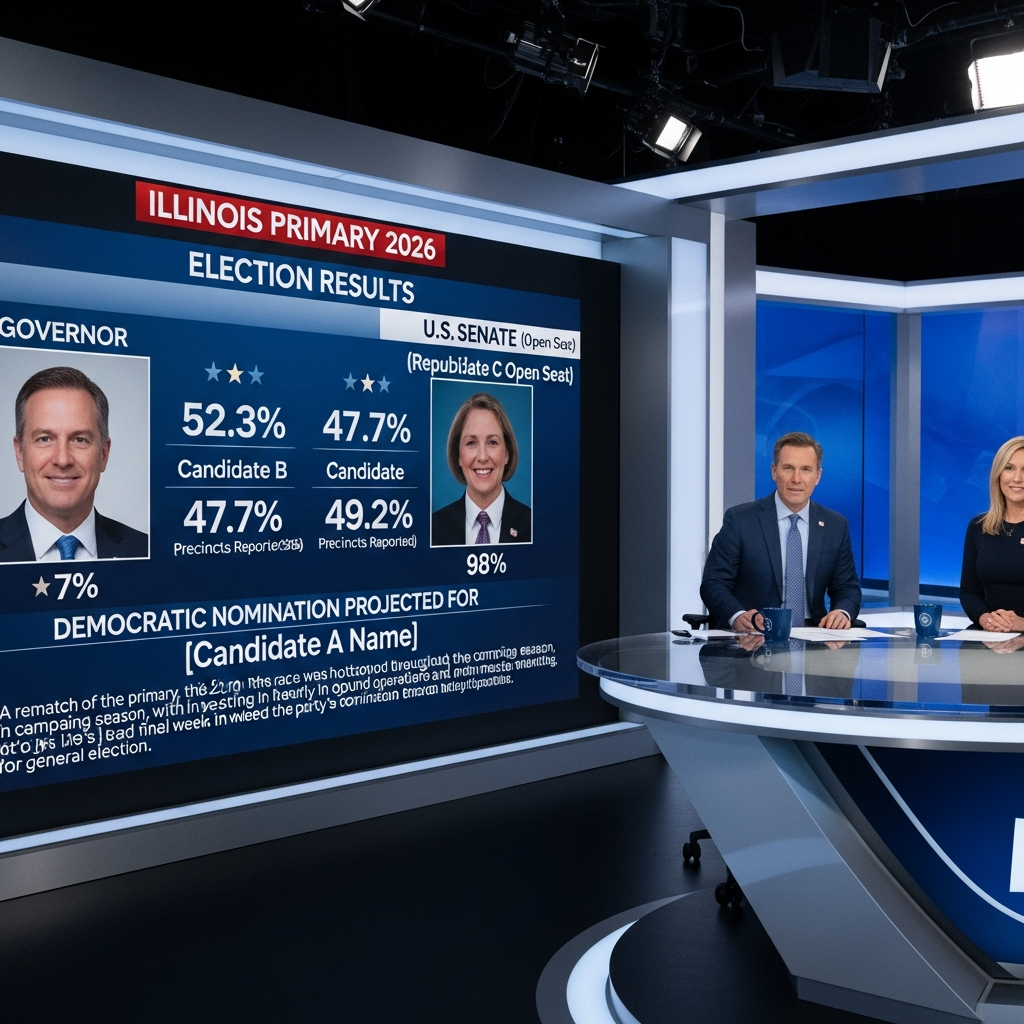
The 2026 Illinois Primary Election delivered a clear roadmap for November’s general election, establishing several high-stakes contests and setting the stage for repeat political battles. Despite relatively low voter turnout across the Chicago area, the results solidified key matchups, including a highly anticipated gubernatorial rematch and a competitive open Senate race. This comprehensive overview delves into the primary’s significant outcomes, offering crucial insights into the political landscape ahead for Illinois voters.
Unpacking Illinois’ Primary Election Day: Key Takeaways
Primary Election Day in Illinois saw voters heading to the polls to decide who would represent their parties in the upcoming 2026 general election. While few outcomes surprised political observers, the results confirmed a slate of compelling races, ensuring a dynamic electoral season. The general election is set for November 3rd, promising intense campaigns across the state.
Voter Engagement and Demographics: A Closer Look at Turnout
Early, unofficial data pointed to a voter turnout hovering around 25 percent. This figure is expected to slightly increase once final vote-by-mail and provisional ballots are fully tallied. Analyzing voter demographics provides valuable context for understanding the electorate.
Ballots cast by age group revealed interesting patterns:
18-24: 19,605 ballots
25-34: 65,658 ballots
35-44: 61,313 ballots
45-54: 53,972 ballots
55-64: 67,714 ballots
65-74: 73,154 ballots
75 and older: 53,469 ballots
The 65-74 age bracket demonstrated the highest participation, closely followed by the 55-64 and 25-34 demographics. A significant gender disparity was also observed, with females casting 223,376 ballots, considerably more than the 171,385 cast by males. Additionally, 591 ballots came from Non-Binary/X voters, and 676 were undeclared. These numbers highlight the differing engagement levels across various demographic segments in this pivotal Illinois Primary Election 2026.
Gubernatorial Rematch: Pritzker vs. Bailey, Round Two
The most prominent outcome of the Illinois Primary Election 2026 is the confirmed rematch in the Illinois governor’s race. Incumbent Governor JB Pritzker, who faced no opposition in the Democratic primary, will once again challenge Republican Darren Bailey in November. Their 2022 contest was notably contentious, with Pritzker securing a decisive victory.
Governor JB Pritzker’s National Profile and Policy Stance
Governor JB Pritzker, a billionaire heir to the Hyatt Hotels fortune, has cultivated a rising national profile. He is widely considered a progressive politician, frequently discussed as a potential presidential contender for 2028. Pritzker notably positioned himself as a strong antagonist to former President Donald Trump. During a federal immigration enforcement operation in Illinois, he actively encouraged residents to document potential abuses. He even formed the Illinois Accountability Commission, led by a federal judge, to investigate alleged constitutional violations by federal officers.
Pritzker often leverages his personal wealth, funding his own campaigns and contributing significantly to super PACs supporting allies. His public popularity has remained consistent since his 2018 victory. During his tenure, he has enacted a range of legislation. These include new gun laws protecting domestic violence victims and a bill progressively raising the state’s minimum wage to $15 an hour. One of his most contentious initiatives was signing the SAFE-T Act, making Illinois the first state to eliminate cash bail statewide. While judges can still detain flight risks or public safety threats, Republicans fiercely criticize this law, citing public safety concerns.
Darren Bailey’s Resurgence and Strategic Shift
Darren Bailey, a millionaire farmer from southern Illinois, successfully secured the Republican nomination with approximately 50% of the vote. He previously served in both the Illinois House and Senate. Bailey gained prominence for his legal challenges against Pritzker’s COVID-19 stay-at-home orders and for defying mask mandates in the state legislature. He also advocates for Chicago to become a separate state, often criticizing the city.
This marks Bailey’s second attempt at the governorship, following a “sound beating” in 2022. Pritzker’s 2022 campaign notably ran ads that, while seemingly critical of Bailey, subtly appealed to the GOP’s conservative base, effectively boosting his primary chances against better-financed candidates. After his 2022 loss, Bailey unsuccessfully ran for U.S. Congress in 2024. For his 2026 campaign, Bailey announced a “different kind of campaign,” pledging to focus more on Chicago and its suburbs. He selected Cook County Republican Party Chairman Aaron Del Mar as his running mate, aiming to improve suburban outreach. Despite a profound personal tragedy—the loss of his son, daughter-in-law, and two grandchildren in a helicopter crash—Bailey chose to continue his campaign, motivated by a desire for a better future for Illinois families. While he indicated he would model some policies after former President Trump, Bailey has also begun to distance himself, stating, “I am my own man.”
High-Stakes Senate Race: Stratton Takes On Tracy
The retirement of Senator Dick Durbin sparked a fervent primary contest for the open Senate seat. The Democratic primary, featuring ten candidates, proved particularly contentious, marked by attack ads. Lieutenant Governor Juliana Stratton emerged victorious, claiming the Democratic nomination. She secured 39.7 percent of the vote with 85 percent counted, narrowly defeating her closest rival, Rep. Raja Krishnamoorthi, who had 33.4 percent.
Stratton received significant support, including $14.8 million in ad spending from the Illinois Future Fund, a super PAC backing her and featuring Governor Pritzker’s personal endorsement. She will now face Republican Don Tracy in November. Tracy, former chairman of the Illinois Republican Party, won his primary with 40 percent of the vote (with 67 percent counted). This race promises to be a key battleground in the upcoming general election.
Cook County Board: Preckwinkle’s Enduring Leadership
Toni Preckwinkle, the incumbent President of the Cook County Board of Commissioners, easily fended off a challenge in the Democratic primary. She defeated Ald. Brendan Reilly (42nd Ward) handily, securing approximately 68 percent of the vote with 84 percent counted. Preckwinkle has led the Cook County Board since 2010 and is widely expected to win the general election in November, continuing her long tenure.
Congressional Primaries Shape Up
Several competitive Democratic primaries for Congressional seats concluded with clear winners:
2nd District: Donna Miller secured the Democratic nomination.
5th Congressional District: Mike Quigley won the Democratic primary.
7th Congressional District: La Shawn Ford emerged victorious from a crowded field.
- 9th Congressional District: Biss claimed victory in a competitive Democratic primary.
- blockclubchicago.org
- www.nbcnews.com
- abc7chicago.com
- capitolnewsillinois.com
- www.kwqc.com
The Unique Challenge of the 4th Congressional District
A unique situation unfolded in the 4th Congressional District. Patty García was the sole name on the Democratic primary ballot, guaranteeing her the nomination. However, she faces a potentially crowded and diverse field of independent challengers in the general election. Two strong independent Latino candidates, Pilsen Ald. Byron Sigcho-Lopez and political organizer Mayra Macías, are positioning themselves, pending ballot access. Additionally, two independent candidates from the suburbs have joined the race: Lindsay Church, a nonbinary veteran and nonprofit leader from Berwyn, and Chris Getty, the Lyons mayor and township director, known for substantial fundraising. This district promises a dynamic and multi-faceted contest.
Other Noteworthy Primary Outcomes
Beyond the major races, primary elections were also held for other crucial state and county positions. Results were decided for Cook County Assessor, Illinois Secretary of State, and Comptroller. While specific details were not universally highlighted, these outcomes complete the slate of candidates who will vie for these significant roles in the November general election, further shaping Illinois’s political future.
Frequently Asked Questions
What were the key outcomes of the Illinois Primary Election 2026?
The Illinois Primary Election 2026 confirmed several major matchups for the November general election. Key outcomes included a gubernatorial rematch between Governor JB Pritzker and Republican Darren Bailey, an open Senate race featuring Democrat Juliana Stratton and Republican Don Tracy, and Cook County Board President Toni Preckwinkle’s decisive primary victory. Several competitive Congressional primaries also concluded, setting the stage for general election contests. Voter turnout was reported at about 25 percent.
Which candidates will face off in the Illinois Governor’s race in November 2026?
Incumbent Governor JB Pritzker will face Republican challenger Darren Bailey in the November 2026 general election. This marks their second direct confrontation, following Pritzker’s clear victory in the 2022 gubernatorial contest. Both candidates ran unopposed or won their respective primaries decisively. This rematch is expected to be a central focus of the general election campaign, revisiting prior political rivalries and policy debates.
How did voter turnout in the Illinois Primary Election 2026 compare, and what does it suggest for the general election?
Early unofficial voter turnout for the Illinois Primary Election 2026 stood at approximately 25 percent, indicating relatively low participation. While this figure may slightly increase with final ballot counts, it suggests a need for increased voter engagement leading into the general election. Typically, general elections see higher turnout, but the primary numbers highlight potential areas for campaigns to energize their bases and appeal to undecided voters to boost participation in November’s crucial races.
Conclusion
The Illinois Primary Election 2026 has drawn the battle lines for what promises to be an engaging and consequential general election. Voters in November will choose leaders for the governorship, a pivotal open Senate seat, key county positions, and numerous Congressional districts. The confirmed gubernatorial rematch between JB Pritzker and Darren Bailey will undoubtedly dominate headlines, with Pritzker’s national ambitions clashing against Bailey’s renewed challenge and strategic shift. The competitive Senate race and dynamic Congressional contests further underscore the high stakes. As campaigns ramp up, the outcomes of these races will significantly shape Illinois’s policy direction and political trajectory for years to come.